

Quick Answer
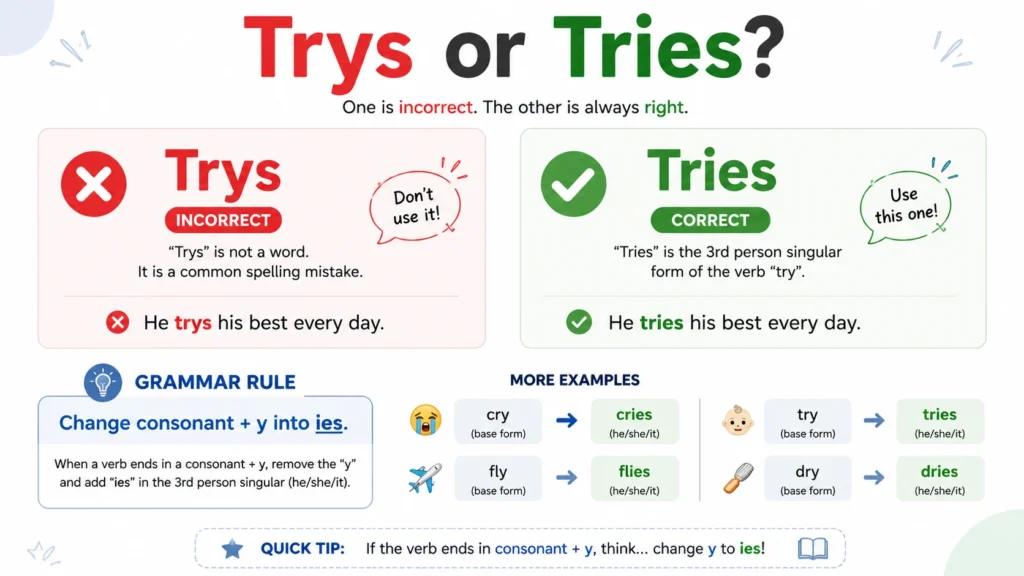
Tries is the correct spelling in standard English. Trys is considered incorrect in most situations. When the verb try changes to third person singular, the letter y changes to ies, forming tries.
Many English learners get confused about trys or tries. The words look similar, and both seem possible at first glance. However, only one spelling is correct in modern English grammar.
The correct form is tries. The spelling trys is considered incorrect in formal writing, academic work, blogs, business communication, and everyday English. This confusion happens because many verbs ending in y follow special spelling rules.
For example, the verb try changes when used with he, she, or it. Instead of adding just s, the word changes from try to tries. Similar rules apply to words like cry becoming cries and fly becoming flies.
Understanding trys or tries is important for students, writers, bloggers, teachers, and professionals. Correct spelling improves grammar, writing quality, and communication clarity.
This complete guide explains everything in simple language. You will learn grammar rules, spelling patterns, examples, common mistakes, real world usage, exercises with answers, and expert writing tips.
Quick Overview
Tries is the correct spelling.
Trys is incorrect in standard English grammar.
The verb try changes to tries because verbs ending in consonant plus y usually change y to ies.
Key Difference Between Trys or Tries


4
The main difference is grammatical correctness.
Tries follows English spelling rules.
Trys breaks standard grammar rules.
Therefore, writers should always use tries in formal and informal writing.
Comparison Table
| Feature | Trys | Tries |
|---|---|---|
| Grammar status | Incorrect | Correct |
| Used in standard English | No | Yes |
| Dictionary accepted | Rarely | Yes |
| Academic writing | Incorrect | Correct |
| Example | He trys hard | He tries hard |
What Does Try Mean
The word try means to attempt something. It describes effort, action, or testing.
Examples:
I try to learn English every day.
She tries to help her friends.
They try new ideas at work.
The meaning stays the same even when the spelling changes.
Why Tries Is Correct
English grammar has a special spelling rule for many verbs ending in consonant plus y.
When using he, she, or it, the y changes to ies.
Examples
Try becomes tries
Cry becomes cries
Fly becomes flies
Carry becomes carries
Therefore, try becomes tries in third person singular form.
Why Trys Is Incorrect
Many people think adding s directly creates the correct form. However, English spelling rules do not work that way for most words ending in consonant plus y.
Because of this rule, trys is considered a spelling mistake in:
- School writing
- Academic essays
- Professional communication
- Blogs and websites
- Exams and grammar tests
Understanding the Grammar Rule
The rule is simple.
If a verb ends in consonant plus y
Remove y
Add ies
Examples
Study becomes studies
Worry becomes worries
Reply becomes replies
Try becomes tries
However, if the letter before y is a vowel, just add s.
Examples
Play becomes plays
Enjoy becomes enjoys
Stay becomes stays
Real World Examples of Tries
Example One School Writing
A student writes:
She tries her best in class.
This sentence is correct.
Example Two Workplace Communication
An employee says:
He tries to solve customer problems quickly.
This usage is correct.
Example Three Blogging and SEO
Writers often use tries correctly in articles because grammar affects professionalism and search ranking.
Common Mistakes With Trys or Tries
Mistake One Adding Only S
Incorrect
He trys hard.
Correct
He tries hard.
Mistake Two Forgetting the Y Rule
Some learners forget to replace y with ies.
Correct pattern:
Try becomes tries
Mistake Three Mixing Verb Forms
Incorrect
I tries to help.
Correct
I try to help.
Correct
She tries to help.
Mid Article Grammar Difference Visual


4
This grammar pattern helps learners understand why tries is correct and trys is incorrect.
Singular and Plural Grammar Usage
Singular Subject
He tries
She tries
It tries
Plural Subject
They try
We try
People try
This rule is important in sentence structure.
Trys or Tries in American and British English
Both American and British English use tries as the correct spelling.
There is no major regional difference here. Unlike words such as color and colour, the spelling tries remains standard globally.
Therefore, trys is not accepted in either major English system.
Verb Conjugation of Try
| Subject | Correct Form |
|---|---|
| I | Try |
| You | Try |
| He | Tries |
| She | Tries |
| It | Tries |
| We | Try |
| They | Try |
This table shows exactly when tries should be used.
Why People Write Trys
Several reasons cause confusion.
Fast Typing
People type quickly and simply add s.
Lack of Grammar Knowledge
Some learners do not know the consonant plus y rule.
Social Media Influence
Informal writing online sometimes spreads incorrect spellings.
Autocorrect Errors
Some devices may fail to correct spelling instantly.
Importance of Correct Spelling
Correct grammar improves:
- Professional writing
- Academic grades
- Reader trust
- SEO quality
- Communication clarity
Using tries instead of trys helps writing appear polished and reliable.
Related Grammar Comparisons
Crys or Cries
Correct form is cries.
Flys or Flies
Correct form is flies.
Worrys or Worries
Correct form is worries.
These words follow the same grammar rule as try becoming tries.
Pronunciation Differences
Interestingly, trys and tries sound similar when spoken quickly. Because of this, learners often confuse the spelling.
However, pronunciation does not change grammar correctness.
Correct pronunciation of tries sounds like:
Trize
Beginner Grammar Understanding
Beginner Level
Try changes to tries with he, she, or it.
Intermediate Level
Words ending in consonant plus y change y to ies.
Advanced Level
This spelling rule comes from English morphological patterns that improve pronunciation and grammar consistency.
Educational Importance
Teachers focus on trys or tries because it teaches:
- Verb agreement
- Spelling transformation
- Sentence structure
- Grammar consistency
This rule appears often in school exams and language learning tests.
Trys or Tries in Digital Writing
Correct spelling matters online.
SEO and Blogging
Search engines prefer grammatically correct content.
Professional Emails
Incorrect spelling can appear unprofessional.
Academic Platforms
Grammar errors reduce credibility.
Therefore, writers should always use tries.
Historical Development of the Rule
English grammar evolved over centuries. The y to ies rule developed to make pronunciation smoother and more natural.
Without the change, words like trys or crys would look awkward and inconsistent.
As a result, modern English standardized spellings such as:
Tries
Cries
Flies
Studies
Sentence Examples Using Tries
She tries new recipes every weekend.
The company tries to improve customer service.
He tries hard to learn grammar.
My dog tries to catch the ball.
The student tries to finish homework early.
All these examples use correct grammar.
Incorrect Sentence Examples
He trys to win every game.
She trys to sing loudly.
My brother trys hard in school.
These sentences contain spelling mistakes.
Common Writing Tips
Learn the Y Rule
Always check the letter before y.
Practice Verb Forms
Practice changing verbs into third person singular.
Read More English Content
Books and articles help reinforce correct spelling.
Use Grammar Tools Carefully
Grammar checkers help, but understanding the rule is better.
Practical Usage in Daily Life
You may use tries in:
- School essays
- Office emails
- Textbooks
- News articles
- Blog writing
- Social media captions
Correct grammar improves communication everywhere.
Mid Article Educational Comparison


4
These examples clearly show how English spelling rules work in everyday grammar.
Advantages of Learning Grammar Rules
- Improves writing confidence
- Reduces spelling mistakes
- Helps in exams
- Strengthens communication skills
- Improves professional image
Disadvantages of Incorrect Spelling
- Creates confusion
- Looks unprofessional
- Lowers academic quality
- Hurts SEO readability
- Weakens communication clarity
Common Confusions Related to Trys or Tries
Tryed or Tried
Correct spelling is tried.
Trying or Tryeing
Correct spelling is trying.
Tries or Trying
Tries is present tense.
Trying shows ongoing action.
Exercises With Answers
Question One
Which spelling is correct
Trys or tries
Answer
Tries
Question Two
Fill in the blank
She ___ her best every day.
Answer
Tries
Question Three
Is trys accepted in formal English
Answer
No
Question Four
What rule changes try into tries
Answer
Consonant plus y changes to ies
Question Five
Which sentence is correct
He tries hard
He trys hard
Answer
He tries hard
Advanced Grammar Insights
English spelling rules support readability and pronunciation consistency.
The transformation from try to tries prevents awkward visual patterns and helps maintain language structure.
This system also connects related verbs into predictable grammar families.
For example:
Carry becomes carries
Study becomes studies
Reply becomes replies
Because of this consistency, learners can apply one rule to many verbs.
Regional and Global Usage
English speakers around the world use tries as the standard spelling.
Countries using this form include:
- United States
- United Kingdom
- Canada
- Australia
- India
Therefore, tries is globally accepted.
FAQs
Is tries the correct spelling?
Yes, tries is the correct spelling in English grammar.
Is trys a real word?
Trys is generally considered incorrect in modern English writing.
Why does try become tries?
Because verbs ending in consonant plus y change y to ies in third person singular form.
Do American and British English both use tries?
Yes, both systems use tries as the correct spelling.
Can I use trys in formal writing?
No, you should always use tries.
What is the grammar rule behind tries?
Consonant plus y changes to ies when forming third person singular verbs.
Is tries singular or plural?
Tries is used with singular subjects like he, she, or it.
How can I remember the correct spelling?
Remember this pattern: try becomes tries just like cry becomes cries.
Does pronunciation change between trys and tries?
No, pronunciation is similar, but only tries is grammatically correct.
Why is correct spelling important in SEO writing?
Correct spelling improves readability, professionalism, and search engine trust.
Conclusion
Understanding trys or tries is important for correct English grammar. The correct spelling is tries, while trys is considered incorrect in standard writing. This happens because verbs ending in consonant plus y follow a special spelling rule that changes y to ies.
Learning this rule improves grammar, writing quality, and communication confidence. It also helps students perform better in exams and allows writers to create more professional content.
Although many people accidentally write trys, especially online, standard English strongly prefers tries in both American and British usage. Therefore, writers should always use tries in essays, blogs, emails, and professional communication.
The easiest way to remember the rule is through similar examples like cry becoming cries and fly becoming flies. Once you understand the pattern, using tries correctly becomes simple and natural.