

Quick Answer
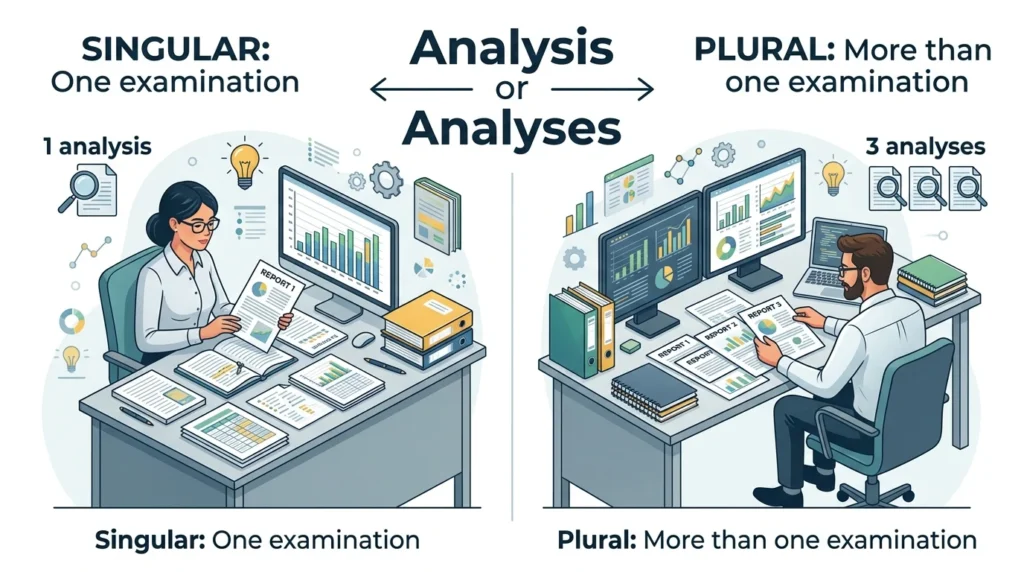
Analysis is the singular form, while analyses is the plural form. Use analysis when talking about one detailed examination and analyses when talking about two or more separate examinations.
Analysis and analyses are easy to confuse because they look very similar, but they are used differently. The main difference is number. Analysis refers to one examination, while analyses refers to more than one.
For example, you can say, “The report includes an analysis of the data.” If a report contains several separate examinations, you can say, “The report includes several analyses of the data.”
The spelling can also be confusing because the plural form does not simply add an s. Instead, analysis changes to analyses. This pattern appears in several English words that come from Greek.
Understanding this difference is important for business writing, academic papers, research, news articles, reports, and everyday English. Once you know the singular and plural forms, choosing the right word becomes much easier.
Is Analysis or Analyses Correct?
Both analysis and analyses are correct words.
The choice depends on whether you are talking about one analysis or more than one.
Analysis = singular
Analyses = plural
For example:
“The researcher completed one analysis.”
But:
“The researchers completed several analyses.”
So, neither word is incorrect. They simply serve different grammatical purposes.
What Does Analysis Mean?
Analysis is a noun that means a detailed examination of something.
It involves studying information, facts, data, ideas, or situations to understand them better.
For example:
“The analysis showed that sales increased.”
Here, analysis refers to one detailed examination of the sales information.
You might also see the word in:
- Data analysis
- Financial analysis
- Market analysis
- Literary analysis
- Statistical analysis
- Risk analysis
- Business analysis
- Political analysis
In each case, analysis involves examining something carefully.
What Does Analyses Mean?
Analyses is the plural form of analysis.
Use it when you are talking about multiple examinations or studies.
For example:
“The report contains three analyses.”
This means that the report contains three separate examinations.
Another example is:
“Several analyses were conducted during the study.”
The word analyses indicates that more than one analysis took place.
Analysis vs Analyses
The basic difference is easy to remember.
| Word | Number | Meaning |
|---|---|---|
| Analysis | Singular | One detailed examination |
| Analyses | Plural | More than one detailed examination |
Examples:
One analysis
“The analysis was helpful.”
Two or more analyses
“The analyses were helpful.”
This is the main rule you need to know.
How Do You Spell Analysis?
The singular spelling is:
A N A L Y S I S
The word ends in sis.
For example:
“Her analysis was detailed.”
Do not confuse it with the plural form.
The singular form is analysis.
How Do You Spell Analyses?
The plural spelling is:
A N A L Y S E S
The ending changes from sis to ses.
For example:
“The analyses were presented in the report.”
This spelling may look unusual at first, but it is the standard plural form.
A useful way to remember it is:
Analysis → Analyses
The pronunciation also changes.
Analysis Pronunciation
Analysis is pronounced roughly like:
uh-NAL-uh-sis
The final sound is similar to sis.
For example:
“The analysis was completed yesterday.”
The word is singular.
Analyses Pronunciation
Analyses is pronounced differently.
It sounds roughly like:
uh-NAL-uh-seez
The ending sounds like sees.
For example:
“The analyses were completed yesterday.”
This pronunciation difference can help you identify whether someone means one analysis or several.
Why Is the Plural of Analysis Analyses?
Analysis follows a pattern found in several words that have Greek origins.
Similar examples include:
- analysis → analyses
- diagnosis → diagnoses
- crisis → crises
- thesis → theses
- hypothesis → hypotheses
- synthesis → syntheses
These words do not form their plurals by simply adding s.
For example, analysises is incorrect.
The correct plural is:
analyses
Knowing these related patterns can make the spelling easier to remember.
Analysis in Academic Writing
Analysis is extremely common in academic writing.
Students may perform an analysis of a book, article, experiment, argument, or set of data.
For example:
“This analysis examines the author’s main argument.”
Another example:
“The analysis supports the researcher’s conclusion.”
When a paper includes several separate examinations, use analyses.
“The study includes statistical and qualitative analyses.”
Because academic writing often deals with complex information, both forms appear frequently.
Analysis in Business
Businesses use analysis to make decisions.
For example:
“The company conducted a market analysis.”
“Our financial analysis shows strong growth.”
“The team completed an analysis of customer behavior.”
If several separate studies were performed, use analyses.
“The company reviewed several analyses before making its decision.”
This distinction is important in reports and presentations.
Analysis in Data and Research
The word analysis is especially common in research.
Researchers may analyze:
- Survey results
- Sales data
- Customer behavior
- Scientific measurements
- Financial information
- Experimental results
For example:
“The data analysis revealed an important trend.”
When multiple methods or separate studies are involved, you can use analyses.
“The researchers performed several analyses of the results.”
Here, analyses correctly shows that more than one examination took place.
Analysis in Literature
Students often encounter the word analysis in English and literature classes.
For example:
“Her analysis of the novel was insightful.”
This means she carefully examined the novel and explained its meaning, themes, characters, or writing techniques.
If students write about several separate literary works, they may use analyses.
“The assignment includes analyses of three poems.”
One poem can have an analysis.
Three poems can have three analyses.
Analysis in News and Media
News organizations frequently publish analysis to explain events.
For example:
“The article provides an analysis of the election results.”
When multiple experts provide separate examinations, analyses may be appropriate.
“The newspaper published several analyses of the economic situation.”
The same rule applies regardless of the subject.
One = analysis.
More than one = analyses.
Analysis in Everyday English
Although analysis can sound academic, people also use it in everyday professional conversations.
For example:
“I need to do a quick analysis of these numbers.”
“The analysis was easy to understand.”
“Let’s look at the analysis before making a decision.”
You may also hear the plural form in workplaces:
“We reviewed several analyses before choosing the best option.”
The words are not limited to classrooms or research labs.
Common Mistakes With Analysis and Analyses
One of the most common mistakes is using analysises as the plural form.
Incorrect:
“The report contains several analysises.”
Correct:
“The report contains several analyses.”
Another mistake is using analyses for one examination.
Incorrect:
“This analyses is useful.”
Correct:
“This analysis is useful.”
If the sentence refers to one examination, use analysis.
If it refers to multiple examinations, use analyses.
Analysis Is Singular
Remember that analysis is singular.
You can use singular verbs with it.
For example:
“The analysis is complete.”
“The analysis shows a clear trend.”
“This analysis was conducted last year.”
The words is, shows, and was fit the singular noun.
Analyses Is Plural
Analyses is plural.
Therefore, plural verbs are normally used with it.
For example:
“The analyses are complete.”
“The analyses show different results.”
“These analyses were conducted by different researchers.”
The words are, show, and were match the plural noun.
This is a useful grammar clue when you are unsure which form to use.
Analysis or Analyses in a Sentence
Compare these examples carefully.
Singular
“The analysis of the report was helpful.”
This refers to one analysis.
Plural
“The analyses of the reports were helpful.”
This refers to multiple analyses.
Another example:
“Our analysis found a problem.”
One analysis.
“Our analyses found several problems.”
More than one analysis.
The surrounding words often make the correct choice obvious.
Analysis or Analyses in Reports
Reports can contain one analysis or many analyses.
For example:
“The report includes an analysis of customer satisfaction.”
This means one analysis.
However:
“The report includes several analyses of customer satisfaction.”
This means multiple examinations, perhaps using different methods or data sets.
Both sentences are grammatically correct.
The correct choice depends on the number of analyses being discussed.
Analysis or Analyses in Professional Emails
You may need either form in a workplace email.
For example:
“I attached the analysis for your review.”
This suggests one document or examination.
For multiple documents or examinations:
“I attached the analyses for your review.”
The difference is small but important.
Using the wrong form can make your writing sound less precise.
Analysis or Analyses With Numbers
Numbers can help you decide which form to use.
Use analysis with one:
“One analysis was completed.”
Use analyses with two or more:
“Two analyses were completed.”
“Five analyses were completed.”
This is one of the easiest ways to remember the rule.
One analysis.
Several analyses.
Analysis, Analyze, and Analytical
Several related words can also cause confusion.
Analysis
A detailed examination.
“The analysis was useful.”
Analyze
The verb meaning to examine something carefully.
“We need to analyze the data.”
Analytical
An adjective describing careful examination or logical thinking.
“She has strong analytical skills.”
These words are related but have different grammatical roles.
Analysis vs Analyze
Do not confuse the noun analysis with the verb analyze.
For example:
“We need to analyze the results.”
Here, analyze is the action.
“Our analysis of the results was successful.”
Here, analysis is the examination itself.
A simple pattern is:
Analyze = action
Analysis = examination
Analyses vs Analysis’s
Another spelling issue involves possessive forms.
If something belongs to one analysis, you can write:
“The analysis’s conclusion was clear.”
However, this construction can sound awkward. In many cases, rewriting the sentence is smoother.
For example:
“The conclusion of the analysis was clear.”
For multiple analyses, the possessive form is different:
“The analyses’ results were compared.”
The apostrophe comes after the plural noun.
However, for most everyday writing, restructuring the sentence can make things clearer.
How to Remember Analysis and Analyses
The easiest rule is:
Analysis = one
Analyses = more than one
You can also remember the ending:
Analysis sounds like sis.
Analyses sounds like sees.
Another useful group to memorize is:
Analysis → analyses
Diagnosis → diagnoses
Crisis → crises
Thesis → theses
These words follow similar plural patterns.
Practice Questions
Choose analysis or analyses in each sentence.
Question 1
“The ______ shows a significant change in sales.”
A. analysis
B. analyses
Question 2
“The researchers completed several ______.”
A. analysis
B. analyses
Question 3
“This ______ is based on recent data.”
A. analysis
B. analyses
Question 4
“The report contains three separate ______.”
A. analysis
B. analyses
Question 5
“Our ______ was completed yesterday.”
A. analysis
B. analyses
Answers
- Analysis
- Analyses
- Analysis
- Analyses
- Analysis
The key is to identify whether the sentence describes one examination or multiple examinations.
More Examples
Here are additional examples to reinforce the difference:
- “The analysis is detailed.”
- “The analyses are detailed.”
- “We need another analysis.”
- “We compared three analyses.”
- “Her analysis was accurate.”
- “Their analyses produced different results.”
- “The financial analysis is complete.”
- “The financial analyses are complete.”
- “This analysis supports the conclusion.”
- “These analyses support different conclusions.”
Notice how the verb often changes as well.
A Simple Rule for Writers
When writing, ask yourself one question:
Am I talking about one analysis or more than one?
If the answer is one, use:
analysis
If the answer is two or more, use:
analyses
For example:
“I completed one analysis.”
“I completed four analyses.”
That simple check will prevent most mistakes.
Analysis or Analyses: Final Difference
Analysis and analyses are both correct, but they are not interchangeable.
Analysis is singular and refers to one detailed examination.
Analyses is plural and refers to two or more detailed examinations.
The spelling changes from analysis to analyses, and the pronunciation changes as well. Analysis ends with a sound similar to sis, while analyses ends with a sound similar to sees.
Remember the simple rule:
One analysis.
Two or more analyses.
Once this pattern becomes familiar, you can use both forms confidently in academic, professional, and everyday writing.
Frequently Asked Questions
Is analysis or analyses correct?
Both are correct. Analysis is the singular form, while analyses is the plural form.
What is the plural of analysis?
The plural of analysis is analyses. The word does not become “analysises.”
What is the difference between analysis and analyses?
Analysis refers to one detailed examination. Analyses refers to two or more detailed examinations.
How do you pronounce analysis and analyses?
Analysis is commonly pronounced like “uh-NAL-uh-sis,” while analyses is pronounced like “uh-NAL-uh-seez.” Their endings sound different.
Can I say analyses for one study?
Usually, no. If you are referring to one examination, use analysis. Use analyses when you are referring to multiple separate examinations.
Conclusion
The difference between analysis and analyses comes down to number. Analysis is the singular form, so it refers to one detailed examination. Analyses is the plural form, so it refers to two or more examinations.
For example, you can say, “The analysis was helpful” when discussing one examination. If several examinations were performed, say, “The analyses were helpful.”
The spelling may seem unusual at first, but the pattern becomes easier with practice. Remember the simple rule: one analysis, several analyses. This will help you use the correct form in reports, research papers, business writing, and everyday communication.