
Quick Answer
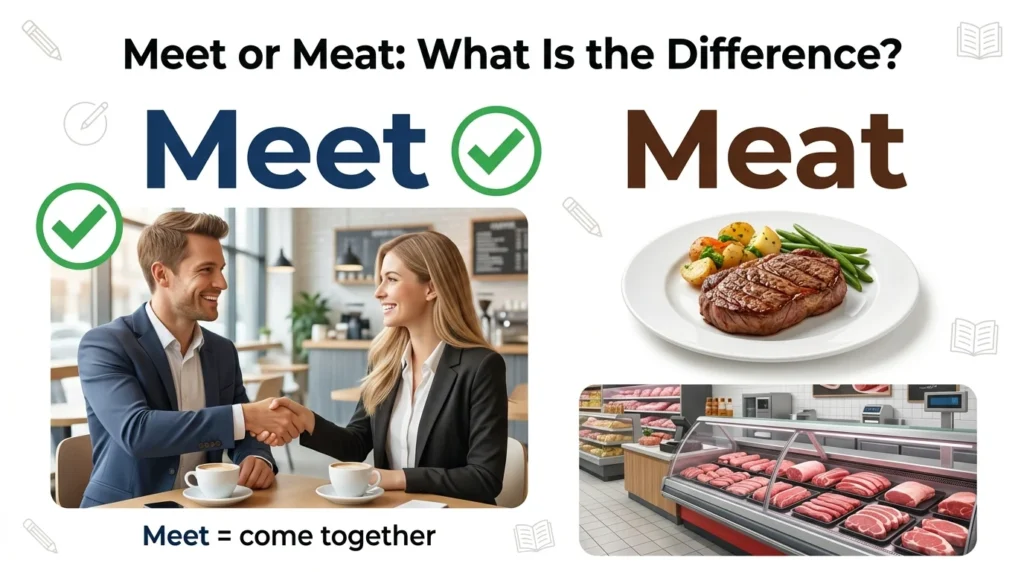
Meet is a verb that means to come together with someone, encounter someone, or satisfy a requirement. Meat is a noun that refers to animal flesh used as food. They sound the same but have different meanings and spellings.
English has many words that sound exactly the same but have completely different meanings. Meet and meat are a common example. They are pronounced the same, but you cannot use one in place of the other.
Meet is usually a verb. You can meet a friend, meet a new person, meet a deadline, or meet a goal. Meat, on the other hand, is a noun used for food that comes from animals, such as beef, chicken, pork, or lamb.
This difference is easy to understand once you connect each spelling with its meaning. However, the two words can still cause mistakes in texts, emails, school assignments, social media posts, and everyday writing.
Whether you are learning English or simply want to improve your spelling, knowing when to use meet and meat will help you write more clearly.
What Does Meet Mean?
Meet is a verb with several related meanings.
The most common meaning is to come together with another person.
For example:
“I will meet my friend after work.”
It can also mean encountering someone for the first time.
“I met Sarah at a conference.”
Meet can also describe reaching a goal, requirement, standard, or deadline.
For example:
“We need to meet the deadline.”
“The product meets all safety requirements.”
So, meet is not limited to people. It can also be used when talking about goals, standards, expectations, and requirements.
What Does Meat Mean?
Meat is a noun that usually refers to the flesh of an animal used as food.
Common examples include:
- Beef
- Chicken
- Pork
- Lamb
- Turkey
- Goat
- Venison
For example:
“We bought fresh meat from the grocery store.”
You can also use meat when talking about food in a general sense.
“He does not eat meat.”
Unlike meet, meat is not normally used as a verb in standard modern English.
Meet vs Meat
The basic difference is simple:
| Word | Meaning | Part of Speech |
|---|---|---|
| Meet | Come together or satisfy a requirement | Verb |
| Meat | Animal flesh used as food | Noun |
For example:
Meet: “I need to meet my doctor tomorrow.”
Meat: “We bought chicken meat for dinner.”
The words sound alike, but their meanings are completely different.
Why Do Meet and Meat Sound the Same?
Meet and meat are homophones.
Homophones are words that have the same pronunciation but different meanings or spellings.
Other common examples include:
- See and sea
- Right and write
- Pair and pear
- Here and hear
- Buy and by
- Flower and flour
Meet and meat belong to the same group.
When you hear someone say either word, you usually need the context to know which word they mean.
For example, if someone says:
“I want to meet you.”
The meaning is clear from the sentence.
If someone says:
“I want some meat.”
The meaning is completely different.
Meet as a Verb
Meet is commonly used as a verb when people come together.
Here are some examples:
- “Let’s meet tomorrow.”
- “I need to meet my manager.”
- “We met at school.”
- “She wants to meet your family.”
- “They meet every Friday.”
- “I met him last year.”
The form of the word can change depending on the tense.
For example:
Present: I meet my friends every week.
Past: I met my friends yesterday.
Future: I will meet my friends tomorrow.
This is important because the past tense of meet is met, not “meeted.”
Meet a Person
One of the most common uses of meet is talking about spending time with or encountering another person.
For example:
“I am going to meet my cousin.”
“She met her new neighbor yesterday.”
“We should meet for coffee.”
The word can describe both planned meetings and unexpected encounters.
For example:
“I met an old friend at the store.”
Here, the meeting was unexpected.
Meet for Coffee or Lunch
In everyday American conversation, meet is often used when making plans.
For example:
“Do you want to meet for lunch?”
“Let’s meet for coffee tomorrow.”
“We can meet after work.”
These sentences are natural and common.
The word does not necessarily mean a formal meeting. Friends can meet, coworkers can meet, and family members can meet.
Meet a Deadline
Meet has another very important meaning in work and school.
It can mean completing something by the required time.
For example:
“I need to meet the deadline.”
“The team met the deadline.”
“Can you meet the Friday deadline?”
Here, meet does not mean physically coming together. It means successfully completing something within the required time.
This use is very common in professional English.
Meet a Goal
You can also use meet when talking about goals, expectations, standards, or requirements.
For example:
“The company met its sales goal.”
“She met her fitness goals.”
“The project met our expectations.”
This meaning is similar to achieving or satisfying a target.
Meet a Requirement
Meet is also common in official and professional language.
For example:
“Applicants must meet all requirements.”
“The building meets safety standards.”
“This product meets federal regulations.”
In these examples, meet means to satisfy a particular condition or standard.
Meat as Food
Meat is commonly used when discussing food and cooking.
For example:
“The recipe calls for ground meat.”
“We bought fresh meat for dinner.”
“He prefers chicken over red meat.”
Different types of meat have different names.
Beef comes from cattle.
Pork comes from pigs.
Chicken comes from chickens.
Lamb comes from sheep.
These foods can all be described as meat.
Types of Meat
When people talk about meat, they may refer to different categories.
Red Meat
Common examples include:
- Beef
- Pork
- Lamb
- Goat
Poultry
Common examples include:
- Chicken
- Turkey
- Duck
Other Meat
Depending on the culture and diet, people may also eat:
- Venison
- Rabbit
- Goat
- Bison
The exact use of the word depends on the context.
Meet or Meat in Everyday Sentences
Compare these sentences:
“I will meet you at the restaurant.”
“The restaurant serves meat.”
The first sentence is about people coming together.
The second sentence is about food.
Here is another pair:
“We need to meet at six.”
“We need to buy meat at six.”
The spelling changes the meaning completely.
Common Mistakes With Meet and Meat
One common mistake is writing meat when you mean meet.
Incorrect:
“I will meat you tomorrow.”
Correct:
“I will meet you tomorrow.”
Another common mistake is using meet when talking about food.
Incorrect:
“We bought meet for dinner.”
Correct:
“We bought meat for dinner.”
Because the words sound the same, spelling mistakes can happen easily when writing from memory.
Meet, Met, and Meat
It is also useful to understand met.
Meet is the present form.
Met is the past form.
Meat is the food-related noun.
For example:
“I meet my coworkers every Monday.”
“I met my coworkers yesterday.”
“We ordered meat for dinner.”
A simple memory trick is:
Meet = people or goals
Met = past form of meet
Meat = food
Meet or Meat in Text Messages
In casual texting, people may make spelling mistakes because they type quickly.
For example:
“Can we meat at 7?”
The intended word is meet.
Although the meaning may still be obvious from context, the spelling is incorrect.
The correct message is:
“Can we meet at 7?”
Similarly:
“We need to buy meet.”
should be:
“We need to buy meat.”
Correct spelling matters even in casual communication because it makes your message easier to understand.
Meet or Meat in Professional Writing
In professional writing, choosing the correct spelling is especially important.
Consider this sentence:
“We need to meat the deadline.”
That is incorrect.
The correct version is:
“We need to meet the deadline.”
A spelling mistake like this can make an email, report, resume, or business document look careless.
Therefore, always check the context before choosing between meet and meat.
Meet or Meat in American English
Both meet and meat are standard words in American English.
Their pronunciation is the same, but their spelling and meanings are different.
American speakers commonly use meet when discussing:
- Meetings
- People
- Plans
- Goals
- Deadlines
- Requirements
- Standards
Meat is commonly used when discussing:
- Food
- Cooking
- Grocery shopping
- Restaurants
- Diets
- Recipes
The spelling does not change between these meanings.
How to Remember Meet and Meat
A simple memory trick can make this pair easier.
Think of the double e in meet as two people coming together.
Meet = people come together.
For meat, think about food.
Meat = food.
You can also remember these examples:
“I will meet you.”
“I will eat meat.”
The different spellings connect directly to the different meanings.
Practice Questions
Choose meet or meat to complete each sentence.
Question 1
“I will ______ you at the coffee shop.”
A. meet
B. meat
Question 2
“We bought fresh ______ for dinner.”
A. meet
B. meat
Question 3
“She needs to ______ the deadline.”
A. meet
B. meat
Question 4
“Do you want to ______ my parents?”
A. meet
B. meat
Question 5
“He does not eat ______.”
A. meet
B. meat
Answers
- Meet
- Meat
- Meet
- Meet
- Meat
If the sentence involves coming together, use meet. If it involves food from animals, use meat.
More Examples to Test Yourself
Try these sentences without looking at the answer.
- “Let’s ______ outside the store.”
- “She ordered a ______ sandwich.”
- “The project must ______ the required standards.”
- “I first ______ him in college.”
- “They do not sell fresh ______ here.”
Answers
- Meet
- Meat
- Meet
- Met
- Meat
Notice that sentence four uses met because the action happened in the past.
Meet or Meat: Final Difference
The difference between meet and meat is straightforward once you focus on meaning.
Meet is mainly a verb. It can mean coming together with someone or satisfying a goal, requirement, standard, or deadline.
Meat is a noun related to food. It refers to animal flesh that people eat.
The two words sound exactly alike, which makes them homophones. However, their spellings must match the meaning of the sentence.
Remember:
Meet = come together or satisfy something.
Meat = food.
With that simple rule, you can avoid one of the most common homophone spelling mistakes in English.
Frequently Asked Questions
Is meet or meat the correct spelling?
Both meet and meat are correct English words, but they have different meanings. Meet relates to coming together or satisfying a requirement, while meat refers to animal food.
What is the difference between meet and meat?
Meet is generally a verb meaning to come together, encounter someone, or satisfy a goal or requirement. Meat is a noun referring to animal flesh used as food.
Do meet and meat sound the same?
Yes. Meet and meat are homophones, so they have the same pronunciation but different spellings and meanings.
How do you use meet in a sentence?
You can use meet when talking about people coming together or satisfying something. For example, “I will meet you after work” or “We must meet the deadline.”
How do you remember the difference between meet and meat?
Remember that meet is connected with people, plans, goals, and requirements, while meat is connected with food. A simple example is “I will meet you” and “I will eat meat.”
Conclusion
Meet and meat sound the same, but they have very different meanings. Meet is commonly used as a verb for coming together with someone, encountering a person, or satisfying a goal, standard, requirement, or deadline. Meat is a noun that refers to animal flesh used as food.
The easiest way to remember them is to connect meet with people and goals, while meat is connected with food. Also remember the past form met, which is different from both words.
Once you understand the context, choosing the correct spelling becomes much easier. Whether you are writing a text, email, school assignment, or professional document, using meet, met, and meat correctly will make your writing clearer and more accurate.