

Quick Answer
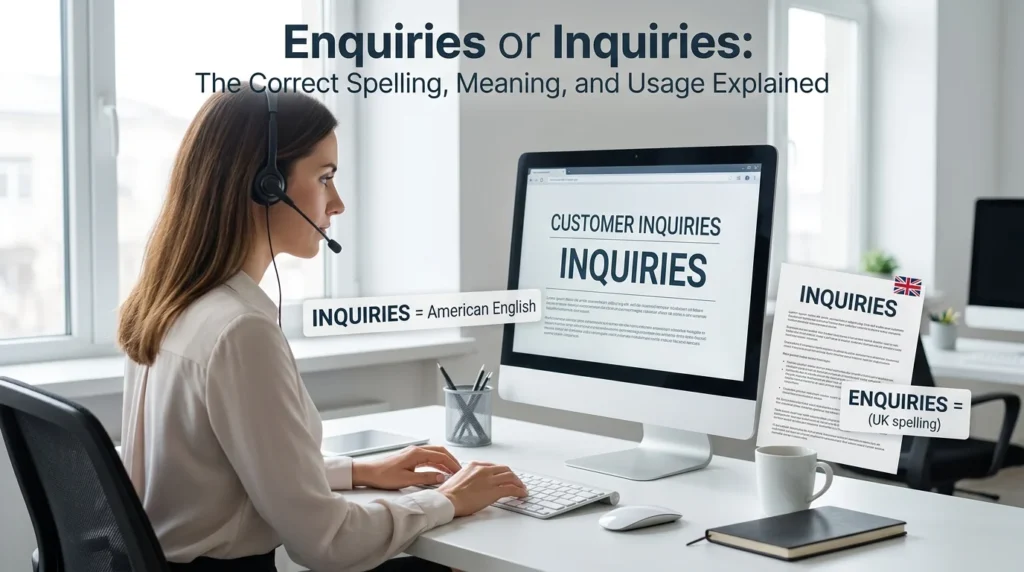
Inquiries is the standard spelling in American English, while enquiries is mainly used in British English. Both words mean requests for information or questions, but inquiries is the better choice for US audiences, American websites, business writing, and professional communication.
If you have ever written a business email, customer service message, or website page, you may have wondered whether to use enquiries or inquiries. Both spellings are correct, so the confusion is understandable. The main difference is regional rather than grammatical.
In American English, inquiries is the standard spelling. In British English, enquiries is commonly used when referring to requests for information. This small spelling difference matters when you are writing for a specific audience. For example, a US company would normally write, “For more information, please contact us with your inquiries.” A British company may use “enquiries” instead.
The good news is that the meaning remains almost the same. Once you know which spelling matches your audience, choosing between enquiries and inquiries becomes simple.
What Does Inquiries Mean?
Inquiries is the plural form of inquiry.
An inquiry is a question, request for information, or attempt to learn more about something.
Examples:
- We received several inquiries about the product.
- Please send your inquiries to our customer service team.
- The company is responding to customer inquiries.
- I made an inquiry about the price.
The word inquiries is especially common in American English.
For example:
We welcome inquiries from potential customers.
This sounds natural for a US audience.
What Does Enquiries Mean?
Enquiries is the plural form of enquiry.
It has essentially the same meaning as inquiries.
Examples:
- We received several enquiries about the service.
- Please direct your enquiries to the office.
- The company responded to customer enquiries.
The spelling enquiries is especially associated with British English.
Therefore, enquiries is not a misspelling. It is a regional spelling variant.
Enquiries or Inquiries: The Main Difference
The main difference is regional spelling.
| Spelling | Common Usage | Meaning |
|---|---|---|
| Inquiries | American English | Questions or requests for information |
| Enquiries | British English | Questions or requests for information |
For a US audience, choose:
Inquiries
For a British audience, choose:
Enquiries
The meaning does not change simply because the spelling changes.
Is Inquiries Correct in American English?
Yes. Inquiries is the standard spelling for American English.
US companies, schools, websites, and organizations commonly use inquiry and inquiries.
Examples:
- Customer inquiries
- Product inquiries
- General inquiries
- Media inquiries
- Sales inquiries
- Information inquiries
A US website might say:
For customer inquiries, please contact our support team.
This is a natural American English expression.
Is Enquiries Correct in American English?
Enquiries can be understood by American readers, but it is not the usual American spelling.
For US-focused content, inquiries is the safer and more natural choice.
For example, if you are creating a website for American customers, use:
Contact us for more information or inquiries.
Rather than:
Contact us for more information or enquiries.
The second version may look British to a US reader.
British English and Enquiries
In British English, enquiry and enquiries are widely used for general requests for information.
Examples:
- Please send your enquiries by email.
- We answer customer enquiries within two business days.
- For further enquiries, contact the office.
- The hotel received several enquiries about room availability.
If your website targets the UK, enquiries may be the more natural choice.
This is why both spellings continue to exist.
Inquiry vs Enquiry
The singular forms are:
Inquiry — commonly preferred in American English
Enquiry — commonly used in British English for general requests for information
The plural forms are:
Inquiries
Enquiries
Examples:
- I have an inquiry.
- We received several inquiries.
- I have an enquiry.
- We received several enquiries.
The difference is mainly the spelling pattern.
Why Does the Spelling Change?
The spelling difference comes from regional conventions in English.
American English generally favors inquiry and inquiries.
British English commonly uses enquiry and enquiries for general questions or requests for information.
However, there is an additional nuance. British English can use inquiry for a formal investigation, especially in legal, official, or institutional contexts.
For example:
The government launched an inquiry into the incident.
So the difference can involve both regional spelling and, in some British usage, a distinction between a general question and a formal investigation.
Inquiries in Business Writing
Inquiries is extremely common in American business communication.
Companies may receive:
- Customer inquiries
- Sales inquiries
- Product inquiries
- Service inquiries
- Media inquiries
- Partnership inquiries
- Employment inquiries
Examples:
We respond to all customer inquiries within 24 hours.
Please direct media inquiries to our communications department.
Our sales team handles product inquiries.
These expressions are natural and professional for US readers.
Inquiries in Customer Service
Customer service departments deal with inquiries every day.
Examples:
- We received your inquiry.
- Thank you for your inquiry.
- Our team will respond to your inquiry shortly.
- We are happy to answer your inquiries.
- Please contact us with any questions or inquiries.
A common professional phrase is:
Thank you for your inquiry.
This is especially useful in customer service emails.
Inquiries on Websites
Many websites use inquiries in contact pages and customer support sections.
Examples:
For general inquiries, contact us today.
For sales inquiries, call our team.
For media inquiries, please contact our press office.
Submit your inquiry using the form below.
If the website is targeting US customers, inquiries is generally the best spelling.
Inquiries in Job Applications
Job seekers may see the word inquiries in employment information.
Examples:
- Employment inquiries
- Job inquiries
- Hiring inquiries
- Recruitment inquiries
A company might write:
For employment inquiries, please contact Human Resources.
An applicant might also write:
I am writing to make an inquiry about the open position.
The American spelling is inquiry.
Inquiries in Education
Schools and universities also receive inquiries.
Examples:
- Student inquiries
- Admissions inquiries
- Financial aid inquiries
- Enrollment inquiries
- Program inquiries
A US university might write:
For admissions inquiries, contact the admissions office.
This is a natural professional use of the word.
Inquiries in Travel and Hotels
Hotels, airlines, and travel companies often use inquiries when discussing customer questions.
Examples:
- We received several inquiries about room availability.
- Please contact us with booking inquiries.
- Our team handles travel inquiries.
- For group reservation inquiries, contact the hotel directly.
For a US travel website, inquiries is normally the preferred spelling.
Inquiries vs Questions
Inquiry and question are related, but they are not always identical.
A question can be very simple.
Example:
What time does the store open?
An inquiry often sounds more formal or purposeful.
Example:
I am writing to make an inquiry about your return policy.
In business writing, inquiry can sound more professional than simply saying question.
However, everyday American English often uses question because it sounds more natural and direct.
Inquire vs Enquire
The same regional difference appears with the verbs.
Inquire is the standard American spelling.
Enquire is commonly associated with British English.
Examples:
- I would like to inquire about the position.
- Please inquire about availability.
- She inquired about the price.
British English may use:
- I would like to enquire about the position.
- Please enquire about availability.
For US-focused writing, use inquire.
Inquiring vs Enquiring
The difference continues in the present participle.
American English:
inquiring
British English:
enquiring
Examples:
- An inquiring customer contacted us.
- We received an inquiring email.
- The inquiring student wanted more information.
For American audiences, inquiring is the natural spelling.
Common Mistakes With Enquiries and Inquiries
One common mistake is using enquiries when writing specifically for an American audience.
For example:
For customer enquiries, contact us.
This is understandable, but it uses the British spelling.
For a US website, write:
For customer inquiries, contact us.
Another mistake is treating inquiries as singular.
Incorrect:
I have several inquiry.
Correct:
I have several inquiries.
Use inquiry for one request and inquiries for more than one.
Inquiry or Inquiries: Singular and Plural
The difference between singular and plural is simple.
Inquiry means one question or request.
Example:
I sent an inquiry about the service.
Inquiries means more than one.
Example:
We received several inquiries about the service.
Likewise, in British English:
Enquiry = one
Enquiries = more than one
This pattern is important because the spelling changes along with the number.
Formal Inquiry Meaning
The word inquiry can also mean a formal investigation.
For example:
The committee launched an inquiry into the issue.
Here, the word means more than a simple question. It refers to a careful investigation or official examination.
Other examples include:
- A government inquiry
- A public inquiry
- A formal inquiry
- An independent inquiry
This meaning is particularly common in legal, government, academic, and institutional contexts.
Enquiries or Inquiries for SEO
If your website targets US search traffic, inquiries should generally be your primary spelling.
For example, US-focused pages may naturally use:
- Customer inquiries
- Product inquiries
- Sales inquiries
- General inquiries
- Business inquiries
- Media inquiries
- Contact inquiries
If your website targets British readers, enquiries may be more appropriate.
SEO content should match the language used by the audience you want to reach. Do not switch spellings randomly within the same page.
Which Spelling Should You Use?
Use inquiries when writing for:
- United States readers
- American businesses
- US websites
- American customers
- US schools
- American professional communication
Use enquiries when writing primarily for:
- United Kingdom readers
- British businesses
- UK websites
- British customers
If you are writing for an international audience, either spelling can be understood. However, keeping your regional style consistent makes your content look more polished.
Real World Examples
Here are some natural examples using the American spelling:
- We received several customer inquiries.
- Thank you for your inquiry.
- Please contact us with any inquiries.
- Our team handles sales inquiries.
- The website includes a form for general inquiries.
- The university receives thousands of admissions inquiries.
- We respond to product inquiries within one business day.
- Please direct media inquiries to our communications team.
British-style examples would use enquiries instead.
Practice: Choose the Correct Spelling
Choose the best word for a US-focused sentence.
- We received several customer ___.
- Thank you for your ___.
- Please contact us with any ___.
- The company handles sales ___.
- For general ___, contact our office.
- The university received many student ___.
- We respond to all product ___ quickly.
- Media ___ should be sent to the communications team.
Answers
- inquiries
- inquiry
- inquiries
- inquiries
- inquiries
- inquiries
- inquiries
- inquiries
For a British audience, the plural form would generally be enquiries.
Quick Comparison
| Word | Region | Meaning |
|---|---|---|
| Inquiry | American English | One question or request |
| Inquiries | American English | More than one question or request |
| Enquiry | British English | One question or request |
| Enquiries | British English | More than one question or request |
The main takeaway is simple:
Inquiries is the preferred US spelling.
Enquiries is the common British spelling.
Final Tips
Keep these points in mind:
- Inquiry is the common American singular form.
- Inquiries is the common American plural form.
- Enquiry is commonly used in British English.
- Enquiries is the common British plural form.
- Both spellings can mean questions or requests for information.
- Inquiries is usually the better choice for US-focused content.
- Use inquiry for one request and inquiries for multiple requests.
- Inquire is the common American verb.
- Enquire is commonly associated with British English.
- Keep your spelling consistent throughout your website or document.
FAQs
1. Is it inquiries or enquiries in American English?
Inquiries is the standard spelling in American English. Enquiries is mainly associated with British English.
2. Are enquiries and inquiries the same thing?
Yes. In most everyday contexts, both words mean questions or requests for information. The main difference is regional spelling.
3. Should a US website use inquiries or enquiries?
A US website should generally use inquiries because it matches standard American English and sounds natural to American readers.
4. Is inquiry singular or plural?
Inquiry is singular. Inquiries is plural. For example, “I have one inquiry” but “We received several inquiries.”
5. Is “customer inquiries” correct?
Yes. Customer inquiries is a common and natural American English phrase for questions or requests made by customers.
Conclusion
The choice between enquiries or inquiries mainly comes down to regional English. Both spellings are correct, and both refer to questions or requests for information. However, inquiries is the standard choice for American English, while enquiries is commonly used in British English.
If you are writing for a US audience, use inquiry for one request and inquiries for several. This applies to business websites, customer service pages, emails, job applications, schools, travel companies, and professional documents.
For example, “Thank you for your inquiry” and “We respond to customer inquiries within 24 hours” are natural choices for American readers. If your content is aimed at the UK, enquiry and enquiries may fit better.
The most important thing is consistency. Choose the spelling that matches your audience and use it throughout your content.