
Quick Answer
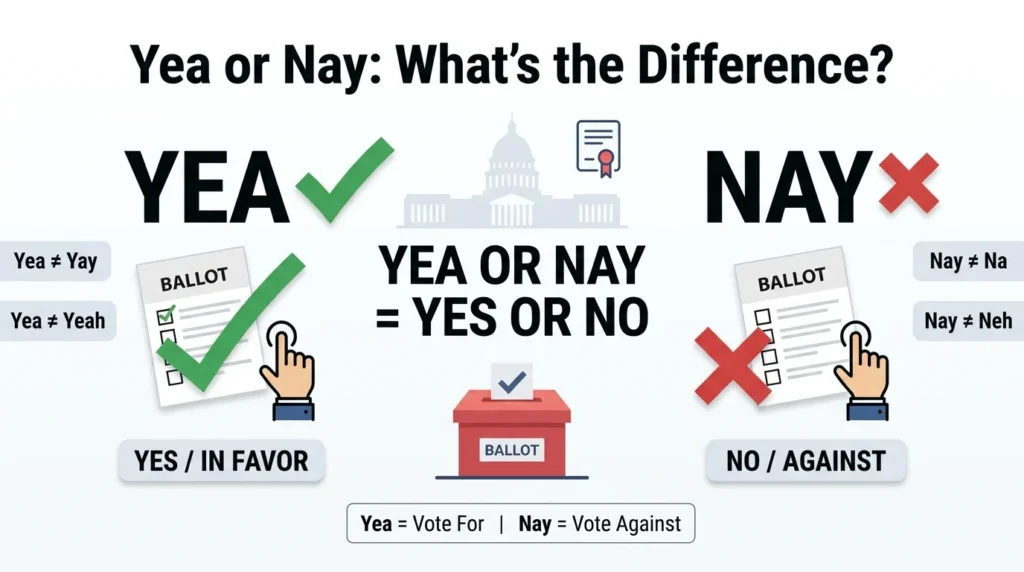
Yea means yes or a vote in favor, while nay means no or a vote against. The phrase “yea or nay” means “yes or no” and is most common in formal voting, official decisions, and American English contexts.
If you have ever heard someone ask “Yea or nay?”, you may have wondered what these two unusual words mean. The answer is simple, but their usage can be confusing because yea, yay, yeah, and nay look or sound similar. In American English, yea and nay are most strongly connected with voting and formal decisions. A yea means that someone supports a proposal, while a nay means that someone opposes it. For example, a government vote may be recorded as 50 yeas and 45 nays. In everyday conversation, however, Americans usually say yes or no instead of yea or nay. You may also see these words in historical writing, formal speeches, books, and traditional expressions. This guide explains yea or nay in simple American English. You will learn the exact meanings, pronunciation, differences from yay and yeah, voting usage, common mistakes, real world examples, exercises, and the best way to use these words naturally.
Yea or Nay Meaning
The easiest way to remember yea or nay is:
Yea = yes
Nay = no
In a formal vote:
Yea = vote in favor
Nay = vote against
So if someone asks:
“Yea or nay?”
they are basically asking:
“Yes or no?”
or:
“Do you approve or not?”
Example
The committee voted yea on the new policy.
This means the committee voted in favor of the policy.
The committee voted nay on the proposal.
This means the committee voted against it.
What Does Yea Mean?
Yea is a formal or traditional word meaning yes. In modern American English, it is especially associated with an affirmative vote.
For example:
I vote yea.
This means:
I vote yes.
You may also see:
The bill received 55 yeas.
This means 55 people voted in favor.
Yea as a Positive Vote
When a person votes yea, they support the proposal.
For example:
The senator voted yea on the bill.
The board recorded eight yeas.
The proposal passed with 30 yeas and 12 nays.
In these examples, yea has a clear voting meaning.
What Does Nay Mean?
Nay means no, especially when referring to a formal vote.
For example:
I vote nay.
This means:
I vote no.
You can also say:
The bill received 40 yeas and 20 nays.
The 20 nays represent votes against the bill.
Nay as a Negative Vote
Examples:
The senator voted nay.
Five members voted nay.
The motion received more nays than yeas.
The committee recorded 12 yeas and 9 nays.
Yea or Nay in American English
For a US audience, one of the most important things to understand is that yea and nay are not the normal everyday replacements for yes and no.
Americans normally say:
Yes, I agree.
No, I disagree.
But in a formal voting situation, you may hear:
Yea.
Nay.
For example:
The chair asked for a yea or nay vote.
This sounds natural in a formal meeting.
Everyday vs Formal Usage
| Situation | Natural American English |
|---|---|
| Casual conversation | Yes / No |
| Text message | Yes / No |
| Normal question | Yes / No |
| Government vote | Yea / Nay |
| Committee vote | Yea / Nay |
| Board vote | Yea / Nay |
| Historical writing | Yea / Nay |
| Playful expression | Yea or nay |
The key is context.
What Does “Yea or Nay” Mean in Voting?
In voting, yea or nay asks whether a person supports or opposes a proposal.
Imagine a city council is voting on a new parking rule.
The chair might ask members to vote.
A member who supports it gives a:
Yea
A member who opposes it gives a:
Nay
The final record might show:
25 yeas
10 nays
The proposal received more votes in favor than against.
Yea or Nay in U.S. Government
Yea and nay are especially useful when discussing legislative voting in the United States.
You may encounter phrases such as:
yea vote
nay vote
yeas and nays
vote yea
vote nay
For example:
The House recorded 218 yeas and 212 nays.
Or:
The senator voted nay on the measure.
These terms help describe whether lawmakers supported or opposed a proposal.
Yea or Nay in a Committee
Formal committees may also use these words.
For example:
The committee voted 7 yeas to 3 nays.
This means seven members supported the proposal and three opposed it.
Another example:
The motion passed after the members cast their yeas and nays.
Here, yeas and nays simply means the positive and negative votes.
Yea or Nay in a Board Meeting
A company board may vote on an important decision.
For example:
The board voted 6 yeas and 2 nays on the proposal.
This is a formal way to describe the decision.
In a normal email, however, you would probably write:
Please let me know if you approve the proposal.
You would not usually write:
Please give me your yea or nay.
That can sound overly formal.
Yea or Nay in Everyday Conversation
Although yea or nay is less common in normal conversation, Americans still understand it.
People sometimes use it for humor or emphasis.
For example:
New restaurant tonight, yea or nay?
This simply means:
Do you want to go to the new restaurant or not?
Another example:
Yea or nay on this new design?
This means:
Do you approve of the new design?
The expression can sound playful because it has a formal or old-fashioned feel.
Yea or Nay in Text Messages
You may see yea or nay in casual texting.
For example:
Movie tonight, yea or nay?
New haircut, yea or nay?
Pizza for dinner, yea or nay?
In these examples, the speaker is usually being playful.
A normal version would be:
Movie tonight, yes or no?
Both can be understood, but they create different tones.
Yea vs Yes
Yea and yes can have similar meanings, but they are not equally common.
Yes
Yes is the standard word for agreement.
Yes, I understand.
Yes, I want to go.
Yes, that is correct.
Yea
Yea is more formal, traditional, or connected to voting.
I vote yea.
The measure received 50 yeas.
For everyday American English, use yes unless the context specifically calls for yea.
Yea vs Yeah
This is one of the most common spelling mistakes.
Yeah is an informal form of yes.
Yea is a formal or traditional word meaning yes or an affirmative vote.
Examples
Yeah, I can help you.
This is casual American English.
The senator voted yea.
This is voting language.
Simple Rule
Yeah = casual yes
Yea = yes or affirmative vote
Yea vs Yay
This difference is also very important.
Yea means yes or a positive vote.
Yay expresses happiness, excitement, or celebration.
Examples
The senator voted yea.
Yay! We won!
The words may sound alike, but they have different meanings.
Remember
Yea = yes
Yay = excitement
For example:
Yay! It’s Friday!
This shows excitement.
You would not normally use yea here if you mean excitement.
Yea vs Aye
Another useful comparison is yea vs aye.
Both yea and aye can mean an affirmative vote.
For example:
The motion passed with 10 yeas and 2 nays.
You may also encounter:
The motion passed with 10 ayes and 2 noes.
However, yea and nay are especially recognizable as a paired expression in formal voting language.
For American English learners, the most important rule is:
yea = affirmative vote
nay = negative vote
Nay vs No
Nay and no have the same basic negative idea, but their usage is different.
No
Use no in normal conversation.
No, I don’t want coffee.
No, that’s not correct.
No, I can’t go.
Nay
Use nay mainly in formal voting or old-fashioned language.
The senator voted nay.
The motion received five nays.
Saying:
Nay, I don’t want coffee.
is grammatically understandable, but it sounds old-fashioned or dramatic.
Nay vs Neigh
Do not confuse nay with neigh.
They sound the same, but they have completely different meanings.
Nay = no
Neigh = the sound a horse makes
Examples
The senator voted nay.
The horse gave a loud neigh.
This is a classic English homophone pair.
Yea or Nay Pronunciation
Yea is generally pronounced like yay.
Nay is pronounced like nay.
This creates an important spelling issue.
You may hear:
yea
and:
yay
as the same sound.
But their meanings are different.
Yea = yes or affirmative vote
Yay = excitement
How to Use Yea in a Sentence
Here are natural examples.
I vote yea.
The proposal received 30 yeas.
The senator cast a yea vote.
The committee recorded 12 yeas.
The bill passed with a strong yea vote.
The board voted yea on the proposal.
These examples all relate to agreement or support.
How to Use Nay in a Sentence
Here are natural examples.
I vote nay.
The senator cast a nay vote.
The committee recorded five nays.
The proposal received 20 yeas and 15 nays.
The board voted nay on the proposal.
These examples all indicate opposition or rejection.
Yea or Nay in a Sentence
The phrase can be used naturally in several ways.
Yea or nay on the new plan?
The committee must decide yea or nay.
Members were asked to vote yea or nay.
The final result was 18 yeas and 7 nays.
The board gave a clear yea to the proposal.
The exact grammar can vary, but the meaning remains related to approval or rejection.
Common Yea and Nay Phrases
Learning common phrases is one of the best ways to remember these words.
Yea Vote
The senator cast a yea vote.
Nay Vote
The senator cast a nay vote.
Yeas and Nays
The clerk recorded the yeas and nays.
Vote Yea
I will vote yea.
Vote Nay
She decided to vote nay.
Yea or Nay
What’s your yea or nay?
A Yea
The proposal received a yea.
A Nay
The proposal received a nay.
Yea Can Have an Older Meaning
There is another use of yea that is worth knowing.
In older or literary English, yea can mean indeed, even, or more than that.
For example:
He was tired, yea, exhausted.
This means:
He was tired, indeed, he was exhausted.
This use is uncommon in everyday American English.
You are more likely to see it in:
- Older literature
- Historical writing
- Religious texts
- Traditional language
- Formal or poetic writing
In modern American English, a writer would usually say:
He was tired, in fact, exhausted.
Nay Can Have an Older Literary Meaning
Nay can also be used in older or literary writing to mean more than simply “no.”
For example:
Nay, he was not merely tired; he was exhausted.
This sounds formal or old-fashioned.
Modern American English would usually say:
No, he was not merely tired. In fact, he was exhausted.
This older meaning is useful when reading historical texts, but it is not necessary for normal conversation.
Yea or Nay in Historical Writing
If you read older English books, you may see yea and nay much more often than you would in modern American conversation.
For example:
Nay, I shall not do it.
This means:
No, I will not do it.
A modern American speaker would normally say:
No, I won’t do it.
Understanding this difference can help you read older material without confusion.
Yea or Nay in Religious Texts
Readers may also encounter yea and nay in older religious writing.
These words can appear because older forms of English used them more frequently.
If you encounter yea in an older text, do not automatically assume it means yay.
Look at the context.
It may mean:
yes
indeed
truly
or an affirmative response.
Yea or Nay on Social Media
Modern social media has brought some older expressions back in playful ways.
For example:
New logo: yea or nay?
This outfit: yea or nay?
Should I buy it? Yea or nay?
Here, the phrase means:
Do you approve?
or:
Yes or no?
This is not necessarily formal. The writer may simply like the sound of the phrase.
Yea or Nay in Online Polls
You might see:
Yea or nay?
in an online poll or discussion.
For example:
New website design: yea or nay?
The intended choices are:
Yea = approve
Nay = do not approve
This usage is usually informal and conversational.
Yea or Nay in Business English
Business writers should generally choose yes and no for simple communication.
For example:
Please let me know whether you approve the proposal.
This is clearer than:
Please provide your yea or nay.
However, if you are documenting an official vote, yea and nay are appropriate.
The board recorded six yeas and three nays.
The key difference is between ordinary communication and formal voting records.
Yea or Nay in School and College
Teachers, student councils, and school boards may use these words in formal voting.
For example:
The student council voted 12 yeas and 4 nays.
A normal classroom conversation would usually use:
yes
and:
no
For example:
Do you agree with the proposal? Yes or no?
Yea or Nay in Local Government
Local government decisions may also involve formal votes.
For example:
The city council approved the proposal with 8 yeas and 3 nays.
This is a useful American English example because local councils often make formal decisions through recorded votes.
Yea or Nay in a Court or Legal Context
You may encounter yea and nay in legal or historical documents, especially when describing a vote or formal decision.
However, ordinary legal writing does not require these words simply because something is formal.
For example, a modern document may simply say:
The motion was approved by a majority vote.
The terms yea and nay are most useful when the individual votes themselves are being recorded or described.
Common Mistakes With Yea or Nay
Mistake One: Using Yea Instead of Yay
Incorrect if you mean excitement:
Yea! We won!
Better:
Yay! We won!
Mistake Two: Using Yeah for a Formal Vote
Less appropriate:
The senator voted yeah.
Better:
The senator voted yea.
Mistake Three: Using Nay in Every Situation
Unnatural in ordinary conversation:
Nay, I don’t want pizza.
More natural:
No, I don’t want pizza.
Mistake Four: Confusing Nay With Neigh
Remember:
Nay = no
Neigh = horse sound
Mistake Five: Thinking Yea and Yay Have the Same Meaning
They may sound the same, but they are different words.
Yea = yes / vote in favor
Yay = excitement
Yea or Nay: Common American English Mistakes
Here are some quick corrections.
| Incorrect or Unnatural | Better American English |
|---|---|
| Yea, I want coffee. | Yes, I want coffee. |
| Yea! We won! | Yay! We won! |
| The senator voted yeah. | The senator voted yea. |
| The senator voted yay. | The senator voted yea. |
| Nay, I don’t want it. | No, I don’t want it. |
| The horse gave a nay. | The horse gave a neigh. |
These corrections are especially useful for English learners.
Advantages of Using Yea and Nay
Using yea and nay can be useful when the situation is formal.
Clear Voting Language
They clearly identify positive and negative votes.
Useful in Official Records
They can make voting records easy to understand.
Helpful for Understanding U.S. Politics
You may encounter them when reading about legislative votes.
Useful for Historical Texts
Knowing these words makes older English easier to understand.
Useful for Formal or Playful Writing
The phrase yea or nay can add a traditional or humorous tone.
Disadvantages of Using Yea and Nay
There are also reasons not to use them everywhere.
They Can Sound Old-Fashioned
Nay, I disagree sounds much older than:
No, I disagree.
They Are Less Common in Casual Speech
Americans normally use:
yes
and:
no
Yea Can Be Confused With Yay
Both words usually sound like yay.
Nay Can Be Confused With Neigh
Both words sound alike.
When Should You Use Yea?
Use yea when:
- Talking about a formal vote
- Describing an affirmative vote
- Writing about government voting
- Describing a committee decision
- Referring to historical language
- Intentionally creating a formal or traditional tone
Examples:
I vote yea.
The measure received 60 yeas.
When Should You Use Nay?
Use nay when:
- Talking about a formal vote
- Describing a negative vote
- Writing about government decisions
- Describing committee results
- Referring to historical or literary language
Examples:
I vote nay.
The motion received 12 nays.
When Should You Use Yes and No?
Use yes and no in most everyday American English.
Examples:
Yes, I agree.
No, I don’t agree.
Yes, I can help.
No, I cannot attend.
This is the safest choice for normal conversation and professional communication.
Yea or Nay vs Yes or No
| Yea or Nay | Yes or No |
|---|---|
| Formal | Neutral |
| Traditional | Modern |
| Common in voting | Common everywhere |
| Can sound old-fashioned | Natural everyday English |
| Often used for official votes | Used for ordinary answers |
| Can be playful | Usually straightforward |
Nay or Yea vs Yay or Nay
Yea or nay is the more traditional voting phrase.
Yay or nay may appear in casual or playful writing.
Compare:
The committee voted yea or nay.
This is formal.
New haircut, yay or nay?
This sounds casual.
If you are describing an official vote, yea and nay are the better choices.
Yea or Nay vs Aye or No
You may also encounter aye in voting contexts.
For American English learners, remember:
yea = affirmative vote
nay = negative vote
aye = affirmative vote in certain formal or traditional voting contexts
no = ordinary negative answer
The exact terminology can depend on the organization and voting procedure.
A Simple Memory Trick
Use this simple formula:
YEA = YES
NAY = NO
Then remember:
YEA = FOR
NAY = AGAINST
And for everyday American English:
YES = normal
NO = normal
For excitement:
YAY = happy
For a horse:
NEIGH = horse sound
This small chart covers almost every common confusion.
Real World Examples
Example: U.S. Government
The measure received 220 yeas and 210 nays.
Meaning:
220 voted for it.
210 voted against it.
Example: Company Board
The board voted yea on the proposal.
Meaning:
The board approved it.
Example: School Council
The student council recorded 15 yeas and 4 nays.
Meaning:
15 members supported the proposal.
Example: Casual Conversation
New restaurant tonight, yea or nay?
Meaning:
Do you want to go or not?
Example: Social Media
This new logo: yea or nay?
Meaning:
Do you like or approve of the logo?
Example: Historical Writing
Nay, I shall not agree.
Meaning:
No, I will not agree.
Exercises With Answers
Exercise One
Fill in the blank with yea or nay.
- The senator voted ______ on the bill.
- The committee recorded 15 ______ and 6 nays.
- The proposal received 20 yeas and 8 ______.
- I vote ______ because I support the plan.
- He voted ______ because he opposed the proposal.
Answers
- yea
- yeas
- nays
- yea
- nay
Exercise Two
Choose yea, yay, yeah, or nay.
- “______! We finally finished the project!”
- “The senator voted ______.”
- “______ or nay on the new restaurant?”
- “______, I understand what you mean.”
- “The proposal received 10 yeas and 5 ______.”
Answers
- Yay
- yea
- yea
- Yeah
- nays
Exercise Three
Choose the best American English option.
- Normal conversation:
A. Yea, I understand.
B. Yes, I understand.
- Formal vote:
A. The senator voted yea.
B. The senator voted yay.
- Excitement:
A. Yay! We won!
B. Yea! We won!
- Negative formal vote:
A. The senator voted nay.
B. The senator voted neigh.
Answers
- B. Yes, I understand.
- A. The senator voted yea.
- A. Yay! We won!
- A. The senator voted nay.
FAQs
What does yea or nay mean in American English?
Yea or nay means yes or no, especially when asking for a formal decision or vote. Yea shows support, while nay shows opposition.
Is yea the same as yes?
Yes, yea can mean yes, but it is mainly used in formal, traditional, or voting contexts. Yes is the normal word in everyday American English.
What is the difference between yea and yay?
Yea means yes or an affirmative vote. Yay expresses excitement or happiness, as in “Yay! We won!”
What is the difference between yea and nay?
Yea means a positive answer or vote in favor. Nay means a negative answer or vote against.
Should I use yea or nay in everyday conversation?
Usually, use yes or no in everyday American English. Use yea or nay for formal voting, historical language, or a playful expression such as “New design, yea or nay?”
Conclusion
The meaning of yea or nay is simple once you understand the context. Yea means yes or a vote in favor, while nay means no or a vote against. The phrase “yea or nay” therefore means “yes or no,” and it is especially common when discussing formal votes, government decisions, committees, boards, and other official decisions. In modern American English, however, yes and no are much more common in everyday conversation.
It is also important to separate yea from yay and yeah. Yea is associated with agreement or voting, yay expresses excitement, and yeah is an informal way to say yes. Likewise, nay should not be confused with neigh, the sound made by a horse. If you are learning American English, remember the easiest rule: yea means yes or for, and nay means no or against. Use these words when the context is formal or when you want to understand voting and traditional English. For normal daily conversation, yes and no are usually the best choices.