
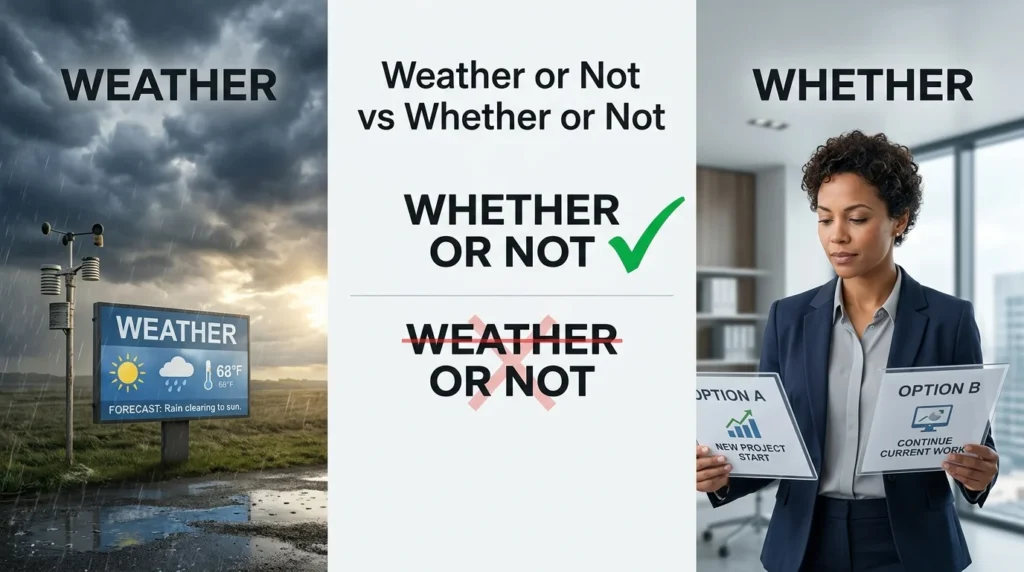

Quick Answer
The correct phrase is whether or not, not weather or not, when you mean two possibilities or uncertainty. Weather refers to conditions such as rain, wind, sunshine, and temperature, while whether introduces a choice or possibility.
Weather or not and whether or not sound very similar, which makes them easy to confuse. However, only one is correct when you are talking about a choice, possibility, or uncertain situation. The correct phrase is whether or not. For example, “I do not know whether or not she will come” talks about two possible outcomes. On the other hand, weather is used when you are talking about rain, sunshine, wind, storms, or temperature. This difference is simple once you understand what each word means. In this guide, you will learn when to use weather, when to use whether, why whether or not is correct, and how to avoid this common spelling mistake.
What Does Weather Mean?
Weather is mainly a noun. It describes the condition of the atmosphere at a particular time and place.
Weather can include:
- Rain
- Snow
- Wind
- Sunshine
- Heat
- Cold
- Clouds
- Storms
- Temperature
Examples:
The weather is beautiful today.
We checked the weather before leaving home.
Bad weather delayed the flight.
The weather forecast says it will rain tomorrow.
If your sentence is about what is happening outside, weather is usually the word you need.
What Does Whether Mean?
Whether is used to introduce a choice, possibility, or uncertainty.
Examples:
I do not know whether he will come.
She cannot decide whether to stay.
We need to find out whether the store is open.
I am not sure whether this plan will work.
In many situations, whether can be understood as something similar to if.
For example:
I do not know whether he is coming.
You could also say:
I do not know if he is coming.
Both can work in many indirect questions. However, whether is preferred in certain structures, especially before a verb with to.
Is Weather or Not Correct?
When you mean a choice or two possible outcomes, weather or not is incorrect.
Incorrect:
I do not know weather or not she will come.
Correct:
I do not know whether or not she will come.
The problem comes from confusing weather with whether.
Weather relates to atmospheric conditions.
Whether relates to possibilities, choices, or uncertainty.
The correct phrase is:
whether or not
This is a standard English expression.
What Does Whether or Not Mean?
Whether or not means that there are two possibilities: something may happen, or it may not happen.
For example:
We will go whether or not it rains.
This means the plan will continue in both situations.
If it rains, we will go.
If it does not rain, we will still go.
Another example is:
She will attend whether or not you invite her.
The sentence says that her attendance does not depend on the invitation.
You can think of whether or not as meaning regardless of which possibility is true.
Whether or Not vs Whether
You do not always need or not.
Both of these sentences can be correct:
I do not know whether he is coming.
I do not know whether or not he is coming.
The second version makes the two possibilities more explicit.
However, whether or not is especially useful when you want to emphasize that the result will remain the same regardless of what happens.
For example:
We will finish the project whether or not they help us.
The meaning is that their help will not change the decision.
Weather vs Whether: The Main Difference
The easiest way to remember these words is to connect each one with its meaning.
| Word | Meaning | Example |
|---|---|---|
| Weather | Conditions outside | The weather is cold. |
| Whether | Choice or possibility | I do not know whether he is coming. |
| Whether or not | Two possible outcomes | We will go whether or not it rains. |
So, ask yourself:
Am I talking about rain, wind, sunshine, or temperature?
If yes, use weather.
Am I talking about a choice, uncertainty, or two possibilities?
If yes, use whether.
Common Examples of Weather
Here are some natural examples of weather:
The weather is getting colder.
We had terrible weather last weekend.
What will the weather be like tomorrow?
The weather forecast predicts heavy rain.
I hope the weather stays warm.
The storm created dangerous weather conditions.
In all of these sentences, the word refers to atmospheric conditions.
Common Examples of Whether
Now compare those examples with whether:
I am not sure whether he is coming.
She asked whether I needed help.
We need to decide whether to leave.
They are discussing whether the plan is practical.
I wonder whether she knows the answer.
These sentences have nothing to do with rain or temperature. Instead, they involve choices, questions, or uncertainty.
Whether or Not in Everyday English
You will often hear whether or not in normal conversation.
Examples:
I am going whether or not you come.
Tell me whether or not you need help.
I do not know whether or not they are ready.
We have to decide whether or not to stay.
She will finish the job whether or not she feels tired.
The phrase is natural in both everyday and professional communication.
Whether or Not in Professional Writing
Whether or not is also common in business emails, reports, school assignments, and formal writing.
Examples:
Please confirm whether or not you will attend the meeting.
We need to determine whether or not the proposal meets the requirements.
The company will continue the project whether or not additional funding becomes available.
Please let us know whether or not you have received the document.
Using whether correctly matters in professional writing because replacing it with weather creates an obvious spelling error.
Whether or Not Before a Verb
A common structure is:
whether or not + to + verb
Examples:
I cannot decide whether or not to go.
She is considering whether or not to apply.
We need to decide whether or not to continue.
He does not know whether or not to accept the offer.
You can often shorten these sentences by removing or not:
I cannot decide whether to go.
She is considering whether to apply.
We need to decide whether to continue.
The form with whether before to is important. Standard English does not normally use if to in this structure.
Weather and Whether in the Same Sentence
Interestingly, weather and whether can appear in the same sentence.
For example:
We do not know whether the weather will improve.
Here, both words are correct.
Whether introduces uncertainty.
Weather refers to atmospheric conditions.
Another example:
Whether we go outside depends on the weather.
Again, each word has a completely different job.
This is one of the best ways to understand the difference.
Common Mistakes With Weather or Not
Mistake One
Incorrect:
I do not know weather or not he will come.
Correct:
I do not know whether or not he will come.
The sentence expresses uncertainty, so whether is correct.
Mistake Two
Incorrect:
We will go whether or not the weather is good.
Correct:
We will go whether or not the weather is good.
This sentence actually uses both words correctly.
Whether introduces the possibility.
Weather describes outdoor conditions.
Mistake Three
Incorrect:
I wonder weather she is ready.
Correct:
I wonder whether she is ready.
The sentence expresses uncertainty, not atmospheric conditions.
Mistake Four
Incorrect:
The whether is terrible today.
Correct:
The weather is terrible today.
This sentence talks about outdoor conditions, so weather is correct.
How to Remember Weather vs Whether
Here is a simple memory trick.
Think of weather whenever you think about:
rain, wind, sun, storms, or temperature.
Think of whether whenever you think about:
choice, uncertainty, or possibilities.
Another useful test is to see if you can replace the word with if.
For example:
I do not know whether she is coming.
You can say:
I do not know if she is coming.
That tells you whether is the right word.
However:
The weather is cold.
You cannot replace weather with if.
So the sentence needs weather.
Whether or Not vs If
In many sentences, whether and if can both work.
For example:
I do not know whether he is home.
I do not know if he is home.
Both are natural.
However, whether has some advantages in formal writing and in specific grammatical structures.
For example:
I am not sure whether to stay.
This is correct.
Using if before to stay is not standard in this structure.
Also, when you want to show two alternatives, whether works very naturally:
We need to decide whether to stay or leave.
Therefore, whether is often the safer choice when a clear choice or alternative appears.
Weather in Common Expressions
The word weather appears in several familiar expressions.
Under the Weather
I am feeling a little under the weather today.
This means feeling unwell.
Weather the Storm
The company managed to weather the storm.
Here, weather is used as a verb. It means to survive or deal with a difficult situation.
Fair Weather Friend
He is only a fair-weather friend.
This describes someone who stays around during good times but disappears during difficult times.
These expressions all use weather, not whether.
Whether in Common Structures
You will often see whether in these structures:
Whether or not
I will go whether or not she comes.
Whether to
He cannot decide whether to stay.
Whether or
We need to decide whether to drive or take the train.
Whether someone will
I do not know whether she will attend.
Learning these patterns makes correct usage much easier.
Weather or Not in Text Messages
Because weather and whether sound alike, people often type the wrong spelling in text messages.
For example:
Let me know weather or not you are coming.
The correct version is:
Let me know whether or not you are coming.
Texting may be informal, but the correct spelling still improves clarity.
If you are writing a message for work, school, or an important conversation, always use whether or not when you mean a possibility.
Weather or Not in School and Academic Writing
Students often need whether when discussing choices or uncertainty.
Examples:
The study examined whether the treatment was effective.
Researchers wanted to know whether the results were reliable.
The paper discusses whether the policy should change.
Using weather in these sentences would be incorrect because none of them refers to atmospheric conditions.
For academic writing, checking the meaning before choosing the spelling can prevent this common mistake.
Practice: Choose Weather or Whether
Choose the correct word in each sentence.
- I do not know ___ she will come.
- The ___ is beautiful today.
- We will go ___ or not they agree.
- Did you check the ___ forecast?
- She cannot decide ___ to stay.
- The cold ___ made driving difficult.
- Tell me ___ you are available.
- We will continue ___ or not it rains.
Answers
- whether
- weather
- whether
- weather
- whether
- weather
- whether
- whether
The quickest test is to ask whether the sentence talks about outdoor conditions or a choice.
Quick Comparison Examples
Here are some examples you can use as a final review.
Weather
The weather is warm.
Whether
I do not know whether he is ready.
Whether or not
We will leave whether or not he is ready.
Weather
Bad weather canceled the game.
Whether
She asked whether the game was canceled.
Both together
We do not know whether the weather will improve.
This last example is especially useful because it shows how different the two words are.
Final Tips for Correct Usage
Keep these simple rules in mind:
- Weather means atmospheric conditions.
- Whether introduces a choice or possibility.
- Whether or not is the correct phrase for two possible outcomes.
- Use whether to when discussing a choice about an action.
- Weather or not is incorrect when you mean whether or not.
- Both weather and whether can appear in the same sentence.
If you remember only one rule, remember this:
Rain, sun, wind, and temperature mean weather. Choices and possibilities mean whether.
FAQs
Is “weather or not” correct?
No. When you mean two possibilities or uncertainty, the correct phrase is whether or not. Weather refers to atmospheric conditions such as rain, wind, and temperature.
What is the difference between weather and whether?
Weather is mainly a noun that describes atmospheric conditions. Whether is a conjunction used to introduce a choice, possibility, or uncertainty.
Is whether or not grammatically correct?
Yes. Whether or not is a standard English expression. It can show that something will happen regardless of which of two possibilities is true.
Can I use if instead of whether?
Often, yes. For example, “I do not know whether she is coming” and “I do not know if she is coming” are both natural. However, whether is used before a verb with to, as in “whether to go.”
How can I easily remember whether or not?
Think about the meaning. If you are talking about rain, sunshine, wind, or temperature, use weather. If you are talking about a choice or possibility, use whether. The correct phrase is whether or not.
Conclusion
The difference between weather and whether is easy to understand once you connect each word with its meaning. Weather refers to conditions outside, such as rain, sunshine, wind, snow, and temperature. Whether introduces a choice, possibility, or uncertainty. Therefore, when you mean two possible outcomes, the correct phrase is whether or not, not weather or not. For example, “We will go whether or not it rains” is correct. If you remember that weather is about the outside world and whether is about choices, you can avoid this common mistake in everyday conversations, school writing, emails, and professional communication.