

Quick Answer
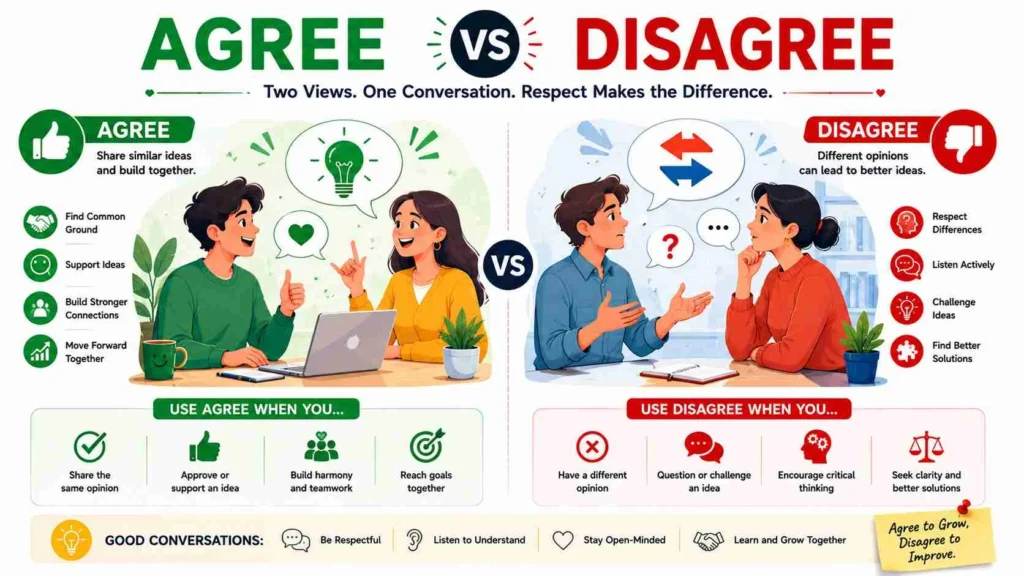
Agree means to have the same opinion, belief, or idea as someone else. Disagree means to have a different opinion or not accept an idea. Both words are important in communication because they help people express their thoughts clearly and respectfully.
Every day, people share opinions. Sometimes they support an idea, and other times they oppose it. This is where the words agree and disagree become important. These simple words are used in conversations, classrooms, workplaces, debates, and online discussions.
Many English learners get confused about when to use agree or disagree. They may know the basic meaning, but they often struggle to use these words correctly in sentences, essays, and formal discussions.
Understanding agree or disagree helps improve communication skills. It allows people to express opinions confidently while respecting the views of others. you are writing an essay, participating in a debate, or having a casual conversation, knowing how to agree and disagree properly is an essential skill.
This guide explains agree or disagree in simple language. You will learn meanings, examples, grammar rules, common phrases, real world usage, common mistakes, exercises with answers, and professional writing tips.
Quick Overview
Agree means to support or accept an opinion.
Disagree means to oppose or reject an opinion.
Agree creates harmony and shows support.
Disagree presents a different viewpoint.
Both are important for healthy communication and critical thinking.
What Does Agree Mean
The word agree means to have the same opinion, feeling, or belief as another person.
Examples:
I agree with your idea.
She agrees that education is important.
We all agree on the final decision.
When people agree, they share a common understanding or viewpoint.
Common Situations Where People Agree
Conversations with friends
Business meetings
Classroom discussions
Family decisions
Team projects
Agreeing does not always mean complete support. Sometimes people agree with only part of an idea.
What Does Disagree Mean
The word disagree means to have a different opinion or belief from someone else.
Examples:
I disagree with that statement.
They disagree about the best solution.
Many experts disagree on the topic.
Disagreement is normal and healthy when it is expressed respectfully.
Common Situations Where People Disagree
Political discussions
Business strategies
Academic debates
Personal preferences
Social issues
Different opinions often help people see new perspectives and improve decisions.
Key Difference Between Agree and Disagree
The main difference is simple.
Agree means accepting an idea.
Disagree means rejecting or questioning an idea.
Comparison Table
| Feature | Agree | Disagree |
|---|---|---|
| Meaning | Accept an idea | Reject an idea |
| Purpose | Show support | Show opposition |
| Communication Style | Positive and supportive | Different viewpoint |
| Example | I agree with you | I disagree with you |
| Outcome | Shared opinion | Different opinion |
When to Use Agree
Use agree when you support a statement or share the same opinion.
Examples:
I agree that exercise improves health.
We agree with the manager’s decision.
Most students agree that practice helps learning.
Agree is commonly used in both formal and informal communication.
When to Use Disagree
Use disagree when your opinion differs from another person’s opinion.
Examples:
I disagree with that conclusion.
Many scientists disagree on certain theories.
She disagrees with the proposed plan.
Disagreeing respectfully is an important communication skill.
Agree and Disagree in Everyday Conversations
People use agree and disagree every day.
Example Conversation
Person A: This restaurant has great food.
Person B: I agree. The food is excellent.
Example Conversation
Person A: Online learning is better than classroom learning.
Person B: I disagree. Face to face learning is more effective.
These examples show how opinions are shared naturally.
Agree and Disagree in Academic Writing
In academic writing, students often need to agree or disagree with a statement.
Example:
Some people believe technology improves education.
You may agree by providing supporting evidence.
You may disagree by presenting different evidence.
Strong essays explain reasons clearly rather than simply saying agree or disagree.
Agree and Disagree in IELTS and Essay Writing
Many English tests include agree or disagree questions.
Example Topic
Social media does more harm than good.
Do you agree or disagree?
A strong response should:
State your position clearly
Provide supporting reasons
Include examples
Maintain logical structure
Use formal language
Examiners reward clear arguments and strong evidence.
Common Phrases for Agreeing
There are many ways to express agreement.
Examples:
I agree.
I completely agree.
That is true.
You are right.
I share the same opinion.
I think so too.
Exactly.
Absolutely.
These phrases make communication more natural.
Common Phrases for Disagreeing
Disagreement should be polite and respectful.
Examples:
I disagree.
I do not think so.
I see it differently.
I am not sure about that.
I have another opinion.
I respectfully disagree.
That may not be correct.
These phrases help avoid conflict while expressing different views.
Advantages and Disadvantages of Agreeing
Advantages
Builds cooperation
Creates harmony
Supports teamwork
Strengthens relationships
Disadvantages
May reduce critical thinking
Can encourage group pressure
May prevent new ideas from emerging
Advantages and Disadvantages of Disagreeing
Advantages
Encourages critical thinking
Introduces new ideas
Improves decision making
Promotes discussion
Disadvantages
Can create conflict
May cause misunderstandings
Can slow group decisions
Real World Examples
Example One Workplace Discussion
A manager proposes a new strategy.
Some employees agree because it increases efficiency.
Others disagree because it may increase workload.
The discussion helps improve the final plan.
Example Two Classroom Debate
Students debate school uniforms are necessary.
Some agree because uniforms reduce distractions.
Others disagree because uniforms limit personal expression.
Example Three Family Decision
Family members discuss vacation plans.
Different opinions lead to a better decision that satisfies everyone.
Common Mistakes
Mistake One
Using agree without a preposition.
Incorrect:
I agree you.
Correct:
I agree with you.
Mistake Two
Being rude when disagreeing.
Incorrect:
You are wrong.
Correct:
I respectfully disagree.
Mistake Three
Giving no reason for agreement or disagreement.
Always explain your opinion clearly.
Related Concepts
Opinion
Argument
Debate
Discussion
Persuasion
Critical Thinking
These concepts are closely connected to agree or disagree communication.
Beginner to Advanced Understanding
Beginner Level
Agree means yes.
Disagree means no.
Intermediate Level
Agreeing supports an idea.
Disagreeing challenges an idea.
Advanced Level
Effective communication requires presenting agreement and disagreement with evidence, logic, and respect.
Regional and Global Usage
Agree and disagree are universal concepts used across cultures.
However, some cultures encourage direct disagreement while others prefer indirect and polite disagreement.
Understanding cultural differences helps improve communication in international settings.
Exercises With Answers
Question One
What does agree mean?
Answer
To share the same opinion.
Question Two
What does disagree mean?
Answer
To have a different opinion.
Question Three
Which phrase shows agreement?
Answer
I completely agree.
Question Four
Which phrase shows disagreement?
Answer
I respectfully disagree.
Question Five
Why is respectful disagreement important?
Answer
It helps maintain positive communication.
FAQs
What does agree mean?
Agree means accepting or supporting an idea, opinion, or statement.
What does disagree mean?
Disagree means having a different opinion or viewpoint.
Can people disagree respectfully?
Yes. Respectful disagreement is important for healthy communication.
Why is agree or disagree important in essays?
It helps writers present clear opinions and arguments.
What is the difference between agree and disagree?
Agree supports an idea while disagree opposes it.
How do I express agreement politely?
Use phrases such as I agree or That is true.
How do I express disagreement politely?
Use phrases such as I respectfully disagree or I see it differently.
Is disagreement always negative?
No. It often helps improve ideas and decisions.
Can agree and disagree be used in formal writing?
Yes. They are common in academic and professional writing.
Why do people disagree?
People have different experiences, beliefs, and perspectives.
Conclusion
Understanding agree or disagree is essential for effective communication. Agree means sharing the same opinion, while disagree means having a different viewpoint. Both play important roles in conversations, debates, workplaces, and academic writing.
Learning how to agree and disagree respectfully helps build stronger relationships and encourages meaningful discussions. Agreement creates cooperation, while disagreement promotes critical thinking and new ideas. The key is to express opinions clearly, support them with reasons, and respect the perspectives of others.
You are speaking with friends, writing an essay, or participating in a professional discussion, mastering agree or disagree will improve your communication skills and confidence.