
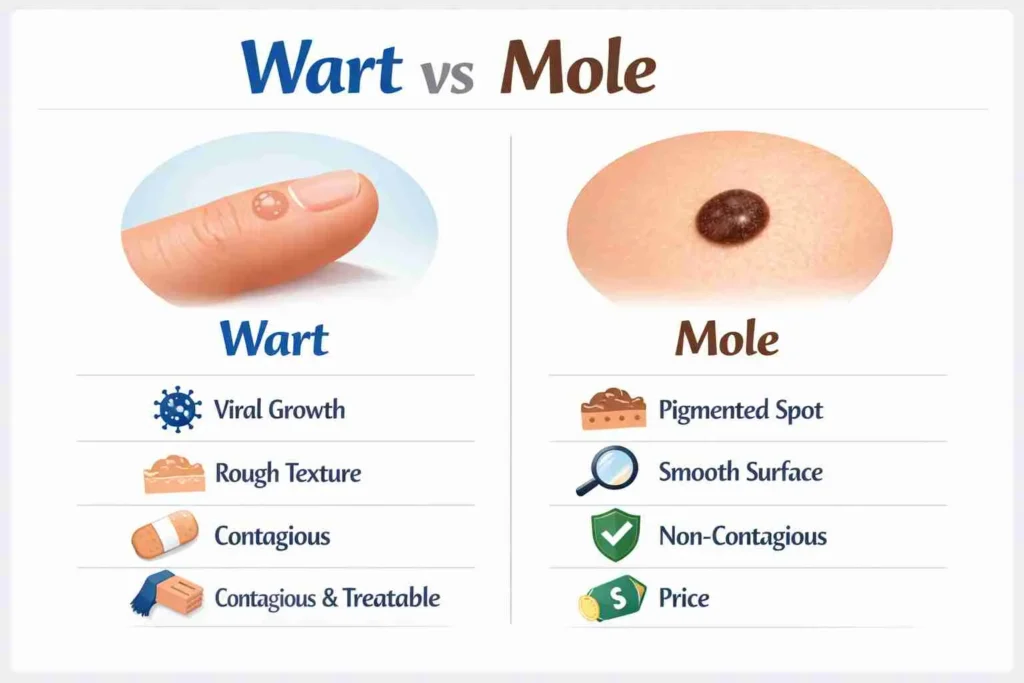

Many people notice a small bump or spot on their skin and immediately wonder whether it is a wart or mole. At first glance, these skin growths can appear similar, especially when they are small. However, they develop for very different reasons and may require different approaches to care and treatment.
A wart is generally caused by the human papillomavirus, often called HPV. This virus affects the outer layer of the skin and can lead to rough raised growths. A mole, on the other hand, develops when pigment producing cells called melanocytes grow together in one area.
Understanding the difference between a wart or mole is important because some skin changes may require medical attention. While most warts and moles are harmless, unusual growth, color changes, pain, bleeding, or irregular borders should never be ignored.
This guide explains everything you need to know about wart or mole differences, including appearance, causes, symptoms, treatment options, real world examples, common mistakes, prevention tips, and answers to frequently asked questions.
Quick Overview
A wart is usually caused by a viral infection.
A mole develops from pigment producing skin cells.
Warts often have a rough surface.
Moles are usually smooth and evenly colored.
Most warts are contagious.
Most moles are not contagious.
Key Difference Between Wart or Mole
The main difference between a wart or mole is how they develop.
A wart forms because of a viral infection that affects the skin.
A mole forms because pigment cells cluster together beneath the skin surface.
Quick Comparison Table
| Feature | Wart | Mole |
|---|---|---|
| Cause | Human papillomavirus | Pigment cell growth |
| Contagious | Yes | No |
| Texture | Rough | Smooth |
| Color | Flesh colored or gray | Brown, black, pink, or flesh colored |
| Shape | Irregular | Usually round or oval |
| Growth Pattern | May spread | Usually remains stable |
| Treatment | Often removable | Usually monitored |
Understanding What a Wart Is
A wart is a small skin growth caused by infection with the human papillomavirus.
The virus enters the skin through tiny cuts or breaks. Once inside, it causes the outer skin layer to grow more quickly than normal.
Warts can appear on many parts of the body, including:
- Hands
- Fingers
- Feet
- Knees
- Face
- Around nails
Most warts are harmless, but they can be bothersome or embarrassing.
Understanding What a Mole Is
A mole is a collection of pigment producing cells known as melanocytes.
These cells produce melanin, which gives skin its color.
Moles can be:
- Brown
- Black
- Tan
- Pink
- Flesh colored
Many people are born with some moles, while others develop during childhood or adulthood.
Most moles are harmless and remain unchanged for years.
Visual Differences Between Wart or Mole


5
Although both appear on the skin, their texture and appearance are often very different.
Warts usually feel rough.
Moles are usually smoother and more evenly shaped.
Types of Warts
There are several types of warts.
Common Warts
These typically appear on hands and fingers.
They often have a rough surface.
Plantar Warts
These develop on the soles of the feet.
They may cause discomfort while walking.
Flat Warts
These are smaller and smoother.
They often appear in groups.
Filiform Warts
These have a thread like appearance.
They commonly appear around the face.
Periungual Warts
These grow around fingernails and toenails.
Types of Moles
Moles also come in different forms.
Congenital Moles
These are present at birth.
Acquired Moles
These develop later in life.
Dysplastic Moles
These are unusual looking moles that may require monitoring.
Raised Moles
These extend above the skin surface.
Flat Moles
These remain level with the skin.
Causes of Warts
Several factors contribute to wart development.
Viral Infection
Human papillomavirus is the primary cause.
Skin Contact
Direct contact with infected skin may spread the virus.
Shared Items
Towels, razors, and personal items may contribute to transmission.
Weak Immune System
People with weaker immune systems may develop more warts.
Causes of Moles
Moles develop differently.
Genetics
Family history plays a major role.
Sun Exposure
Ultraviolet radiation may increase mole development.
Hormonal Changes
Pregnancy and puberty can affect moles.
Natural Cell Growth
Sometimes pigment cells simply cluster together.
Wart Development Process


A wart begins when the virus enters damaged skin.
The virus triggers extra skin cell growth.
Over time, the growth becomes visible as a wart.
Some warts disappear naturally, while others persist for years.
Mole Development Process
Pigment producing cells gather in one location.
These cells create a visible spot or bump.
Most moles grow slowly and remain stable.
Changes in size, shape, or color should be evaluated by a healthcare professional.
Symptoms of Wart or Mole
Wart Symptoms
- Rough texture
- Small raised bump
- Black dots inside some warts
- Skin colored appearance
- Possible discomfort
Mole Symptoms
- Smooth surface
- Even color
- Round shape
- Stable appearance
- Usually painless
Signs That Require Medical Attention
Most warts and moles are harmless.
However, seek medical advice if you notice:
- Rapid growth
- Bleeding
- Pain
- Itching
- Color changes
- Irregular borders
- Multiple new growths
These signs may require further evaluation.
Real World Examples
Example One
A student develops a rough bump on a finger after using shared sports equipment.
This is likely a wart.
Example Two
A person notices a brown spot that has been present for years without change.
This is likely a mole.
Example Three
A mole suddenly changes color and shape.
A dermatologist recommends examination.
Example Four
A runner develops a painful growth on the sole of the foot.
This may be a plantar wart.
Treatment Options for Warts


5
Several treatment options exist.
Salicylic Acid
Helps remove layers of infected skin.
Cryotherapy
Uses freezing techniques to destroy wart tissue.
Laser Treatment
Targets stubborn warts.
Minor Procedures
Some warts can be surgically removed.
Natural Resolution
Some disappear without treatment.
Treatment Options for Moles
Most moles do not need treatment.
Treatment may be recommended if:
- The mole changes appearance
- It causes irritation
- It raises cosmetic concerns
Options include:
- Surgical removal
- Shave removal
- Medical monitoring
Advantages and Disadvantages of Identifying Wart or Mole Correctly
Advantages
- Early detection of skin issues
- Better treatment decisions
- Reduced anxiety
- Improved skin health awareness
Disadvantages of Misidentification
- Delayed treatment
- Unnecessary worry
- Incorrect home remedies
- Missed warning signs
Common Mistakes When Comparing Wart or Mole
Mistake One
Assuming every raised bump is a wart.
Correction:
Many bumps are actually moles or other skin growths.
Mistake Two
Thinking moles are always dangerous.
Correction:
Most moles are harmless.
Mistake Three
Ignoring changes in a mole.
Correction:
Any significant change should be checked.
Mistake Four
Trying to remove a wart aggressively at home.
Correction:
Improper removal may cause infection.
Mistake Five
Assuming warts and moles spread the same way.
Correction:
Warts can spread through viral transmission, while moles cannot.
Related Skin Conditions
Understanding related conditions can help identify skin growths.
Skin Tags
Soft growths that hang from the skin.
Seborrheic Keratosis
A common noncancerous skin growth.
Calluses
Thickened skin caused by friction.
Corns
Small thick areas often found on feet.
Birthmarks
Pigmented skin areas present at birth.
Beginner to Advanced Understanding
Beginner Level
Warts are caused by a virus.
Moles are caused by pigment cells.
Intermediate Level
Warts may spread through skin contact.
Moles generally do not spread.
Advanced Level
Dermatologists evaluate suspicious moles using factors such as symmetry, border appearance, color consistency, diameter, and evolution over time.
Regional and Global Usage
Warts occur worldwide because human papillomavirus is common across many populations.
Moles are also found globally and affect people of all skin types.
Climate, genetics, sun exposure, and healthcare access can influence diagnosis and treatment rates.
Prevention Tips
Preventing Warts
- Wash hands regularly
- Avoid sharing personal items
- Wear footwear in public showers
- Avoid picking at warts
Monitoring Moles
- Use sun protection
- Perform skin checks
- Monitor color and size changes
- Schedule regular skin examinations when needed
Exercises With Answers
Question One
What causes most warts?
Answer: Human papillomavirus.
Question Two
What causes most moles?
Answer: Clusters of pigment producing cells.
Question Three
Are moles contagious?
Answer: No.
Question Four
Can warts spread through contact?
Answer: Yes.
Question Five
Which usually has a rough texture?
Answer: Wart.
Question Six
Which is usually evenly colored?
Answer: Mole.
Question Seven
Should changing moles be monitored?
Answer: Yes.
Question Eight
Can plantar warts appear on the feet?
Answer: Yes.
Question Nine
Do all moles require removal?
Answer: No.
Question Ten
Can some warts disappear naturally?
Answer: Yes.
FAQs
How can I tell if it is a wart or mole?
Warts are usually rough and caused by a virus, while moles are typically smooth and formed by pigment cells.
Can a wart turn into a mole?
No. They develop through different biological processes.
Can a mole become cancerous?
Most moles are harmless, but some changes should be evaluated by a healthcare professional.
Are warts contagious?
Yes. Many warts can spread through direct contact.
Should I remove a wart at home?
Some treatments are available, but medical advice is recommended for persistent growths.
Do moles spread to other people?
No. Moles are not contagious.
Can children develop warts and moles?
Yes. Both can occur during childhood.
Why is my wart painful?
Warts on pressure areas, especially feet, may cause discomfort.
Why is my mole changing color?
Color changes should be evaluated by a healthcare professional.
Can sun exposure affect moles?
Yes. Ultraviolet exposure may influence mole development and changes.
Conclusion
Understanding the difference between a wart or mole is important for maintaining healthy skin and recognizing when medical attention may be needed. Warts are usually caused by the human papillomavirus and often appear as rough, raised skin growths. Moles develop from pigment producing cells and are usually smooth, evenly colored, and noncontagious.
Although most warts and moles are harmless, changes in size, color, shape, or texture should never be ignored. Early evaluation can help identify potential concerns and provide peace of mind. Regular skin checks, sun protection, and good hygiene practices are valuable tools for protecting skin health.
When comparing wart or mole characteristics, remember that texture, cause, appearance, and growth patterns provide important clues. If there is uncertainty about any skin growth, consulting a qualified healthcare professional is always the safest and most effective approach.