
Quick Answer
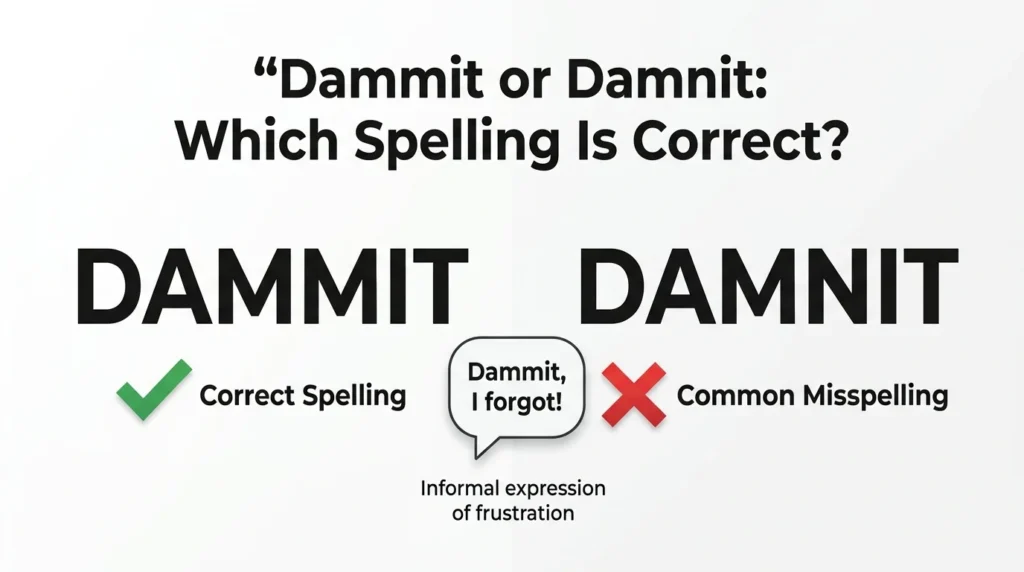
Dammit is the standard spelling of the informal expression used to show frustration or anger. Damnit is a common misspelling, so use dammit when you want the recognized one word form in American English.
Have you ever typed damnit and wondered whether it should actually be dammit? This is a small spelling question, but it comes up often in texts, social media posts, online comments, fiction, and casual American English. The confusion is easy to understand because damnit closely matches the way many people hear the word when it is spoken quickly.
The standard one word spelling is dammit. It is an informal expression that people use when they feel annoyed, frustrated, angry, or disappointed. Because it is also considered mild profanity, the right spelling is only part of the story. You also need to know when the word fits the situation.
This guide explains the difference between dammit and damnit, shows natural examples, covers punctuation and tone, and explains when a cleaner alternative would be better.
Dammit or Damnit: The Basic Difference
The main difference is spelling.
Dammit is the standard one word spelling.
Damnit is a common nonstandard spelling that usually comes from pronunciation.
| Spelling | Status | Meaning |
|---|---|---|
| Dammit | Standard | An informal expression of frustration |
| Damnit | Nonstandard | Usually intended to mean the same thing |
For example:
Dammit, I forgot my wallet.
This is the standard form.
Writing:
Damnit, I forgot my wallet.
will usually be understood, but dammit is the better choice when standard spelling matters.
What Does Dammit Mean?
Dammit is an emotional exclamation.
People use it when something goes wrong or when they suddenly feel frustrated.
For example:
Dammit, I missed the bus.
The speaker is upset about missing the bus.
Another example:
Dammit! My phone is dead.
Here, the word shows immediate frustration.
The expression does not normally add factual information to a sentence. Instead, it tells the reader how the speaker feels.
Why Is Dammit Spelled With Two Ms?
The spelling comes from the expression damn it.
Over time, the phrase developed an informal one word form:
damn it → dammit
The spelling dammit represents the familiar pronunciation and written form of the exclamation.
That is why simply writing the sound as damnit is not the preferred choice.
A useful way to remember it is:
damn it → dammit
The mm helps distinguish the standard spelling from the common misspelling.
Why Do People Write Damnit?
Pronunciation is the main reason.
When someone says dammit quickly, the middle sound can be difficult to hear clearly. To many listeners, it can sound close to damnit.
That creates a natural spelling mistake.
The same thing happens with many English words. People often write what they think they hear instead of the established spelling.
For this word, however, the standard written form is:
dammit
Dammit and Damn It
There are two related forms worth knowing.
Damn it is the original two word expression.
Dammit is the common informal one word spelling.
For example:
Damn it, I forgot the keys.
You may also see:
Dammit, I forgot the keys.
Both express frustration. The important point for the spelling question dammit or damnit is that dammit is the standard one word form.
Is Dammit a Swear Word?
Yes. Dammit is generally considered mild profanity in American English.
Its strength depends on the speaker, setting, and audience. Some people see it as relatively mild, while others may avoid it completely.
Because of that, context matters.
It can appear naturally in casual adult conversation or fictional dialogue. On the other hand, a formal business email is usually not the right place for it.
When Is Dammit Appropriate?
The word can fit informal situations where emotional language is acceptable.
For example:
Dammit, I left my keys in the car.
Dammit! We missed the last train.
Oh, dammit. I made the same mistake again.
These examples sound like natural expressions of frustration.
Still, the audience should guide your choice. A casual message to a close friend has different expectations from an email to a customer.
When Should You Avoid Dammit?
Avoid dammit when your writing needs a formal or highly professional tone.
This includes:
- Job applications
- Business proposals
- Academic essays
- Formal reports
- Customer service emails
- Official documents
- Professional websites
- Workplace messages sent to a broad audience
For instance, this would not be ideal in a customer email:
Dammit, the order was delayed again.
A better version is:
Unfortunately, the order was delayed again.
The second sentence sounds calm and professional.
Dammit in Text Messages
Texting is one of the places where you may see dammit frequently.
For example:
Dammit, I forgot to call you.
My phone died. Dammit.
Dammit! I thought today was Friday.
Because texting is usually informal, the word may fit among friends or family members.
However, texting does not automatically make profanity appropriate. Consider the relationship before sending it.
Dammit in Social Media
Social media has a wide range of language styles.
A personal account might use:
Dammit, I missed the concert!
A professional business account would usually choose something cleaner:
Unfortunately, we missed the opportunity.
Therefore, the spelling can be correct while the usage is still inappropriate for the audience.
That distinction is important for writers.
Dammit in Fiction and Dialogue
Authors often use dammit to make dialogue sound emotional or realistic.
For example:
“Dammit, Mike, you should have told me!”
The word shows that the character is angry or frustrated.
It can also help establish personality. A character who regularly uses strong language may sound different from someone who avoids profanity.
However, good writing uses such expressions with purpose. Repeating the same exclamation in every scene can make dialogue feel forced.
Dammit in American English
Dammit is familiar to American English speakers and appears in informal speech and writing.
You may encounter it in:
- Casual conversations
- Text messages
- Online discussions
- Social media
- Fiction
- Movie dialogue
- Television dialogue
- Personal writing
There is no special American spelling such as damnit. The standard one word form remains dammit.
Is Dammit Used in British English?
Yes. Dammit is also recognized in British English.
However, the important point for an American English article is that the spelling does not change when you move between these varieties.
American English:
dammit
British English:
dammit
So, if you are targeting US readers, dammit remains the correct choice.
Dammit and Tone
The meaning of dammit is closely connected to tone.
Compare these examples:
Dammit, I forgot my keys.
This sounds frustrated.
Dammit!
This sounds like a sudden emotional reaction.
Oh, dammit.
This can sound disappointed or resigned.
The same word can therefore express slightly different emotions depending on the situation.
Punctuation With Dammit
Punctuation can help show how the word functions in a sentence.
When it introduces the sentence, a comma is common:
Dammit, I forgot the appointment.
When it stands alone as a strong exclamation, use an exclamation point:
Dammit!
It can also appear after another phrase:
I forgot the appointment, dammit.
In that example, the word comes at the end and adds emotional emphasis.
Dammit or Damnit in a Sentence
If you are deciding between the two spellings, choose dammit.
Correct:
Dammit, I lost my keys.
Incorrect:
Damnit, I lost my keys.
Correct:
Dammit! The computer crashed.
Incorrect:
Damnit! The computer crashed.
The meaning is usually clear in both versions, but standard writing favors dammit.
Common Mistake: Spelling It by Sound
One of the biggest problems is writing the word exactly as it sounds.
A person may hear:
damnit
and then write:
damnit
However, spelling is not always a direct reflection of pronunciation.
The established spelling is:
dammit
Learning the written form is therefore more reliable than trying to spell it from sound.
Common Mistake: Using It in Formal Writing
Correct spelling does not automatically make a word suitable for every context.
For example:
Dammit, the project failed.
The spelling is correct, but the tone is informal.
A professional version would be:
Unfortunately, the project did not succeed.
Or:
The project produced an unexpected result.
The second options work better in formal communication.
Common Mistake: Confusing Dammit With Damn
The words are related, but they do not always work in exactly the same way.
Damn can function in several grammatical roles.
For example:
Damn, that was close.
It can also describe something:
That was a damn good performance.
Dammit, however, is mainly used as an emotional exclamation.
For example:
Dammit, I forgot again.
Understanding this difference helps you choose the right expression.
Better Alternatives to Dammit
Sometimes you want to show frustration without using profanity.
Here are some options:
Darn it!
Shoot!
Ugh!
Oh no!
What a shame!
That is frustrating.
Unfortunately!
The best option depends on the situation.
For example, shoot can work in casual conversation, while unfortunately is more appropriate in professional writing.
Dammit vs Darn It
Darn it is a softer expression.
Compare:
Dammit, I forgot my wallet.
Darn it, I forgot my wallet.
Both communicate frustration, but the second sounds more polite.
If you are writing for children, families, or a broad audience, darn it may be a better choice.
Dammit vs Shoot
Shoot is another mild alternative.
For example:
Shoot, I missed the deadline.
It communicates disappointment without using the same level of profanity.
Therefore, writers who want casual but cleaner language may prefer shoot.
Dammit vs Ugh
Ugh focuses more on annoyance or disgust.
For example:
Ugh, I have to do this again.
It does not have exactly the same meaning as dammit, but it can serve a similar purpose when the speaker wants to express frustration.
Professional Alternatives
In workplace writing, clarity is usually more useful than emotional language.
Instead of:
Dammit, the file is missing.
write:
Unfortunately, the file is missing.
Instead of:
Dammit, we missed the deadline.
write:
Unfortunately, we missed the deadline.
Instead of:
Dammit, the system is down again.
write:
The system is down again, and we are working to resolve the issue.
These versions sound more professional and solution focused.
Real World Examples
Consider a few everyday situations.
You Forget Your Wallet
Casual:
Dammit, I forgot my wallet.
Polite:
Oh no, I forgot my wallet.
Professional:
Unfortunately, I do not have my wallet with me.
Your Computer Crashes
Casual:
Dammit! My computer crashed.
Polite:
Ugh, my computer crashed.
Professional:
Unfortunately, my computer has stopped working.
You Miss a Deadline
Casual:
Dammit, I missed the deadline.
Professional:
Unfortunately, I missed the deadline. I will submit the work as soon as possible.
These examples show that choosing the right expression is about more than spelling.
How to Remember the Correct Spelling
Use one simple connection:
damn it → dammit
The standard one word form contains two m letters.
Think:
DAMMIT
not:
DAMNIT
If you remember the phrase damn it, the spelling becomes easier to recognize.
Practice Exercise
Choose the correct form in each sentence.
Dammit or Damnit, I forgot my password.
Dammit or Damnit, we missed the bus.
He shouted, Dammit or Damnit!
Dammit or Damnit, my phone stopped working.
She whispered, Dammit or Damnit, after making the mistake.
Exercise Answers
The correct answers are:
Dammit, I forgot my password.
Dammit, we missed the bus.
He shouted, “Dammit!”
Dammit, my phone stopped working.
She whispered, “Dammit,” after making the mistake.
The standard spelling is dammit in every example.
Rewrite the Sentences
Make these sentences more professional.
Dammit, the meeting was canceled.
Dammit, I forgot to attach the file.
Dammit, the customer has not received the order.
Suggested Answers
Unfortunately, the meeting was canceled.
Unfortunately, I forgot to attach the file.
Unfortunately, the customer has not received the order.
This exercise shows an important writing principle: sometimes the best correction is not another swear word. A neutral phrase can communicate the same situation more effectively.
Quick Comparison
| Expression | Tone | Typical Use |
|---|---|---|
| Dammit | Informal and mildly profane | Casual speech and writing |
| Damn it | Informal and mildly profane | Casual speech and writing |
| Darn it | Mild | Casual and family friendly |
| Shoot | Mild | Casual conversation |
| Ugh | Informal | Annoyance or frustration |
| Unfortunately | Professional | Formal and business writing |
Final Tips for Using Dammit Correctly
Remember these points when you encounter dammit or damnit:
- Dammit is the standard one word spelling.
- Damnit is a common misspelling.
- The expression shows frustration, anger, or disappointment.
- It is informal and mildly profane.
- It can work in casual conversation and fictional dialogue.
- Formal writing usually needs a cleaner alternative.
- Damn it is the related two word expression.
- Punctuation can change the emotional effect.
- Always consider your audience before using profanity.
FAQs
Is it dammit or damnit in American English?
Dammit is the standard spelling in American English. Damnit is a common misspelling caused by pronunciation.
How do you spell dammit correctly?
The standard spelling is dammit, with two m letters. A useful memory aid is damn it becomes dammit.
Is damnit an acceptable spelling?
Damnit is widely understood, but it is not the preferred standard spelling. Use dammit when you want the established one word form.
Is dammit considered a swear word?
Yes. Dammit is generally considered mild profanity. Because of this, it may not be suitable for formal or professional communication.
Can I use dammit in a formal email?
It is better to avoid it in a formal email. Words such as unfortunately, sadly, or I am frustrated can communicate the situation more professionally.
Conclusion
When choosing between dammit or damnit, the standard spelling is dammit. The confusion mainly comes from pronunciation because the word can sound similar to damnit when spoken quickly. However, standard written American English uses dammit for the informal exclamation.
The word expresses emotions such as frustration, anger, annoyance, and disappointment. It is common in casual conversations, texts, social media, fiction, and dialogue. At the same time, dammit is considered mild profanity, so context matters. A spelling can be correct while the word itself is still unsuitable for a particular audience.
For professional emails, school assignments, business documents, and formal writing, choose a cleaner expression such as unfortunately, darn it, shoot, or that is frustrating. If you do use the informal word, remember the simple spelling connection: damn it becomes dammit. That will help you avoid the common damnit mistake.