

Quick Answer
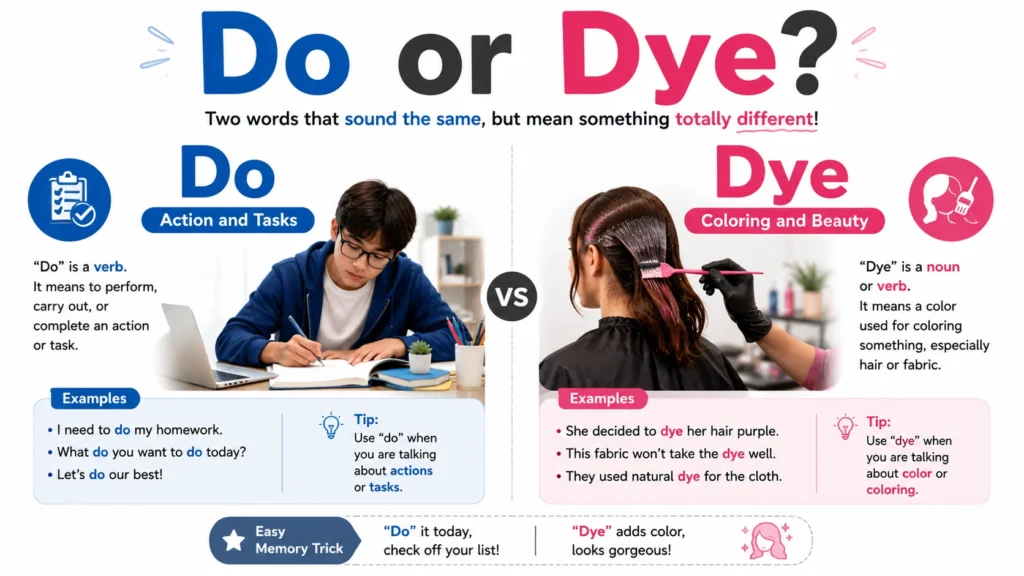
Do and dye are two completely different words with different meanings and uses. Do is a verb that means to perform an action or complete a task, while dye refers to a substance used to change the color of hair, fabric, or other materials.
Although the words sound similar, they are never interchangeable in writing.
Many English learners and writers get confused about do or dye because the words sound alike when spoken quickly. However, their meanings are completely different. One relates to action and work, while the other relates to color and coloring materials.
The word do is one of the most common verbs in the English language. People use it every day in sentences about tasks, activities, work, and responsibilities. In contrast, dye is a noun or verb connected with changing color. It is commonly used for hair dye, fabric dye, and art projects.
Understanding do or dye is important for students, bloggers, professionals, and anyone learning English grammar. Using the wrong word can completely change the meaning of a sentence. For example, saying “I need to dye my homework” sounds funny because homework is completed, not colored.
This guide explains everything about do or dye in simple language. You will learn definitions, grammar rules, pronunciation, examples, comparisons, common mistakes, real world usage, exercises with answers, and professional writing tips.
Quick Overview
Do means to perform an action or task.
Dye means to color something.
Do is mainly used as a verb.
Dye can be both a noun and a verb.
Both words sound similar but have very different meanings.
Key Difference Between Do or Dye


4
The main difference is meaning and usage.
Do relates to actions and activities.
Dye relates to coloring materials and color change.
For example:
I need to do my homework.
She wants to dye her hair blue.
Comparison Table
| Feature | Do | Dye |
|---|---|---|
| Meaning | Perform an action | Change color |
| Part of speech | Verb | Noun and verb |
| Common use | Work and tasks | Hair and fabric coloring |
| Example | Do your job | Dye your shirt |
| Topic category | Action | Color |
Definition of Do
The word do means to perform, complete, or carry out an action. It is one of the most frequently used verbs in English.
People use do in questions, commands, work related tasks, and daily conversations.
Examples of Do
- Do your homework
- Do the dishes
- Do your best
- Do exercise regularly
In grammar, do also works as a helping verb.
For example:
Do you like coffee
I do not understand
Definition of Dye
Dye refers to a substance used for coloring materials such as hair, fabric, paper, or leather. It can also mean the act of changing color.
Examples of Dye
- Hair dye
- Fabric dye
- Dye the curtain blue
- She dyed her hair red
Dye is common in beauty, fashion, and textile industries.
Understanding Pronunciation Differences
Do and dye sound somewhat similar, but their pronunciation is different.
Pronunciation of Do
Do sounds like “doo.”
Pronunciation of Dye
Dye sounds like “die.”
Because of this, confusion usually happens more in spelling than pronunciation.
Grammar Rules for Do
The word do has many grammar functions.
Main Verb Usage
Do your work carefully.
They do exercise every morning.
Helping Verb Usage
Do you understand the lesson
I do not agree
Emphasis Usage
I do want to help you.
In these examples, do supports the sentence structure.
Grammar Rules for Dye
Dye mainly functions as a noun or action verb related to color.
Noun Usage
This hair dye looks natural.
Verb Usage
She wants to dye her dress green.
Unlike do, dye is not used as a helping verb.
Common Situations Where People Use Do
People use do in many areas of life.
School
- Do homework
- Do assignments
Work
- Do projects
- Do office tasks
Health
- Do exercise
- Do yoga
Home
- Do laundry
- Do cleaning
The word do is extremely flexible in English.
Common Situations Where People Use Dye
Dye is mainly used in coloring related situations.
Beauty Industry
- Hair dye
- Beard dye
Fashion
- Dye clothes
- Tie dye shirts
Art and Crafts
- Fabric dye
- Paint dye materials
Manufacturing
- Leather dye
- Textile dye
Real World Examples of Do or Dye
Example One Homework
Correct sentence
I need to do my homework tonight.
Incorrect sentence
I need to dye my homework tonight.
Example Two Hair Coloring
Correct sentence
She wants to dye her hair brown.
Incorrect sentence
She wants to do her hair brown.
Example Three Fabric Coloring
The company uses natural dye for clothes.
Example Four Daily Tasks
Parents teach children to do chores at home.
Why Do People Confuse Do or Dye
Several reasons cause confusion.
Similar Sound
The words sound somewhat alike in fast speech.
Spelling Mistakes
Writers sometimes type quickly and choose the wrong word.
English Learning Challenges
Non native speakers may confuse action verbs with similar sounding words.
Common Mistakes in Do or Dye


4
Mistake One Using Dye for Tasks
Incorrect
Please dye your homework.
Correct
Please do your homework.
Mistake Two Using Do for Coloring
Incorrect
I will do my hair red.
Correct
I will dye my hair red.
Mistake Three Confusing Pronunciation
Some learners pronounce do like dye. However, their sounds are different.
Advantages of Learning the Difference
Understanding do or dye improves communication.
Better Writing
Correct word choice improves clarity.
Professional Communication
Mistakes decrease in emails and reports.
Academic Improvement
Students avoid grammar errors.
Better English Fluency
Correct vocabulary increases confidence.
Related Word Comparisons
Do vs Make
Do relates to actions.
Make relates to creating something.
Dye vs Die
Dye means coloring substance.
Die means to stop living.
Do vs Act
Both relate to actions, but act often refers to behavior or performance.
Historical Background of the Word Do
The word do comes from Old English. It has been used for hundreds of years in everyday speech and grammar.
Over time, do became one of the most important helper verbs in English.
Examples include:
Do not go
Do you know
I do agree
Because of its flexibility, English speakers use do constantly.
Historical Background of the Word Dye
The word dye has roots connected with coloring materials and textiles. Ancient civilizations used natural dye from plants, insects, and minerals.
People used dye for:
- Clothing
- Art
- Decoration
- Cultural traditions
Today, synthetic dyes dominate modern industries.
Beginner to Advanced Understanding
Beginner Level
Do means action.
Dye means coloring.
Intermediate Level
Do functions as both a main verb and helping verb. Dye functions mainly in coloring contexts.
Advanced Level
The word do plays a major role in English grammar structures, while dye belongs mostly to descriptive and industrial vocabulary.
Regional and Global Usage
English speakers worldwide use do daily. It exists in almost every type of sentence.
Meanwhile, dye is more specialized and appears often in:
- Beauty industries
- Fashion industries
- Textile production
British and American English use both words similarly.
Do in Questions and Negatives
One important grammar role of do is question formation.
Questions
Do you like music
Do they play football
Negatives
I do not agree
She does not understand
This makes do essential in English grammar.
Dye in Fashion and Beauty Trends


4
Dye plays an important role in beauty and fashion industries.
Popular uses include:
- Hair coloring
- Tie dye fashion
- Textile coloring
- Artistic design
Modern trends constantly introduce new dye styles and colors.
Professional Writing Tips
Use Context Carefully
If the sentence involves tasks or actions, use do.
If the sentence involves color changes, use dye.
Read Sentences Aloud
Reading aloud helps identify incorrect word choice.
Use Spell Check Carefully
Spell check may not catch word confusion because both are correct English words.
Educational Importance of Do or Dye
Teachers often explain do or dye to improve vocabulary and grammar accuracy.
Correct usage helps students:
- Write clearly
- Avoid embarrassing mistakes
- Improve exam performance
Grammar understanding also supports professional communication later in life.
Cultural Importance of Dye
Dye has historical and cultural value around the world.
Examples include:
- Traditional clothing colors
- Cultural textile art
- Religious garments
- Festival decorations
Natural dyes were once highly valuable in trade and fashion.
Technology and Modern Usage
Modern industries use advanced dye technology for:
- Clothing production
- Printing
- Hair products
- Art supplies
Meanwhile, the word do remains central in digital communication and language learning systems.
Exercises With Answers
Question One
Which word means to perform an action
Answer Do
Question Two
Which word relates to coloring hair
Answer Dye
Question Three
Choose the correct sentence
A I need to do my homework
B I need to dye my homework
Answer A
Question Four
Which word can be used as a helping verb
Answer Do
Question Five
Which industry commonly uses dye
Answer Fashion and beauty industry
Practice Sentences
Fill in the blanks.
- She wants to ___ her hair purple.
Answer Dye - Please ___ your work carefully.
Answer Do - They bought natural fabric ___.
Answer Dye - I always ___ my best in exams.
Answer Do
FAQs
What is the difference between do or dye?
Do means to perform an action, while dye means to color something.
Can do and dye be used interchangeably?
No, they have completely different meanings.
What does dye mean in beauty products?
Dye refers to coloring substances used for hair or cosmetics.
Why do people confuse do or dye?
Because the words sound somewhat similar in speech.
Is do a helping verb?
Yes, do works as both a main verb and helping verb.
Can dye be a noun and a verb?
Yes, dye can describe both the coloring substance and the coloring action.
Which word should I use for homework?
Use do because homework is a task.
Which word should I use for hair coloring?
Use dye because hair color changes involve dye.
Does spell check catch do or dye mistakes?
Not always, because both are valid words.
Why is learning do or dye important?
It improves grammar, writing clarity, and communication skills.
Conclusion
Understanding do or dye is important for clear and accurate English communication. Although the words may sound similar, their meanings are completely different. Do refers to actions, tasks, and activities, while dye relates to coloring materials and color changes.
Using the correct word improves grammar, writing quality, and professional communication. Students, writers, and English learners benefit greatly from understanding this difference. For example, people do homework, but they dye hair or fabric.
The easiest way to remember the difference is simple. If the sentence involves action, use do. If the sentence involves color, use dye.
By practicing examples and understanding context, anyone can master the correct usage of do or dye confidently.