
Quick Answer
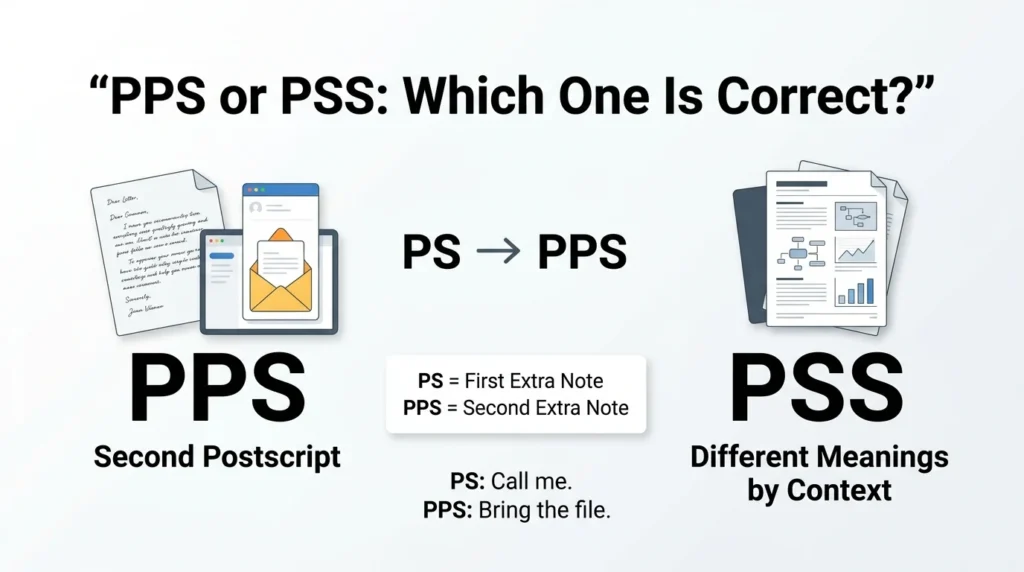
PPS is the correct abbreviation when you want to add a second postscript after a PS in a letter or message. PSS can have other meanings in different fields, so do not use it as a replacement for PPS when you mean a second postscript.
The abbreviations PPS or PSS can look almost identical, but they do not always mean the same thing. This small spelling difference can cause confusion when you write an email, letter, text message, or professional note. If you have ever wondered whether a second postscript should be written as PPS or PSS, the answer is simple: use PPS. The abbreviation follows PS, which means postscript. For example, you can write a PS to add one final thought, then use PPS when another thought comes to mind. However, PSS is a separate abbreviation that may have different meanings depending on the subject or industry. That is why context matters. Learning the basic difference will help you avoid an easy mistake and make your writing look more polished. In this guide, you will learn what PPS and PSS mean, how to use them correctly, when PPS is appropriate, why PSS can mean something different, and how American English speakers commonly use these abbreviations.
What Is the Difference Between PPS and PSS?
The simplest distinction is this:
PPS is commonly used for a second postscript.
PSS is an abbreviation that can have different meanings depending on the context.
A postscript is an extra note placed after the main message.
For example:
PS: Please call me tonight.
If you add another note afterward:
PPS: Please bring the documents.
That is the normal use of PPS.
| Abbreviation | Common meaning | Example |
|---|---|---|
| PS | Postscript | PS: Call me later. |
| PPS | Second postscript | PPS: Bring the file too. |
| PSS | Various meanings depending on context | Defined by the subject or field |
Therefore, if your question is specifically about a second postscript, PPS is the correct choice.
What Does PS Mean?
Before understanding PPS, it helps to understand PS.
PS stands for postscript.
A postscript is an additional thought written after the main part of a letter or message.
For example:
Dear Mike,
Thank you for your help with the project. I really appreciate your time.
Best,
John
PS: Please send me the final document.
The PS comes after the main message.
It is useful when you remember something after finishing your writing.
What Does PPS Mean?
PPS is traditionally used for a second postscript.
Suppose you have already written:
PS: Please send me the report.
Then you remember another detail:
PPS: Please include the updated figures.
The second note can be introduced with PPS.
Think of the sequence like this:
PS → first additional note
PPS → second additional note
PPPS → third additional note
The important point is that PPS comes after PS.
Why Is PPS Used Instead of PSS?
The abbreviation comes from the idea of adding another postscript.
PS represents postscript.
When another postscript is added, PPS is traditionally used.
That gives you:
PS
then
PPS
The extra P helps show that you are adding another postscript.
You should not change the final letter from S to create PSS.
What Does PSS Mean?
Unlike PPS, PSS does not have one single meaning in everyday English.
It can be used as an abbreviation for different terms in different areas.
For example, a specific organization, technical system, academic subject, or professional field may define PSS in its own way.
As a result, the meaning of PSS depends on context.
This is important because PSS is not simply another spelling of PPS.
If you are writing a second postscript, use PPS.
PPS or PSS for a Second Postscript?
Use PPS.
Here is a simple example:
PS: Thank you for your help.
PPS: I also appreciate your advice.
That is correct.
This version is not appropriate when the intended meaning is a second postscript:
PS: Thank you for your help.
PSS: I also appreciate your advice.
For this purpose, PPS is the better choice.
PPS in American English
American English follows the same basic rule.
When an American English writer wants to add a second postscript, PPS is the standard form.
For example:
PS: I enjoyed talking with you.
PPS: Let me know when you are free again.
You may see PPS in personal letters, casual emails, newsletters, and friendly messages.
The abbreviation is easy for most readers to understand when it follows a PS.
How to Use PPS in an Email
PPS can be used in an email when you remember an extra detail after completing the message.
For example:
Hi Sarah,
Thanks for sending the information. I reviewed everything and will get back to you tomorrow.
Best,
Alex
PS: Please send the updated schedule.
PPS: I also need the contact information for the new team member.
The PS adds one extra thought.
The PPS adds another.
However, there is an important writing tip to remember. If the information is essential, put it in the main body of the email instead of hiding it in a postscript.
PPS in a Personal Letter
PPS is especially natural in personal writing.
For example:
Dear Emma,
It was great seeing you last weekend. I hope we can meet again soon.
Take care,
Lisa
PS: Please send me the photos from the trip.
PPS: I still have your book.
This style feels informal and personal.
A PPS can also make a letter sound more conversational because it suggests that the writer remembered one more thing after finishing.
PPS in Text Messages
You can use PPS in a text message, although it is not necessary.
For example:
Thanks for helping me today!
PS: Don’t forget your jacket.
PPS: Bring your charger too.
This is easy to understand.
Still, most people would simply add the extra information to the original message.
Therefore, PPS is more of a writing style choice in casual messages.
PPS in Social Media Posts
PPS sometimes appears in social media captions or promotional writing.
For example:
Thanks to everyone who joined us today.
PS: More photos are coming soon.
PPS: The next event is already being planned.
This can work when the writer wants to add a final thought.
For a short social post, however, PPS may not be necessary.
PPS in Business Communication
You can use PPS in business communication, but professional writers should use it carefully.
For example:
PS: Please review the attached document.
PPS: I have also included the updated price list.
This is understandable.
However, if the price list is important, it would be better to mention it directly in the main message.
Important details should be easy to find.
A postscript is better for small additional information.
When Should You Use PPS?
PPS is useful when:
- You already used PS.
- You remember another small detail.
- The additional information is not central to the message.
- You are writing casually or personally.
- You want to add a final thought after the main message.
For example:
PS: I will call you tomorrow.
PPS: Please remind me about the appointment.
That is a natural use of PPS.
When Should You Avoid PPS?
PPS is not ideal for important information.
Suppose an email says:
PS: The meeting is tomorrow.
If the meeting is important, this information should appear in the main message.
A clearer approach would be:
The meeting is scheduled for tomorrow at 10 a.m.
This makes the information much easier to notice.
The same rule applies to deadlines, payment instructions, important dates, and major requests.
Can You Use PPS Without PS?
Traditionally, PPS follows PS.
Therefore, if you have only one additional thought, use PS.
For example:
PS: Please bring your ID.
If you have another thought after that:
PPS: Please bring your ticket too.
Using PPS without a previous PS may confuse readers because they may wonder where the first postscript went.
Can You Use PPPS?
Yes.
If you add a third postscript, you may see PPPS.
For example:
PS: Bring your passport.
PPS: Bring your charger.
PPPS: Call me when you arrive.
The pattern is easy to understand.
However, using several postscripts can make a message look cluttered.
If you have many additional details, rewrite the message and place the information in the main body.
PPS vs PS
The difference is straightforward.
| Feature | PS | PPS |
|---|---|---|
| Full idea | Postscript | Second postscript |
| Position | First extra note | Extra note after PS |
| Common use | Letters and messages | Letters and messages |
| Example | PS: Call me. | PPS: Bring the file. |
Remember:
One extra note = PS
A second extra note = PPS
PPS vs PSS
| Feature | PPS | PSS |
|---|---|---|
| Used for a second postscript | Yes | No |
| Common in personal writing | Yes | Not for this purpose |
| Has one fixed everyday meaning | Generally, yes | No |
| Can have specialized meanings | Sometimes | Yes |
| Correct after PS | Yes | No, when meaning second postscript |
This is the key comparison.
If you mean a second postscript, choose PPS.
Common Mistake: PSS Instead of PPS
One of the most common mistakes is writing:
PS: Thanks for your help.
PSS: I also appreciate your advice.
The better version is:
PS: Thanks for your help.
PPS: I also appreciate your advice.
The reason is simple. PPS is the traditional abbreviation for a second postscript.
Common Mistake: PPS as the First Postscript
Another mistake is starting with PPS.
For example:
PPS: Thanks for your message.
If this is your first extra note, use:
PS: Thanks for your message.
PPS suggests that another postscript already appeared.
Common Mistake: Confusing PSS With a Typo
PSS is not always a typo.
That is important.
If you see PSS in a technical document, it may represent a legitimate term or organization.
The correct interpretation depends on the context.
Therefore, do not automatically “correct” every PSS to PPS.
Instead, ask what the abbreviation means in that particular document.
Common Mistake: Adding Too Many Postscripts
Consider this example:
PS: Bring the report.
PPS: Bring your laptop.
PPPS: Bring your ID.
PPPPS: Bring the presentation.
The reader can understand the message, but the structure is becoming difficult to follow.
A better version would place all important information in the main message.
That approach is cleaner and more professional.
PPS and Formal Writing
PPS is not wrong in formal writing, but it may not always be the best choice.
Formal documents usually benefit from a clear structure.
Instead of adding several postscripts, organize the information in the body.
For example, a business email can list important actions in separate sentences or bullet points.
A PPS can still work for a minor final note.
PPS and Informal Writing
PPS works especially well in casual communication.
You might use it in:
- Personal letters
- Friendly emails
- Greeting cards
- Casual newsletters
- Personal messages
For example:
PS: I hope you have a great weekend.
PPS: Don’t forget to send me those photos!
The style is friendly and natural.
Examples of Correct PPS Usage
PS: Please call me tonight.
PPS: Bring the documents.
PS: Thanks for the invitation.
PPS: I will bring dessert.
PS: The package arrived.
PPS: It is at the front desk.
PS: Good luck with your interview.
PPS: Let me know how it goes.
PS: I enjoyed the trip.
PPS: We should do it again soon.
Each example uses PPS after a PS.
Examples of Correct PSS Usage
Because PSS can represent different terms, there is no single general sentence pattern for it.
Instead, you should identify what PSS means in the specific context.
For example, a technical document may define PSS at the beginning and then use the abbreviation throughout the document.
The important rule is this:
Do not use PSS simply because you think it means a second postscript.
How to Remember PPS or PSS
Use this simple memory rule:
PS comes first. PPS comes next.
You can remember the sequence as:
PS → PPS
If you only have one extra thought, use PS.
If you add another extra thought after that, use PPS.
For example:
PS: Call me later.
PPS: Send me the address.
This simple pattern solves most everyday PPS or PSS questions.
A Quick Test
When you are unsure, ask yourself:
Am I adding a second note after a PS?
If the answer is yes, choose:
PPS
If you are referring to a specific term, system, organization, or concept called PSS, then PSS may be correct.
This test works because the meaning determines the abbreviation.
Practice Exercise
Choose the correct abbreviation.
Question One
You have written one additional note after your letter.
Answer: PS
Question Two
You already wrote a PS and now want to add another note.
Answer: PPS
Question Three
Your technical document defines a specific term as PSS.
Answer: PSS
Question Four
You want to add a third postscript.
Answer: PPPS
Fill in the Blanks
Choose PS, PPS, or PSS.
- ______: Please call me when you arrive.
- ______: Also remember to bring your passport.
- A technical document uses ______ as its official abbreviation.
- You have one final thought after finishing your letter. Use ______.
Answers
- PS
- PPS
- PSS
- PS
Correct These Sentences
Example One
PSS: Please send me the file too.
If this is a second postscript, correct it to:
PPS: Please send me the file too.
Example Two
PPS: Thanks for your help.
If this is the first additional note, use:
PS: Thanks for your help.
Example Three
PS: Call me tonight.
PPS: Bring your ID.
This is correct.
Example Four
PS: Call me tonight.
PSS: Bring your ID.
If the second line is intended as another postscript, change PSS to PPS.
PPS or PSS in Online Searches
When searching for PPS or PSS, you may find different meanings for PSS because the abbreviation is used across many fields.
That does not mean the basic writing rule has changed.
If your search intent is:
“How do I write a second postscript?”
The answer is:
PPS
If your search intent is about a specialized term abbreviated as PSS, then you need to follow the definition used in that field.
Context is the deciding factor.
PPS or PSS for Emails: Which Is Better?
For a second postscript in an email, PPS is better.
For example:
PS: Thank you for reviewing the document.
PPS: I also attached the updated version.
However, if the updated version is important, it would be better to mention it in the main email.
That makes the message easier to scan.
PPS or PSS for Letters: Which Is Better?
For a second postscript in a letter, use PPS.
Example:
PS: I hope you are feeling better.
PPS: Please call me when you have time.
This is a traditional and recognizable use of PPS.
PPS or PSS for Texting: Which Is Better?
If you want to use a second postscript in a text message, PPS is the appropriate form.
Still, texting is usually short and direct.
You may find it more natural to simply add the second thought as another sentence.
For example:
Thanks! Also, don’t forget your charger.
This is often clearer than using PS and PPS.
PPS or PSS for Social Media: Which Is Better?
For a second postscript in social media writing, use PPS.
For example:
PS: Thanks for joining us.
PPS: More updates are coming soon.
However, social media posts often work better when the important information appears directly in the main text.
Why Correct Abbreviations Matter
Small errors can affect how professional your writing looks.
Writing PSS when you mean PPS may not stop readers from understanding you, but it can make the writing appear less polished.
The same principle applies to many common English abbreviations.
Using the established form helps readers understand your message quickly.
FAQs
Is PPS or PSS correct for a second postscript?
PPS is correct for a second postscript. PSS can have other meanings and should not be used as a replacement for PPS in this context.
What does PPS mean in an email?
PPS usually introduces a second postscript in an email. It comes after a PS and adds another final thought.
What is the difference between PS and PPS?
PS is used for the first additional note, while PPS is used for another note after the PS.
Can PPS be used without PS?
It is better to use PS when you have only one extra note. PPS traditionally follows a PS.
Is PSS always wrong?
No. PSS can be a correct abbreviation for different terms in specific fields. It is only incorrect when you use it to mean a second postscript.
Conclusion
The difference between PPS and PSS is easy once you understand the purpose behind each abbreviation. When you are adding a second postscript after a PS, PPS is the correct choice. For example, you can write, “PS: Please call me. PPS: Bring the documents.” The order is simple: PS first, PPS second.
PSS is different. It can represent various terms depending on the subject, industry, or document. Therefore, you should not automatically treat PSS as a spelling variation of PPS. If you are writing a personal letter, casual email, or message and want to add another thought after a PS, choose PPS.
For professional communication, keep important information in the main body instead of placing it in a postscript. A PS or PPS works best for small extra details. Also, avoid using too many postscripts because they can make a message harder to follow. Most importantly, remember the simple rule: one extra note is PS, and a second extra note is PPS. With this rule in mind, you can confidently choose the right form whenever you come across PPS or PSS.