

Quick Answer
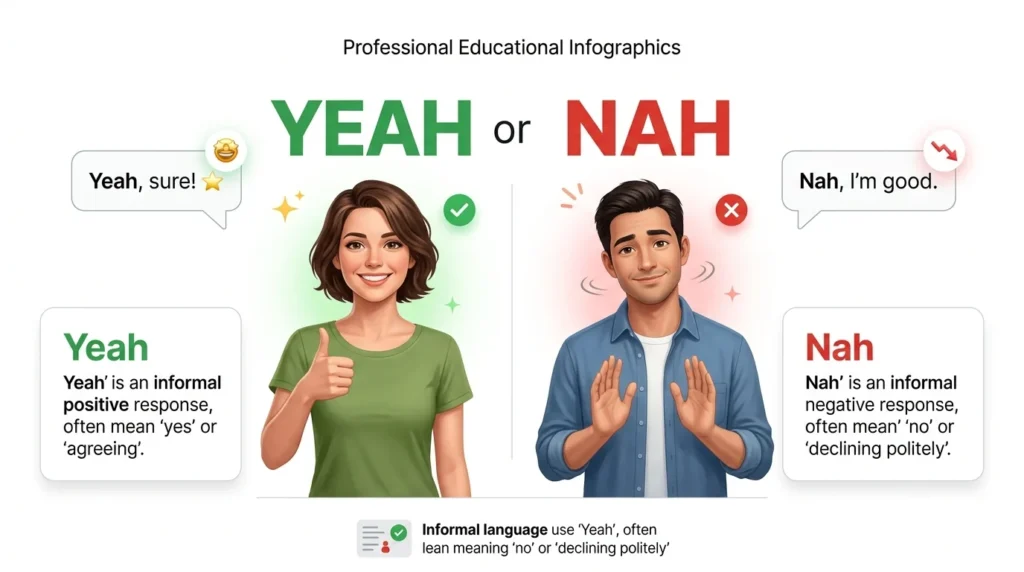
Yeah is an informal way to say yes, while nah is an informal way to say no. Both words are common in casual American conversations, texting, social media, and friendly messages.
If you spend time reading texts, comments, social media posts, or casual conversations, you have probably seen yeah and nah many times. These short words are easy to understand, but their tone can change depending on the situation.
Yeah usually expresses agreement or a positive answer. Nah usually expresses disagreement or a negative answer. However, neither word sounds as formal as yes or no.
For example, a friend might ask, “Are you coming with us?” You could simply reply, “Yeah.” If you do not want to go, “Nah” works naturally. In everyday American speech, these words can make a conversation sound relaxed and friendly.
Still, knowing when to use them matters. A casual text to a friend is different from a job interview, school assignment, or formal email.
What Does Yeah Mean?
Yeah is an informal word that means yes.
People use it to agree with someone, answer a question, confirm information, or show that they understand something.
Here are some simple examples:
- “Are you ready?” — “Yeah.”
- “Do you want pizza?” — “Yeah, sure.”
- “You finished the project?” — “Yeah, I did.”
- “Is this your phone?” — “Yeah.”
Yeah is extremely common in everyday American conversation.
It often sounds more relaxed than yes. In many casual situations, native speakers naturally choose “yeah” without thinking about it.
What Does Nah Mean?
Nah is an informal way to say no.
It usually shows disagreement, refusal, or a negative answer.
For example:
- “Do you want coffee?” — “Nah.”
- “Are you going out tonight?” — “Nah, I’m staying home.”
- “Did you buy the tickets?” — “Nah.”
- “Want another slice?” — “Nah, I’m good.”
The word is casual and conversational. It is especially common among friends, family members, and people having relaxed conversations.
Depending on the speaker’s tone, nah can sound gentle, firm, playful, or dismissive.
Yeah vs Nah
The basic difference is very simple:
| Word | Meaning | Common use |
|---|---|---|
| Yeah | Yes | Agreement or positive answer |
| Nah | No | Disagreement or negative answer |
Think of the pair this way:
Yeah = yes
Nah = no
The main difference is not grammar. It is meaning and tone.
Yeah gives a positive response, while nah gives a negative response.
Yeah and Nah in Everyday Conversations
These words are especially useful in short conversations.
Imagine a friend asks:
“Are you hungry?”
You can answer:
“Yeah.”
If you are not hungry, you can say:
“Nah.”
The conversation feels natural because both responses are short and informal.
Here is another example:
“Did you watch the game last night?”
“Yeah, it was great.”
Or:
“Nah, I missed it.”
In spoken English, these responses are very common.
Is Yeah the Same as Yes?
Not exactly in tone, although they usually have the same basic meaning.
Yes is more neutral and can work in both formal and informal situations. Yeah is more casual.
Compare these examples:
Formal:
“Yes, I understand.”
Casual:
“Yeah, I understand.”
Both sentences communicate agreement. However, the second one sounds more relaxed.
For a professional email, official document, interview, or formal presentation, yes is usually the safer choice.
For a conversation with friends, yeah is completely natural.
Is Nah the Same as No?
Nah generally means no, but it is much more informal.
Compare:
No, thank you.
Nah, I’m good.
The first response can work in almost any situation. The second sounds relaxed and conversational.
That difference is important.
If your manager asks whether you completed an important task, saying “No” is appropriate. Saying “Nah” could sound too casual.
On the other hand, if a friend asks whether you want another burger, “Nah, I’m full” sounds perfectly natural.
Yeah in Text Messages
Yeah is extremely common in texting.
People often use it as a quick response when they want to confirm something.
For example:
“Are you still coming?”
“Yeah.”
“Can you bring some snacks?”
“Yeah, no problem.”
“Did Sarah call you?”
“Yeah, earlier.”
Texting often favors short words. Because of that, yeah appears frequently in casual messages.
You may also see forms such as yeahhh or yeaaah online. These are informal spellings used to show emotion or emphasis. They are not appropriate for formal writing.
Nah in Text Messages
Nah works in texting in much the same way.
For example:
“Want to go out tonight?”
“Nah, I’m tired.”
“Did you order it?”
“Nah, not yet.”
“Are you worried?”
“Nah, it’ll be fine.”
Because texting is usually informal, nah fits naturally into many conversations.
Still, the exact tone depends on context. A short “Nah.” can sometimes sound blunt. Adding a few words can make the response warmer.
For example:
“Want to come?”
“Nah, thanks. Maybe next time.”
That sounds more friendly than simply saying “Nah.”
Yeah and Nah on Social Media
You will often see both words in comments, captions, memes, and casual posts.
Someone might ask:
“Would you try this?”
A person could comment:
“Yeah!”
Another person might write:
“Nah, not for me.”
These words work well online because they are short and easy to understand.
Social media also encourages playful language. As a result, you may see exaggerated versions such as “yeaaaah” or “nahhh.”
These forms are mainly stylistic. They should not be treated as standard formal English.
When Should You Use Yeah?
Use yeah when you are having an informal conversation and want to express agreement or give a positive answer.
Good situations include:
- Talking with friends
- Texting
- Casual conversations
- Social media
- Chatting with family
- Informal online discussions
For example:
“Are you free later?”
“Yeah, I am.”
“Do you like this song?”
“Yeah, it’s good.”
“Did you understand the lesson?”
“Yeah, mostly.”
These examples sound natural because the setting is casual.
When Should You Use Nah?
Use nah when you want to give a casual negative response.
It works well when talking with:
- Friends
- Family
- Close coworkers
- People in casual settings
- Online communities
For example:
“Want to watch another movie?”
“Nah, I’m tired.”
“Are you buying those shoes?”
“Nah, they’re too expensive.”
“Do you need help?”
“Nah, I’m okay.”
The word is informal, so consider the relationship and setting before using it.
When Should You Avoid Yeah and Nah?
Avoid these words when you need highly formal language.
For example, you may want to use yes instead of yeah in:
- Formal business writing
- Academic papers
- Job applications
- Official documents
- Professional presentations
- Formal interviews
Likewise, no is usually better than nah in formal situations.
Instead of writing:
“Nah, I don’t agree.”
A professional response could be:
“No, I do not agree.”
The second version sounds more appropriate in formal writing.
Yeah, Yep, Yup, and Yes
English has several informal ways to express agreement.
Yes is the standard and most flexible choice.
Yeah is very common and conversational.
Yep is also informal and often sounds brief or friendly.
Yup is another casual form that can have a slightly different personal or regional feel.
For example:
“Are you coming?”
“Yes.”
“Yeah.”
“Yep.”
“Yup.”
All four can communicate agreement, but their tone is different.
Among these choices, yes remains the best option when you want to sound neutral or formal.
Nah, Nope, and No
The same idea applies to negative answers.
No is standard and works in formal and informal settings.
Nah is casual.
Nope is also informal and often sounds more definite or playful.
For example:
“Are you hungry?”
“No.”
“Nah.”
“Nope.”
The meaning is similar, but the tone changes.
“Nah” can sound relaxed.
“Nope” can sound more emphatic.
“No” is the safest neutral choice.
Common Mistakes With Yeah or Nah
One common mistake is treating informal words as if they belong in every situation.
For example, writing “Nah” in a formal business report would not be a good choice.
Another mistake is assuming that yeah and nah are incorrect English. They are established informal words used widely in everyday communication.
The issue is not whether they are real words. The issue is where and how you use them.
A third mistake is confusing spelling with pronunciation. Informal speech often has variations, but standard writing should use the conventional spellings yeah and nah.
Yeah or Nah: Example Sentences
Here are more examples to show how naturally these words appear in conversation.
Examples With Yeah
- “Yeah, I can help you.”
- “Yeah, that sounds good.”
- “Yeah, I remember him.”
- “Yeah, you’re right.”
- “Yeah, let’s go.”
- “Yeah, I already finished it.”
Examples With Nah
- “Nah, I’m not interested.”
- “Nah, I don’t think so.”
- “Nah, maybe tomorrow.”
- “Nah, I already ate.”
- “Nah, that’s okay.”
- “Nah, I haven’t seen it.”
These examples show that both words can appear alone or as part of a longer sentence.
Yeah or Nah in American Conversation
In the United States, yeah is one of the most common informal ways to say yes.
Nah is also widely understood and commonly used in casual speech.
However, American speakers do not use these words only as simple yes or no answers. Tone and context can add extra meaning.
For instance:
“Yeah…”
could show hesitation rather than strong agreement.
Likewise:
“Nah…”
could sound gentle instead of completely rejecting an idea.
A speaker’s voice, facial expression, and surrounding words often help listeners understand the intended meaning.
Why Tone Matters
The same word can feel different depending on how it is said.
Imagine someone asks:
“Do you want to come with us?”
If you say:
“Yeah!”
you sound excited.
If you say:
“Yeah…”
you may sound uncertain or uninterested.
The same thing happens with nah.
“Nah!”
can sound firm.
“Nah, I’m good.”
usually sounds friendly.
“Nah…”
could suggest hesitation.
Therefore, learning these words is not only about vocabulary. It is also about understanding conversational tone.
Practice: Choose Yeah or Nah
Try choosing the word that best completes each sentence.
- “Do you want some ice cream?” — “____, please!”
- “Are you going to the party?” — “____, I’m staying home.”
- “Did you finish your homework?” — “____, I finished it.”
- “Want another cup of coffee?” — “____, I’m fine.”
- “Do you like this movie?” — “____, it’s really good.”
Answers
- Yeah
- Nah
- Yeah
- Nah
- Yeah
The pattern is simple: use yeah for agreement and nah for a casual negative response.
Quick Comparison With Formal English
If you are unsure which word to choose, consider the setting.
| Casual | Neutral or Formal |
|---|---|
| Yeah | Yes |
| Nah | No |
For a text message to a friend, casual words are fine.
For a formal email, neutral words are usually better.
This simple distinction can help you avoid awkward wording.
Frequently Asked Questions
Is yeah a correct English word?
Yes. Yeah is a widely used informal word meaning yes. It is especially common in everyday speech, texting, and casual conversation.
Is nah a correct English word?
Yes. Nah is an informal word meaning no. It is common in casual conversations and online communication.
Is yeah more common than yah?
Yes. Yeah is the standard and much more common informal spelling. Yah exists in some uses and dialects, but it is not the usual spelling when you simply mean casual yes.
Can I use yeah and nah in formal writing?
It is usually better to use yes and no in formal writing. Yeah and nah are conversational and may sound too casual in professional or academic contexts.
What is the easiest way to remember yeah and nah?
Remember the simple pair: yeah means yes, and nah means no. Then think about the setting. Use them freely in casual conversation, but choose yes and no when you need a more formal tone.
Conclusion
Yeah and nah are simple, useful words that appear often in casual American conversation. Yeah means yes and normally shows agreement, confirmation, or a positive response. Nah means no and usually expresses disagreement, refusal, or a negative response.
The biggest difference is their tone. Both are informal, so they work especially well in conversations, texts, messages, and social media. For formal emails, academic writing, and professional situations, yes and no are better choices.
Once you understand this small difference, choosing between yeah and nah becomes easy. Just remember the basic rule: yeah is a casual yes, while nah is a casual no.