

Quick Answer
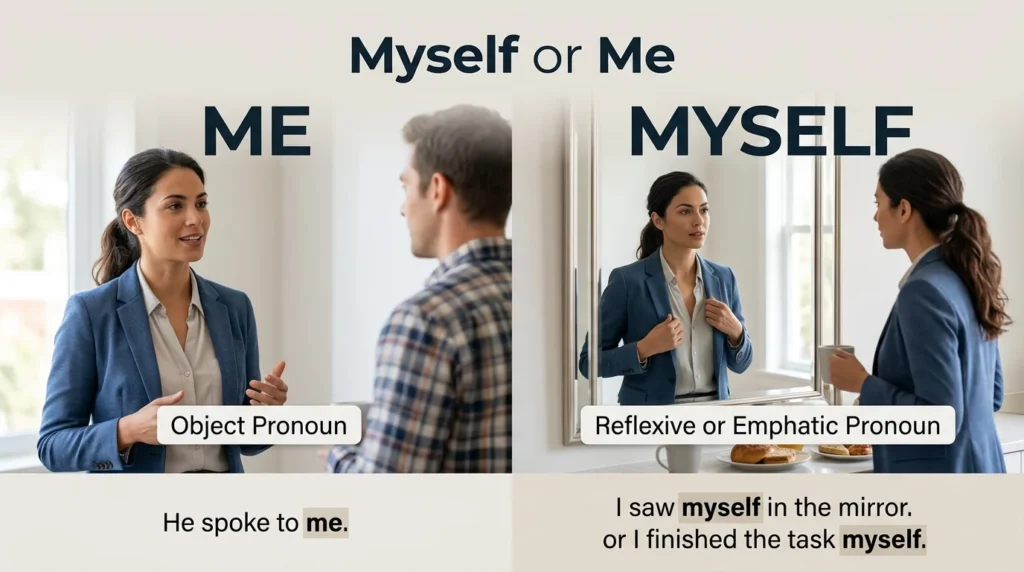
Me is the correct pronoun when you are the object of a verb or preposition. Myself is a reflexive pronoun used when the subject and object are the same person, or for emphasis.
“Myself” and “me” are both correct English words, but they do not serve the same purpose. Many people use myself when me is the correct choice, especially in formal introductions, emails, and workplace conversations. For example, someone may say, “Please contact John or myself,” when standard grammar calls for “John or me.”
The confusion happens because myself sounds more formal, but formal does not always mean correct. In fact, using myself where me belongs can make a sentence sound unnatural.
The good news is that the difference is simple once you understand their roles. Me is an object pronoun. Myself is a reflexive pronoun and can also add emphasis. Learning a few basic patterns will help you choose the right word with confidence.
What Does Me Mean?
Me is the object form of the first-person pronoun I.
Use me when someone does something to you, for you, with you, or toward you.
For example:
- She called me.
- He gave me a book.
- They invited me.
- Please help me.
- Sarah spoke to me.
- The teacher asked me a question.
In these sentences, me receives the action or follows a preposition.
Compare:
I called Sarah.
Here, I performs the action.
Sarah called me.
Here, me receives the action.
This subject and object difference is one of the easiest ways to understand when to use me.
What Does Myself Mean?
Myself is a reflexive pronoun.
You use it when the person doing the action and the person receiving the action are the same.
For example:
I hurt myself.
The person who hurt someone and the person who was hurt are the same person.
More examples include:
- I introduced myself.
- I taught myself how to cook.
- I reminded myself to call her.
- I bought myself a new jacket.
- I looked at myself in the mirror.
- I blamed myself for the mistake.
In each example, myself refers back to I.
Myself vs Me: The Main Difference
The simplest distinction is this:
Me = object pronoun.
Myself = reflexive pronoun or emphasis.
Compare these sentences:
She called me.
This is correct because me receives the action.
I called myself.
This is correct because the person doing the calling and the person receiving the action are the same.
Another example:
He gave me the keys.
The keys were given to me.
I gave myself a break.
I gave the break to myself.
The meaning changes because the grammatical role changes.
When Should You Use Me?
Use me when you are the object of a verb.
Examples:
- She likes me.
- He helped me.
- They saw me.
- My friend called me.
- The manager thanked me.
Use me after a preposition as well.
Examples:
- Come with me.
- This gift is for me.
- She sat beside me.
- He spoke to me.
- They walked toward me.
- Between you and me, this is a good idea.
These are all standard uses of me.
When Should You Use Myself?
Use myself when the action comes back to the subject.
For example:
I cut myself while cooking.
The action performed by I affects myself.
Other examples:
- I prepared myself for the interview.
- I introduced myself to the group.
- I reminded myself about the meeting.
- I asked myself a difficult question.
- I found myself thinking about the problem.
In each case, myself refers back to the subject I.
Myself for Emphasis
Myself can also emphasize the speaker.
For example:
I myself checked the report.
This means that I personally checked the report.
You can often remove myself and still have a complete sentence:
I checked the report.
The word myself adds emphasis.
More examples:
- I myself saw what happened.
- I made the cake myself.
- I myself would choose the first option.
- I spoke to the manager myself.
- I completed the project myself.
Here, myself does not receive the action. Instead, it emphasizes that the speaker personally performed the action.
Myself or Me After a Preposition
A common mistake is using myself after a preposition when me is needed.
For example:
She gave the documents to me.
This is correct.
She gave the documents to myself.
This is usually incorrect.
The same applies to common prepositions:
- with me
- for me
- to me
- from me
- beside me
- between you and me
For example:
Please come with me.
Not:
Please come with myself.
There is one important exception. Myself can follow a preposition when the meaning is genuinely reflexive.
For example:
I was talking to myself.
Here, the speaker is talking to the same person who is the subject.
Myself or Me in Introductions
Introductions often create confusion.
Some people say:
Myself John.
This is not standard English.
Instead, say:
I am John.
Or:
My name is John.
You can also say:
Let me introduce myself.
That sentence correctly uses myself because you are introducing yourself.
For example:
Hello, I’m David. Let me introduce myself.
Here, myself refers back to me, the person being introduced.
Myself or Me in Professional Writing
Workplace writing often contains unnecessary uses of myself.
For example:
Please contact Sarah or myself if you have questions.
In standard grammar, this should usually be:
Please contact Sarah or me if you have questions.
Another example:
The manager spoke with John and myself.
A better version is:
The manager spoke with John and me.
The word myself does not become correct just because the sentence sounds more formal with it.
Clear and simple wording is usually better.
Myself or Me With “And”
The words me and myself often appear after another person’s name.
For example:
Sarah and me went to the store.
This is incorrect in standard English because the phrase is the subject.
Use:
Sarah and I went to the store.
However:
Sarah invited me.
Or:
Sarah invited John and me.
Here, me is correct because the phrase is the object.
You can test the sentence by removing the other person:
Me went to the store.
That sounds wrong.
So:
Sarah and I went to the store.
Now try:
Sarah invited me.
That works.
Therefore:
Subject → I
Object → me
Reflexive → myself
A Simple Test for Me or Myself
When you are unsure, remove the other person from the sentence.
Consider:
The teacher spoke to John and me.
Remove John:
The teacher spoke to me.
That sounds correct, so me is right.
Now consider:
I introduced myself to John.
Remove John:
I introduced myself.
That still works because the action is reflexive.
This quick test can help you avoid many common mistakes.
Common Mistakes With Myself and Me
One of the most common errors is using myself instead of me.
Incorrect:
Please send the email to myself.
Correct:
Please send the email to me.
Another common mistake is using myself as a subject.
Incorrect:
Myself and Sarah attended the meeting.
Correct:
Sarah and I attended the meeting.
You may also see:
Myself will handle the project.
This is incorrect.
Say:
I will handle the project.
Remember that myself cannot normally replace I simply because the sentence sounds more formal.
Myself or Me in Everyday English
In everyday conversation, me is extremely common.
Examples:
- Call me later.
- Tell me the truth.
- Give me a minute.
- Come with me.
- They invited me.
- She helped me.
Myself appears when the action is reflexive or when the speaker wants to add emphasis.
Examples:
- I made it myself.
- I taught myself.
- I reminded myself.
- I introduced myself.
- I saw myself in the mirror.
The difference becomes natural once you focus on the function of the pronoun rather than how formal it sounds.
Myself or Me in Emails
Emails often contain phrases where people choose myself incorrectly.
For example:
Please let John or myself know if you need anything.
A cleaner version is:
Please let John or me know if you need anything.
Another example:
Feel free to contact myself with any questions.
Better:
Feel free to contact me with any questions.
However, this sentence is correct:
I will introduce myself during the meeting.
Here, myself refers back to I.
Myself or Me in Formal Writing
Formal writing does not require you to replace me with myself.
In fact, unnecessary use of myself can make writing sound awkward.
Compare:
Please send the information to myself.
with:
Please send the information to me.
The second sentence is shorter, clearer, and grammatically correct.
Likewise:
The director spoke with myself and the team.
Better:
The director spoke with me and the team.
Formal writing should focus on accuracy and clarity, not on making simple words sound more sophisticated.
Myself and Me in Questions
The same rules apply in questions.
Use me when you are the object.
Examples:
- Did you call me?
- Can you help me?
- Did she invite me?
- Why did he ask me?
- Can you send it to me?
Use myself when the action is reflexive.
Examples:
- Did I hurt myself?
- Should I introduce myself?
- Did I remind myself about the appointment?
- Why am I blaming myself?
The structure of the sentence tells you which word you need.
Myself or Me With “Between You and Me”
One famous expression is:
Between you and me.
This is correct.
You may sometimes hear:
Between you and I.
That is not standard grammar.
Why?
Because between is a preposition, and the pronouns after it should be object pronouns.
So:
between you and me
is correct.
For example:
Between you and me, I think we should wait.
This phrase is common in informal and conversational English.
Myself vs Me vs I
It helps to look at all three first-person forms together.
| Word | Role | Example |
|---|---|---|
| I | Subject | I called her. |
| Me | Object | She called me. |
| Myself | Reflexive or emphasis | I called myself. |
Think of them this way:
I does the action.
Me receives the action.
Myself refers back to I or adds emphasis.
For example:
I hurt myself.
I performs the action.
Myself receives the action.
Another example:
She helped me.
She performs the action.
Me receives the action.
Real-Life Examples
Here are some examples you might hear or use in real situations.
At Work
Please send the report to me.
I will handle it myself.
At School
The teacher asked me a question.
I taught myself how to solve the problem.
With Friends
Come with me.
I made this myself.
In an Email
Please contact me if you need more information.
During an Introduction
Let me introduce myself.
These examples show how naturally the two words can work when their roles are clear.
Practice: Choose Me or Myself
Choose the correct word.
- She called ___ yesterday.
- I introduced ___ to the new manager.
- Please send the file to ___.
- I made this cake ___.
- He asked John and ___ to stay.
- I hurt ___ while playing soccer.
- Come with ___.
- I will do it ___.
- She gave the book to ___.
- I reminded ___ to buy milk.
Answers
- me
- myself
- me
- myself
- me
- myself
- me
- myself
- me
- myself
The pattern is simple: use me as the object and myself when the action refers back to the subject or adds emphasis.
How to Remember the Difference
Use this three-word rule:
I = I do it.
Me = someone does something to me.
Myself = I do something to myself.
Examples:
I washed the car.
My brother helped me.
I washed myself.
For emphasis:
I washed the car myself.
Once you remember these patterns, most cases become easy.
Final Tips
Keep these rules in mind:
- Use I as the subject.
- Use me as the object.
- Use myself for reflexive actions.
- Use myself when you want to add personal emphasis.
- Say John and me when the phrase is an object.
- Say John and I when the phrase is a subject.
- Say between you and me, not “between you and I.”
- Do not use myself simply to make a sentence sound more formal.
- In introductions, say I am… or My name is…, not “Myself…”
- Use let me introduce myself when you are talking about introducing yourself.
FAQs
Is “myself” or “me” correct?
Both are correct, but they have different grammatical roles. Me is an object pronoun, while myself is a reflexive pronoun or an emphatic pronoun.
Can I say “Please contact myself”?
In standard English, Please contact me is the correct choice. Myself is not normally used as a replacement for me.
Is “myself John” correct English?
No. Say I am John, I’m John, or My name is John. You can use myself in a sentence such as “Let me introduce myself.”
Should I say “John and me” or “John and I”?
It depends on the grammatical role. Use John and I as the subject: “John and I went home.” Use John and me as the object: “She invited John and me.”
Why do people use “myself” instead of “me”?
People sometimes use myself because they think it sounds more formal or professional. However, formality does not make it grammatically correct. If me is the object, use me.
Conclusion
Myself and me are both correct, but they have different jobs in a sentence. Use me when you are the object of a verb or preposition. Use myself when the action comes back to you or when you want to emphasize that you personally did something.
For example, say “She called me” because you receive the action. Say “I introduced myself” because you are introducing the same person as the subject. For emphasis, you can say “I did it myself.”
The easiest rule to remember is simple: I performs an action, me receives an action, and myself refers back to I or adds emphasis. Once you learn this pattern, choosing between myself and me becomes much easier.