

Quick Answer
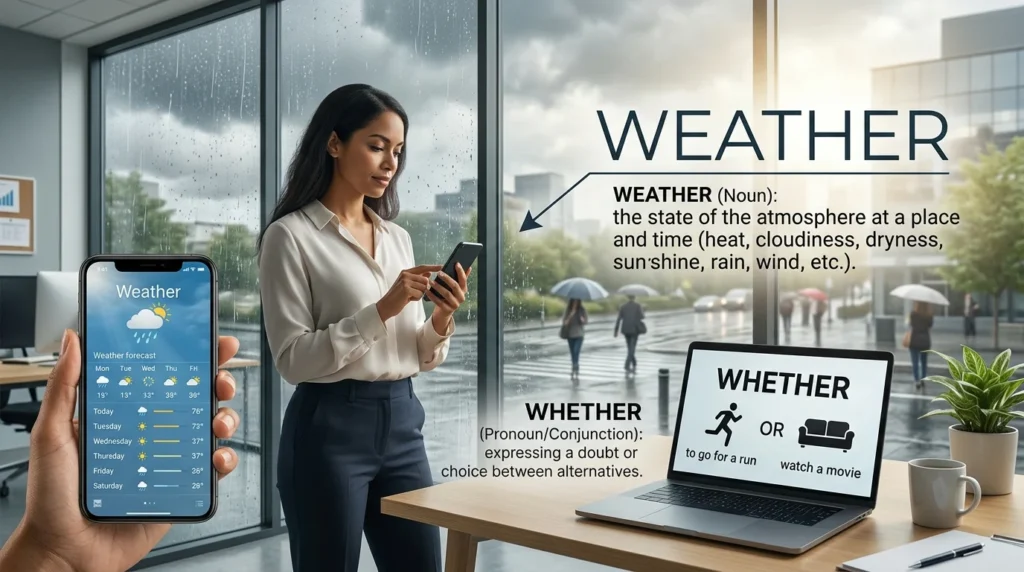
Whether is used when talking about a choice, possibility, or two alternatives. Weather refers to conditions outside, such as rain, wind, sunshine, snow, and temperature.
Whether and weather sound almost the same when spoken, but they have completely different meanings. This makes them easy to confuse, especially when writing quickly or typing a message.
You use whether when you are talking about a choice or asking if something is true. For example, I do not know whether she will come. You use weather when talking about conditions in the air outside, such as rain or sunshine. For example, The weather is beautiful today.
The spelling difference is small, but the words play very different roles in a sentence. Once you connect each word with its meaning, the difference becomes much easier to remember.
What Does Whether Mean?
Whether is used to talk about a choice, possibility, or uncertainty between two or more options.
For example:
I do not know whether he will come.
The speaker is unsure if he will come.
Another example is:
We need to decide whether to stay or leave.
Here, whether introduces two possible choices: stay or leave.
Whether often appears when a sentence involves uncertainty.
Examples include:
I am not sure whether she knows.
Tell me whether you agree.
We need to find out whether the store is open.
He asked whether I wanted coffee.
What Does Weather Mean?
Weather is a noun that describes the conditions outside at a particular time or place.
It can include:
- Rain
- Snow
- Wind
- Sunshine
- Clouds
- Heat
- Cold
- Storms
- Temperature
For example:
The weather is warm today.
We had bad weather yesterday.
The weather forecast says it will rain tomorrow.
Here, weather has nothing to do with choices or uncertainty. It describes the atmosphere and outdoor conditions.
Whether vs Weather
The easiest way to understand the difference is to look at the meaning.
Whether relates to a choice or possibility.
I do not know whether I should go.
Weather relates to outdoor conditions.
I do not like the cold weather.
These words sound alike, but they cannot normally replace each other.
You cannot say:
I do not know weather I should go.
The correct sentence is:
I do not know whether I should go.
Likewise:
The whether is getting colder.
is incorrect.
The correct sentence is:
The weather is getting colder.
When Should You Use Whether?
Use whether when you are talking about alternatives or uncertainty.
For example:
I cannot decide whether to buy the blue shirt or the black one.
There are two choices.
You can also use whether when the alternatives are not directly stated.
I do not know whether he is at home.
The speaker is uncertain about the situation.
More examples:
She asked whether I needed help.
We are not sure whether the plan will work.
He wondered whether they had arrived.
I need to know whether you are coming.
In each sentence, whether introduces a question, possibility, or choice.
When Should You Use Weather?
Use weather when talking about conditions outside.
For example:
The weather is perfect for a picnic.
The weather changed suddenly.
We stayed home because of the bad weather.
The weather forecast looks good for tomorrow.
Cold weather can make driving difficult.
Weather is a common word in everyday conversation because people often talk about rain, heat, storms, and temperature.
Whether or Not
One of the most common phrases with whether is whether or not.
It means that something is true or not true, or that both possibilities are being considered.
For example:
I will go whether or not it rains.
This means the speaker will go in either situation.
Another example:
We need to decide whether or not to accept the offer.
The person must choose between accepting and not accepting.
More examples:
She will finish the project whether or not you help her.
I do not know whether or not he will attend.
You should call us whether or not you need assistance.
Whether or If
Whether and if can sometimes be used in similar sentences.
For example:
I do not know whether he is coming.
You could also say:
I do not know if he is coming.
Both are common.
However, whether is often the better choice when you are presenting two alternatives or using or.
For example:
I do not know whether he will stay or leave.
This sounds natural.
You would not normally say:
I do not know if he will stay or leave.
Although the meaning can still be understood, whether fits the structure better.
Whether to Do Something
Another common structure is whether + to + verb.
Examples:
I cannot decide whether to go.
She is thinking about whether to accept the job.
We need to decide whether to continue.
He does not know whether to call her.
This structure is especially useful when someone has to make a decision.
Notice that weather cannot be used in these sentences.
Incorrect:
I cannot decide weather to go.
Correct:
I cannot decide whether to go.
Whether or Weather in Questions
Whether often appears in indirect questions.
For example:
She asked whether I was ready.
He wanted to know whether the store was open.
I asked whether they had enough food.
These sentences report a question without using a direct question format.
Weather, on the other hand, appears when the question concerns outdoor conditions.
For example:
What is the weather like today?
Did you check the weather forecast?
How will the weather be tomorrow?
The meaning makes the choice clear.
Common Weather Expressions
Weather appears in many common expressions.
Bad Weather
The flight was delayed because of bad weather.
Cold Weather
I enjoy staying home during cold weather.
Hot Weather
Drinking water is important in hot weather.
Severe Weather
The city issued a warning about severe weather.
Weather Forecast
I checked the weather forecast before leaving.
Weather Conditions
The weather conditions made the road dangerous.
These phrases all relate to conditions in the atmosphere.
Weather as a Verb
Weather can also be used as a verb.
As a verb, weather means to survive or endure something difficult.
For example:
The company managed to weather the financial crisis.
This does not mean the company experienced rain or sunshine. It means the company survived a difficult period.
Another example:
They weathered the storm and continued working.
The word can be used literally for a storm or figuratively for a difficult situation.
Whether in Everyday Conversation
Whether is very common in normal speech.
You might hear:
I don’t know whether I should go.
I’m not sure whether she is coming.
Let me know whether you need anything.
We have to decide whether to leave now.
Although if is often used in casual conversation, whether remains completely natural.
Weather in Everyday Conversation
Weather is one of the most common topics in everyday conversation.
People often say:
The weather is nice today.
The weather looks terrible.
I hope the weather improves.
The weather was much warmer yesterday.
Did you see the weather forecast?
These sentences all use weather to describe outdoor conditions.
Common Mistakes With Whether and Weather
The most common mistake is using weather when the sentence needs whether.
Incorrect:
I don’t know weather she is coming.
Correct:
I don’t know whether she is coming.
Another common mistake is using whether when talking about rain or sunshine.
Incorrect:
The whether is beautiful today.
Correct:
The weather is beautiful today.
There is also a common spelling mistake in phrases such as whether or not.
Incorrect:
Correct:
whether or not
Remember that the phrase about choices is whether or not.
Whether or Weather in Professional Writing
Both words are useful in professional writing, but their meanings remain completely different.
For example:
Please let us know whether you accept the proposal.
Here, whether introduces a choice.
Now consider:
Due to severe weather, the meeting has been postponed.
Here, weather refers to outdoor conditions.
Another example:
We need to determine whether the shipment has arrived.
versus:
The shipment was delayed because of bad weather.
The words may look similar, but the context makes the difference clear.
Whether or Weather in School Writing
Students often encounter both words in essays and assignments.
Examples with whether:
The study examined whether exercise affected sleep.
Researchers wanted to know whether the results were reliable.
Examples with weather:
The weather affected the farming season.
Severe weather caused several problems for the community.
Using the right word helps make your writing clear and accurate.
Whether, Weather, and If
These three words can sometimes cause confusion.
Whether introduces uncertainty or alternatives.
I do not know whether he is coming.
If can also introduce a condition.
If he comes, we will start the meeting.
Weather refers to outdoor conditions.
The weather is getting colder.
A useful distinction is:
Whether = choice or possibility
If = condition
Weather = outdoor conditions
For example:
I don’t know whether it will rain.
If it rains, we will stay home.
The weather looks rainy.
Each sentence uses a different word for a different reason.
Real-Life Examples With Whether
Here are some natural examples:
I am not sure whether I locked the door.
She asked whether I wanted to join them.
We need to decide whether to take the train.
He does not know whether the store is open.
Let me know whether you are available tomorrow.
They discussed whether the plan was realistic.
I wonder whether she received my message.
These sentences all involve uncertainty, a question, or a choice.
Real-Life Examples With Weather
Now look at weather in everyday sentences:
The weather is beautiful today.
We canceled the picnic because of the weather.
The weather forecast says rain is coming.
I prefer warm weather.
The weather became colder after sunset.
Severe weather caused delays at the airport.
The weather has been unpredictable this week.
Here, the word always relates to atmospheric conditions or the effects of those conditions.
How to Remember Whether and Weather
A simple memory trick can help.
Think of weather as something you can check before leaving home.
You check the weather to see if it will rain, snow, or become hot.
Think of whether as something connected to a choice.
You use whether when you are deciding between possibilities.
For example:
I checked the weather before deciding whether to go outside.
This sentence contains both words, and each one has a clear job.
Weather = conditions outside
Whether = choice or possibility
Can Whether and Weather Appear Together?
Yes, they can appear in the same sentence.
For example:
We do not know whether the weather will improve.
This sentence is a great way to remember the difference.
Whether introduces uncertainty.
Weather refers to outdoor conditions.
Another example:
I cannot decide whether the weather is good enough for a picnic.
The two words work together but have completely different meanings.
Practice Exercise
Choose whether or weather for each sentence.
- I don’t know ______ she will come.
- The ______ is beautiful today.
- We need to decide ______ to stay or leave.
- The bad ______ delayed the flight.
- Tell me ______ you need help.
- I checked the ______ before going outside.
- She asked ______ I wanted coffee.
- I will go ______ or not it rains.
Answers
- whether
- weather
- whether
- weather
- whether
- weather
- whether
- whether
The easiest way to solve these is to ask what the sentence means. If it concerns a choice or possibility, use whether. If it concerns rain, temperature, wind, or outdoor conditions, use weather.
Whether or Weather: Quick Comparison
| Word | Meaning | Example |
|---|---|---|
| Whether | Choice, possibility, or uncertainty | I don’t know whether she will come. |
| Weather | Conditions outside | The weather is cold today. |
| Whether or not | Either possibility | I will go whether or not it rains. |
| Weather forecast | Prediction of outdoor conditions | Check the weather forecast. |
Final Tips
The difference between whether and weather becomes easy once you focus on meaning instead of spelling.
Use whether when you are talking about a choice, possibility, or uncertainty.
Use weather when you are talking about rain, sunshine, wind, temperature, snow, or other outdoor conditions.
Remember these two examples:
I don’t know whether he will come.
I don’t like cold weather.
If you remember that whether deals with possibilities and weather deals with conditions outside, you will rarely confuse them again.
FAQs
What is the difference between whether and weather?
Whether is used for choices, possibilities, and uncertainty. Weather refers to conditions outside, such as rain, wind, sunshine, and temperature.
Is it whether or not or weather or not?
The correct phrase is whether or not. It is used when talking about two possible outcomes.
Can I use whether instead of if?
Sometimes. Whether and if can both introduce uncertainty, but whether is usually better when you mention two alternatives or use a structure such as whether to go.
What is an easy way to remember whether and weather?
Think of weather as something you check before going outside. Think of whether as a word connected to a choice or possibility.
Can whether and weather be used in the same sentence?
Yes. For example: We do not know whether the weather will improve. Whether introduces uncertainty, while weather refers to outdoor conditions.
Conclusion
Whether and weather sound alike, but they have very different meanings. Whether is used when a sentence involves uncertainty, a choice, or different possibilities. Weather describes conditions outside, including rain, snow, wind, sunshine, heat, and cold.
The easiest way to remember them is to connect each word with its purpose. If you are making a choice, thinking about possibilities, or using a phrase such as whether or not, choose whether. If you are talking about what is happening outside, choose weather.
Once you focus on meaning rather than sound, this common spelling confusion becomes much easier to avoid.