
Quick Answer
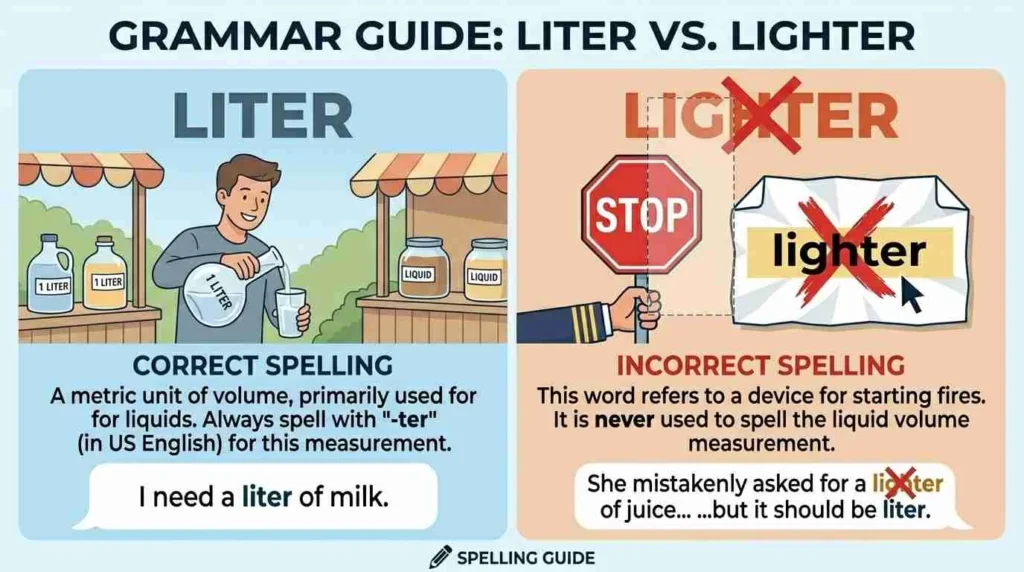
Liter and litre have the same meaning. Both refer to a unit of volume equal to 1,000 milliliters. The only difference is spelling. Liter is used in American English, while litre is used in British English, Canadian English, Australian English, and many other countries.
Many people search for liter or litre because they notice different spellings in books, recipes, science classes, product labels, and online articles. One website may write liter, while another uses litre. This often makes students, writers, travelers, and English learners wonder which spelling is correct.
The good news is that both spellings are correct. The difference depends on the variety of English being used. If you are writing for an American audience, liter is the preferred spelling. If you are writing for readers in the United Kingdom, Canada, Australia, New Zealand, or many other countries, litre is the standard spelling.
Understanding liter or litre helps improve spelling accuracy, professional writing, and international communication. Whether you are studying science, cooking, traveling, buying fuel, or writing educational content, knowing when to use each spelling will help you avoid confusion.
This guide explains liter or litre in simple English with clear definitions, comparison tables, real world examples, grammar rules, regional differences, common mistakes, exercises, and frequently asked questions.
Quick Overview
Liter and litre have exactly the same meaning.
Both measure liquid volume.
Liter is the American English spelling.
Litre is the British English spelling.
Neither spelling is more correct than the other.
Key Difference Between Liter or Litre
| Feature | Liter | Litre |
|---|---|---|
| Meaning | Unit of volume | Unit of volume |
| Measurement Value | One thousand milliliters | One thousand milliliters |
| American English | Yes | No |
| British English | No | Yes |
| Canadian English | Rare | Yes |
| Australian English | No | Yes |
| Scientific Value | Same | Same |
The only difference is spelling.
The measurement never changes.
What Is a Liter
A liter is a metric unit used to measure liquid volume.
One liter equals
One thousand milliliters
One cubic decimeter
Approximately one point zero five seven US quarts
The spelling liter is standard in the United States.
Examples
The bottle contains one liter of water.
Please buy two liters of milk.
The fuel tank holds fifty liters.
What Is a Litre
A litre is exactly the same measurement.
The only difference is spelling.
Countries using British English write litre instead of liter.
Examples
This container holds one litre of juice.
The car uses six litres of fuel every one hundred kilometers.
She bought two litres of cooking oil.
Visual Comparison of Liter or Litre
Image Prompt 1600 by 900
Create a professional educational comparison image titled Liter or Litre. Use a clean white background. Show Liter on the left with the United States flag and a one liter water bottle labeled American English. Show Litre on the right with the United Kingdom, Canada, and Australia flags and the same bottle labeled British English. Include measuring cups, graduated cylinders, metric icons, green check marks, flat modern infographic style, and a 1600 by 900 ratio.
Origin of the Word
The word comes from the French word litre.
As the metric system spread around the world, different English speaking countries adopted different spellings.
The United States simplified many words.
Therefore, American English adopted liter.
Countries following British English kept litre.
Although the spellings differ, the measurement has always remained the same.
Why People Confuse Liter or Litre
Several reasons explain the confusion.
Students learn from books written in different countries.
International websites use different English styles.
Food recipes often come from different regions.
Science textbooks may follow American or British spelling.
Travelers see different spellings while visiting other countries.
Fortunately, both spellings are correct.
The important thing is consistency.
Countries That Use Liter
The United States mainly uses liter.
American schools teach this spelling.
American companies print liter on product labels.
American recipes use liter.
Examples
One liter bottle
Two liter soda
Five liter container
Countries That Use Litre
Many countries following British English use litre.
Examples include
United Kingdom
Canada
Australia
New Zealand
India
Pakistan
South Africa
Ireland
Most European countries writing English also prefer litre.
Global Usage Map
Image Prompt 1600 by 900
Create a professional educational world map titled Where Liter and Litre Are Used. Highlight the United States in blue labeled Liter. Highlight the United Kingdom, Canada, Australia, New Zealand, India, Pakistan, and South Africa in green labeled Litre. Include measuring cups, water bottles, and metric symbols. Use a clean white background and modern infographic style.
Liter or Litre in Science
Scientists use the metric system because it is simple and consistent.
Scientific formulas remain exactly the same.
Whether a textbook says liter or litre, the measurement never changes.
Examples include
Laboratory experiments.
Medical dosage calculations.
Chemistry measurements.
Biology experiments.
Environmental research.
Scientists focus on the measurement rather than the spelling.
Liter or Litre in Cooking
Recipes often include liquid measurements.
American recipes usually write
One liter of broth.
British recipes usually write
One litre of stock.
The quantity remains identical.
Only the spelling changes.
Liter or Litre in Fuel Measurement
Many countries sell fuel in liters or litres.
In the United States, fuel is commonly measured in gallons.
However, when Americans discuss the metric system, they use liter.
Countries using British English write litre at fuel stations.
Everyday Examples
A supermarket sells a two liter bottle of juice in the United States.
A supermarket sells a two litre bottle of juice in Australia.
A chemistry teacher measures one liter of water in America.
A science teacher measures one litre of water in England.
A travel guide may use either spelling depending on its audience.
Advantages of Understanding Liter or Litre
Improves international communication.
Helps students understand textbooks.
Reduces spelling confusion.
Improves professional writing.
Makes travel easier.
Supports scientific learning.
Improves SEO writing for international audiences.
Common Mistakes
Mistake One
Thinking liter and litre measure different amounts.
Correction
They measure exactly the same volume.
Mistake Two
Mixing both spellings in one article.
Correction
Choose one spelling and stay consistent.
Mistake Three
Believing one spelling is wrong.
Correction
Both are correct.
Mistake Four
Using American spelling for British publications.
Correction
Use litre for British English.
Mistake Five
Using British spelling for American audiences.
Correction
Use liter for American English.
Related Measurement Comparisons
Meter or Metre
Center or Centre
Color or Colour
Favorite or Favourite
Theater or Theatre
Neighbor or Neighbour
Program or Programme
Gray or Grey
These words also differ because of American and British spelling conventions.
Third Educational Image
Image Prompt 1600 by 900
Create a professional educational comparison infographic titled Liter or Litre. Show measuring cups, laboratory glassware, fuel pumps, milk bottles, and recipe books. Display Liter equals American English and Litre equals British English with green check marks. Use a modern flat infographic style, clean white background, balanced layout, and high resolution.
Beginner to Advanced Understanding
Beginner Level
Liter and litre mean the same thing.
Intermediate Level
Liter is American English.
Litre is British English.
Advanced Level
Professional writers select the spelling that matches their target audience while keeping the measurement consistent across scientific, educational, and commercial documents.
Regional and Global Usage
The United States uses liter.
The United Kingdom uses litre.
Canada officially uses litre.
Australia uses litre.
New Zealand uses litre.
Pakistan generally follows British English, so litre is preferred.
India also commonly uses litre.
International scientific organizations recognize both spellings depending on language style guides.
Exercises With Answers
Question One
Which spelling is used in American English
Answer
Liter
Question Two
Which spelling is used in British English
Answer
Litre
Question Three
Do liter and litre measure different amounts
Answer
No
Question Four
One liter equals how many milliliters
Answer
One thousand milliliters
Question Five
Which spelling is preferred in Pakistan
Answer
Litre
Question Six
Which spelling appears in American textbooks
Answer
Liter
Question Seven
Can both spellings appear in scientific writing
Answer
Yes, depending on the English style being followed.
Question Eight
Should one article mix both spellings
Answer
No
FAQs
Is liter or litre correct
Both are correct depending on the variety of English.
Which spelling is used in the United States
Liter.
Which spelling is used in the United Kingdom
Litre.
Do liter and litre have different meanings
No. They mean exactly the same thing.
Which spelling should I use for an American audience
Use liter.
Which spelling should I use for British readers
Use litre.
How many milliliters are in one liter or litre
One thousand milliliters.
Is litre used in Canada
Yes. Canadian English generally prefers litre.
Should I mix liter and litre in the same article
No. Choose one spelling based on your audience.
Which spelling is better for international writing
Use the spelling that matches your target readers and remain consistent throughout the content.
Conclusion
Understanding liter or litre is simple once you know the difference. Both words describe exactly the same metric unit of volume, and both equal one thousand milliliters. The only distinction is regional spelling. Liter is the preferred form in American English, while litre is the standard spelling in British English and many other countries.
Whether you are writing scientific reports, recipes, travel guides, educational articles, or business documents, choosing the correct spelling for your audience improves readability and professionalism. Remember that neither spelling is more accurate than the other. The measurement remains identical. The best practice is to stay consistent throughout your writing. By following this simple rule, you can communicate clearly with readers anywhere in the world.