
Quick Answer
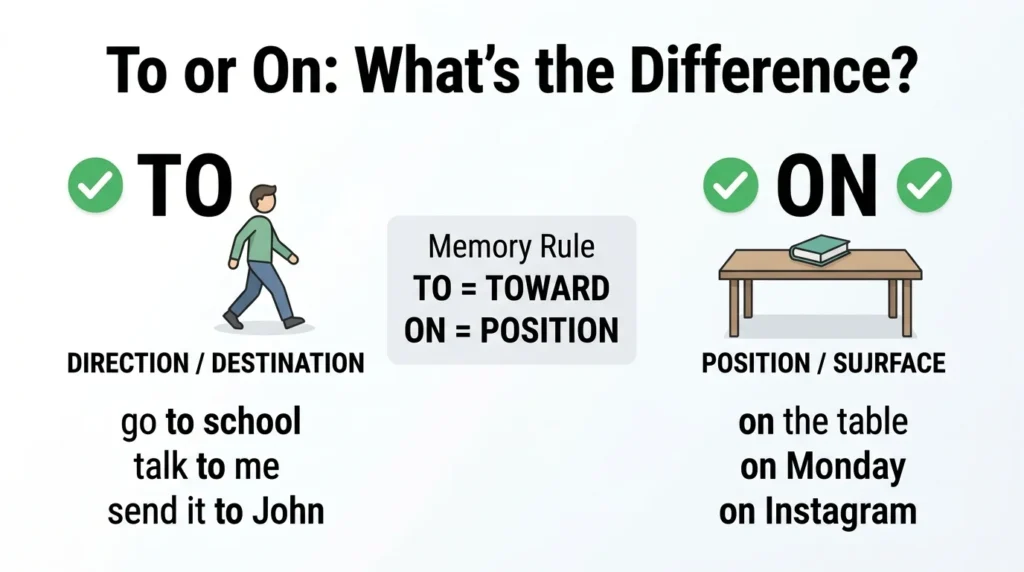
To usually shows direction, movement, a destination, or a person receiving something. On usually shows position, contact with a surface, a day or date, a platform, or certain forms of transportation.
Knowing when to use to or on is an important part of learning natural American English. These two small words appear in thousands of everyday sentences, but they do not have the same job. A learner may know both words but still wonder whether to say “go to school,” “go on the bus,” “meet on Monday,” or “send it to me.” The answer depends on what you want to express. To often points toward a destination, person, or action. On often tells us where something is located, what day something happens, or what platform or transportation method is involved. American English also has some useful expressions that learners need to memorize, such as on the weekend, on the phone, and on the internet. This guide explains to or on with simple rules, American English examples, common phrases, real world situations, mistakes, exercises, and comparisons. By the end, you will know which preposition to choose with much more confidence.
What Does To Mean?
To is one of the most common words in English. It has several important uses.
The most basic use of to is to show movement toward a place or destination.
I am going to work.
She drove to the airport.
We walked to the store.
In each example, to tells us where someone is going.
To Shows Direction
Use to when something or someone moves toward a destination.
He ran to the door.
She walked to the bus stop.
We drove to the restaurant.
They moved to California.
The important idea is movement toward a destination.
To Shows a Recipient
Use to when something is given, sent, shown, or explained to another person.
Give the keys to me.
Send the email to Sarah.
Show the picture to your brother.
Explain the problem to your teacher.
Here, to identifies the person who receives the action or information.
To Shows Communication
We commonly use to with people when describing communication.
Talk to me.
Speak to your manager.
Listen to your mother.
Write to your friend.
Respond to the customer.
This is why we say talk to someone, not normally talk on someone.
To + Verb: The Infinitive
One of the most important uses of to is before a verb.
This is called the to infinitive.
Examples include:
to eat
to work
to study
to learn
to sleep
to understand
to improve
You will often see this structure after verbs such as want, need, plan, hope, and decide.
Common Examples
I want to learn English.
She needs to study.
We plan to travel.
He decided to leave.
They hope to win.
In these sentences, to is not showing a physical destination. It is part of the verb structure.
This is an important reason why you cannot learn to only as a word meaning “toward.”
Common To Expressions
Many English phrases naturally use to.
Talk To
I need to talk to my manager.
Listen To
Please listen to me.
Go To
I go to work every morning.
Belong To
This phone belongs to me.
Give To
She gave the book to her friend.
Send To
Please send the file to me.
Refer To
The report refers to a recent study.
Respond To
Please respond to the email.
Apologize To
He apologized to his customer.
Introduce To
She introduced me to her parents.
Learning these combinations can make your American English sound much more natural.
What Does On Mean?
On has several common uses in American English.
One of the most basic uses is to show that something is touching or positioned on a surface.
The book is on the table.
My phone is on the desk.
The keys are on the counter.
There is a picture on the wall.
In these sentences, on describes position.
On Shows Position
Use on when something is located on a surface.
Examples
The laptop is on the desk.
Your shoes are on the floor.
The cup is on the table.
The picture is on the wall.
There is snow on the roof.
The basic idea is:
On = positioned on or attached to a surface
On for Days and Dates
American English normally uses on with specific days and dates.
Examples
I will see you on Monday.
The meeting is on Tuesday.
We arrived on Friday.
The event is on July 4.
Her birthday is on August 21.
A useful rule is:
on + day
on + specific date
For example:
on Monday
on Saturday
on January 10
on December 25
for the Weekend in American English
This is an important American English usage.
Americans commonly say:
on the weekend
and:
on weekends
Examples
What are you doing on the weekend?
We usually visit our family on weekends.
I work on the weekend sometimes.
British English often uses at the weekend, but on the weekend is very common in American English.
If your goal is natural US English, remember:
American English: on the weekend
On for Transportation
We commonly use on with buses, trains, planes, ships, and other forms of transportation where passengers are considered aboard.
Examples
I am on the bus.
She is on the train.
He is on the plane.
They are on the subway.
We are on the ferry.
However, American English often uses in for smaller private vehicles.
I am in the car.
She is in a taxi.
So you can say:
I am on the bus.
but:
I am in the car.
To or On for Transportation
These two prepositions can appear together when describing travel.
I am going to the airport on the bus.
Here:
to the airport = destination
on the bus = transportation
Another example:
She went to work on the train.
to work = destination
on the train = transportation
This is a useful way to understand the difference.
To or On for Places
Use to when someone moves toward a place.
I went to school.
She drove to the store.
We walked to the park.
He went to the hospital.
Use on when something is located on a surface or particular line/location.
The store is on Main Street.
The restaurant is on the corner.
The picture is on the wall.
Compare
I walked to Main Street.
This shows movement toward Main Street.
I live on Main Street.
This describes location.
To the Hospital or In the Hospital?
American English gives us a useful real world example.
He went to the hospital.
This describes movement or a destination.
He is in the hospital.
This describes his current location.
We do not normally use on in these expressions.
This shows why English prepositions should be learned as phrases rather than translated one word at a time.
To School or On School?
The correct expression is:
I go to school.
This means school is the destination.
But:
The book is on the school desk.
Here, on describes the position of the book.
Another example:
She went to school on the bus.
There are two prepositions:
to school = destination
on the bus = transportation
To Work or On Work?
The normal expression is:
go to work
I go to work at 8 a.m.
But we use on with many work related activities.
I am working on a report.
She is working on a new project.
They are working on the problem.
So:
go to work
but:
work on a project
Work To or Work On?
Both expressions are possible, but they have different meanings.
Work on usually means spend time doing, developing, fixing, or improving something.
I am working on my resume.
She is working on a new website.
We are working on the problem.
Work to can mean work in order to achieve a goal.
We work to improve customer service.
They work to reduce costs.
The difference is small but useful.
To or On for Technology
Modern American English frequently uses on for platforms, websites, apps, and media.
Examples
I saw it on YouTube.
She posted it on Instagram.
He shared the link on Facebook.
I found the product on Amazon.
We met on Zoom.
I saw the story on the internet.
But to is used when describing movement or sending something to a destination or person.
Go to the website.
Send the link to me.
I sent the file to Sarah.
On the Internet or To the Internet?
The normal phrase is:
on the internet
Examples:
I found the information on the internet.
She spends a lot of time on the internet.
The article is available on the internet.
But:
Go to the internet is possible in certain contexts when describing access or movement, although go online is often more natural.
For a website, use:
Go to the website.
On a Website or To a Website?
Both can be correct.
I found the article on the website.
This means the article is located there.
I went to the website.
This means I visited or navigated to the website.
Compare:
I found the product on Amazon.
I went to Amazon to buy the product.
The first focuses on location.
The second focuses on destination or navigation.
To or On Social Media
Use on for content located on a social media platform.
I saw your post on Instagram.
She uploaded the video on YouTube.
He shared the picture on Facebook.
Use to when something is sent to another person.
I sent the picture to John.
She forwarded the message to me.
Compare
I saw it on Instagram.
I sent it to Sarah.
This is a very common American English pattern.
On the Phone or To the Phone?
The normal phrase is:
on the phone
Examples:
She is on the phone.
I was on the phone all morning.
He spent an hour on the phone.
But we use to for the person receiving the communication.
I talked to my boss on the phone.
Here:
to my boss = person
on the phone = communication method
To or On for Topics
On can mean about or concerning a subject.
Examples
She wrote a book on American history.
He gave a presentation on marketing.
We had a meeting on the new policy.
I watched a video on grammar.
However, to is used with the person receiving communication.
She explained the topic to me.
He spoke to the class.
Common On Expressions
Learning common combinations with on is useful for American English.
Work On
I am working on my homework.
Focus On
Focus on the main point.
Depend On
It depends on the weather.
Rely On
We rely on our customers for feedback.
Agree On
They agreed on a price.
Concentrate On
Please concentrate on your work.
Spend Money On
She spent $50 on a new shirt.
Comment On
He commented on the report.
To or On With Listen
The correct phrase is:
listen to
Examples:
Listen to me.
Listen to the music.
Listen to the teacher.
But you can use on to identify the platform or device.
I listen to music on Spotify.
Here:
music = what you listen to
Spotify = where you listen
To or On With Talk
The common phrase is:
talk to someone
Examples:
Talk to your teacher.
I talked to my doctor.
She talked to her manager.
But talk on can be used when referring to a topic.
He talked on the subject for an hour.
In everyday American English, talk about is often more natural for topics.
He talked about the problem.
To or On With Depend
Use:
depend on
Not:
depend to
Example
The answer depends on the situation.
Success depends on preparation.
This is a fixed English expression.
To or On With Focus
Use:
focus on
Examples
Focus on your work.
We need to focus on quality.
She focused on improving her writing.
Not:
focus to
This is why learning common word combinations is so helpful.
To or On With Belong
Use:
belong to
Examples
This book belongs to me.
The car belongs to my brother.
That house belongs to them.
Not:
belong on
unless on has a completely different meaning in the sentence.
To or On With Refer
Use:
refer to
Examples
Please refer to the instructions.
The article refers to several studies.
He referred to the previous report.
This is another common to combination.
To or On With Apologize
Use:
apologize to someone
Examples
I apologized to my friend.
She apologized to the customer.
He apologized to his manager.
The preposition is to because it identifies the person receiving the apology.
To or On With Explain
Use:
explain something to someone
Examples
Please explain the problem to me.
She explained the rules to the students.
He explained the situation to his boss.
A common mistake is:
Explain me the problem.
For standard American English, say:
Explain the problem to me.
To or On With Send
Use send to for a recipient.
Send the email to me.
Send the package to the office.
Send the message to Sarah.
But send on can mean forward something.
Please send the email on to the next person.
The meanings are different.
To or On for Dates and Time
Remember this simple pattern:
at + clock time
on + day/date
in + month/year
Examples:
The meeting starts at 9 a.m.
The meeting is on Monday.
The meeting is in August.
The company was founded in 1995.
This comparison helps prevent many preposition mistakes.
To or On for Holidays
Use on with specific holidays when referring to the day.
We visit family on Thanksgiving.
The store is closed on Christmas Day.
They travel on New Year’s Day.
For a general holiday period, other prepositions can sometimes be more natural depending on the sentence.
On the Weekend vs To the Weekend
Use:
on the weekend
We usually relax on the weekend.
You may also hear:
by the weekend
which means no later than the weekend.
I need to finish the project by the weekend.
And:
until the weekend
means continuing up to that point.
These are different from to.
To or On in American Addresses
American English uses on when describing a location on a street.
I live on Main Street.
The store is on Fifth Avenue.
But use to when describing movement.
I walked to Main Street.
She drove to Fifth Avenue.
This is a useful distinction for anyone learning American English.
To or On the Road
Use on the road for a location or state of traveling.
We are on the road.
He spends a lot of time on the road.
Use to when the road is a destination or direction.
We drove to the highway.
They went to the road to meet us.
In normal American speech, context determines the exact preposition.
To or On the Floor
On the floor means position.
The phone is on the floor.
She sat on the floor.
There is a bag on the floor.
To the floor can show movement toward the floor.
The ball fell to the floor.
This gives us another useful pattern:
to = movement
on = final position
To or On the Table
Compare:
I walked to the table.
The book is on the table.
Put the book on the table.
The first sentence shows movement.
The second shows position.
The third shows placement on a surface.
This is one of the easiest examples to remember.
To or On the Wall
I walked to the wall.
This shows movement toward the wall.
The picture is on the wall.
This shows position.
She put the picture on the wall.
This shows placement.
The preposition changes according to the relationship between the action and the object.
To or On in Business English
American business communication uses both prepositions constantly.
To
Send the report to the client.
Talk to your manager.
Respond to the email.
Refer to the contract.
On
Work on the project.
Focus on the deadline.
Comment on the proposal.
Agree on the price.
Learning these phrases can improve professional writing.
To or On in School and College
Students frequently use these prepositions.
To
Go to class.
Talk to the professor.
Submit the assignment to the teacher.
Listen to the lecture.
On
Work on an assignment.
Write a paper on history.
Study on the weekend.
Take notes on the lecture.
These are common phrases in American schools and colleges.
Common Mistakes With To and On
Mistake One
Incorrect:
I went on the store.
Correct:
I went to the store.
Mistake Two
Incorrect:
The book is to the table.
Correct:
The book is on the table.
Mistake Three
Incorrect:
Talk on me.
Correct:
Talk to me.
Mistake Four
Incorrect:
Send it on me.
Correct:
Send it to me.
Mistake Five
Incorrect:
We will meet to Monday.
Correct:
We will meet on Monday.
Mistake Six
Incorrect:
I saw the photo to Instagram.
Correct:
I saw the photo on Instagram.
Mistake Seven
Incorrect:
I am working to my project.
Correct:
I am working on my project.
Mistake Eight
Incorrect:
It depends to the weather.
Correct:
It depends on the weather.
Mistake Nine
Incorrect:
Listen on me.
Correct:
Listen to me.
Mistake Ten
Incorrect:
This book belongs on Sarah.
Correct:
This book belongs to Sarah.
A Simple Way to Remember To
Think of to as an arrow.
You → school
You → work
You → the store
You → your friend
The word to often points toward the destination or person.
Examples:
I went to school.
She drove to work.
Send it to me.
A Simple Way to Remember On
Think of on as something resting on or connected with a surface, day, platform, or system.
Book → table
Meeting → Monday
Video → YouTube
Person → bus
Examples:
The book is on the table.
The meeting is on Monday.
The video is on YouTube.
She is on the bus.
To vs On Quick Comparison
| Use | To | On |
|---|---|---|
| Direction | Go to the store | Not normally used |
| Destination | Travel to New York | Not normally used |
| Recipient | Give it to me | Not normally used |
| Surface | Not normally used | On the table |
| Day | Not normally used | On Monday |
| Date | Not normally used | On July 4 |
| Public transport | Go to the airport | On the plane |
| Platform | Go to the website | On YouTube |
| Communication | Talk to her | On the phone |
| Work | Go to work | Work on a project |
| Topic | Explain it to me | A book on history |
Real World American English Examples
At a Restaurant
We went to the restaurant on Friday.
The menu is on the table.
At Work
I went to the office on Monday.
I am working on a new project.
At School
She went to class on Tuesday.
She is working on her assignment.
Online
I went to the website.
I found the information on Google.
Social Media
I sent the link to my friend.
I saw the post on Instagram.
Transportation
We went to Chicago on the train.
Phone Call
I talked to my manager on the phone.
These examples show how both prepositions can work together in the same sentence.
Exercises With Answers
Exercise One
Choose to or on.
- I went ___ the store.
- The keys are ___ the counter.
- Please talk ___ your manager.
- We will meet ___ Friday.
- She is ___ the bus.
- Send the package ___ my office.
- The picture is ___ the wall.
- I found the video ___ YouTube.
- He is working ___ a new project.
- This car belongs ___ my brother.
Answers
- to
- on
- to
- on
- on
- to
- on
- on
- on
- to
Exercise Two
Choose the best answer.
- I want ___ learn English.
A. on
B. to
- She is ___ the phone.
A. to
B. on
- We drove ___ the airport.
A. to
B. on
- The meeting is ___ Monday.
A. to
B. on
- Please listen ___ me.
A. to
B. on
- I saw it ___ Instagram.
A. to
B. on
- We are working ___ the problem.
A. to
B. on
- Give the book ___ Sarah.
A. to
B. on
Answers
- B. to
- B. on
- A. to
- B. on
- A. to
- B. on
- B. on
- A. to
Exercise Three: Correct the Sentences
- I am going on work.
- The laptop is to the desk.
- Please send it on me.
- We meet to Monday.
- I saw your post to Facebook.
- She is working to a new project.
- Listen on the teacher.
- It depends to the weather.
Answers
- I am going to work.
- The laptop is on the desk.
- Please send it to me.
- We meet on Monday.
- I saw your post on Facebook.
- She is working on a new project.
- Listen to the teacher.
- It depends on the weather.
FAQs
What is the difference between to and on in English?
To usually expresses direction, destination, a recipient, or the infinitive form of a verb. On usually expresses position, surface contact, days, dates, platforms, and some forms of transportation.
Should I say to or on the weekend in American English?
Use on the weekend or on weekends in American English. For example, “We usually relax on the weekend.”
Is it to Monday or on Monday?
Use on Monday because American English uses on with specific days and dates. For example, “The meeting is on Monday.”
Should I say on Instagram or to Instagram?
Use on Instagram when something is posted or seen there. Use to when something is sent to a person, such as “I sent the photo to Sarah.”
Should I say go to work or go on work?
The correct expression is go to work. Use on in expressions such as work on a project, work on a report, or work on a problem.
Conclusion
Understanding to or on is much easier when you focus on the relationship between the words in a sentence. To often works like an arrow because it points toward a destination, person, or action. We go to school, drive to work, send an email to a customer, talk to a friend, and want to learn. On often describes position, a surface, a day or date, a digital platform, or a form of transportation. We say on the table, on Monday, on Instagram, on the bus, and on the phone.
For American English, also remember some important patterns such as on the weekend, go to work, work on a project, and live on Main Street. Do not try to translate every preposition directly from another language. Instead, learn common phrases and notice the meaning of each sentence. When you are unsure, ask yourself whether the sentence shows movement toward something or position, time, platform, or contact with something. With regular practice, the difference between to and on will become natural and much easier to use correctly.