

Quick Answer
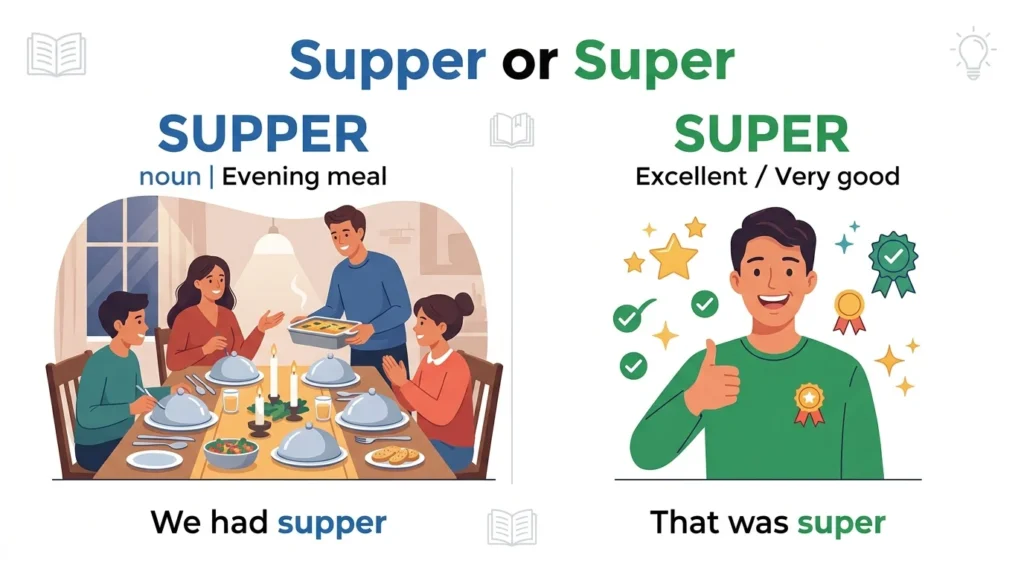
Supper means an evening meal, while super usually means excellent, very good, or above a normal level. They sound similar, but their meanings are completely different.
Supper or super can be confusing because the two words differ by only one letter, and both are common in everyday English. However, they have very different meanings and grammatical uses. Supper is a noun that refers to a meal, usually eaten in the evening. Super has several uses, but it often works as an adjective meaning excellent or very good. It can also mean very or extremely when used informally.
For example, “We had supper at my grandmother’s house” talks about a meal. In contrast, “That movie was super” means the movie was excellent. The words may look similar, but context makes the difference clear.
Understanding these two words is useful when writing texts, emails, school assignments, social media posts, and everyday conversations. Once you know what each word means, choosing between supper and super becomes simple.
Supper vs Super at a Glance
| Word | Part of Speech | Main Meaning | Example |
|---|---|---|---|
| Supper | Noun | An evening meal | We had supper at home. |
| Super | Adjective or adverb | Excellent, very good, or very | That was super! |
The easiest rule is:
Supper = meal
Super = excellent or very
These meanings are not interchangeable.
What Does Supper Mean?
Supper is a noun that traditionally refers to an evening meal.
For example:
We had supper at seven.
Here, supper means the meal eaten in the evening.
You might also hear:
What are we having for supper?
We invited our neighbors over for supper.
She prepared supper for the family.
The exact meaning can vary slightly depending on region and family tradition. In some places, supper is simply another word for the evening meal.
What Does Super Mean?
Super has several meanings.
In everyday informal English, it often means excellent, great, or very good.
For example:
That restaurant was super.
You did a super job.
The movie was super fun.
It can also be used to mean very or extremely.
For example:
I’m super tired today.
She is super excited about the trip.
That test was super easy.
In these examples, super adds emphasis.
Supper or Super: The Main Difference
The main difference is meaning.
Supper is related to food and meals.
Super is related to quality, degree, or excellence.
Compare these sentences:
We ate supper together.
We had a super meal together.
The first sentence talks about the evening meal itself. The second describes the meal as excellent.
Another example:
What time is supper?
What a super dinner!
The first asks about a meal. The second gives a positive opinion.
When to Use Supper
Use supper when you are talking about an evening meal.
Examples:
- We are having supper at home.
- What did you have for supper?
- She cooked supper for everyone.
- They invited us to supper.
- Supper is ready.
- We usually eat supper around seven.
The word is especially common in some American regions and in certain family or traditional settings.
However, dinner is more common in much of the United States when referring to the main evening meal.
When to Use Super
Use super when you want to describe something as excellent, great, or very good.
For example:
Your idea is super.
That was a super performance.
She did a super job.
You can also use super before an adjective or adverb to add emphasis.
For example:
The room is super clean.
He runs super fast.
I’m super happy.
This use is informal and very common in casual American English.
Is Supper the Same as Dinner?
Not always.
Both words can refer to an evening meal, but dinner is generally more common in the United States for the main evening meal.
The word supper can sound more traditional, regional, or informal depending on the speaker.
For example:
We had dinner at a restaurant.
sounds very natural to many American speakers.
You might also hear:
We had supper at home.
The second sentence is completely correct, but the choice can reflect regional or family usage.
In some communities, people use dinner and supper differently based on the size or timing of the meal.
Supper in American English
Supper is a real and standard English word in the United States.
It is particularly familiar in some Southern, Midwestern, and rural communities, although usage varies from person to person.
For some speakers, supper simply means the evening meal.
For others, dinner is the usual word.
For example:
“Are you staying for supper?”
is a natural sentence in many American households.
There is no spelling problem with supper. The important point is understanding its meaning.
Super in American English
Super is extremely common in American English.
People use it in casual speech, advertising, texting, social media, entertainment, and everyday conversation.
Examples include:
That’s super cool.
I’m super excited.
She is super talented.
The new restaurant is super popular.
The word often adds enthusiasm or emphasis.
It can also appear in more specific terms, such as supermarket, superstar, and superpower.
Supper as a Noun
The word supper functions as a noun.
That means it names a thing or event, in this case a meal.
Examples:
Supper is ready.
We enjoyed supper together.
They prepared a large supper.
You can use possessive forms too:
We went to my aunt’s house for supper.
The word refers to the meal itself.
Super as an Adjective
Super can work as an adjective when it describes a noun.
For example:
She is a super athlete.
He did a super job.
That’s a super idea.
In these sentences, super gives a positive description.
It can also appear before other descriptive words:
a super-fast car
a super-friendly person
a super-easy recipe
In informal writing, this use is very common.
Super as an Adverb
Super can also function informally as an adverb.
In this use, it means very or extremely.
For example:
I’m super tired.
She is super excited.
This coffee is super hot.
The instructions were super clear.
This use is especially common in casual American conversation.
In formal writing, however, alternatives such as very, extremely, or a more precise description may be better.
Supper or Super in a Sentence
Seeing both words in complete sentences makes the difference clearer.
Supper
We had supper with our grandparents.
Supper will be ready soon.
She cooked supper for the family.
What are we having for supper?
Super
That was a super performance.
Your new car looks super.
I’m super excited about the trip.
He did a super job.
Each word has a different purpose.
Common Mistakes With Supper and Super
One common mistake is using super when you mean an evening meal.
Incorrect:
What are we having for super?
Correct:
What are we having for supper?
Another mistake is using supper when you want to say something is excellent.
Incorrect:
That movie was supper.
Correct:
That movie was super.
The extra “p” in supper is important because it changes the meaning.
Supper or Super in Texting
Text messages often use super as an informal intensifier.
For example:
I’m super busy right now.
That’s super cool!
I’m super excited!
The word is short, natural, and conversational.
Supper can also appear in texts:
Are you coming over for supper?
Supper is ready.
The context usually makes the meaning obvious.
Supper or Super in School Writing
Both words can be correct in school writing when used properly.
For example:
The family gathered for supper.
This is grammatically correct.
You could also write:
The experiment produced super results.
However, super meaning “very” or “excellent” can sound informal. In an academic essay, a more precise word may be better.
Instead of:
The results were super good.
you could write:
The results were excellent.
That choice makes the writing more polished.
Supper or Super in Professional Writing
Supper can be used professionally when it refers to an actual meal or event.
For example:
The organization will host a community supper on Friday.
That sounds perfectly natural.
Super, however, is often informal when it means “very” or “excellent.”
For example:
The results were super good.
would usually be better as:
The results were excellent.
Still, super can appear in professional contexts when it is part of an established term or brand name.
Pronunciation of Supper and Super
The two words also sound different.
Supper is commonly pronounced like:
SUHP-er
Super is commonly pronounced like:
SOO-per
The vowel sound is the main difference.
For example:
We had supper at home.
That’s super exciting.
Listening to the vowel can help you tell the words apart in conversation.
However, spelling and context are still important because pronunciation can vary between speakers.
Supper, Dinner, and Lunch
Understanding meal-related vocabulary can help you understand supper more clearly.
Breakfast is usually the first meal of the day.
Lunch is generally eaten around the middle of the day.
Dinner can refer to the main meal of the day and is commonly used for the evening meal in the United States.
Supper traditionally refers to an evening meal and can overlap with the meaning of dinner.
For example:
We had lunch at noon.
We had dinner at seven.
We had supper at seven.
The last two can describe the same general meal, depending on regional and personal usage.
Super, Very, and Extremely
When super means “very,” it is usually informal.
Compare:
I’m super tired.
I’m very tired.
I’m extremely tired.
All three sentences communicate a high degree of tiredness.
The difference is tone.
Super sounds casual.
Very is neutral.
Extremely sounds stronger and can be more formal.
Choosing the right form depends on your audience and the type of writing you are doing.
Super in Popular Words
You may already know super from many English words.
Examples include:
- Superhero
- Superstar
- Superpower
- Supermarket
- Superhuman
- Supermodel
- Superfast
In these compounds, super often carries the idea of being above normal, exceptional, or unusually powerful.
For example:
She became a superstar after the movie became a hit.
The word super has a broad range of meanings, but the basic idea often relates to something exceptional or above an ordinary level.
How to Remember Supper or Super
A simple memory trick can help.
Think of the extra p in supper as representing the extra food associated with a meal.
Supper = meal
Super = excellent or very
You can also remember these examples:
We eat supper.
The food is super.
The first word identifies the meal. The second describes the food.
That distinction is easy to apply in everyday writing.
Supper or Super: Practice Questions
Choose supper or super to complete each sentence.
- We are having ___ at six tonight.
- That was a ___ movie.
- What are you making for ___?
- She is ___ excited about the trip.
- They invited us over for ___.
- You did a ___ job.
- Is ___ ready yet?
- This new phone is ___ fast.
- We usually eat ___ together.
- He is a ___ talented musician.
Answers
- supper
- super
- supper
- super
- supper
- super
- supper
- super
- supper
- super
The easiest clue is meaning. If the sentence is about an evening meal, choose supper. If it describes something as excellent or very good, choose super.
Supper or Super: Final Comparison
| Feature | Supper | Super |
|---|---|---|
| Main meaning | Evening meal | Excellent, very, or above normal |
| Common part of speech | Noun | Adjective or adverb |
| Related to food | Yes | No |
| Describes quality | No | Yes |
| Common example | We had supper. | That was super. |
| US usage | Regional or traditional in some areas | Very common |
Although the words look similar, their meanings are easy to separate once you focus on the context.
Frequently Asked Questions
Is supper or super the correct spelling for an evening meal?
Supper is the correct word for an evening meal. For example, “We had supper at home.” Super has a different meaning and does not refer to a meal.
What is the difference between supper and super?
Supper is a noun that refers to an evening meal. Super can mean excellent or very good, and it can also be used informally to mean very or extremely.
Is supper commonly used in American English?
Yes. Supper is standard English and is used by many Americans, although dinner is more common in much of the United States for the evening meal. Usage can vary by region and family.
Does super mean very?
Yes. In informal American English, super can mean very or extremely. For example, “I’m super tired” means “I’m very tired.”
How can I remember supper and super?
Remember the meanings: supper is a meal, while super means excellent or very. The extra “p” in supper can help you recognize the meal-related word.
Conclusion
The difference between supper or super is simple once you focus on meaning. Supper refers to an evening meal, while super usually describes something as excellent, very good, or unusually strong. Super can also work as an informal way to say “very.”
For example, “We had supper with our family” talks about a meal. Meanwhile, “We had a super evening” describes the evening positively. The two words may look almost alike, but they cannot be used interchangeably.
When you are writing about food or an evening meal, choose supper. When you want to describe something as excellent or add emphasis, choose super. Keeping that simple difference in mind will help you use both words correctly.