

Quick Answer
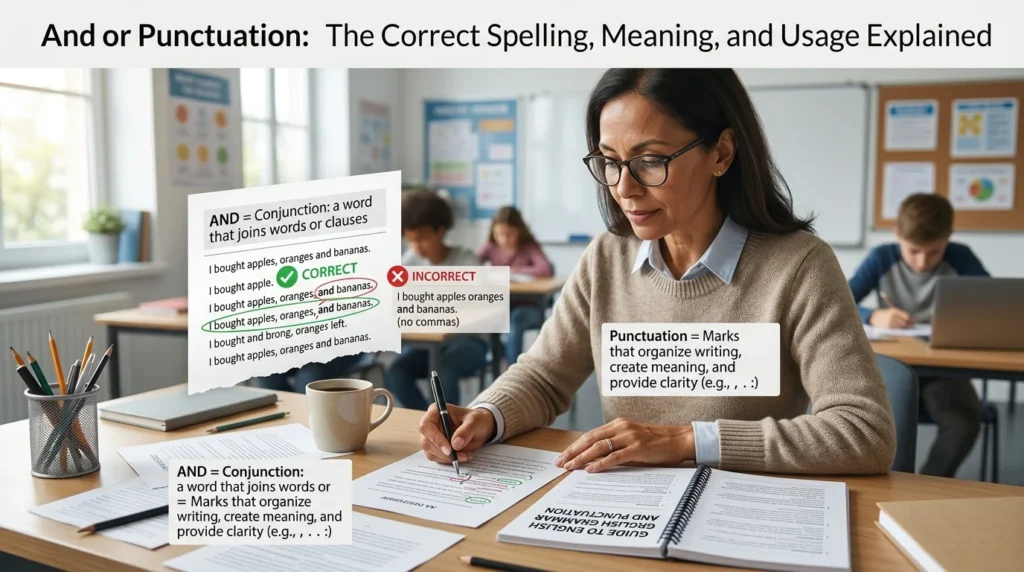
And is a conjunction used to connect words, phrases, or ideas. Punctuation refers to marks such as commas, periods, question marks, and semicolons that help organize written language. The word and is not itself punctuation, but it often works together with punctuation, especially commas.
The word and is one of the most common words in English. It connects people, objects, actions, descriptions, and complete ideas. Because it appears so often, writers sometimes become unsure about whether they should add punctuation before or after it. This is especially common when using commas in lists or joining two complete sentences.
For example, you might wonder whether to write “I bought apples, oranges, and bananas” or “I bought apples, oranges and bananas.” You may also wonder whether a comma should appear before and when two independent sentences are joined. The answer depends on the structure of the sentence.
Understanding how and works with punctuation can make your writing clearer, smoother, and more professional. These rules are especially useful for school writing, business emails, articles, and everyday American English.
What Does And Mean?
And is a conjunction.
It connects two or more words, phrases, or ideas that are related.
Examples:
- Sarah and John are friends.
- I bought bread and milk.
- She smiled and walked away.
- The room was clean and quiet.
- We studied grammar and punctuation.
The word and usually adds information rather than showing contrast or giving an alternative.
Compare:
I like coffee and tea.
The sentence says that both things are included.
What Is Punctuation?
Punctuation is the system of marks used to organize written language.
Common punctuation marks include:
- Period
- Comma
- Question mark
- Exclamation point
- Colon
- Semicolon
- Apostrophe
- Quotation marks
- Parentheses
Punctuation helps readers understand how words and ideas are connected.
For example:
Let’s eat, Grandma.
The comma helps show that Grandma is being addressed.
Without the comma:
Let’s eat Grandma.
The meaning can become humorous and completely different.
And Is Not a Punctuation Mark
One important point is that and is a word, not a punctuation mark.
It is a conjunction that connects parts of a sentence.
For example:
Tom and Lisa went shopping.
Here, and connects two names.
Punctuation may appear around or near and, but and itself is not punctuation.
This distinction is useful when discussing grammar because punctuation and conjunctions perform different jobs.
Should You Put a Comma Before And?
Sometimes you should put a comma before and, and sometimes you should not.
The answer depends on what and is connecting.
When and joins two independent clauses, a comma is often used before it.
Example:
I finished my work, and I went home.
Both parts can stand as complete sentences:
I finished my work.
I went home.
Because and connects two independent clauses, the comma is appropriate.
Comma Before And in a Simple Sentence
You usually do not need a comma before and when it simply connects two words or short phrases.
Examples:
- I bought apples and oranges.
- She likes reading and writing.
- Tom and Mike are brothers.
- We need paper and pencils.
Adding a comma in these sentences would usually be unnecessary.
For example:
I bought apples, and oranges.
This is not the normal way to connect two items in a simple pair.
The natural version is:
I bought apples and oranges.
Comma Before And in a List
The comma before and can also appear in a list.
This is called the Oxford comma, also known as the serial comma.
Example:
I bought apples, oranges, and bananas.
The comma before and is the Oxford comma.
Without it:
I bought apples, oranges and bananas.
Both styles are used in English.
In American writing, the Oxford comma is widely accepted and is often preferred because it can make lists clearer.
What Is the Oxford Comma?
The Oxford comma is the comma placed before and or or before the final item in a list of three or more items.
Example:
We invited Sarah, John, and Mike.
The Oxford comma appears after John.
Without the Oxford comma:
We invited Sarah, John and Mike.
Both versions can be grammatically acceptable, depending on the style guide being followed.
For professional and academic writing, consistency matters more than randomly switching between styles.
And Between Two Independent Clauses
An independent clause contains a subject and a verb and can usually stand alone as a complete sentence.
When and joins two independent clauses, a comma is commonly placed before it.
Example:
The movie ended, and everyone left.
The two independent clauses are:
The movie ended.
Everyone left.
Another example:
She studied hard, and she passed the exam.
This structure is common in both formal and everyday writing.
When You Do Not Need a Comma Before And
If and connects two parts that do not form separate independent clauses, a comma is usually unnecessary.
Examples:
- She opened the door and walked inside.
- He washed the dishes and cleaned the kitchen.
- We watched the movie and ate popcorn.
- I called my friend and asked for help.
In these examples, and connects verbs or actions within the same sentence structure.
Adding a comma may make the sentence unnecessarily broken.
And With Two Verbs
A common use of and is connecting two verbs that share the same subject.
Example:
She opened the window and looked outside.
The subject she applies to both actions.
Another example:
He picked up the phone and answered the call.
Usually, no comma is needed before and in this structure.
However, punctuation can change when the sentence becomes long or when clarity requires a pause.
And With Two Subjects
And can connect two subjects.
Examples:
- Jack and Emily are coming.
- My brother and sister live nearby.
- Coffee and tea are available.
- The teacher and the student discussed the problem.
A comma is normally not needed between two subjects connected by and.
Incorrect:
Jack, and Emily are coming.
Correct:
Jack and Emily are coming.
And With Two Adjectives
The word and can also connect adjectives.
Examples:
- She is kind and patient.
- The house is large and beautiful.
- He is smart and hardworking.
- The test was difficult and confusing.
You usually do not need a comma before and when two adjectives are simply connected.
However, coordinate adjectives can sometimes take a comma when each adjective independently describes the noun.
For example:
It was a long, difficult journey.
This is a different punctuation structure because the adjectives can function independently.
And in Formal Writing
In formal writing, and is completely acceptable and very common.
You can use it in:
- Academic papers
- Business reports
- Emails
- Essays
- Articles
- Instructions
- Professional documents
The key is not to avoid and, but to use it correctly.
For example:
The report explains the problem and provides several possible solutions.
This is clear and professional.
And in Business Emails
Business writing often uses and to connect related actions or requests.
Examples:
Please review the document and send your feedback by Friday.
We contacted the customer and resolved the issue.
The team completed the project and submitted the final report.
When and connects two related actions with the same subject, you generally do not need a comma.
And in Academic Writing
Academic writing uses and frequently.
Examples:
- The study examines language and communication.
- The researchers collected and analyzed the data.
- The results were clear and consistent.
- The paper discusses grammar and punctuation.
When joining two independent clauses, use appropriate punctuation.
Example:
The researchers collected the data, and they analyzed the results.
This makes the relationship between the two complete clauses clear.
And in Everyday Writing
In everyday English, and appears constantly.
Examples:
- Come and sit down.
- Call me and let me know.
- I went to the store and bought dinner.
- She smiled and waved.
- We talked and laughed for hours.
These simple structures usually do not require a comma before and.
And in Text Messages and Social Media
Informal writing often uses and without strict punctuation.
For example:
I went to the store and got some snacks
This can be perfectly understandable in a text message.
However, if you are writing something professional, punctuation becomes more important.
For example:
I went to the store, and then I returned to the office.
Good punctuation makes professional writing easier to read.
Common Mistakes With And and Punctuation
One common mistake is adding a comma before and whenever the word appears.
Incorrect:
I like pizza, and pasta.
Correct:
I like pizza and pasta.
Another mistake is leaving out a comma when and joins two independent clauses.
Less clear:
I finished my work and I went home.
Better:
I finished my work, and I went home.
However, sentence length and writing style can affect punctuation choices, so context still matters.
And vs Ampersand
The symbol & is called an ampersand.
It represents the word and.
For example:
Johnson & Johnson
The ampersand is common in:
- Company names
- Branding
- Signs
- Titles
- Informal design
In normal formal prose, spelling out and is generally preferred.
For example:
Research and Development
is usually more suitable in regular writing than:
Research & Development
unless the official name or style uses the ampersand.
And vs Or
And and or have different meanings.
And generally combines items.
Example:
Bring a pen and notebook.
This suggests both items.
Or presents alternatives.
Example:
Bring a pen or notebook.
This suggests one option or another.
Punctuation can also appear before and and or when they connect independent clauses.
Examples:
I wanted to go, but it was raining.
You can stay here, or you can come with us.
Punctuation Before And in Lists
Consider these examples:
I need eggs, milk, bread, and cheese.
The commas separate the list items.
The final comma before and is the Oxford comma.
Another example:
She packed shirts, pants, shoes, and socks.
This style is common in American writing.
If you choose to use the Oxford comma, use it consistently throughout the same piece of writing.
Punctuation After And
You normally do not place a comma immediately after and.
For example:
Incorrect:
I went to the store and, bought some milk.
Correct:
I went to the store and bought some milk.
However, a comma can appear after and when another grammatical element requires it.
For example:
And, despite the rain, we continued walking.
Here, the commas belong to the interrupting phrase despite the rain. The comma is not simply there because of and.
Starting a Sentence With And
Yes, you can start a sentence with and.
This is common in modern English, especially when the writer wants to emphasize a connection with the previous sentence.
Example:
The weather changed suddenly. And the temperature dropped within minutes.
In formal writing, some editors may prefer combining the ideas:
The weather changed suddenly, and the temperature dropped within minutes.
Still, beginning a sentence with And is not automatically grammatically wrong.
And in Long Sentences
Long sentences require extra attention to punctuation.
For example:
The team reviewed the report, discussed the findings, and prepared a final presentation.
The commas help separate the three actions.
Another example:
The manager reviewed the proposal, and the team discussed the changes before the meeting.
Here, the comma helps separate two major clauses.
Good punctuation prevents long sentences from becoming difficult to follow.
How to Use And Correctly
When deciding whether punctuation is needed around and, ask what the word is connecting.
If it connects two simple words:
Use no comma.
Example:
Tom and Sarah
If it connects two actions with the same subject:
Usually no comma.
Example:
She smiled and waved.
If it connects two independent clauses:
A comma is commonly used before and.
Example:
She smiled, and he waved.
If it is the final connector in a three-item list:
Consider the Oxford comma.
Example:
Red, blue, and green.
Practice: Add the Correct Punctuation
Add punctuation where needed.
- I bought apples and oranges.
- She finished her work and went home.
- I finished my work and I went home.
- We need paper pencils and folders.
- Tom Sarah and Mike joined us.
- The sun came out and the rain stopped.
- I called the office and left a message.
- She wanted to leave but stayed for the meeting.
- We studied grammar punctuation and spelling.
- He opened the door and walked inside.
Answers
- I bought apples and oranges.
- She finished her work and went home.
- I finished my work, and I went home.
- We need paper, pencils, and folders.
- Tom, Sarah, and Mike joined us.
- The sun came out, and the rain stopped.
- I called the office and left a message.
- She wanted to leave but stayed for the meeting.
- We studied grammar, punctuation, and spelling.
- He opened the door and walked inside.
Quick Comparison
| Use | Example |
|---|---|
| Connect two nouns | Tom and Sarah |
| Connect two verbs | Read and write |
| Connect two adjectives | Easy and clear |
| Connect list items | Apples, oranges, and bananas |
| Connect independent clauses | I called, and she answered |
| Start a sentence | And then we left |
| Symbol | & means and |
Final Tips
Keep these simple rules in mind:
- And is a conjunction, not punctuation.
- Do not automatically put a comma before and.
- Use a comma when and joins two independent clauses.
- A comma can appear before and in a list when using the Oxford comma.
- Do not normally put a comma immediately after and.
- And can connect nouns, verbs, adjectives, phrases, and clauses.
- The ampersand & represents and but is more common in names and informal design.
- Starting a sentence with And can be acceptable.
- Always consider the structure of the sentence before adding punctuation.
- Consistency matters when using the Oxford comma.
FAQs
1. Should there always be a comma before and?
No. A comma is not automatically required before and. It depends on what and is connecting. For example, “I bought apples and oranges” does not need a comma.
2. When do you put a comma before and?
A comma is commonly used before and when it joins two independent clauses. For example, “I finished my work, and I went home.”
3. Is the comma before and in a list necessary?
It depends on the style being used. The comma before and in a list is called the Oxford comma. It is widely used in American English and can improve clarity.
4. Can you start a sentence with And?
Yes. Starting a sentence with And is acceptable in modern English. It is often used to connect an idea strongly to the previous sentence.
5. Is and a punctuation mark?
No. And is a conjunction. Punctuation marks include commas, periods, question marks, semicolons, and other written symbols that organize sentences.
Conclusion
And and punctuation work together often, but they are not the same thing. And is a conjunction that connects words, phrases, and ideas, while punctuation marks organize the written sentence and make its meaning clearer.
The most important rule is to look at what and connects. You usually do not need a comma when and joins two simple words or actions. However, a comma is commonly used when and joins two independent clauses. In a list, the Oxford comma may appear before the final and, especially in American writing.
Once you understand these basic patterns, punctuation around and becomes much easier. Instead of adding a comma simply because you see and, check the sentence structure first.