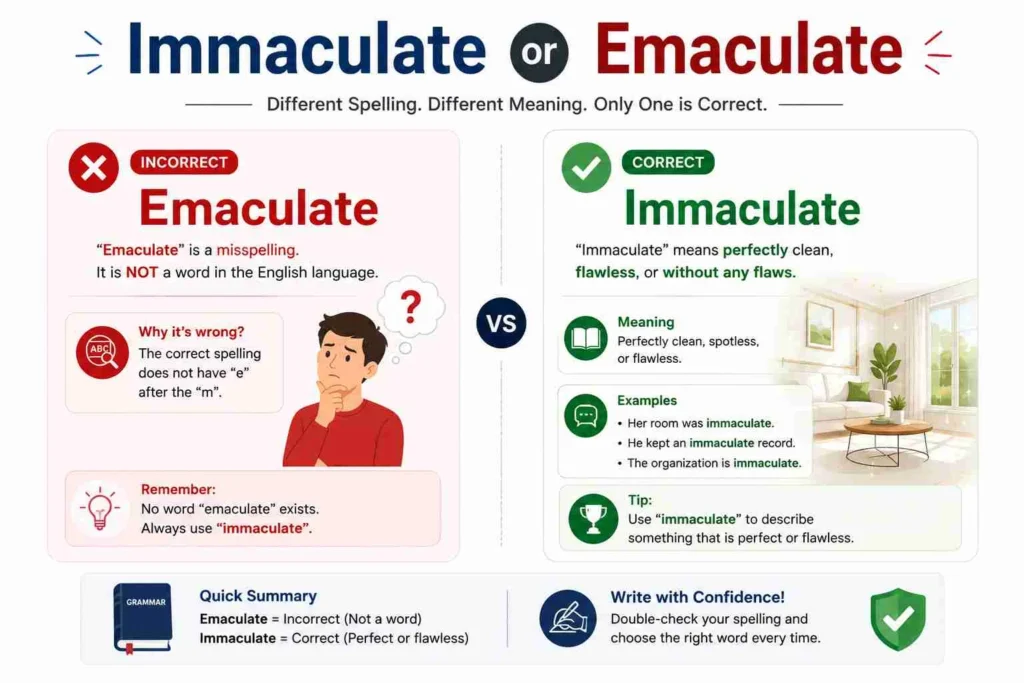

Many people feel confused about immaculate or emaculate because the two words sound very similar. While typing quickly or speaking casually, people often spell immaculate incorrectly as emaculate. However, only one of these spellings is correct in standard English.
The word immaculate is commonly used to describe something perfectly clean, neat, pure, or without flaws. You may hear it in conversations about fashion, homes, grammar, design, or appearance. In contrast, emaculate is not a proper English dictionary word. Most grammar tools and dictionaries recognize it as a spelling error.
Understanding immaculate or emaculate is important for students, writers, bloggers, and professionals. Correct spelling improves communication, writing quality, and search engine credibility. It also helps avoid embarrassing mistakes in emails, articles, school assignments, and social media posts.
This guide explains everything about immaculate or emaculate in simple language. You will learn definitions, spelling rules, meanings, grammar usage, examples, common mistakes, pronunciation, and professional writing tips.
Quick Overview
Immaculate is the correct spelling.
Emaculate is an incorrect spelling.
Immaculate means clean, perfect, or flawless.
Emaculate has no accepted meaning in standard English.
Therefore, professional writing should always use immaculate.
Key Difference Between Immaculate or Emaculate


7
The main difference is correctness.
Immaculate is a valid English word found in dictionaries.
Emaculate is a misspelling and should be avoided.
Because of this, teachers, editors, and grammar tools always recommend using immaculate.
Comparison Table
| Feature | Immaculate | Emaculate |
|---|---|---|
| Correct spelling | Yes | No |
| Dictionary word | Yes | No |
| Meaning | Perfectly clean or flawless | No accepted meaning |
| Used in writing | Commonly used | Considered an error |
| Grammar status | Correct | Incorrect |
What Does Immaculate Mean
Immaculate means extremely clean, perfect, tidy, or free from mistakes.
People use this word to describe:
- Clean homes
- Perfect clothing
- Error free writing
- Neat appearance
- Flawless design
Example Sentences
Her house looked immaculate before the guests arrived.
The student submitted an immaculate assignment without mistakes.
His white suit remained immaculate during the event.
Why Do People Write Emaculate


People usually write emaculate because of pronunciation confusion. When speaking quickly, some accents make immaculate sound like emaculate.
Typing mistakes and autocorrect issues also contribute to the confusion.
However, English dictionaries and grammar checkers do not accept emaculate as a standard word.
Origin of the Word Immaculate
The word immaculate comes from Latin roots meaning without stain or without impurity.
Over time, English adopted the word to describe cleanliness, perfection, and purity.
Today, immaculate appears in everyday language, literature, business writing, and even religious contexts.
Pronunciation Differences
Both words may sound similar in casual speech. However, only immaculate has an official pronunciation.
Correct pronunciation:
Im mac u late
Many people accidentally remove the first syllable and say emaculate, which leads to spelling mistakes.
Common Uses of Immaculate
Home and Interior Design
People often describe a spotless room as immaculate.
Example
The hotel lobby looked immaculate and luxurious.
Fashion and Appearance
The word also describes neat clothing and grooming.
Example
She wore an immaculate black dress.
Academic and Professional Writing
Editors use immaculate to describe error free work.
Example
The report was immaculate and professionally written.
Sports and Performance
Athletes may receive praise for immaculate performance.
Example
The player showed immaculate timing during the match.
Real World Examples
Example One Student Writing
A student types emaculate in an essay. The teacher corrects it to immaculate.
Example Two Online Search
Someone searches emaculate meaning online but finds results for immaculate instead.
Example Three Professional Email
A business employee uses immaculate to describe clean office presentation.
Common Mistakes When Using Immaculate or Emaculate
Mistake One Using Emaculate in Formal Writing
Correction Always use immaculate because emaculate is incorrect.
Mistake Two Mispronouncing the Word
Correction Pronounce the full word carefully to remember correct spelling.
Mistake Three Depending Only on Sound
Correction English spelling often differs from pronunciation.
Mistake Four Ignoring Spell Check
Correction Grammar tools help catch spelling mistakes quickly.
Visual Spelling Difference


The spelling difference may seem small, but it changes correctness completely.
Immaculate starts with I M M
Emaculate incorrectly starts with E M
Remembering this pattern helps avoid mistakes.
Advantages of Correct Spelling
Using correct spelling improves communication and professionalism.
Benefits of Using Immaculate Correctly
- Better academic writing
- Improved SEO and blog quality
- Professional communication
- Stronger grammar skills
- Fewer spelling errors
Correct spelling also helps readers trust your content.
Disadvantages of Incorrect Spelling
Using emaculate instead of immaculate can create problems.
Problems Caused by Incorrect Spelling
- Lower writing credibility
- Confusion for readers
- Grammar correction penalties
- Poor SEO optimization
- Negative academic impression
Therefore, correct spelling matters in both school and professional work.
Related Grammar Comparisons
Accept vs Except
Affect vs Effect
Loose vs Lose
Than vs Then
Immaculate vs Emaculate
These examples show how small spelling changes can completely alter correctness or meaning.
Beginner to Advanced Understanding
Beginner Level
Immaculate is correct.
Emaculate is wrong.
Intermediate Level
Immaculate means clean, perfect, or flawless. It appears in professional and academic writing.
Advanced Level
The confusion happens because English pronunciation sometimes changes syllable sounds in fast speech. However, spelling rules remain fixed in formal English.
Regional and Global Usage
Immaculate is used worldwide in English speaking countries including:
- United States
- United Kingdom
- Canada
- Australia
- India
Meanwhile, emaculate appears mostly as a typing or pronunciation mistake rather than a recognized regional spelling.
SEO and Writing Importance
Correct spelling matters for search engines and online writing.
Search engines recognize immaculate as a valid keyword. However, emaculate has lower search accuracy because it is considered an error.
Bloggers and content writers should always use immaculate for better readability and ranking.
Immaculate in Religious Contexts
The word immaculate sometimes appears in religion to describe purity and holiness.
For example:
Immaculate Conception is a well known religious term in Christianity.
In this context, immaculate symbolizes purity without stain or sin.
Immaculate in Literature and Media
Writers often use immaculate to create strong visual descriptions.
Example
The author described an immaculate garden filled with white flowers.
Movies and advertisements also use the word to suggest perfection and luxury.
Tips to Remember Correct Spelling
- Remember that immaculate starts with I
- Think of immaculate as impressive cleanliness
- Use spell check tools
- Practice writing the word in sentences
These methods help improve spelling memory.
Exercises With Answers
Question One
Which spelling is correct
Answer Immaculate
Question Two
Does emaculate exist in standard dictionaries
Answer No
Question Three
What does immaculate mean
Answer Perfectly clean or flawless
Question Four
Which word should be used in academic writing
Answer Immaculate
Question Five
Why do people confuse these words
Answer Because they sound similar in speech
FAQs
Is immaculate or emaculate correct?
Immaculate is correct, while emaculate is a spelling mistake.
What does immaculate mean?
It means perfectly clean, flawless, or without mistakes.
Is emaculate a real English word?
No, it is not recognized in standard English dictionaries.
Why do people type emaculate?
Because pronunciation confusion and typing mistakes often occur.
Can I use emaculate in formal writing?
No, professional writing should always use immaculate.
How do you pronounce immaculate?
It is pronounced im mac u late.
What is an immaculate room?
It means a perfectly clean and tidy room.
Does spell check recognize emaculate?
Most grammar tools mark it as incorrect.
Is immaculate positive or negative?
It is a positive word used to describe perfection or cleanliness.
Why is correct spelling important?
Correct spelling improves communication, professionalism, and readability.
Conclusion
Understanding immaculate or emaculate is simple once you know the spelling rules. Immaculate is the correct English word used to describe something perfectly clean, flawless, or pure. On the other hand, emaculate is only a spelling mistake and should not appear in formal writing.
This confusion usually happens because the words sound similar in fast speech. However, dictionaries, grammar tools, and professional editors always recognize immaculate as the proper spelling.
Using correct spelling improves academic writing, online content, and professional communication. It also builds trust with readers and helps avoid unnecessary grammar mistakes.
Whenever you feel confused between immaculate or emaculate, remember one important rule. Only immaculate belongs in correct English writing.