

Quick Answer
Lay and laid are forms of the same verb. Lay means to put something down in the present, while laid is the past tense and past participle of lay. The key idea is that both need an object, something that receives the action.
Many learners feel confused about lay vs laid. These words look simple, yet they often cause mistakes in writing and speaking. The confusion happens because English has similar verbs like lie and lay, and their forms overlap.
Lay means to put or place something down. Laid is the past form of lay. For example, you lay a book on the table today, but yesterday you laid it there. The meaning stays the same, but the time changes.
Understanding lay vs laid is important for students, writers, and professionals. Correct usage improves grammar, clarity, and confidence. It also helps in exams, essays, and everyday communication.
In this complete guide, you will learn everything about lay vs laid. We will cover definitions, grammar rules, comparison tables, real life examples, common mistakes, exercises, and expert tips in simple language.
Quick Overview
Lay is present tense
Laid is past tense
Both need an object
Both mean to place something down
Example
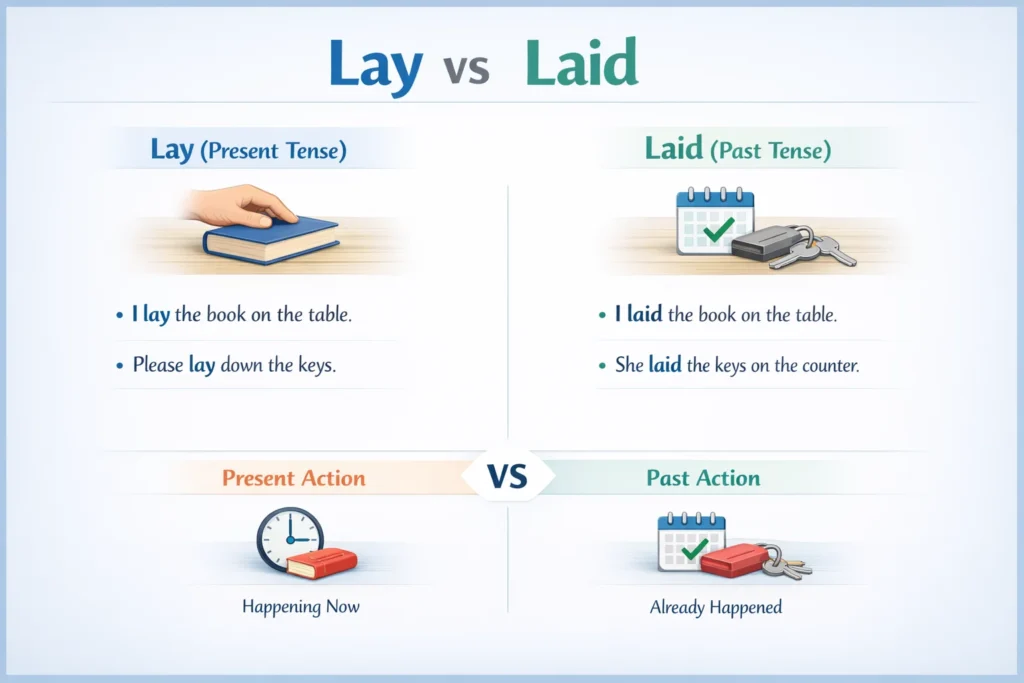
I lay the book on the table
I laid the book on the table yesterday
Key Difference Between Lay vs Laid


The main difference is time.
Lay is used in present tense
Laid is used in past tense
Both verbs require an object, meaning something must receive the action.
Comparison Table
| Feature | Lay | Laid |
|---|---|---|
| Tense | Present | Past |
| Meaning | To place something | Placed something |
| Verb type | Transitive | Transitive |
| Example | Lay the keys here | I laid the keys here |
Definition of Lay
Lay means to put or place something down. It always needs an object.
Examples
Lay the phone on the table
Please lay the bag here
In each sentence, something is being placed.
Definition of Laid
Laid is the past tense and past participle of lay. It also needs an object.
Examples
I laid the phone on the table
She laid the book on the desk
The action already happened.
Understanding the Grammar Rule
To understand lay vs laid, remember this simple rule.
Lay needs an object and is used in present
Laid needs an object and is used in past
Think like this
Today I lay the book
Yesterday I laid the book
This rule helps avoid confusion.
Lay vs Lie Confusion
Many learners confuse lay with lie.
Lie means to rest and does not need an object.
Examples
I lie on the bed
Yesterday I lay on the bed
This creates confusion because lay can also be a past form of lie.
Simple Trick
Lay needs an object
Lie does not
Verb Forms Table
| Verb | Present | Past | Past Participle |
|---|---|---|---|
| Lay | Lay | Laid | Laid |
| Lie | Lie | Lay | Lain |
This table is very important for mastering lay vs laid.
Real World Examples
1 Example One Daily Action
I lay my phone on the table every night
Yesterday I laid it near my bed
2 Example Two Office Work
She lays the files on the desk
She laid them there yesterday
3 Example Three School Usage
Students lay books on the table
They laid them before class started
Mid Practice Visualization


These visuals help you remember tense and usage clearly.
Advantages of Learning Lay vs Laid
- Improves grammar accuracy
- Helps in exams and writing
- Builds confidence in speaking
- Reduces common mistakes
Common Mistakes
1 Mistake One Using Laid in Present
Incorrect I laid the book now
Correct I lay the book now
2 Mistake Two Forgetting Object
Incorrect I lay on the bed
Correct I lie on the bed
3 Mistake Three Mixing Lay and Lie
Correction Learn object rule carefully
Advanced Usage Tips
Use lay when something is placed
Use laid when the action already happened
Always check if an object exists
Example
Correct She laid the keys on the table
Incorrect She laid on the table
Related Comparisons
Lay vs Lie
Lay needs object, lie does not
Sit vs Set
Sit is intransitive, set is transitive
Rise vs Raise
Rise happens naturally, raise needs action
Beginner to Advanced Understanding
Beginner Level
Lay means place
Laid means placed
Intermediate Level
Lay is present
Laid is past
Advanced Level
Understanding verb forms and object usage improves accuracy
Regional and Practical Usage
Lay vs laid is used globally in English. However, mistakes are common in casual speech. Formal writing requires correct usage.
In exams like IELTS or academic writing, using lay vs laid correctly improves scores.
Exercises With Answers
One Question
Which is present tense
Answer Lay
Two Question
Which is past tense
Answer Laid
Three Question
Does lay need an object
Answer Yes
Four Question
Fill the blank
I ___ the book yesterday
Answer Laid
Five Question
Fill the blank
Please ___ the keys here
Answer Lay
Practice Exercise Section
Practice helps you master the concept faster.
FAQs
What is the difference between lay vs laid?
Lay is present tense while laid is past tense of the same verb.
Does lay need an object?
Yes, lay always needs something to place.
Is laid correct in present tense?
No, laid is used for past actions.
Why is lay vs laid confusing?
Because lie has a past form that looks like lay.
Can I say I laid on the bed?
No, you should say I lay or I lay down depending on tense.
Is lay formal or informal?
It is used in both formal and informal English.
How can I remember lay vs laid?
Think lay now, laid before.
Is laid a past participle?
Yes, it is both past and past participle.
Conclusion
Understanding lay vs laid is essential for correct English grammar. Lay means to place something in the present, while laid refers to the same action in the past. Both verbs require an object, which makes them different from similar verbs like lie.
The main challenge comes from confusing lay with lie. However, by remembering the simple rule that lay needs an object, you can avoid most mistakes. Practice with examples and exercises also helps improve accuracy.
In professional writing, exams, and daily communication, correct usage of lay vs laid shows strong grammar skills. Therefore, take time to practice and apply these rules in real life.