
Quick Answer
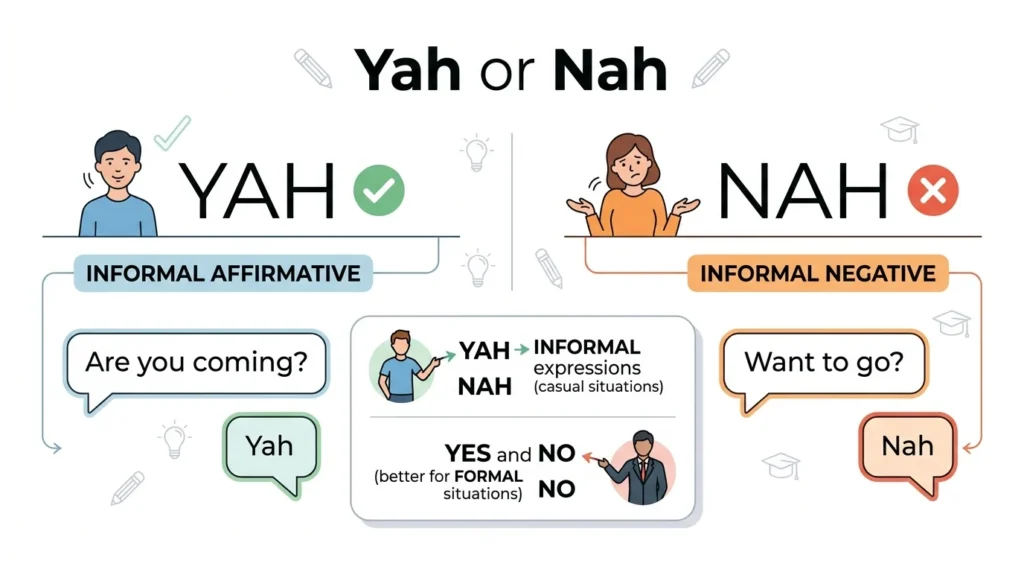
Yah is an informal way to say yes, while nah is an informal way to say no. Both are common in casual speech and online conversations, but they are not usually the best choices for formal writing.
Have you ever seen someone reply with “yah” or “nah” and wondered what they really mean? These short words appear often in texting, social media, casual conversations, comments, and online messages. They are easy to understand in context, yet their spelling and tone can sometimes cause confusion.
Yah generally expresses agreement or a positive response. Nah, on the other hand, usually expresses disagreement or a negative response. Both words can sound relaxed, friendly, blunt, playful, or dismissive depending on the situation and the way they are written.
For US readers, these forms are most useful in informal communication. If you are writing a school assignment, business email, professional report, or formal message, yes and no are usually safer choices.
Understanding the difference helps you choose the right word for the right situation.
What Does Yah Mean?
Yah is an informal expression that can mean yes or yeah.
It is often used to show agreement, confirmation, or acceptance.
For example:
- “Are you coming with us?”
“Yah, I’ll be there.” - “Did you finish the project?”
“Yah, I finished it.” - “Do you want pizza?”
“Yah, that sounds good.”
The exact tone depends on the conversation. In some cases, “yah” can sound casual and friendly. In other situations, it may simply be a short response.
However, yes is still the standard form for formal writing.
What Does Nah Mean?
Nah is an informal way to say no.
It is common in casual conversations and especially common in texting.
Examples include:
- “Do you want coffee?”
“Nah, I’m good.” - “Are you going to the party?”
“Nah, I have other plans.” - “Did you buy the new phone?”
“Nah, I decided to wait.”
The word often sounds relaxed. It can also make a refusal feel less formal than simply saying “no.”
Still, tone matters. A short “nah” can sometimes sound dismissive if the conversation is serious.
Yah vs Nah: The Basic Difference
The easiest way to understand the pair is to connect each word with its meaning.
Yah generally means yes.
Nah generally means no.
| Word | Meaning | Tone | Common Use |
|---|---|---|---|
| Yah | Yes | Informal | Casual conversations and texting |
| Nah | No | Informal | Casual conversations and texting |
| Yes | Yes | Standard | Formal and informal situations |
| No | No | Standard | Formal and informal situations |
So, if someone asks:
“Do you want to come?”
You could answer:
“Yah.”
If you do not want to go, you could say:
“Nah.”
The meaning is simple, but the tone is more casual than yes and no.
Is Yah the Same as Yeah?
Yah and yeah can sometimes be used to express the same basic idea, but they are not always identical in spelling or usage.
Yeah is a very common informal form of yes in American English.
For example:
“Are you ready?”
“Yeah.”
Yah can also express agreement, but it is less standard as a spelling choice for that meaning.
Because of this, if you want a natural informal response in American English, yeah is often more common than yah.
That does not mean “yah” can never appear. It simply means you should consider the context and intended tone.
Is Nah the Same as No?
Not exactly in tone, although the basic meaning is similar.
No is the standard word for refusing or disagreeing.
Nah is a casual alternative.
Compare these examples:
“No, I don’t want to go.”
and
“Nah, I don’t want to go.”
Both communicate a negative response. However, the second sentence sounds more relaxed and conversational.
You may hear nah between friends, family members, coworkers who know each other well, and people chatting online.
For formal situations, no is usually the better choice.
When Should You Use Yah?
Use yah only when the casual tone fits the situation.
It may work in:
- Text messages
- Casual chats
- Social media comments
- Informal conversations
- Dialogue in creative writing
- Friendly online discussions
For example:
“Yah, I can help you later.”
“Yah, that movie was pretty good.”
“Yah, I remember that place.”
However, if you are responding to a teacher, employer, client, or professional contact, yes is usually more appropriate.
Instead of:
“Yah, I received the document.”
write:
“Yes, I received the document.”
The second version sounds clearer and more professional.
When Should You Use Nah?
Nah is best suited to casual situations.
For example:
“Nah, I’m not hungry.”
“Nah, let’s do it tomorrow.”
“Nah, I haven’t seen that show.”
It works especially well when the conversation already has a relaxed tone.
However, avoid relying on it in formal writing. A business email that says “Nah” can sound too casual or even dismissive.
Instead of:
“Nah, we can’t approve this.”
a professional message could say:
“No, we cannot approve this request at this time.”
The second sentence communicates the same basic idea with a more appropriate tone.
Yah or Nah in Text Messages
Texting is one of the places where these expressions are most likely to appear.
People often shorten responses because texting is quick and informal.
For example:
Friend: Are you coming tonight?
You: Yah.
Or:
Friend: Want to watch another episode?
You: Nah, I’m tired.
These responses are short and natural in casual messaging.
You might also see variations such as:
- Yeah
- Yup
- Yep
- Nah
- Nope
- Nah, I’m good
Each expression has its own tone.
Yah or Nah on Social Media
Social media encourages short, conversational language. As a result, informal expressions such as yah and nah can appear frequently.
Someone might post:
“New haircut. Yah or nah?”
Here, yah or nah means something like:
“Do you like it or not?”
A person might respond:
“Yah! Looks great.”
Another person could say:
“Nah, the old style was better.”
This use is informal and conversational. It is not meant to follow strict formal writing rules.
What Does “Yah or Nah” Mean?
The phrase yah or nah usually asks someone to make a simple positive or negative judgment.
In other words, it can mean:
Yes or no?
or:
Do you like it or not?
For example:
“New shoes. Yah or nah?”
The speaker is asking whether people approve of the shoes.
Another example is:
“Should I buy this jacket? Yah or nah?”
The person wants a quick opinion.
This phrase is especially common in casual online conversations because it is short and easy to understand.
Yah or Nah in Questions
Both words can answer questions.
Consider:
“Are you going to the game?”
Possible answers include:
“Yah.”
or:
“Nah.”
You can also make the answers longer:
“Yah, I’m going with my brother.”
“Nah, I have to work.”
The short versions are more casual. Longer answers give more information and can sound more polite.
Yah or Nah in Everyday American Conversation
Informal American conversation includes many short responses.
You might hear:
- Yeah
- Yep
- Yup
- Nah
- Nope
- Sure
- Absolutely
The choice depends on personality, context, and tone.
For example:
“Want to grab lunch?”
A friendly response could be:
“Yeah, sure.”
A negative response could be:
“Nah, maybe tomorrow.”
These expressions make conversations sound relaxed.
However, yah is not as standard or common as yeah for this purpose. If your goal is natural American English, yeah is generally the safer informal spelling.
Is Yah Formal English?
Generally, yah should not be treated as a formal replacement for yes.
Formal English favors standard words and clear sentence structures.
For example, in a professional email:
“Yes, I agree with your recommendation.”
is appropriate.
Writing:
“Yah, I agree.”
makes the message sound much more casual.
That does not automatically make it wrong. Instead, it changes the tone.
The important question is not only whether someone understands the word. You should also consider whether the situation calls for formal or informal language.
Is Nah Formal English?
Nah is also informal.
It is perfectly understandable in everyday conversation, but it may not fit professional or academic writing.
For example:
“Nah, I don’t think that’s necessary.”
sounds like casual speech.
A formal alternative would be:
“No, I do not think that is necessary.”
Or, depending on the situation:
“I don’t believe that is necessary.”
The best choice depends on the relationship between the speakers and the purpose of the message.
Common Mistakes With Yah and Nah
One common mistake is assuming that yah is always the standard spelling of “yes.”
It is better to understand the difference between yes, yeah, and yah.
Yes is the standard form.
Yeah is a very common informal form.
Yah can be informal, but its use is less standard for this meaning.
Another mistake is using nah in situations where a more professional response is expected.
For example:
“Nah, I can’t attend.”
may be fine in a text to a friend.
For a professional invitation, a better response would be:
“No, I won’t be able to attend.”
Yah or Nah vs Yes or No
The four words can be compared by tone.
Yes and no are standard and flexible.
Yeah and nah are informal.
Yah can also appear as an informal affirmative expression, but it is less common as a standard American spelling than yeah.
Consider this simple guide:
| Situation | Better Choice |
|---|---|
| Business email | Yes or no |
| School assignment | Yes or no |
| Job application | Yes or no |
| Texting a friend | Yeah or nah |
| Casual social media | Yeah or nah |
| Friendly conversation | Yeah or nah |
| Formal presentation | Yes or no |
The context should guide your choice.
Examples of Yah and Nah
Here are more natural examples.
Yah
“Did you get my message?”
“Yah, I just saw it.”
“Are you free tomorrow?”
“Yah, I should be.”
“Do you want to order pizza?”
“Yah, I’m hungry.”
Nah
“Do you need a ride?”
“Nah, I can drive.”
“Are you buying those shoes?”
“Nah, they’re too expensive.”
“Want to go out tonight?”
“Nah, I think I’ll stay home.”
These examples show how the words work in relaxed conversation.
How Tone Changes the Meaning
The same word can feel different depending on context.
For example:
“Nah.”
can sound friendly when said between close friends.
But if someone asks an important question and receives only:
“Nah.”
the response might sound cold or dismissive.
The same applies to yah.
“Yah!”
can sound enthusiastic.
Meanwhile:
“Yah.”
may sound uninterested depending on the conversation.
Punctuation, context, and the relationship between speakers all affect tone.
Practice: Choose Yah or Nah
Complete each casual conversation with yah or nah.
- “Do you want some ice cream?”
“___, that sounds good.” - “Are you going to the concert?”
“___, I already have plans.” - “Did you watch the new episode?”
“___, it was really good.” - “Do you want to go for a walk?”
“___, maybe later.” - “Should we order pizza?”
“___, I’m hungry.”
Answers
- Yah
- Nah
- Yah
- Nah
- Yah
The answers depend on the intended meaning of each sentence.
Better Alternatives to Yah and Nah
If you want your writing to sound more polished, choose words based on the situation.
Instead of yah, you can use:
- Yes
- Yeah
- Yep
- Certainly
- Absolutely
- Sure
Instead of nah, you can use:
- No
- Nope
- Not really
- I don’t think so
- Certainly not
For formal communication, yes and no are usually the safest choices.
For casual communication, yeah and nah can sound more natural.
Frequently Asked Questions
Is yah or nah correct?
Both can be understood in informal communication, but they do not have the same status. Yah can be used informally to express agreement, while nah is a common informal way to say no. For standard writing, use yes and no.
Does yah mean yes?
Yes. In informal usage, yah can mean yes or indicate agreement. However, yeah is generally more common as an informal spelling in American English.
Does nah mean no?
Yes. Nah is an informal way to say no. It is common in casual conversations, texting, and social media.
Is yah or nah formal English?
No. These expressions are mainly informal. For professional, academic, or formal writing, yes and no are better choices.
What does “yah or nah” mean?
“Yah or nah” is an informal way of asking for a yes or no opinion. For example, “New shoes, yah or nah?” asks whether someone likes the shoes or approves of them.
Conclusion
Yah or nah is a simple informal expression used to communicate agreement or disagreement. Yah can mean yes, while nah means no. The pair is especially common in casual conversations, texting, social media, and other relaxed settings.
Still, there is an important difference between understanding a word and choosing the best word for a situation. Yes and no are the standard choices, while yeah and nah are more casual. Although yah can be used informally, yeah is generally the more familiar spelling for an informal affirmative response in US English.
When writing for school, work, business, or other formal situations, stick with yes and no. When chatting with friends, however, informal expressions such as yeah and nah can make the conversation sound more natural.