
Quick Answer
Through is the standard spelling used in American English, while thru is a shortened, informal form commonly seen in signs, advertisements, and phrases such as drive-thru. For school, business, academic, and professional writing, use through.
Thru or through is a common spelling question for American English learners because both forms sound the same but are used differently. You may see drive-thru, thru traffic, or open 24 hours thru Sunday on signs and advertisements across the United States. At the same time, standard writing normally uses through. This can make it hard to know which spelling is correct. The good news is that the rule is simple. Through is the normal and standard spelling for general English. Thru is a shortened form used mainly in informal, commercial, or space-saving situations. In this guide, you will learn what thru and through mean, when to use each one, whether thru is a real word, how Americans use both forms, common mistakes, pronunciation, examples, and easy rules that will help you choose the correct spelling.
What Is the Difference Between Thru and Through?
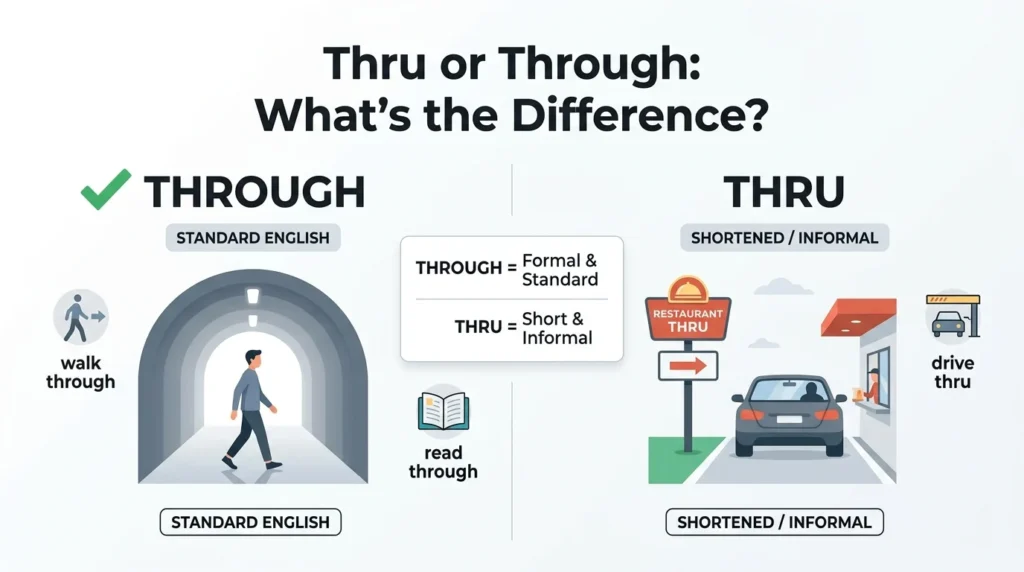
The main difference between thru and through is their level of formality and standard usage.
Through is the standard spelling.
Thru is a shortened form that is especially common in American signs, advertising, and informal language.
For example:
We drove through the tunnel.
This is standard English.
You may see:
Drive-Thru
on an American restaurant sign.
The two forms are closely related, but they are not equally appropriate in every situation.
| Word | Status | Best Use | Example |
|---|---|---|---|
| Through | Standard English | Formal, professional, academic, and general writing | We walked through the park. |
| Thru | Shortened/informal form | Signs, advertising, labels, and casual usage | The restaurant has a drive-thru. |
The easiest rule is:
Use through in normal writing. Use thru when the shortened spelling fits the context.
What Does Through Mean?
Through has several meanings in American English.
It can describe movement from one side of something to another.
We walked through the door.
It can describe movement inside a place.
She drove through the city.
It can describe a period of time.
The store is open through Friday.
It can describe an experience or process.
He went through a difficult time.
It can also describe completing or examining something.
Let’s go through the report.
Because through has so many uses, it is an important word in everyday American English.
What Does Thru Mean?
Thru is a shortened spelling of through.
It is commonly used when short wording is useful.
You may see it on:
- Restaurant signs
- Road signs
- Store signs
- Advertisements
- Menus
- Labels
- Informal messages
- Business names
- Digital interfaces
The most familiar American example is:
Drive-thru
For example:
I stopped at the drive-thru for lunch.
In general prose, however, through is usually the preferred spelling.
Is Thru a Real Word?
Yes, thru is a recognized English spelling, but that does not mean it is the best choice in every sentence.
It is often treated as an informal or shortened form of through.
This distinction is important.
You can see thru on an American restaurant sign and understand exactly what it means. But if you are writing a college essay, business report, formal email, or professional article, through is usually the better choice.
For example:
Informal or commercial:
Drive-Thru Open
Standard writing:
The drive-through is open.
Both are understandable, but the contexts are different.
Through in American English
In the United States, through is the normal spelling used in standard English.
Americans use it in everyday speech and writing.
Examples
I drove through downtown.
She walked through the store.
We worked through the problem.
He read through the instructions.
The meeting lasted through the afternoon.
You do not need to use thru simply because you are writing for an American audience.
In fact, through is generally the safer choice for American readers.
Thru in American English
Thru is especially visible in American commercial and public language.
The strongest example is:
drive-thru
American restaurants frequently use this spelling in names, signs, menus, and advertisements.
You may see:
Drive-Thru Open
24-Hour Drive-Thru
Drive-Thru Pickup
Drive-Thru Pharmacy
Drive-Thru Window
This makes thru familiar to American readers.
However, familiarity does not mean it should replace through in every context.
Drive Thru or Drive Through?
This is one of the most common questions about thru or through.
In American English, drive-thru is extremely common as a noun or adjective, especially in commercial settings.
For example:
Let’s go through the drive-thru.
You may also see:
Drive-thru coffee
Drive-thru restaurant
Drive-thru pharmacy
Drive-thru pickup
The spelling drive-through is also standard and is preferred in more formal writing.
American Usage
A restaurant sign may say:
Drive-Thru
A formal article may write:
The restaurant offers drive-through service.
Both are understood by American readers.
Drive-Thru as a Noun
Drive-thru can function as a noun.
Example
I ordered food at the drive-thru.
Here, drive-thru refers to the service area where customers order or receive food without leaving their cars.
Another example:
The drive-thru was busy this morning.
Drive-Through as an Adjective
Drive-through can be used as a descriptive form.
Example
The restaurant offers drive-through service.
It describes the type of service.
In everyday American usage, however, drive-thru is extremely common.
Walk Through or Walk Thru?
The standard spelling is:
Walk through
For example:
Can you walk me through the process?
This means:
Can you explain the process step by step?
You may see:
Walk me thru it.
in informal messages, but this is less appropriate for professional writing.
Compare
Casual text:
Can you walk me thru the steps?
Professional email:
Can you walk me through the steps?
For business communication, the second version is the better choice.
Thru or Through in Formal Writing
If you are unsure which spelling to use, choose through in formal writing.
This includes:
- College essays
- School assignments
- Business reports
- Resumes
- Cover letters
- Professional emails
- Academic papers
- Research papers
- News articles
- Official documents
- Website content
Example
Less appropriate:
We worked thru several problems during the meeting.
Better:
We worked through several problems during the meeting.
Another example:
Less formal:
Please read thru the document.
Standard:
Please read through the document.
Thru or Through in Text Messages
Text messaging is more flexible.
Someone might write:
I’ll look thru it later.
This is easy to understand.
However, if you want your writing to look polished, through is still better:
I’ll look through it later.
The shortened spelling is not necessary unless you are intentionally writing casually or trying to save space.
Thru or Through in Social Media
Social media has no single strict rule.
You may see both forms.
For example:
Come thru the drive-thru tonight!
or:
Come through the drive-through tonight!
In casual social media writing, thru can feel shorter and more conversational.
But if your social media account represents a business, organization, school, or professional brand, through may provide a more polished appearance unless thru is part of the official branding.
Through as a Preposition
One of the most common grammatical uses of through is as a preposition.
It can show movement inside or across something.
Examples
She walked through the door.
We drove through the tunnel.
He ran through the field.
The train traveled through the mountains.
In these sentences, through connects the action with a place or space.
Through as a Description of Time
Through can also describe a period of time.
Examples
The store is open through Friday.
She worked through the night.
The program runs through December.
We stayed there through the summer.
In these examples, through means continuing until or during a particular point in time.
Through as a Process
American English often uses through to describe experiencing or dealing with something.
Examples
She went through a difficult experience.
We are going through some changes.
He went through a long interview process.
They went through a difficult period.
Here, there is no physical movement through a place. Instead, through describes an experience or process.
Work Through
Work through is a very common American English phrase.
It means to deal with something step by step until it is resolved or understood.
Examples
We need to work through this problem.
Let’s work through the details together.
She worked through several technical issues.
Do not normally write:
We need to work thru this problem.
in formal writing.
Use:
We need to work through this problem.
Go Through
Go through has several common meanings.
It can mean physically move through something.
We went through the tunnel.
It can mean examine something.
Let’s go through the report.
It can mean experience something.
She went through a difficult time.
It can also mean use or consume something.
We went through several boxes of paper.
This is one reason through is so useful in English.
Look Through
Look through means to examine or search something.
Examples
I looked through my email.
She looked through the documents.
He looked through the photos.
Please look through the report before the meeting.
The standard spelling is always through in formal writing.
Read Through
Read through means to read something from beginning to end or carefully review it.
Examples
Please read through the instructions.
I read through the contract before signing it.
She read through the entire report.
In informal texting, you may see:
Read thru this when you get a chance.
But professional writing should use:
Read through this when you get a chance.
Get Through
Get through is another common American English expression.
It can mean successfully complete something difficult.
We got through the exam.
It can also mean successfully contact someone.
I tried to call her, but I couldn’t get through.
It can describe reaching the end of a period.
We’ll get through this difficult time.
Through and Until
Sometimes learners wonder whether through and until mean the same thing.
They can have similar meanings when discussing time, but their use can vary.
Example
The store is open through Friday.
This generally means Friday is included.
You can also say:
The store is open until Friday.
Depending on context, the exact interpretation can differ.
For clear schedules, it is often better to give the exact date or time.
Through and Across
Through and across can both describe movement, but they are not always interchangeable.
Across usually emphasizes movement from one side to another over a surface or area.
We walked across the street.
Through emphasizes movement inside or within something.
We walked through the tunnel.
Compare:
She walked across the field.
She walked through the forest.
The choice depends on the type of space.
Through and Throughout
These words are related but have different meanings.
Through can describe movement or a period.
Throughout usually means in every part of something or during the whole period.
Examples
We drove through the city.
There were stores throughout the city.
She worked through the night.
It rained throughout the night.
Through and Threw
This is another important spelling comparison.
Through is related to movement, time, or processes.
Threw is the past tense of throw.
Examples
We walked through the park.
He threw the ball.
Remember:
Through = movement or process
Threw = past tense of throw
Through and Though
Do not confuse through with though.
Though often means although or however.
Examples
Though it was raining, we went outside.
We walked through the rain.
The words look similar but have different meanings and pronunciations.
Through and Thorough
Through and thorough are also different.
Through can mean from one side to another.
Thorough means complete and careful.
Examples
We walked through the building.
She conducted a thorough review.
A thorough review is a careful and complete review.
Through and Thru Pronunciation
Thru and through are pronounced the same.
The shortened spelling does not create a different pronunciation.
Both are generally pronounced approximately like:
throo
This is why the words can be confusing when you hear them rather than see them written.
For American English learners, this is an important point:
Same pronunciation does not always mean same spelling or same usage.
Why Does Thru Appear on Signs?
Signs have limited space.
A shorter word can make a sign:
- Easier to read
- Faster to understand
- Less crowded
- More visually appealing
- Cheaper to print
For example:
DRIVE-THRU
is short and instantly recognizable.
This is especially useful for restaurants, pharmacies, banks, and other businesses serving customers in cars.
Thru in American Business Names
Some American businesses may use Thru as part of a brand name or service name.
When a company intentionally uses Thru, you should preserve its official spelling.
For example, if a business brands its service as:
Drive Thru Express
you would normally keep the business’s chosen spelling when referring to its name.
This is different from choosing thru in ordinary writing.
Thru in Road and Traffic Language
You may sometimes see shortened wording involving thru in American road signs or traffic information.
For example:
Thru Traffic
This can mean traffic continuing through an area rather than stopping there.
You may also encounter:
Thru Lane
or similar shortened wording.
The goal is usually quick communication and limited sign space.
In ordinary prose, however, through traffic is the more standard form.
Common Mistakes
Mistake One
Please read thru the report.
Standard:
Please read through the report.
Mistake Two
We drove thru the tunnel.
Standard:
We drove through the tunnel.
Mistake Three
Let’s work thru this problem.
Standard:
Let’s work through this problem.
Mistake Four
She walked thru the door.
Standard:
She walked through the door.
Mistake Five
Using thru in a formal essay.
Better:
Use through.
Mistake Six
Thinking thru and through have different meanings.
In most contexts, thru is simply a shortened form of through, not a completely different word.
When Thru Is Appropriate
Thru can be appropriate when it is:
- Part of an established expression
- Used on a sign
- Used in advertising
- Part of a business name
- Used in casual communication
- Needed to save space
Examples:
Drive-thru
Drive-thru window
Drive-thru pharmacy
Thru traffic
Open thru Sunday
The last example is more informal and commercial than standard prose.
When Through Is Appropriate
Use through for:
- Academic writing
- Professional writing
- Formal communication
- General articles
- Business reports
- School assignments
- Official documents
- Clear international English
Examples:
Please read through the instructions.
We worked through the issue.
The train traveled through the tunnel.
The store is open through Friday.
A Simple Decision Rule
Ask yourself:
Am I writing standard English?
If yes, use:
Through
Are you writing a sign, advertisement, casual message, or established commercial phrase?
Then:
Thru may be appropriate.
If you are unsure:
Choose through.
It is the safest and most widely accepted spelling.
Advantages of Through
Through has several advantages.
- It is the standard spelling.
- It works in formal writing.
- It works in informal writing.
- It is appropriate for academic work.
- It is appropriate for business communication.
- It is understood across English-speaking regions.
- It avoids questions about spelling style.
Advantages of Thru
Thru is useful in specific situations.
- It is shorter.
- It saves space.
- It works well on signs.
- It is familiar to American readers.
- It is common in commercial language.
- It can fit better in advertisements.
Disadvantages of Through
There are very few disadvantages to using through.
The main issue is simply length.
A sign saying:
DRIVE THROUGH
takes more space than:
DRIVE-THRU
This is why businesses may prefer the shorter version on signs.
Disadvantages of Thru
Thru has a more limited role.
- It can look informal.
- It may be considered nonstandard in some contexts.
- It is not ideal for academic writing.
- It can make professional writing look less polished.
- It may be marked as a spelling error by some editors or teachers.
American English Examples
Here are common examples that will help you understand the difference.
Restaurant
Let’s go through the drive-thru.
Business
Please look through the contract.
Travel
We drove through Texas.
Education
The teacher walked us through the lesson.
Problem Solving
We worked through the problem together.
Time
The store is open through Sunday.
Casual Text
I’ll look thru it tonight.
The last example is understandable but informal.
Practice Exercises
Exercise One
Choose thru or through.
- We drove ______ the tunnel.
- Please read ______ the instructions.
- The restaurant has a drive ______.
- She walked ______ the door.
- We worked ______ the problem.
- The store is open ______ Friday.
- I looked ______ the photos.
- The train traveled ______ the mountains.
Answers
- Through
- Through
- Thru
- Through
- Through
- Through
- Through
- Through
Exercise Two
Choose the best form for formal American English.
- Please read ______ the attached report.
A. thru
B. through
- We need to work ______ these issues.
A. thru
B. through
- The company operates ______ the weekend.
A. thru
B. through
- The restaurant has a ______ service.
A. drive-thru
B. drive through
Answers
- B. through
- B. through
- B. through
- A. drive-thru is common commercial American usage; drive-through is also standard.
Exercise Three
Correct the informal spelling for professional writing.
- Please look thru the file.
- We need to go thru the data.
- She walked thru the building.
- I will read thru the contract.
- We worked thru several problems.
Answers
- Please look through the file.
- We need to go through the data.
- She walked through the building.
- I will read through the contract.
- We worked through several problems.
Exercise Four
Choose the correct word.
- The car drove ______ the tunnel.
A. threw
B. through
C. though
- He ______ the ball across the field.
A. through
B. threw
C. thorough
- ______ it was late, she continued working.
A. Through
B. Though
C. Thru
- The manager conducted a ______ review.
A. through
B. threw
C. thorough
Answers
- B. through
- B. threw
- B. Though
- C. thorough
Quick Comparison With Related Words
| Word | Meaning | Example |
|---|---|---|
| Through | From one side to another, during, or by means of a process | We walked through the park. |
| Thru | Shortened form of through | Drive-thru service |
| Threw | Past tense of throw | He threw the ball. |
| Though | Although or however | Though it rained, we went out. |
| Thorough | Complete and careful | She gave it a thorough review. |
| Throughout | In every part or during the whole period | It rained throughout the day. |
FAQs
Is thru or through correct in American English?
Both forms are recognized, but through is the standard spelling. Thru is a shortened form commonly used in signs, advertising, and informal American English.
Should I use thru or through in formal writing?
Use through in formal, academic, professional, and business writing. It is the safest standard form.
Is drive-thru or drive-through correct?
Both are used in American English. Drive-thru is extremely common in signs and commercial language, while drive-through is the standard full spelling and works well in formal writing.
Is thru a real word or just a misspelling?
Thru is a recognized shortened spelling of through, especially in American commercial and informal usage. It is not simply a random spelling mistake, but it is less formal than through.
Why do Americans write drive-thru instead of drive-through?
Drive-thru is shorter, easy to read, and very common in American restaurant and business signage. It saves space while remaining immediately understandable.
Conclusion
The difference between thru or through is mostly about standard spelling, formality, and context. Through is the standard form and is the best choice for almost all normal writing. Use it in school assignments, professional emails, business reports, articles, academic papers, and other formal communication. It can describe movement, time, experiences, processes, and many common expressions such as walk through, go through, read through, and work through.
Thru is a shortened form that is especially common in American commercial language. You will often see it in drive-thru, restaurant signs, advertisements, road signs, labels, and casual messages. It is familiar and useful, but it can look too informal in professional writing. The best rule for American English is simple: when you are writing normally, choose through; when you are reading a sign or using a short commercial expression, thru may be appropriate. If you are ever unsure, through is the safest choice.