
Quick Answer
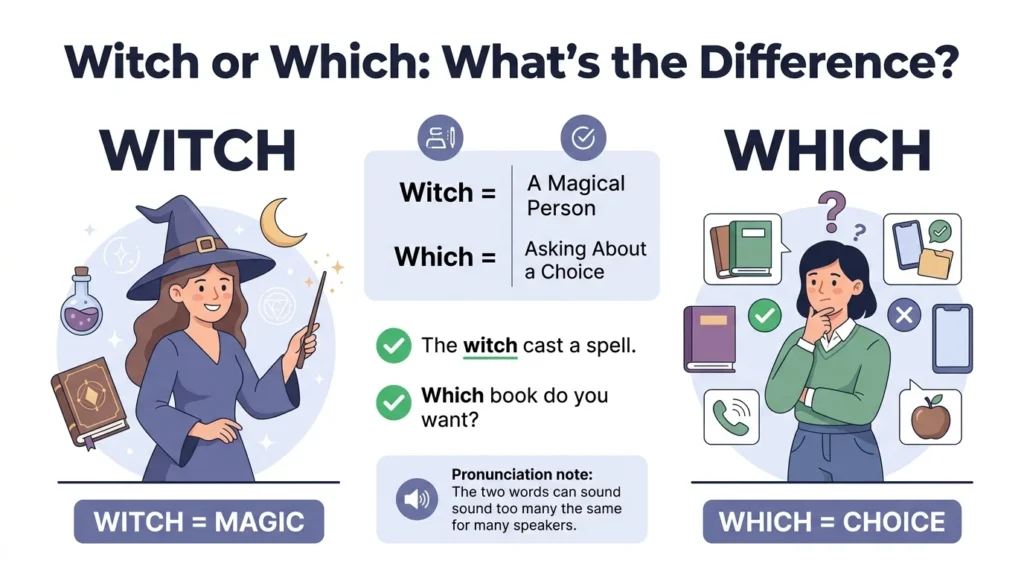
Witch is a noun that usually refers to a person, traditionally a woman, believed to use magic. Which is a pronoun or determiner used when asking about or identifying a person or thing from a specific group or choice.
The words witch and which sound very similar, so they can easily confuse English learners. However, they have completely different meanings and grammatical uses. Witch is usually connected with magic, folklore, and stories, while which is commonly used when asking a question or giving information about a particular choice or thing. For example, you can say, “The witch lives in the forest,” but you would say, “Which book do you want?” Learning the difference between witch or which is important for clear writing, correct spelling, and natural English. In this guide, you will learn their meanings, grammar, pronunciation, examples, common mistakes, comparisons, exercises, and simple ways to remember which word to use.
What Does Witch Mean?
Witch is a noun. Traditionally, it refers to a person, usually a woman, who is believed to have magical powers or practice witchcraft.
The word is common in:
- Folklore
- Fairy tales
- Fantasy stories
- Halloween traditions
- Historical discussions
- Movies and television
- Fiction
Examples
- The witch lived in a dark forest.
- The story was about a powerful witch.
- The witch used magic to help the village.
- The children were afraid of the witch.
- A witch appeared in the old castle.
In these sentences, witch refers to a person or character.
Witch in Fairy Tales
The word witch is especially common in fairy tales.
For example:
The witch lived in a small house deep in the forest.
Another example:
The witch gave the princess a magical apple.
In stories, witches are often shown as characters who can use magic, cast spells, or make potions.
However, different cultures and historical traditions have very different ideas about witches and witchcraft.
Witch in Modern English
Today, witch can be used in different ways depending on context.
It may describe:
- A fictional magical character
- A person associated with witchcraft
- A character in a fantasy story
- A person who practices a modern spiritual tradition
- A historical figure accused of witchcraft
The meaning depends on the context.
What Does Which Mean?
Which is a pronoun or determiner used to identify or ask about a particular person or thing from a group.
It is extremely common in English.
Examples
- Which book do you want?
- Which color do you prefer?
- Which car is yours?
- Which restaurant should we choose?
- Which student answered the question?
- Which option is better?
In each sentence, which helps identify a particular choice or item.
Which in Questions
One of the most common uses of which is asking someone to choose between options.
Examples
Which shirt do you like?
Which phone should I buy?
Which road should we take?
Which movie do you want to watch?
Which answer is correct?
Here, which means something like “what one” or “what ones” from a known or limited group.
Which in Relative Clauses
Which can also introduce a relative clause.
Examples:
I bought a new phone, which has a better camera.
She visited Paris, which is famous for its museums.
He missed the bus, which made him late.
In these examples, which adds information about something already mentioned.
Witch or Which: Key Difference
| Word | Part of Speech | Meaning | Example |
|---|---|---|---|
| Witch | Noun | A person associated with magic or witchcraft | The witch cast a spell. |
| Which | Pronoun / Determiner | Used to identify or choose something | Which dress do you like? |
The easiest rule is:
Witch = Magic
Which = Choice
Witch vs Which Pronunciation
In many varieties of English, witch and which are pronounced exactly the same or very similarly.
They are commonly pronounced like:
Witch = wich
Which = wich
This makes them homophones or near homophones for many speakers.
Because they sound the same, you usually need to understand the meaning and context to choose the correct spelling.
For example:
Which book is yours?
The context clearly shows that you need which, not witch.
Likewise:
The witch lives in the castle.
The meaning clearly shows that witch is correct.
Why Do People Confuse Witch and Which?
The main reason is pronunciation.
When people hear the words spoken, they may not be able to tell which spelling is being used.
This is especially common for English learners.
For example, if someone says:
Which movie are you watching?
A learner may hear something similar to:
Witch movie are you watching?
The pronunciation does not provide enough information. You need to understand the sentence.
This is why learning words in context is important.
When Should You Use Witch?
Use witch when talking about a person or character associated with magic or witchcraft.
Examples
- The witch flew across the sky.
- The witch lived in a castle.
- The children saw a witch in the story.
- The witch prepared a magic potion.
- The old witch helped the young girl.
- The movie features a powerful witch.
When Should You Use Which?
Use which when asking about a choice or identifying something from a group.
Examples
- Which book should I read?
- Which dress looks better?
- Which city do you live in?
- Which answer is correct?
- Which laptop should I buy?
- Which student won the competition?
You can also use which to add information.
The house, which was built in 1920, is still standing.
Common Mistakes
Mistake One
Incorrect:
Witch book do you want?
Correct:
Which book do you want?
Why?
You are asking someone to choose a book, so which is correct.
Mistake Two
Incorrect:
The which lived in the forest.
Correct:
The witch lived in the forest.
Why?
You are talking about a magical character, so witch is correct.
Mistake Three
Incorrect:
Witch color do you like?
Correct:
Which color do you like?
Why?
You are asking someone to choose a color.
Mistake Four
Incorrect:
The which cast a spell.
Correct:
The witch cast a spell.
Why?
A person who uses magic is a witch.
Witch or Which in Everyday English
Which is much more common in everyday English because people use it frequently when asking questions.
Examples:
- Which one?
- Which way?
- Which one do you want?
- Which is better?
- Which should I choose?
- Which day works for you?
Witch is much more specific.
You normally encounter it when talking about:
- Magic
- Fantasy
- Folklore
- Halloween
- Witchcraft
- Stories
Real World Examples
Example One: Shopping
A customer asks:
Which shirt should I buy?
Here, which is used because the customer is choosing between shirts.
Example Two: Storytelling
A child reads:
The witch lived in a magical castle.
Here, witch refers to a magical character.
Example Three: School
A teacher asks:
Which answer is correct?
Here, which asks the student to identify one answer.
Example Four: Fantasy Movie
Someone says:
The witch in the movie was very powerful.
Here, witch refers to a magical character.
Witch and Which in American English
Both words are common in American English, but which is much more frequent because it is an everyday grammar word.
Examples:
Which one do you want?
Which restaurant should we visit?
Which answer did you choose?
Witch is generally used in stories, folklore, Halloween discussions, and other contexts related to magic.
Witch and Which in British English
British English uses witch and which in the same basic way.
Examples:
Which train should we take?
The witch appeared in the story.
The main difference learners may notice is pronunciation. Some British speakers distinguish the initial sounds of which and witch, while many speakers pronounce them the same.
Witch or Which in Writing
Writing makes the difference very clear because the spellings are different.
Compare:
Which book is yours?
The witch is in the book.
Even though the words can sound alike, their written forms and meanings are completely different.
This is why proofreading is important.
Witch vs Wizard
Witch and wizard are related words, especially in fantasy stories.
A witch is commonly portrayed as someone who uses magic.
A wizard is also a person who uses magic, often portrayed as a male magical character in traditional fantasy.
However, modern stories can use these terms in many different ways.
Examples:
The witch cast a spell.
The wizard studied magic.
Which vs What
English learners sometimes confuse which and what.
Both can be used to ask questions, but there is often a difference.
Which
Use which when choosing from a limited or known group.
Which dress do you want, the red one or the blue one?
What
Use what when the possible answers are more open.
What dress do you want?
A simple rule is:
Which = limited choices
What = open choice
Which vs That
Which and that can both introduce information about a noun in certain sentences.
Example:
The book that I bought was expensive.
The book, which I bought yesterday, was expensive.
Grammar rules for which and that can become more advanced, especially in defining and non defining relative clauses. For beginner writing, focus first on the basic use of which for questions and additional information.
Easy Memory Trick
Here is a simple way to remember witch or which:
Witch = Magic
Think about:
Witch → Wizard → Magic
Which = Choice
Think about:
Which one?
Whenever you are asking someone to choose, which is usually the word you need.
Whenever you are talking about a magical person or character, use witch.
Advantages of Knowing the Difference
Understanding witch or which can help you:
- Improve spelling.
- Write clearer sentences.
- Avoid confusing readers.
- Ask better questions.
- Improve grammar.
- Understand stories more easily.
- Perform better in English exams.
- Improve professional writing.
- Build vocabulary.
- Communicate more confidently.
Practice Exercises
Exercise One: Choose Witch or Which
Fill in each blank with witch or which.
- ______ book do you want?
- The ______ lived in a dark forest.
- ______ color is your favorite?
- The children were afraid of the ______.
- ______ movie should we watch?
- The ______ made a magical potion.
- ______ road should we take?
- The story is about a powerful ______.
Answers
- Which
- witch
- Which
- witch
- Which
- witch
- Which
- witch
Exercise Two: Correct the Mistakes
- Witch phone do you use?
- The which flew over the house.
- Witch answer did you choose?
- The which used magic.
- Witch restaurant do you recommend?
Answers
- Which phone do you use?
- The witch flew over the house.
- Which answer did you choose?
- The witch used magic.
- Which restaurant do you recommend?
Exercise Three: Identify the Meaning
Decide whether the bold word refers to magic or choice.
- Which book should I buy?
- The witch cast a spell.
- Which road leads to the city?
- The witch lives in the forest.
- Which answer is correct?
Answers
- Choice
- Magic
- Choice
- Magic
- Choice
FAQs
What is the difference between witch and which?
Witch is a noun related to a person associated with magic or witchcraft, while which is used to ask about or identify a choice or thing.
Are witch and which pronounced the same?
For many English speakers, witch and which are pronounced the same or almost the same. Context usually tells you which word is intended.
Is “witch book do you want” correct?
No. The correct sentence is “Which book do you want?” because you are asking someone to choose a book.
What does witch mean in simple English?
A witch is traditionally a person, usually a woman, believed to use magic or witchcraft. The word is also common for magical characters in stories.
How can I remember witch and which?
Remember witch = magic and which = choice. If you are asking “which one,” use which. If you are talking about magic, use witch.
Conclusion
The difference between witch or which becomes easy when you connect each word with its meaning. Witch is a noun associated with magic, witchcraft, folklore, and fantasy. Which is a very common English word used to ask about a choice or identify something from a group. It can also be used in relative clauses to add information about a person, place, thing, or idea.
The main challenge is pronunciation because witch and which sound the same or very similar for many English speakers. This means you cannot always identify the correct spelling by listening alone. Instead, look at the meaning and context of the sentence. If you are asking about a choice, use which. If you are talking about a magical person or character, use witch.
A simple memory trick is witch = magic and which = choice. Practice these words in short sentences, read them in context, and pay attention to their spelling. With regular practice, you will quickly avoid this common English mistake.