
Quick Answer
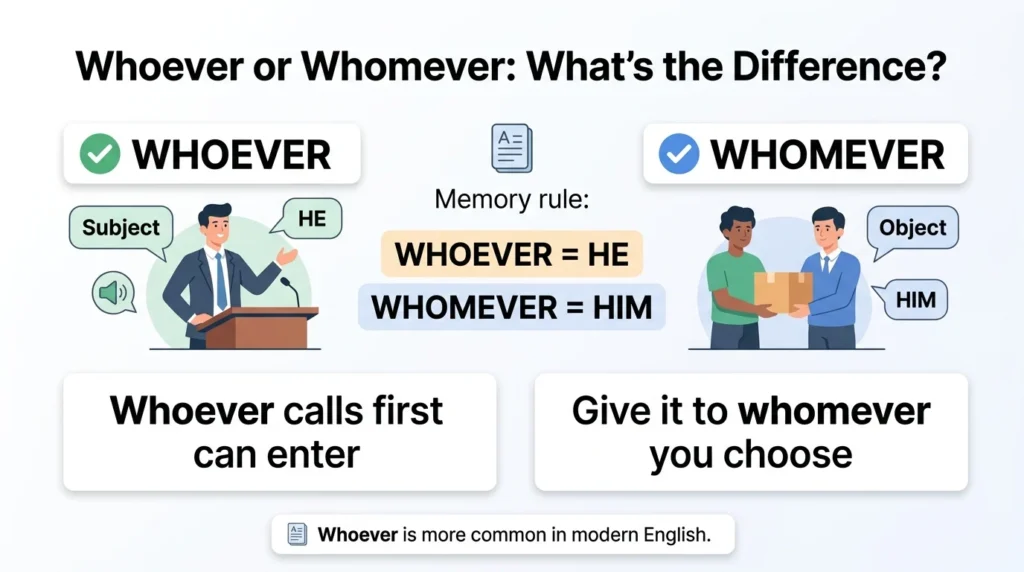
Whoever is used when the word acts as the subject of a clause, while whomever is used when it acts as the object. In modern everyday English, whoever is much more common, and it is often preferred even in places where whomever may be grammatically possible.
The difference between whoever or whomever can be confusing because both words refer to an unknown or unspecified person. The main difference is grammatical: whoever usually works as a subject, while whomever works as an object. This can sound difficult at first, but a simple trick makes the choice much easier. Replace the word with man or she or him or her. If man or she sounds correct, use whoever. If him or her sounds correct, use whomever. For example, “Whoever calls first will get the job” uses whoever because it is the subject. “Give the prize to whomever you choose” uses whomever because it is the object. This guide explains the difference with simple rules, examples, common mistakes, exercises, and practical usage.
What Does Whoever Mean?
It is used when the identity of a person is unknown or does not matter.
Whoever means any person who, the person who, or no matter who.
Examples
- Whoever calls first will get the job.
- Whoever finishes first can leave.
- Choose whoever you like.
- Whoever told you that was wrong.
- I will help whoever needs me.
The exact meaning depends on the sentence, but the word always relates to a person whose identity is not specified.
What Does Whomever Mean?
Whomever is the objective form of whoever.
It is traditionally used when the person is the object of a verb or preposition.
Examples
- Give the message to whomever you choose.
- Invite whomever you want.
- We will hire whomever the manager recommends.
- You may speak with whomever you prefer.
However, whomever is becoming less common in modern English. Many native speakers use whoever in these situations, especially in everyday speech.
Whoever vs Whomever
The main difference is grammatical.
| Word | Function | Simple Meaning | Example |
|---|---|---|---|
| Whoever | Subject | Any person who | Whoever arrives first can enter. |
| Whomever | Object | Any person whom | Give it to whomever you choose. |
The traditional rule is:
Whoever = who
Whomever = whom
The Easy He or Him Trick
One of the easiest ways to choose between whoever and whomever is to replace the word with he or him.
If he works, use whoever.
If him works, use whomever.
Example
Whoever arrives first will get the seat.
Ask:
He arrives first.
That works.
So:
Whoever is correct.
Another example:
Give the book to whomever you choose.
Ask:
Give the book to him.
That works.
So:
Whomever is traditionally correct.
Whoever as the Subject
Use whoever when the person performs the action.
Example
Whoever wins the competition will receive a prize.
Who performs the action?
Whoever wins.
Therefore, whoever is the subject.
Another example:
Whoever calls first will get an appointment.
The person who calls is performing the action.
Therefore:
Whoever is correct.
Whomever as the Object
Use whomever when the person receives the action.
Example
Choose whomever you want.
The person is receiving the action of choose.
Therefore, traditional grammar uses:
Whomever
Another example:
Invite whomever you like.
The person is the object of invite.
Whoever or Whomever After a Preposition
A preposition can sometimes help you identify the object.
Common prepositions include:
- To
- For
- With
- From
- By
- About
- Of
Traditional grammar often uses whomever after a preposition.
Examples
- To whomever it may concern
- With whomever you choose
- For whomever needs help
- From whomever you received it
However, modern English often uses whoever, especially when the sentence sounds more natural that way.
Whoever vs Whomever in Everyday English
In modern everyday English, whoever is much more common.
People often say:
Give it to whoever you want.
This sounds completely natural to many native speakers.
Traditional grammar may prefer:
Give it to whomever you want.
Both forms are widely understood, but whomever can sound formal, old fashioned, or overly careful.
Why Is Whomever Less Common?
English has changed over time.
The distinction between who and whom is becoming less important in everyday English. Many native speakers use who instead of whom, especially in conversation.
Because whomever is connected to whom, it has also become less common.
For example:
Whoever you choose is fine.
sounds natural.
Whomever you choose is fine.
sounds more formal to many speakers.
Formal vs Informal Usage
The choice can depend on the style of writing.
Informal English
In casual conversation, whoever is often the best choice.
Give the ticket to whoever wants it.
Formal English
In highly formal or traditional writing, whomever may be used when it is grammatically the object.
Give the ticket to whomever you deem appropriate.
However, even in formal writing, many modern style guides prefer clear and natural language over forcing whomever.
Common Mistakes
Mistake One
Incorrect according to traditional grammar:
Whomever arrives first gets the prize.
Better:
Whoever arrives first gets the prize.
Why?
The person is performing the action arrives.
Therefore, use whoever.
Mistake Two
Traditional grammar:
Give the prize to whoever you choose.
More traditionally:
Give the prize to whomever you choose.
Here, the person is the object of choose.
Mistake Three
Incorrect:
Whomever wants to join can come.
Correct:
Whoever wants to join can come.
The person is the subject of wants.
Mistake Four
Traditional grammar:
You can invite whoever you want.
More formally:
You can invite whomever you want.
The word is the object of invite.
In everyday English, however, whoever is very common.
Whoever in Relative Clauses
Whoever can introduce a clause that describes an unknown or unspecified person.
Examples
Whoever wins will receive a trophy.
Whoever needs help can call me.
Whoever made this cake did a great job.
These sentences all use whoever naturally.
Whomever in Relative Clauses
Whomever can also introduce a relative clause when it functions as the object.
Examples
I will support whomever you recommend.
She can invite whomever she wants.
Choose whomever you think is best.
These forms are grammatically traditional, but many modern speakers would use whoever instead.
A Common Complication
Sometimes the word after whoever or whomever makes the sentence tricky.
Consider:
Give the award to whoever deserves it.
You might think whomever is required because of to.
But look inside the clause:
Whoever deserves it.
The word whoever is the subject of deserves.
Therefore, whoever is correct.
This is why you should not always choose whomever simply because you see a preposition before it.
The Clause Test
When a sentence feels confusing, look at the clause containing whoever or whomever.
Example
Give the prize to whoever wins.
The smaller clause is:
Whoever wins.
Ask:
Who wins?
Whoever wins.
Therefore, use whoever.
Now consider:
Give the prize to whomever you choose.
The smaller clause is:
You choose whomever.
Here, the person is the object of choose.
Therefore, traditional grammar uses whomever.
Whoever or Whomever After To
This is one of the most confusing areas.
Consider:
Give the package to whoever answers the door.
Although to appears before the word, whoever is correct because it is the subject of answers.
Compare:
Give the package to whomever you select.
Here, whomever is the object of select.
This shows why you should examine the entire clause instead of looking only at the word before it.
Real World Examples
Example One
Whoever finishes the work first can go home.
The person performs the action finishes.
Use whoever.
Example Two
Choose whomever you trust.
The person receives the action choose.
Traditional grammar uses whomever.
Example Three
Whoever calls me can leave a message.
The person performs calls.
Use whoever.
Example Four
Send the email to whomever you think is responsible.
Inside the clause:
Whomever you think is responsible.
The person is the complement of is responsible, so many modern speakers may prefer whoever here.
A natural modern version is:
Send the email to whoever you think is responsible.
Whoever or Whomever in Business Writing
In professional writing, clarity is more important than using a complicated form.
For example:
Please contact whoever is responsible for the project.
This sounds natural and clear.
You could write:
Please contact whomever is responsible for the project.
But many readers may find it unnecessarily formal.
When the distinction is difficult, rewriting the sentence can often make it clearer.
For example:
Please contact the person responsible for the project.
This avoids the issue completely.
How to Remember the Difference
Use the simple he or him test.
Whoever
Replace it with he.
Whoever calls first will win.
He calls first.
Correct.
Whomever
Replace it with him.
Give it to whomever you choose.
Give it to him.
Correct.
Remember:
Whoever = he
Whomever = him
Whoever vs Whom
Understanding who vs whom makes whoever vs whomever easier.
| Subject | Object |
|---|---|
| Who | Whom |
| Whoever | Whomever |
| He | Him |
| She | Her |
| They | Them |
For example:
Who called?
He called.
But:
Whom did you call?
I called him.
The same basic idea applies to whoever and whomever.
Advantages and Disadvantages
Advantages of Using Whoever
- It is natural in modern English.
- It is widely understood.
- It works well in everyday speech.
- It avoids overly formal language.
- It is often easier for readers.
Disadvantages of Using Whoever
- Traditional grammar may prefer whomever in some object positions.
- It can be considered less formal in certain contexts.
Advantages of Using Whomever
- It follows traditional object grammar.
- It can be useful in formal writing.
- It clearly shows an object relationship when used correctly.
Disadvantages of Using Whomever
- It can sound formal or old fashioned.
- Many speakers rarely use it.
- It is easy to use incorrectly.
- It may make simple writing sound unnecessarily complicated.
Practice Exercises
Exercise One
Choose whoever or whomever.
- ______ arrives first can choose a seat.
- Give the package to ______ you trust.
- ______ wants to join the team can apply.
- Invite ______ you want.
- ______ calls should leave a message.
Answers
- Whoever
- Whomever
- Whoever
- Whomever
- Whoever
In modern everyday English, whoever is also commonly used in sentences such as number 2 and number 4.
Exercise Two
Use the He or Him Test.
- ______ wins the race gets the prize.
- Give the award to ______ you choose.
- ______ needs help can contact us.
- Talk to ______ you trust.
Answers
- Whoever
He wins the race. - Whomever
Give the award to him. - Whoever
He needs help. - Whomever
Talk to him.
Exercise Three
Correct the sentences according to traditional grammar.
- Whomever arrives first gets the ticket.
- Give the book to whoever you choose.
- Whoever you invite can attend.
- Whomever wants to participate should register.
Answers
- Whoever arrives first gets the ticket.
- Give the book to whomever you choose.
- Whoever you invite can attend.
In traditional grammar, whomever may also be used because it is the object of invite. - Whoever wants to participate should register.
FAQs
What is the difference between whoever and whomever?
Whoever is traditionally used as a subject, while whomever is traditionally used as an object. In modern English, whoever is much more common.
When should I use whoever?
Use whoever when the person performs the action, such as “Whoever arrives first can enter.”
When should I use whomever?
Use whomever when the person is the object of a verb or preposition, especially in formal or traditional writing.
Is whomever still correct in modern English?
Yes, whomever is still grammatically correct in appropriate object positions, but it is less common than whoever and can sound formal.
Is whoever more common than whomever?
Yes. Whoever is far more common in modern everyday English and is often preferred for natural, clear writing.
Conclusion
The difference between whoever or whomever comes down to their traditional grammatical roles. Whoever is used when the person acts as the subject, while whomever is used when the person acts as the object. The easiest way to test the difference is to replace the word with he or him. If he works, choose whoever. If him works, traditional grammar calls for whomever.
However, modern English is more flexible than older grammar rules. Whoever is much more common in everyday speech and writing, and many native speakers use it where traditional grammar would use whomever. If whomever makes a sentence sound too formal, you can often use whoever or rewrite the sentence for greater clarity. The most important thing is to understand the role of the word in the clause rather than choosing based only on the presence of a preposition. With the he or him test, choosing between these two words becomes much easier.