
Many people search for yay or nay because the two words often appear together in conversations, social media posts, polls, and decision making discussions. Although they rhyme and are commonly paired, they do not mean the same thing.
The word yay is used when someone feels happy, excited, or pleased about something. It is often seen in celebrations, achievements, and positive reactions. In contrast, nay is an older English word that means no, disagreement, rejection, or a negative vote.
The phrase yay or nay has become popular because people use it when asking for opinions or decisions. For example, someone might ask, “Should I buy this laptop, yay or nay?” In this case, they are asking for a positive or negative opinion.
Understanding yay or nay improves communication skills, grammar knowledge, and writing accuracy. This guide explains the meaning, history, usage, examples, common mistakes, comparisons, and practical applications of both words in simple language.
Quick Overview
Yay expresses happiness, approval, or excitement.
Nay expresses disagreement, rejection, or a negative response.
Yay is positive.
Nay is negative.
Both words are correct English words but serve different purposes.
Definition of Yay
Yay is an interjection used to express joy, excitement, celebration, approval, or success.
People often use yay when something good happens.
Examples:
- Yay, we won the game.
- Yay, my package arrived.
- Yay, it is finally Friday.
The word is informal and commonly used in speech, text messages, and social media.
Common Situations for Yay
- Celebrating achievements
- Receiving good news
- Winning competitions
- Completing goals
- Expressing excitement
Definition of Nay
Nay is a word that means no, refusal, disagreement, or rejection.
Historically, it was commonly used in formal voting procedures and parliamentary discussions.
Examples:
- The proposal received ten votes in favor and two votes nay.
- I say nay to that suggestion.
- The committee voted nay.
Although less common in everyday conversation, nay still appears in formal and literary contexts.
Key Difference Between Yay or Nay
The primary difference is meaning.
Yay is positive.
Nay is negative.
Quick Comparison Table
| Feature | Yay | Nay |
|---|---|---|
| Meaning | Happiness or approval | No or disagreement |
| Tone | Positive | Negative |
| Usage | Informal | Formal and informal |
| Emotion | Excitement | Rejection |
| Common Context | Celebrations | Voting and decisions |
| Opposite | Nay | Yay |
Visual Comparison of Yay or Nay


5
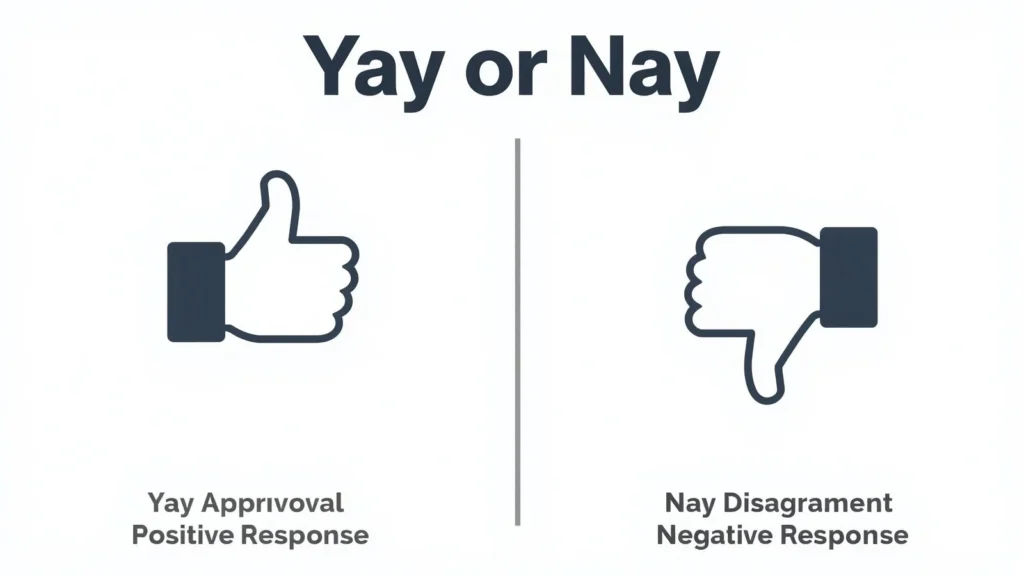
The comparison shows that yay represents approval and excitement, while nay represents disagreement and rejection.
Origin of the Word Yay
The exact origin of yay is uncertain, but it developed as an expression of excitement and celebration.
Over time, it became common in spoken English.
Today, people use yay frequently in:
- Social media
- Text messages
- Casual conversations
- Online communities
Examples:
- Yay, vacation starts tomorrow.
- Yay, I passed the exam.
Origin of the Word Nay
Nay has a much older history.
It comes from Old English and was traditionally used instead of no.
Historically, governments, councils, and assemblies often used yay and nay during voting procedures.
Examples:
- The motion passed with twenty yays and five nays.
- Members voted yay or nay on the proposal.
Even today, legislative bodies sometimes use the term.
Why People Confuse Yay or Nay
Several factors contribute to confusion.
Similar Sound
Both words rhyme.
Therefore, people may assume they are variations of the same word.
Frequent Pairing
The phrase yay or nay appears so often that learners sometimes misunderstand the meanings.
Informal Internet Usage
Online communication often shortens expressions, making the distinction less obvious.
Lack of Historical Knowledge
Many people know yay but are unfamiliar with the older meaning of nay.
How Yay Is Used in Everyday Conversations
Yay is extremely common in casual communication.
Examples:
- Yay, we are going on vacation.
- Yay, the weather is beautiful.
- Yay, my team won.
Because it expresses enthusiasm, it is often associated with positive emotions.
Social Media Examples
- Yay, one thousand followers.
- Yay, new job.
- Yay, weekend time.
How Nay Is Used in Decisions and Voting
Nay commonly appears when choices must be made.
Examples:
- Give me a yay or nay by tomorrow.
- The board voted nay.
- The proposal received several nay votes.
The word often indicates rejection or opposition.
Second Visual Comparison Section


5
Many organizations and groups use yay and nay when making decisions or conducting votes.
The Popular Phrase Yay or Nay
The phrase yay or nay means yes or no.
It is often used when requesting a decision.
Examples:
- Should I buy this car, yay or nay?
- Do you like the design, yay or nay?
- Is this idea good, yay or nay?
In these examples, the speaker wants a clear answer.
Yay in Modern Internet Culture
The internet has made yay even more popular.
People use it in:
- Comments
- Captions
- Messages
- Memes
- Forums
Examples:
- Yay, free shipping.
- Yay, new update.
- Yay, the project succeeded.
Its positive tone makes it highly engaging.
Nay in Literature and Formal Language
Although less common today, nay still appears in:
- Literature
- Historical documents
- Political discussions
- Formal voting records
Examples:
- He answered with a firm nay.
- The proposal received a nay vote.
This gives the word a more formal feel.
Advantages of Using Yay Correctly
Positive Communication
It expresses happiness clearly.
Friendly Tone
It creates an encouraging atmosphere.
Easy Understanding
Most people immediately recognize its meaning.
Social Media Engagement
Positive language often attracts attention.
Advantages of Using Nay Correctly
Precise Communication
It clearly expresses disagreement.
Formal Usage
It fits voting and decision making contexts.
Historical Accuracy
It reflects traditional English usage.
Clear Decision Making
It communicates rejection directly.
Common Mistakes When Using Yay or Nay
Mistake One
Using yay to mean no.
Incorrect:
- Yay, I disagree.
Correct:
- Nay, I disagree.
Mistake Two
Using nay to celebrate.
Incorrect:
- Nay, we won.
Correct:
- Yay, we won.
Mistake Three
Assuming nay is misspelled.
Correction:
Nay is a legitimate English word.
Mistake Four
Using yay in formal voting documents.
Correction:
Formal voting often uses yay and nay carefully according to context.
Real World Examples
Example One
A student passes an important exam.
Response:
- Yay, I passed.
Example Two
A city council votes on a proposal.
Result:
- Twelve voted yay and three voted nay.
Example Three
A shopper asks friends for advice.
Question:
- Should I buy these shoes, yay or nay?
Related Words and Comparisons
Several words are related to yay and nay.
Yay vs Yes
Yes confirms agreement.
Yay expresses excitement.
Nay vs No
Both mean rejection.
Nay sounds more formal.
Approval vs Disapproval
Yay indicates approval.
Nay indicates disapproval.
Positive vs Negative Response
Yay is positive.
Nay is negative.
Third Visual Comparison Section


6
These examples show how yay and nay communicate opposite ideas in decision making and communication.
Regional and Global Usage
Yay is widely used in English speaking countries around the world.
These include:
- United States
- United Kingdom
- Canada
- Australia
- New Zealand
Nay is also recognized globally but appears more often in formal contexts and historical writing.
Beginner to Advanced Understanding
Beginner Level
Yay means happiness.
Nay means no.
Intermediate Level
Yay expresses approval.
Nay expresses disagreement.
Advanced Level
Yay functions as an interjection expressing positive emotion, while nay serves as a formal negative response often associated with voting and decision making.
Practical Usage in Professional Communication
Professional communication sometimes uses yay and nay during voting procedures.
Examples:
- Board members voted yay.
- Directors voted nay.
- Please provide a yay or nay response by Friday.
Although yay is usually informal, it may appear in voting records and decision making contexts.
Exercises With Answers
Question One
Which word expresses excitement?
Answer: Yay
Question Two
Which word means no?
Answer: Nay
Question Three
Complete the sentence.
_____ we won the championship.
Answer: Yay
Question Four
Complete the sentence.
The committee voted _____ on the proposal.
Answer: Nay
Question Five
What does the phrase yay or nay mean?
Answer: Yes or no.
Question Six
Is nay a real English word?
Answer: Yes.
Question Seven
Which word is positive?
Answer: Yay
Question Eight
Which word is negative?
Answer: Nay
Question Nine
Can yay be used on social media?
Answer: Yes.
Question Ten
Can nay be used in voting?
Answer: Yes.
FAQs
Is yay or nay correct English?
Both are correct English words with different meanings.
What does yay mean?
Yay expresses excitement, happiness, or approval.
What does nay mean?
Nay means no, disagreement, or rejection.
Why do people say yay or nay?
They want a positive or negative opinion.
Is nay old fashioned?
It is older than no but still used today.
Can yay replace yes?
Not always. Yay expresses excitement, while yes confirms agreement.
Is nay used in politics?
Yes, especially during voting procedures.
Which word is more common today?
Yay is more common in everyday communication.
Can I use yay in professional writing?
Only when the tone and context are appropriate.
What is the opposite of yay?
Nay.
Conclusion
Understanding yay or nay is important for clear communication and proper English usage. Although the two words sound similar and often appear together, they have opposite meanings. Yay expresses happiness, approval, excitement, and celebration. Nay expresses disagreement, rejection, and a negative response.
The phrase yay or nay has become a popular way to ask for opinions, decisions, and feedback. It appears frequently in conversations, social media, business discussions, and voting situations. Using the correct word helps avoid confusion and ensures your message is understood accurately.
A simple rule makes the difference easy to remember. If the response is positive, use yay. If the response is negative, use nay. By applying this rule, writers, students, professionals, and English learners can communicate more confidently and effectively.