
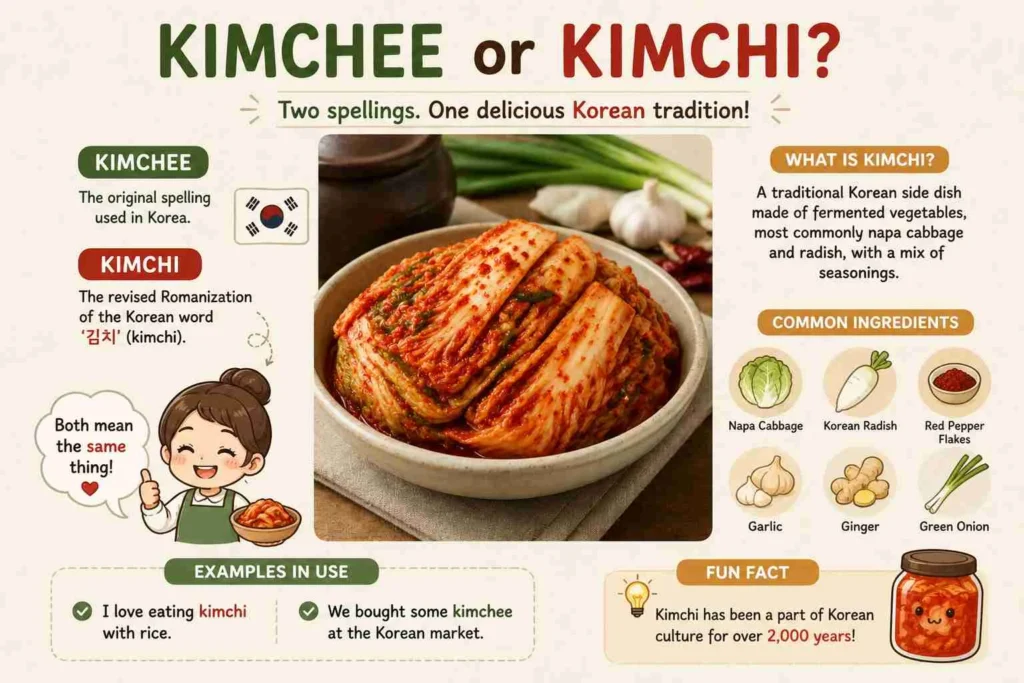

Many people search for kimchee or kimchi because both spellings appear online, in restaurants, on food packaging, and in recipes. Since the words sound almost identical, it is easy to assume they are different foods. However, this is not the case.
Kimchi is one of the most famous foods from Korea. It is known for its unique flavor, health benefits, and long history. Today, people around the world enjoy kimchi as a side dish, ingredient, or healthy snack. At the same time, some people still encounter the spelling kimchee and wonder whether it refers to a different dish.
The confusion comes mainly from language translation. Korean words can be written in English using different romanization systems. As a result, both spellings have appeared over the years. However, modern usage strongly favors kimchi.
Understanding kimchee or kimchi helps writers, students, food lovers, travelers, and bloggers use the correct spelling and communicate more accurately. This guide explains the differences, history, pronunciation, cultural importance, health benefits, common mistakes, and real world usage in simple language.
Quick Overview
Kimchi is the correct and modern spelling.
Kimchee is an older alternative spelling.
Both words refer to the same Korean fermented dish.
Kimchi is the spelling used in dictionaries, restaurants, recipes, and food publications.
Definition of Kimchi
Kimchi is a traditional Korean dish made by fermenting vegetables with seasonings.
The most common ingredients include:
- Napa cabbage
- Radish
- Garlic
- Ginger
- Chili pepper
- Salt
The fermentation process creates a unique flavor that is spicy, tangy, and slightly sour.
Kimchi has been a major part of Korean cuisine for centuries.
Definition of Kimchee
Kimchee is simply an alternative English spelling of kimchi.
It refers to exactly the same food.
There is no difference in ingredients, preparation, taste, or cultural meaning.
The spelling kimchee became popular in some English speaking regions before standardized Korean romanization became widely accepted.
Today, kimchi is the preferred spelling.
Key Difference Between Kimchee or Kimchi
The main difference is spelling rather than food.
Quick Comparison Table
| Feature | Kimchi | Kimchee |
|---|---|---|
| Same Food | Yes | Yes |
| Modern Usage | Yes | Less Common |
| Dictionary Preferred | Yes | Usually Listed as Variant |
| Restaurant Menus | Very Common | Less Common |
| Korean Government Usage | Yes | No |
| Recommended Spelling | Yes | No |
Kimchi is the standard modern spelling.
Kimchee is an alternative spelling that still appears occasionally.
Visual Comparison of Kimchee or Kimchi


5
The visual comparison highlights that both spellings refer to the same Korean dish, but kimchi is the preferred modern form.
The History of Kimchi
Kimchi has a history stretching back thousands of years.
Before refrigerators existed, people needed ways to preserve vegetables during harsh winters. Fermentation became an effective solution.
Ancient Koreans developed methods of preserving vegetables using salt and natural fermentation.
Over time, recipes evolved.
Eventually, ingredients such as chili peppers became common, creating the spicy kimchi known today.
Kimchi became more than food.
It became an important part of Korean identity and culture.
Today, millions of people eat kimchi daily.
Why People Search for Kimchee or Kimchi
There are several reasons behind the confusion.
Different Romanization Systems
Korean words have been translated into English using different systems.
As a result, spellings changed over time.
Older Cookbooks
Many older English language cookbooks used kimchee.
Modern cookbooks typically use kimchi.
Product Packaging
Some imported products still use kimchee.
This creates confusion among consumers.
Internet Content
Older websites may still contain the alternative spelling.
Consequently, both versions continue appearing in search results.
How Kimchi Is Made
The process of making kimchi involves several steps.
Preparing Vegetables
Cabbage or radish is cleaned and cut.
Salting
Vegetables are salted to remove excess moisture.
Creating Seasoning
Garlic, ginger, chili flakes, and other ingredients are mixed.
Mixing
The seasoning is combined with the vegetables.
Fermentation
The mixture is stored in containers and allowed to ferment.
Storage
After fermentation, kimchi is refrigerated and enjoyed.
This process creates beneficial bacteria that contribute to flavor and health benefits.
Popular Types of Kimchi
Many people think there is only one type of kimchi.
In reality, there are hundreds of varieties.
Baechu Kimchi
Made primarily with Napa cabbage.
Kkakdugi
Made with cubed radish.
Oi Kimchi
Made with cucumber.
White Kimchi
Prepared without chili peppers.
Green Onion Kimchi
Made using green onions.
Different regions of Korea often have their own unique recipes.
Health Benefits of Kimchi


5
Kimchi is widely recognized as a nutritious food.
Rich in Probiotics
Fermentation produces beneficial bacteria.
These probiotics support digestive health.
Low in Calories
Kimchi provides flavor without excessive calories.
Contains Vitamins
Kimchi contains vitamins A, B, C, and K.
Supports Gut Health
Healthy bacteria contribute to digestive balance.
Rich in Antioxidants
Many ingredients contain compounds that help protect cells.
As a result, kimchi is often included in healthy eating plans.
Kimchi in Korean Culture
Kimchi is much more than a side dish.
It plays an important cultural role.
Families often gather to prepare large batches together.
This tradition is known as Kimjang.
Kimjang represents cooperation, family values, and community spirit.
The cultural importance of kimchi is recognized internationally.
It remains one of Korea’s most famous foods.
Kimchi Around the World
Kimchi has become popular far beyond Korea.
Today, it can be found in:
- North America
- Europe
- Australia
- Southeast Asia
- Middle East
Many restaurants include kimchi in creative dishes such as:
- Kimchi fried rice
- Kimchi burgers
- Kimchi tacos
- Kimchi noodles
- Kimchi soups
Its popularity continues growing every year.
Kimchi in Modern Cooking


7
Modern chefs use kimchi in many ways.
Examples include:
- Sandwiches
- Pizza
- Pasta
- Salads
- Rice bowls
The strong flavor adds depth and complexity to dishes.
Therefore, chefs frequently experiment with kimchi.
Advantages of Using the Correct Spelling
Using kimchi instead of kimchee offers several benefits.
Better Communication
Most readers recognize kimchi instantly.
Improved Search Visibility
Kimchi receives significantly more searches.
Professional Writing
Food writers generally use kimchi.
Cultural Accuracy
Kimchi aligns with modern Korean romanization.
Disadvantages of Using Kimchee
Using kimchee may create confusion.
Appears Outdated
Many readers consider it an older spelling.
Lower Recognition
Modern audiences are more familiar with kimchi.
Search Limitations
Kimchi is the dominant search term.
Less Common Usage
Restaurants and publishers increasingly prefer kimchi.
Real World Examples
Example One
A food blogger writes an article about homemade kimchi.
Example Two
A restaurant menu lists kimchi fried rice.
Example Three
A grocery store sells jars labeled kimchi.
Example Four
A cooking channel teaches viewers how to make kimchi.
In all these situations, kimchi is usually the preferred spelling.
Common Mistakes When Using Kimchee or Kimchi
Mistake One
Thinking they are different foods.
Correction:
They refer to the same dish.
Mistake Two
Assuming kimchee is the modern spelling.
Correction:
Kimchi is the preferred modern spelling.
Mistake Three
Using both spellings in the same article.
Correction:
Choose one spelling and remain consistent.
Mistake Four
Believing kimchi is only cabbage.
Correction:
Many vegetables can be used.
Mistake Five
Thinking all kimchi is extremely spicy.
Correction:
Some varieties are mild.
Related Concepts and Comparisons
Kimchi vs Sauerkraut
Both are fermented vegetable dishes.
However, kimchi typically contains spices and seasonings.
Kimchi vs Pickles
Pickles are usually preserved in vinegar.
Kimchi relies on fermentation.
Fermented Foods
Kimchi belongs to a larger category of fermented foods.
Examples include:
- Yogurt
- Kefir
- Miso
- Tempeh
Korean Cuisine
Kimchi is one of the most important foods in Korean cuisine.
Beginner to Advanced Understanding
Beginner Level
Kimchi is the correct spelling.
Kimchee is an alternative spelling.
Intermediate Level
Both spellings describe the same fermented Korean food.
Kimchi is preferred today.
Advanced Level
Kimchi represents centuries of Korean culinary tradition, cultural identity, fermentation science, and global food influence.
Regional and Global Usage
In Korea, kimchi is the standard spelling used internationally.
In North America, Europe, and Australia, kimchi dominates restaurant menus and food publications.
Kimchee occasionally appears on older packaging and historical references.
However, modern usage strongly favors kimchi.
Exercises With Answers
Question One
Which spelling is preferred today?
Answer: Kimchi
Question Two
Do kimchi and kimchee refer to different foods?
Answer: No
Question Three
What type of food is kimchi?
Answer: Fermented vegetables
Question Four
Which country is kimchi associated with?
Answer: Korea
Question Five
Is kimchee considered a modern standard spelling?
Answer: No
Question Six
Does kimchi contain probiotics?
Answer: Yes
Question Seven
Can kimchi be made from vegetables other than cabbage?
Answer: Yes
Question Eight
Which spelling appears most often on restaurant menus?
Answer: Kimchi
FAQs
Is kimchee or kimchi correct?
Kimchi is the preferred modern spelling used worldwide.
Are kimchee and kimchi the same food?
Yes, both names refer to the same Korean fermented dish.
Why do some people write kimchee?
It comes from older English transliterations of Korean words.
Which spelling should I use in writing?
Use kimchi because it is the accepted modern form.
Is kimchi healthy?
Yes, kimchi contains vitamins, fiber, and beneficial probiotics.
Does kimchi always contain cabbage?
No, many varieties use radish, cucumber, and other vegetables.
Why is kimchi popular around the world?
People enjoy its flavor, versatility, and health benefits.
Is kimchi spicy?
Many versions are spicy, but mild varieties also exist.
Can beginners eat kimchi?
Yes, mild kimchi varieties are suitable for beginners.
Which spelling is better for SEO, kimchee or kimchi?
Kimchi is generally the stronger and more widely recognized search term.
Conclusion
Understanding kimchee or kimchi is easier once you know that both spellings refer to the same traditional Korean fermented food. The key difference is not the dish itself but the spelling used to represent it in English.
Today, kimchi is the preferred and widely accepted spelling. It appears in dictionaries, restaurant menus, cookbooks, food blogs, and international publications. Meanwhile, kimchee survives mainly as an older alternative spelling that occasionally appears on packaging or historical references.
Beyond spelling, kimchi is one of the world’s most famous fermented foods. It offers a rich history, cultural significance, nutritional value, and remarkable versatility in cooking. Whether served as a side dish or used in modern fusion cuisine, kimchi continues to gain popularity across the globe.
For accurate writing, professional communication, and modern usage, choose kimchi. Doing so aligns with current language standards and helps readers immediately recognize this iconic Korean dish.