
Many writers, students, bloggers, and professionals search for engrained or ingrained because both spellings appear online. At first glance, they seem interchangeable. Since they sound very similar and share a related history, it is easy to understand why people become confused.
However, modern English has a clear preference. Most dictionaries, style guides, educational institutions, and professional editors recommend using ingrained. This spelling is considered standard in academic writing, business communication, journalism, and everyday English.
The word is commonly used when describing habits, traditions, values, attitudes, beliefs, skills, behaviors, and cultural practices that have become deeply established over time. Understanding the difference between engrained or ingrained can improve your grammar, writing quality, and professional credibility.
This guide explains everything you need to know about engrained or ingrained, including definitions, historical development, modern usage, examples, grammar rules, common mistakes, related concepts, exercises, and frequently asked questions.
Quick Overview
Ingrained is the preferred modern spelling.
Engrained is an older variant spelling.
Both words carry similar meanings.
Most dictionaries recommend ingrained.
Ingrained is used in academic, professional, and everyday writing.
Definition of Ingrained
Ingrained means deeply rooted, firmly fixed, or permanently established.
It often describes habits, attitudes, beliefs, traditions, behaviors, or values that have become difficult to change.
Examples:
- Respect for elders is ingrained in many cultures.
- Good study habits become ingrained over time.
- Safety procedures are ingrained in employee training.
- The value of honesty was ingrained during childhood.
The word suggests something that has developed gradually and become a natural part of a person or group.
Definition of Engrained
Engrained is an alternative historical spelling that appears in some older texts and publications.
Although it shares the same meaning as ingrained, it is rarely preferred in modern English.
Examples from historical usage may include:
- The tradition became engrained in society.
- Certain customs were engrained over generations.
Today, most editors would replace engrained with ingrained.
Key Difference Between Engrained or Ingrained
The primary difference is modern acceptance.
Comparison Table
| Feature | Ingrained | Engrained |
|---|---|---|
| Modern English | Preferred | Rare |
| Dictionary Acceptance | Yes | Sometimes listed as variant |
| Academic Writing | Recommended | Usually avoided |
| Business Writing | Recommended | Rare |
| Journalism | Common | Uncommon |
| Professional Use | Standard | Limited |
| Meaning | Deeply rooted | Deeply rooted |
The meaning is nearly identical, but ingrained is the standard spelling used today.
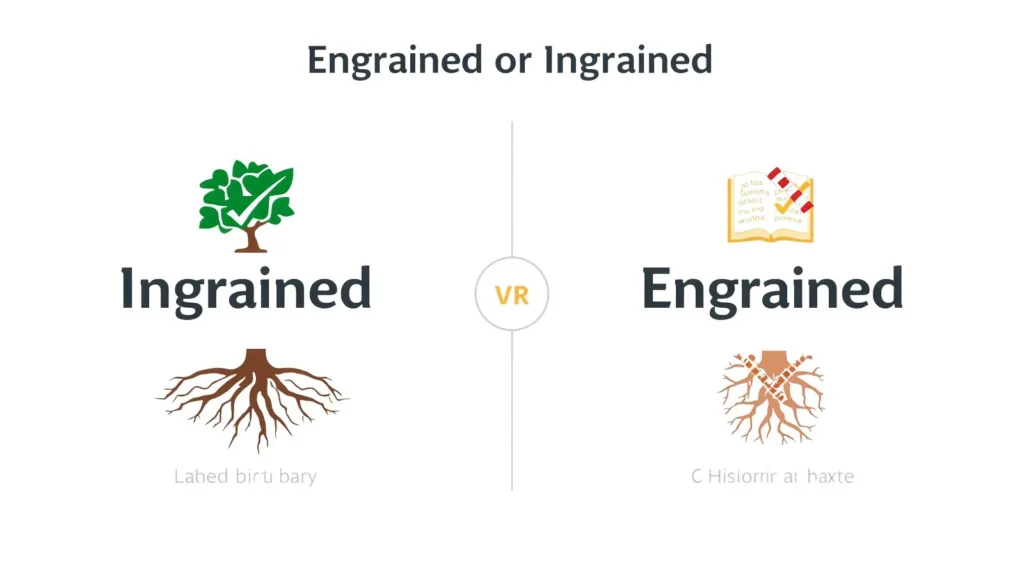
Visual Comparison of Engrained or Ingrained


Modern dictionaries overwhelmingly favor ingrained as the standard spelling.
History of the Word
Understanding the history helps explain the confusion.
The word originated from concepts related to deeply embedding or fixing something into a material. Over time, it developed a figurative meaning that described ideas, behaviors, and habits becoming firmly established.
Historically, both engrained and ingrained appeared in English writing. However, language evolved, and ingrained gradually became the dominant spelling.
Today, major dictionaries, educational institutions, and publishing organizations use ingrained almost exclusively.
Why People Confuse Engrained or Ingrained
Several factors contribute to the confusion.
Similar Pronunciation
Both spellings sound almost identical.
Because of this, many writers assume either spelling is acceptable.
Historical Usage
Older books and publications sometimes contain engrained.
Readers who encounter these sources may believe it remains standard.
Online Content
Some websites continue using engrained.
This creates uncertainty among learners.
Lack of Dictionary Verification
Many people write words based on memory rather than checking authoritative sources.
How Ingrained Is Used in Everyday Language
The word ingrained appears frequently in daily communication.
Examples include:
- Ingrained habits
- Ingrained beliefs
- Ingrained values
- Ingrained traditions
- Ingrained behaviors
People often use the word when discussing long term patterns that are difficult to change.
Example:
- Punctuality became an ingrained habit after years of practice.
Ingrained in Education
Education provides many examples of ingrained behaviors.
Teachers often help students develop positive habits.
Examples:
- Reading daily becomes ingrained through repetition.
- Good study techniques become ingrained over time.
- Classroom rules become ingrained in student behavior.
Learning relies heavily on repetition, which helps create ingrained knowledge and skills.
Ingrained in Workplace Culture
Businesses often discuss ingrained company values.
Examples include:
- Customer service excellence
- Professional conduct
- Teamwork
- Accountability
- Safety awareness
Successful organizations create ingrained workplace habits that guide employee behavior.
Visual Examples of Ingrained Habits


4
These examples show how repeated actions gradually become ingrained behaviors.
Ingrained in Psychology
Psychology frequently uses the concept of ingrained behavior.
An ingrained behavior develops through repeated experiences and reinforcement.
Examples include:
- Daily routines
- Emotional reactions
- Communication styles
- Social habits
Psychologists often study how deeply established patterns influence decision making.
Ingrained in Culture and Society
Many traditions become ingrained within communities.
Examples include:
- National celebrations
- Cultural customs
- Religious practices
- Social expectations
These traditions often continue across generations because they become deeply embedded in society.
Ingrained in Sports and Training
Athletes develop ingrained skills through practice.
Examples include:
- Shooting techniques in basketball
- Swing mechanics in golf
- Passing skills in soccer
- Footwork in boxing
Repeated practice turns complex actions into automatic responses.
Advantages of Understanding the Correct Spelling
Using ingrained correctly offers several benefits.
Improved Writing Quality
Correct spelling enhances readability.
Professional Credibility
Accurate language creates a professional impression.
Better Academic Performance
Students avoid unnecessary spelling mistakes.
Stronger Communication
Readers immediately understand the intended meaning.
Disadvantages of Using Engrained in Modern Writing
Using engrained may create issues.
Reader Confusion
Some readers may assume it is a spelling error.
Editorial Corrections
Editors frequently replace engrained with ingrained.
Reduced Professional Appearance
Nonstandard spellings can weaken credibility.
Academic Concerns
Many instructors prefer modern standard usage.
Common Mistakes When Using Engrained or Ingrained
Mistake One
Using engrained in academic papers.
Correction:
Use ingrained.
Mistake Two
Assuming both spellings are equally common.
Correction:
Ingrained is significantly more common.
Mistake Three
Using engrained because it sounds logical.
Correction:
Modern dictionaries recommend ingrained.
Mistake Four
Mixing both spellings within the same document.
Correction:
Use ingrained consistently.
Real World Examples
Example One
A company emphasizes customer service.
Correct sentence:
- Customer care is ingrained in our company culture.
Example Two
A student studies daily.
Correct sentence:
- Effective study habits became ingrained over time.
Example Three
A community celebrates an annual festival.
Correct sentence:
- The tradition is deeply ingrained in local culture.
Example Four
A professional athlete practices regularly.
Correct sentence:
- Proper technique became ingrained through years of training.
Related Words and Concepts
Several words share similar meanings.
Embedded
Firmly placed within something.
Rooted
Deeply established.
Entrenched
Strongly fixed and difficult to change.
Established
Widely accepted and practiced.
Internalized
Accepted as part of one’s beliefs or behavior.
Grammar and Usage Rules
The word ingrained is usually used as an adjective.
Examples:
- Ingrained habits
- Ingrained beliefs
- Ingrained traditions
It can also appear in passive constructions.
Example:
- Respect was ingrained from childhood.
Professional writers often use it to describe long term development.
Beginner to Advanced Understanding
Beginner Level
Ingrained means deeply rooted.
Engrained is rarely used today.
Intermediate Level
Ingrained describes habits, values, traditions, and behaviors that become difficult to change.
Advanced Level
The concept of ingrained behavior plays an important role in psychology, education, culture, leadership, and organizational development.
Regional and Global Usage
The preference for ingrained exists worldwide.
Countries that primarily use English generally favor ingrained.
This includes:
- United States
- United Kingdom
- Canada
- Australia
- New Zealand
Major dictionaries across these regions list ingrained as the preferred spelling.
Professional Writing Recommendations
Editors, teachers, and style guides recommend:
- Use ingrained in articles.
- Use ingrained in academic papers.
- Use ingrained in business reports.
- Use ingrained in professional communication.
Following modern standards improves clarity and credibility.
Second Visual Comparison Section


4
Professional and academic writing overwhelmingly favors ingrained.
Exercises With Answers
Question One
Which spelling is preferred in modern English?
Answer: Ingrained
Question Two
Which spelling appears less frequently today?
Answer: Engrained
Question Three
What does ingrained mean?
Answer: Deeply rooted or firmly established.
Question Four
Which sentence is correct?
Answer: Honesty is ingrained in the company culture.
Question Five
Can ingrained describe habits?
Answer: Yes.
Question Six
Can ingrained describe traditions?
Answer: Yes.
Question Seven
Is engrained usually recommended in professional writing?
Answer: No.
Question Eight
Which spelling should students use?
Answer: Ingrained.
Question Nine
Can values become ingrained?
Answer: Yes.
Question Ten
Is ingrained widely accepted internationally?
Answer: Yes.
FAQs
Is ingrained or engrained correct?
Both exist historically, but ingrained is the preferred modern spelling.
Why is ingrained more common than engrained?
Language evolved over time, and dictionaries adopted ingrained as the standard form.
Is engrained wrong?
It is not always considered completely wrong, but it is generally avoided in modern writing.
Which spelling should students use?
Students should use ingrained.
Do dictionaries recognize engrained?
Some dictionaries list it as a variant, but ingrained is preferred.
Can ingrained describe habits?
Yes. It commonly describes deeply established habits.
Can ingrained describe beliefs?
Yes. Ingrained beliefs are deeply rooted beliefs.
Is ingrained used in psychology?
Yes. Psychologists often discuss ingrained behaviors and thought patterns.
Can traditions become ingrained?
Yes. Cultural traditions often become ingrained over generations.
Which spelling is best for professional writing?
Ingrained is the recommended choice.
Conclusion
Understanding engrained or ingrained becomes simple once you know modern English preferences. While both spellings share similar historical roots and meanings, ingrained is the accepted standard in contemporary writing. It appears in dictionaries, educational materials, academic publications, professional reports, journalism, and everyday communication.
The word ingrained describes habits, beliefs, values, traditions, behaviors, and skills that become deeply rooted through repetition and experience. It is widely used in psychology, education, business, culture, leadership, and personal development.
Although engrained occasionally appears in older texts, modern writers are strongly encouraged to use ingrained for clarity and professionalism. Whether you are writing an article, preparing a school assignment, creating business content, or improving your vocabulary, choosing ingrained will ensure your writing follows current English standards and communicates effectively.