
Many people search for yay or yey because both words seem to express excitement and joy. They sound very similar when spoken, which often creates confusion about which spelling should be used in writing.
The word yay is common in everyday English. People use it when celebrating good news, achievements, victories, birthdays, holidays, and special moments. You may see children shout yay after winning a game or adults write yay when sharing exciting news online.
On the other hand, yey appears frequently on social media, in text messages, and in casual conversations. Because it sounds almost identical to yay, some people assume both spellings are equally correct. However, dictionaries and grammar guides generally recognize yay as the standard spelling.
Understanding yay or yey is important for students, writers, bloggers, professionals, and anyone who wants to communicate clearly. This guide explains the differences, meanings, grammar rules, examples, common mistakes, real world usage, and much more in simple language.
Quick Overview
Yay is the standard English spelling.
Yey is usually considered an informal alternative spelling.
Yay expresses excitement, happiness, celebration, or approval.
Yey appears mostly in casual online communication.
For professional and academic writing, yay is recommended.
Definition of Yay
Yay is an interjection.
An interjection is a word used to express emotion.
People use yay when they feel excited, happy, relieved, or proud.
Examples:
- Yay, we won the competition.
- Yay, my package arrived today.
- Yay, summer vacation starts tomorrow.
The word immediately communicates positive feelings.
Common Situations Where Yay Is Used
- Celebrating achievements
- Receiving good news
- Winning games
- Finishing projects
- Passing exams
- Birthday celebrations
- Holiday announcements
Because of its positive tone, yay is one of the most popular celebratory expressions in English.
Definition of Yey
Yey is an informal variation of yay.
It is commonly found in:
- Social media posts
- Text messages
- Online chats
- Informal comments
Examples:
- Yey, I finished my homework.
- Yey, the weekend is here.
Although many people understand its meaning, most dictionaries do not list yey as the preferred spelling.
Therefore, yay remains the standard choice.
Key Difference Between Yay or Yey
The main difference is standard usage.
Yay is accepted by dictionaries and grammar guides.
Yey is generally considered an informal alternative.
Quick Comparison Table
| Feature | Yay | Yey |
|---|---|---|
| Dictionary Accepted | Yes | Rarely |
| Standard English | Yes | No |
| Professional Writing | Yes | No |
| Academic Writing | Yes | No |
| Social Media Usage | Common | Common |
| Recommended Spelling | Yes | No |
Visual Comparison of Yay or Yey


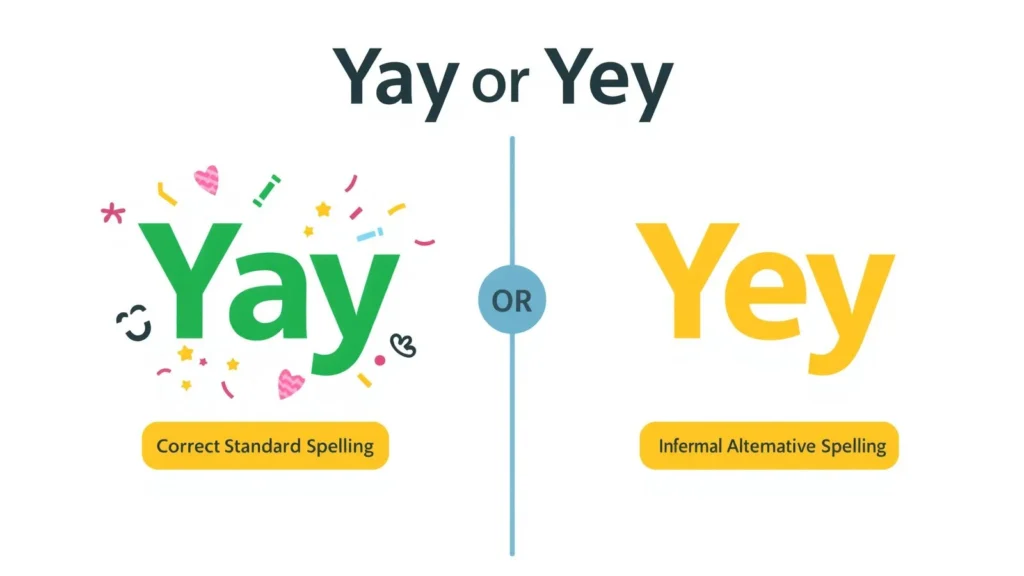
The comparison shows that yay is the accepted spelling in standard English, while yey is mostly used informally online.
Origin of the Word Yay
The word yay has existed in English for many years.
Language experts believe it developed as a natural expression of joy and excitement.
Over time, it became a common way to celebrate positive events.
Today, people of all ages use yay in speech and writing.
Examples:
- Yay for the winning team.
- Yay for good weather.
- Yay for finishing the project.
Because it is simple and expressive, the word remains extremely popular.
Why People Confuse Yay or Yey
Several factors contribute to the confusion.
Similar Pronunciation
Both spellings sound almost identical.
As a result, people often assume both are correct.
Internet Culture
Social media encourages creative spellings.
Therefore, many users write yey instead of yay.
Informal Communication
Text messages often contain shortened or alternative spellings.
This makes informal forms appear more common than they actually are.
Lack of Grammar Awareness
Some writers are unaware that dictionaries favor yay.
How Yay Is Used in Everyday Conversation
People frequently use yay in daily communication.
Examples:
- Yay, the food is ready.
- Yay, school is closed tomorrow.
- Yay, we finally arrived.
The word instantly communicates enthusiasm.
Because of this, it appears in conversations around the world.
Yay in Social Media
Social media platforms contain millions of examples of yay.
People use it when:
- Sharing achievements
- Announcing vacations
- Posting engagement news
- Celebrating birthdays
- Reaching milestones
Examples:
- Yay, one thousand followers.
- Yay, I got the job.
- Yay, the new product launched today.
The word creates a friendly and positive tone.
Yay in Education
Teachers and students often use yay.
Examples:
- Yay, we completed the project.
- Yay, everyone passed the test.
- Yay, the science fair was successful.
The expression helps encourage motivation and positivity.
Second Visual Comparison Section


7
Yay is commonly associated with success, happiness, celebration, and achievement.
Yay in Business Communication
Although business communication is usually formal, yay sometimes appears in internal messages and team chats.
Examples:
- Yay, we reached our quarterly goal.
- Yay, the project launched successfully.
However, highly formal reports usually avoid emotional interjections.
Yay in Marketing and Advertising
Marketers use positive language to engage audiences.
Examples:
- Yay, free shipping today.
- Yay, exclusive discounts available.
- Yay, our new collection has arrived.
The word creates excitement and encourages engagement.
Advantages of Using Yay
Standard English
Yay is widely accepted.
Professional Credibility
It appears more polished than alternative spellings.
Better Communication
Readers instantly understand the meaning.
Academic Acceptance
Teachers and editors recognize it as correct.
Disadvantages of Using Yey
Not Standard English
Most style guides do not recommend it.
Reduced Professionalism
It may appear careless in formal writing.
Potential Confusion
Some readers may question the spelling.
Academic Issues
Teachers may mark it as incorrect.
Real World Examples
Example One
A student passes an important exam.
Correct response:
- Yay, I passed.
Example Two
A company reaches a sales goal.
Correct response:
- Yay, we achieved our target.
Example Three
A traveler arrives safely.
Correct response:
- Yay, we made it.
Example Four
A child wins a game.
Correct response:
- Yay, I won.
Common Mistakes When Using Yay or Yey
Mistake One
Using yey in academic essays.
Correction:
Use yay.
Mistake Two
Assuming both spellings are equally accepted.
Correction:
Yay is the standard form.
Mistake Three
Using alternative spellings in professional documents.
Correction:
Always use yay.
Mistake Four
Ignoring audience expectations.
Correction:
Formal audiences generally expect standard spelling.
Related Expressions
Several expressions have meanings similar to yay.
Hooray
A traditional celebration word.
Woohoo
An enthusiastic expression of excitement.
Awesome
Used to show approval.
Great
Expresses satisfaction.
Excellent
Indicates success or quality.
Third Visual Comparison Section


These expressions all communicate positive emotions, but yay remains one of the most common.
Regional and Global Usage
Yay is widely used throughout English speaking countries.
This includes:
- United States
- United Kingdom
- Canada
- Australia
- New Zealand
The spelling remains consistent across regions.
Yey may appear online, but yay is still preferred internationally.
Beginner to Advanced Understanding
Beginner Level
Yay is correct.
Yey is usually informal.
Intermediate Level
Yay expresses excitement and happiness.
It appears in speech, writing, and online communication.
Advanced Level
Writers choose yay because it follows standard English conventions and maintains credibility across audiences.
Psychological Impact of Positive Expressions
Positive words influence emotions.
When people use yay, they reinforce feelings of:
- Success
- Happiness
- Motivation
- Achievement
Psychologists often note that positive language can improve mood and social interaction.
Because of this, yay remains popular in daily communication.
Yay in Popular Culture
Movies, television shows, books, and online content frequently use yay.
Characters often say yay after:
- Winning competitions
- Receiving good news
- Solving problems
- Achieving goals
The expression has become part of everyday culture.
Exercises With Answers
Question One
Which spelling is standard English?
Answer: Yay
Question Two
Which spelling appears more often in dictionaries?
Answer: Yay
Question Three
Which word expresses excitement?
Answer: Yay
Question Four
Is yey commonly used in professional writing?
Answer: No
Question Five
Can yay be used on social media?
Answer: Yes
Question Six
Which spelling should students use?
Answer: Yay
Question Seven
Is yey considered informal?
Answer: Yes
Question Eight
Which spelling is recommended by grammar guides?
Answer: Yay
Question Nine
Can yay express celebration?
Answer: Yes
Question Ten
Is yay recognized internationally?
Answer: Yes
FAQs
Is yay or yey correct?
Yay is the correct and standard English spelling.
Why do people write yey?
Many people spell it based on pronunciation or internet habits.
Is yey a real word?
It may appear informally online, but yay is the preferred spelling.
Can I use yay in professional writing?
Yes, when an informal celebratory tone is appropriate.
Is yay accepted in dictionaries?
Yes, it is widely recognized.
What does yay mean?
It expresses happiness, excitement, approval, or celebration.
Is yay common on social media?
Yes, it is extremely common.
Should students use yay or yey?
Students should use yay.
Is yey wrong?
In formal English, yay is preferred.
How can I remember the correct spelling?
Remember that dictionaries and grammar guides support yay.
Conclusion
Understanding yay or yey is simple once you know the standard spelling rules. Yay is the accepted English interjection used to express happiness, excitement, success, approval, and celebration. It appears in dictionaries, educational materials, professional communication, and everyday conversations.
Yey, while sometimes seen in social media posts and casual messages, is generally considered an informal alternative rather than the standard spelling. For academic writing, business communication, blogging, and professional content, yay is the recommended choice.
Whether you are celebrating a victory, sharing good news, announcing an achievement, or expressing excitement, using yay helps ensure your writing remains clear, accurate, and widely understood. The easiest rule to remember is simple: yay is standard English, while yey is mainly informal internet usage