
Quick Answer
Whether is used for choices, possibilities, and uncertainty, while weather refers to conditions in the air, such as rain, heat, wind, or snow. For example, “I do not know whether she will come” is correct, while “The weather is cold today” uses weather correctly.
Have you ever typed whether and wondered if you should use weather instead? You are not alone. These two words sound the same in most English accents, but they have very different meanings. That makes whether or weather a common spelling and grammar problem for students, writers, and even native English speakers.
The good news is that the difference is easy to understand. Whether is about a choice, possibility, or question. Weather is about what is happening outside. Rain, sunshine, snow, wind, clouds, and temperature are all related to weather. On the other hand, a sentence such as “I do not know whether he will come” has nothing to do with the sky.
Once you connect each word with its meaning, the confusion becomes much easier to avoid. This guide explains whether or weather with simple definitions, everyday examples, common mistakes, useful sentence patterns, and practice exercises. By the end, you will know exactly when to use each word.
What Is the Difference Between Whether and Weather?
The main difference is meaning.
Whether is used when you are talking about a choice, possibility, or uncertainty.
Weather is a noun that describes atmospheric conditions.
| Word | Meaning | Example |
|---|---|---|
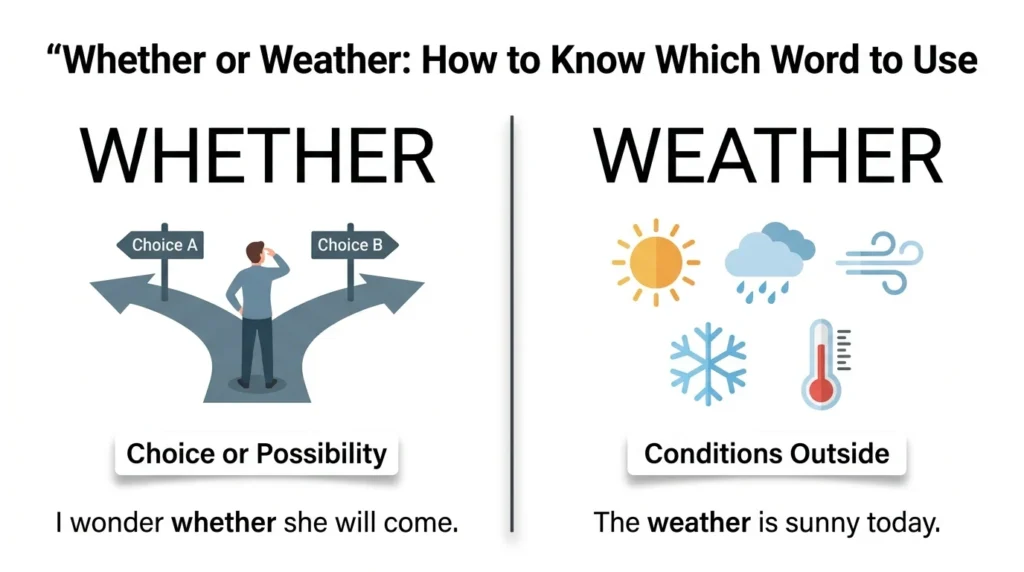
| Whether | Choice or possibility | I do not know whether he is coming. |
| Weather | Conditions outside | The weather is cold today. |
A simple way to remember this is:
Whether = choice
Weather = conditions outside
For example:
I cannot decide whether to go.
There is a choice.
The weather is too cold to go outside.
There is an outdoor condition.
What Does Whether Mean?
Whether is used when you are considering different possibilities.
It often appears when you are not sure about something.
For example:
I do not know whether she will call.
The speaker does not know if she will call.
Here is another example:
We need to decide whether to stay or leave.
There are two choices.
You can also use whether when there are several possible outcomes.
The manager will decide whether the project should continue.
The manager is considering a possibility and making a decision.
What Does Weather Mean?
Weather refers to the condition of the atmosphere.
It includes things such as:
- Rain
- Snow
- Wind
- Sunshine
- Clouds
- Heat
- Cold
- Humidity
- Storms
- Temperature
For example:
The weather is beautiful today.
The weather forecast says it will rain tomorrow.
Bad weather delayed our flight.
In each sentence, weather describes outdoor conditions.
Whether or Weather in Simple Examples
The easiest way to learn the difference is to compare sentences.
I wonder whether John will come.
This sentence is about uncertainty.
The weather is getting colder.
This sentence is about temperature.
Another pair:
She asked whether I wanted coffee.
She checked the weather before leaving.
The first sentence involves a choice.
The second sentence involves outdoor conditions.
One more example:
We need to decide whether to travel today.
We need to check the weather before traveling.
Both words can appear in the same conversation, but they have different meanings.
When to Use Whether
Use whether when you are talking about a choice or possibility.
Whether With Two Choices
This is one of the most common uses.
I cannot decide whether to stay or leave.
She asked whether I wanted tea or coffee.
We must decide whether to drive or take the train.
The word introduces alternatives.
Whether With Uncertainty
You can also use whether when you are unsure about something.
I do not know whether he is home.
She is not sure whether the store is open.
We need to find out whether the information is accurate.
In each case, someone does not know which possibility is true.
How to Use Whether or Not
The phrase whether or not is very common in English.
It means that something will happen or remain true regardless of the result.
For example:
I will go whether or not you come.
This means I will go in either situation.
Another example:
She will finish the work whether or not she gets help.
The result does not depend on receiving help.
More examples include:
I will support you whether or not you agree with me.
We have to complete the project whether or not the weather improves.
He plans to attend whether or not his friends come.
Notice that the correct expression is always:
whether or not
Not:
Whether or Not vs If
Many learners wonder whether whether or not and if can be used in the same way.
Sometimes they can.
For example:
I do not know whether she will come.
I do not know if she will come.
Both sentences are natural.
However, whether is especially useful when there is a clear choice.
For example:
I cannot decide whether to buy the red car or the blue car.
You would not normally say:
I cannot decide if to buy the red car or the blue car.
Therefore, when you have two clear alternatives, whether is usually the better choice.
Whether in Questions
Although whether is not usually used to ask a direct question, it is very common in indirect questions.
For example:
Do you know whether the store is open?
Can you tell me whether she is coming?
I wonder whether they finished the project.
These sentences contain an idea of uncertainty.
A direct question might be:
Is the store open?
An indirect version is:
Do you know whether the store is open?
Both ask about the same basic issue.
Whether in Professional Writing
Whether is common in business, academic, and professional writing.
For example:
The company needs to determine whether the proposal is practical.
The team will evaluate whether the new system improves performance.
Researchers examined whether the results could be repeated.
These sentences deal with questions, possibilities, and decisions.
Because of this, learning how to use whether correctly can improve formal writing.
When to Use Weather
Use weather when you are talking about the atmosphere.
For example:
The weather is sunny today.
The weather was terrible yesterday.
We checked the weather before going hiking.
The weather forecast predicts snow.
The word can describe current conditions or general conditions over a short period.
Weather Conditions
Weather can describe many different things.
Rain
The weather is rainy today.
Snow
The snowy weather caused traffic problems.
Wind
The windy weather made it difficult to walk.
Heat
The hot weather made everyone tired.
Cold
Cold weather can make roads dangerous.
Sunshine
We had perfect weather at the beach.
All of these uses refer to atmospheric conditions.
Weather Forecast
A weather forecast tells you what atmospheric conditions are expected in the future.
For example:
I checked the weather forecast before my flight.
The weather forecast says it will rain tonight.
According to the forecast, the weather should improve tomorrow.
This is a very common phrase in everyday English.
You may also hear:
What is the weather forecast?
Did you check the weather?
What will the weather be like tomorrow?
Weather and Temperature
Weather and temperature are related, but they do not mean the same thing.
Temperature is one part of weather.
For example:
The temperature is 90 degrees today.
This gives one specific measurement.
You could also say:
The weather is very hot today.
This describes the overall condition.
The same idea applies to rain and wind.
Rain is part of the weather.
Wind is part of the weather.
Temperature is part of the weather.
Weather and Climate
Another common comparison is weather vs climate.
Weather describes short-term atmospheric conditions.
Climate describes long-term patterns in a region.
For example:
The weather is cold today.
This describes current conditions.
The climate in this region is generally cold.
This describes a long-term pattern.
So, weather can change from day to day, while climate describes broader patterns over many years.
Why Whether and Weather Are Confusing
The main reason is pronunciation.
In most varieties of English, whether and weather sound the same or almost the same.
Words that sound alike but have different meanings and spellings are called homophones.
Other familiar examples include:
to and too
there and their
hear and here
right and write
Similarly:
whether and weather
Because you cannot always hear the spelling, you need to understand the meaning.
A Simple Memory Trick
Here is an easy trick.
Think:
Weather = what is outside
If you are talking about rain, snow, wind, sunshine, or temperature, use weather.
Think:
Whether = which choice
If you are deciding between possibilities, use whether.
For example:
I checked the weather before leaving.
You are checking outdoor conditions.
I am deciding whether to leave.
You are considering a choice.
This simple connection can help you remember the difference.
Common Mistakes With Whether and Weather
Using Weather for a Choice
Incorrect:
I do not know weather I should go.
Correct:
I do not know whether I should go.
The sentence is about uncertainty, so whether is correct.
Using Whether for Outdoor Conditions
Incorrect:
The whether is beautiful today.
Correct:
The weather is beautiful today.
The sentence describes conditions outside.
Writing Weather or Not
Incorrect:
I will go weather or not you come.
Correct:
I will go whether or not you come.
The fixed expression is whether or not.
Confusing Whether With Weather Forecast
Incorrect:
I checked the whether forecast.
Correct:
I checked the weather forecast.
A forecast predicts atmospheric conditions, so the correct word is weather.
Whether or Weather in American English
For American English readers, both words are standard, but their meanings remain completely separate.
Common American English examples include:
I don’t know whether he is coming.
The weather is warm today.
We should check the weather before driving.
She asked whether I needed help.
The weather forecast predicts heavy rain.
The spelling does not change because of American English. The important point is the meaning of the sentence.
Whether or Weather in Everyday Conversation
You may hear both words many times in a normal conversation.
Imagine two friends planning a trip.
One person might say:
I don’t know whether we should leave today.
The other might respond:
Let’s check the weather first.
The first speaker is discussing a decision.
The second speaker is discussing outdoor conditions.
This shows how naturally the two words can appear together.
Whether or Weather at Work
These words are also common in workplace communication.
For example:
Please let me know whether you can attend the meeting.
Here, the writer wants to know about a possibility.
Now consider:
Please check the weather before traveling to the client’s office.
Here, the writer is talking about outdoor conditions.
Using the correct word keeps the message clear and professional.
Whether or Weather in School Writing
Students often confuse these words in essays and assignments.
Consider:
The study examined whether the treatment was effective.
This is correct because the researchers are examining a possibility.
Now consider:
The weather affected the outdoor experiment.
This is correct because atmospheric conditions affected the experiment.
A simple spelling mistake can make a sentence look careless, even when the intended meaning is clear.
Whether or Weather in Travel
Travel provides many useful examples.
Before a trip, you might say:
I checked the weather before booking the outdoor activity.
When making a decision, you might say:
We need to decide whether to go today or tomorrow.
You can even use both in one sentence:
We need to decide whether to travel today based on the weather.
This sentence contains both words correctly.
Whether or Weather in Text Messages and Emails
The same distinction applies to casual and professional messages.
For example:
Do you know whether Sarah is coming?
Did you check the weather?
I am not sure whether we should cancel the event because of the weather.
That last sentence is useful because it shows the two words working together.
The decision uses whether.
The outdoor condition uses weather.
Whether vs If
The words whether and if sometimes overlap.
Compare:
I do not know whether he is coming.
I do not know if he is coming.
Both can be correct.
However, whether is more natural when the sentence presents alternatives.
I need to decide whether to take the bus or walk.
There is a clear choice.
By contrast, if is very common in conditional sentences.
If it rains, we will stay home.
Here, if introduces a condition.
Whether vs Weather vs If
| Word | Main purpose | Example |
|---|---|---|
| Whether | Choice or uncertainty | I wonder whether she will come. |
| Weather | Atmospheric conditions | The weather is rainy. |
| If | Condition or possibility | If it rains, we will stay home. |
This table can help you separate the three words.
Whether vs Whether or Not
These expressions are closely related.
Whether can introduce a possibility:
I don’t know whether he will come.
Whether or not can show that the outcome does not change the result:
I will go whether or not he comes.
The second sentence means the speaker will go in both situations.
For everyday writing, both forms are useful.
Real World Examples
Making Plans
I need to decide whether to attend the party.
Checking Conditions
The weather looks bad today.
Planning a Trip
We checked the weather before leaving.
Making a Work Decision
The manager must decide whether to approve the request.
Outdoor Activities
The game may be canceled because of bad weather.
Asking About Someone
Do you know whether John is coming?
Looking at a Forecast
The weather forecast says it will be sunny tomorrow.
Making a Final Decision
We will go whether or not the weather improves.
These examples cover some of the most common ways you will see the words used.
Practice Exercise
Choose whether or weather in each sentence.
- I do not know ______ she will attend.
- The ______ is beautiful today.
- We checked the ______ before leaving.
- She asked ______ I wanted tea.
- I will go ______ or not you come.
- The bad ______ caused delays.
- We need to decide ______ to stay or leave.
- The ______ forecast predicts rain.
- Can you tell me ______ the store is open?
- The cold ______ made driving difficult.
Answers
- whether
- weather
- weather
- whether
- whether
- weather
- whether
- weather
- whether
- weather
More Practice With Sentence Meaning
Read each sentence and identify what the word means.
Example One
I don’t know whether she will call.
The word refers to uncertainty.
Example Two
The weather is getting colder.
The word refers to outdoor conditions.
Example Three
We need to decide whether to buy the tickets.
The word refers to a choice.
Example Four
The weather forecast predicts thunderstorms.
The word refers to atmospheric conditions.
Example Five
I will attend whether or not you are there.
The phrase means regardless of the outcome.
Correct the Mistakes
Sentence One
I don’t know weather I should call him.
Correct:
I don’t know whether I should call him.
Sentence Two
The whether is terrible today.
Correct:
The weather is terrible today.
Sentence Three
We checked the whether before going hiking.
Correct:
We checked the weather before going hiking.
Sentence Four
I will finish it weather or not you help me.
Correct:
I will finish it whether or not you help me.
Sentence Five
She asked weather I wanted to join.
Correct:
She asked whether I wanted to join.
How to Remember Whether or Weather
If you often mix these words up, use this three step method.
Step One
Look at the sentence.
Step Two
Ask what you are talking about.
If it is a choice or possibility, choose whether.
If it is rain, snow, wind, temperature, or outdoor conditions, choose weather.
Step Three
Read the sentence again.
For example:
I don’t know ______ to go.
You are making a choice.
Therefore:
I don’t know whether to go.
Now:
The ______ is getting worse.
You are talking about conditions outside.
Therefore:
The weather is getting worse.
Whether or Weather: Final Comparison
| Question | Correct Word |
|---|---|
| Are you talking about rain? | Weather |
| Are you talking about a choice? | Whether |
| Are you talking about temperature? | Weather |
| Are you expressing uncertainty? | Whether |
| Are you talking about snow? | Weather |
| Are you choosing between two options? | Whether |
| Are you using “or not”? | Whether |
| Are you checking a forecast? | Weather |
| Are you asking if something is true? | Whether |
| Are you talking about wind? | Weather |
FAQs
What is the difference between whether and weather?
Whether is used for choices, possibilities, and uncertainty. Weather refers to atmospheric conditions such as rain, wind, snow, sunshine, and temperature.
Is it whether or weather when talking about a choice?
Use whether. For example, “I cannot decide whether to stay or leave.”
Is weather or whether used for rain?
Use weather. For example, “The weather is rainy today.”
Is it whether or not or weather or not?
The correct phrase is whether or not. For example, “I will go whether or not you come.”
Can whether and if be used in the same sentence?
Sometimes. For example, “I don’t know whether he will come” and “I don’t know if he will come” can have the same meaning. However, whether is especially useful when clear alternatives are involved.
Conclusion
Understanding whether or weather is much easier when you focus on meaning instead of pronunciation. The two words sound alike, but they perform very different jobs in a sentence. Whether is connected with choices, possibilities, and uncertainty. Weather is connected with conditions outside, including rain, snow, wind, sunshine, and temperature.
A useful memory rule is simple: weather is what happens outside, while whether introduces a choice or possibility. Therefore, write “The weather is cold today” when discussing temperature. Write “I do not know whether she will come” when discussing uncertainty. The phrase whether or not is also important and should never be written as “weather or not.”
When you are unsure, stop and ask what the sentence means. If you are talking about the sky or outdoor conditions, choose weather. If you are talking about a decision or two possible outcomes, choose whether. With a little practice, this common homophone problem becomes easy to recognize and avoid.