

Quick Answer
Many people get confused between party’s and parties because they look similar. Parties is the correct plural form of party and means more than one party. Party’s is the possessive form and shows that something belongs to one party. If you are talking about multiple celebrations, groups, or political organizations, use parties. If you are showing ownership, use party’s.
English grammar can sometimes be confusing, especially when words look almost identical. One common example is party’s or parties. Many students, writers, business professionals, and English learners struggle to decide which form is correct.
The confusion happens because both words come from the same base word, party. However, they serve completely different purposes in a sentence. One indicates ownership, while the other indicates plurality. Using the wrong form can make your writing look unprofessional and may change the meaning of your sentence.
This guide explains everything you need to know about party’s vs parties. You will learn definitions, grammar rules, examples, common mistakes, exercises, and professional writing tips.
Quick Overview
Parties means more than one party.
Party’s means something belongs to one party.
Parties is plural.
Party’s is possessive.
Understanding this simple rule helps avoid many grammar mistakes.
Key Difference Between Party’s or Parties
The main difference is very simple.
Parties refers to multiple parties.
Example:
There were several parties during the holiday season.
Party’s refers to ownership by one party.
Example:
The party’s decorations looked beautiful.
In the first sentence, multiple parties are being discussed.
In the second sentence, the decorations belong to one party.
Comparison Table
| Feature | Party’s | Parties |
|---|---|---|
| Word Type | Possessive noun | Plural noun |
| Meaning | Belonging to one party | More than one party |
| Apostrophe | Yes | No |
| Shows Ownership | Yes | No |
| Shows Quantity | No | Yes |
| Example | The party’s theme was exciting | Many parties were held |
What Does Party Mean
Before understanding party’s or parties, it helps to understand the base word.
The word party can have several meanings.
Celebration
A gathering of people for fun and entertainment.
Example:
We attended a birthday party.
Political Organization
A group of people with similar political beliefs.
Example:
The political party won the election.
Group Involved in an Agreement
In legal documents, a party can refer to a person or organization involved in a contract.
Example:
Both parties signed the agreement.
Because the word has several meanings, understanding you need the plural or possessive form becomes very important.
What Does Parties Mean
Parties is simply the plural form of party.
When a word ends in y after a consonant, the y changes to ies when making it plural.
Party becomes parties.
Examples
There were three parties this weekend.
Several political parties participated in the debate.
The contract involved two parties.
Notice that all examples refer to more than one party.
What Does Party’s Mean
Party’s is the singular possessive form.
It shows that something belongs to one party.
To create a possessive noun, add an apostrophe and the letter s.
Party becomes party’s.
Examples
The party’s music was excellent.
The party’s host greeted everyone warmly.
The political party’s leader gave a speech.
In every example, something belongs to one party.
Grammar Rules Behind Party’s or Parties
Learning the grammar rule makes the difference easy.
Rule for Parties
Use parties when talking about more than one party.
Example:
Several parties were organized during the festival.
Rule for Party’s
Use party’s when showing ownership by one party.
Example:
The party’s decorations impressed the guests.
Simple Memory Trick
If you can replace the word with more than one, use parties.
If you can replace the word with belongs to the party, use party’s.
When to Use Parties Correctly
Use parties whenever quantity is involved.
Celebrations
Many parties were held across the city.
Political Groups
Several parties competed in the election.
Legal Agreements
Both parties agreed to the terms.
Business Meetings
The parties discussed the contract.
In each case, the word refers to more than one party.
When to Use Party’s Correctly
Use party’s whenever ownership is involved.
Events
The party’s theme was tropical.
Politics
The party’s policy received criticism.
Legal Documents
The party’s obligations were clearly stated.
Business
The party’s representative attended the meeting.
Ownership is always the key idea.
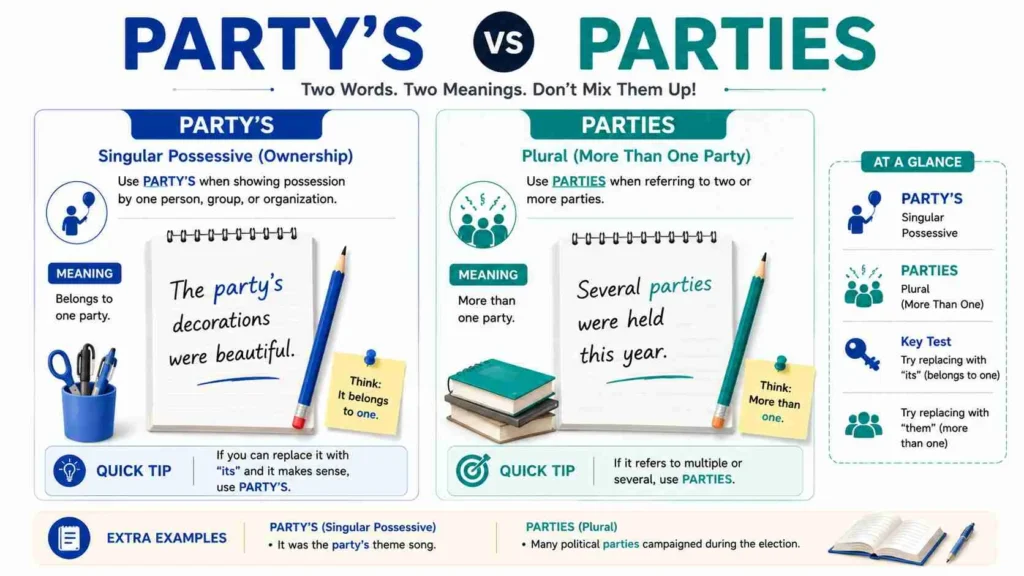
Visual Difference Between Party’s and Parties


6
The image above helps illustrate the difference.
Parties equals multiple parties.
Party’s equals belonging to one party.
This distinction is one of the most important grammar rules for apostrophes.
Real World Examples
Example One
Incorrect:
The party’s were exciting.
Correct:
The parties were exciting.
Reason:
More than one party is being discussed.
Example Two
Incorrect:
The parties decorations were colorful.
Correct:
The party’s decorations were colorful.
Reason:
The decorations belong to one party.
Example Three
Incorrect:
Several party’s attended the event.
Correct:
Several parties attended the event.
Reason:
Plural form is needed.
Common Mistakes Students Make
Using Apostrophes for Plurals
Incorrect:
Three party’s were organized.
Correct:
Three parties were organized.
Forgetting Ownership
Incorrect:
The parties theme was elegant.
Correct:
The party’s theme was elegant.
Mixing Legal Meanings
Incorrect:
The party’s signed the contract.
Correct:
The parties signed the contract.
The sentence refers to more than one party.
Party’s vs Parties in Academic Writing
Academic writing requires accuracy and consistency. Therefore, using party’s and parties correctly is very important.
Many students lose marks because they misuse apostrophes or plural forms. Fortunately, the rule is simple once you understand it.
Example in an Essay
Correct:
Several political parties influenced the election results.
Here, parties is correct because multiple political groups are being discussed.
Example in Research Writing
Correct:
The party’s position changed after the survey results.
Here, party’s is correct because the position belongs to one party.
Why It Matters
Academic readers expect precise grammar. A small mistake can make your writing appear less professional.
Party’s vs Parties in Business Writing
Business communication often includes contracts, agreements, reports, and emails. Because of this, understanding party’s or parties is essential.
Business Example
Correct:
Both parties agreed to the terms.
The sentence refers to two separate groups.
Ownership Example
Correct:
The party’s responsibilities are listed below.
The responsibilities belong to one party.
Common Business Error
Incorrect:
Both party’s agreed to the proposal.
Correct:
Both parties agreed to the proposal.
The sentence discusses multiple groups, not ownership.
Party’s vs Parties in Legal Documents
Legal writing frequently uses both forms.
A contract often refers to the people or organizations involved as parties.
Legal Example
Correct:
The parties shall comply with all terms of the agreement.
This means multiple people or organizations are involved.
Possessive Legal Example
Correct:
The party’s obligations are outlined in Section Five.
The obligations belong to one specific party.
Why Lawyers Care
Legal documents must be precise. A misplaced apostrophe can create confusion about ownership and responsibility.
Related Grammar Comparisons
Learning similar grammar pairs can make party’s or parties easier to understand.
Company’s vs Companies
Company’s shows ownership.
Example:
The company’s profits increased.
Companies means more than one company.
Example:
Several companies attended the conference.
City’s vs Cities
City’s shows ownership.
Example:
The city’s population grew.
Cities means more than one city.
Example:
Many cities experienced growth.
Family’s vs Families
Family’s shows ownership.
Example:
The family’s car was new.
Families means more than one family.
Example:
Several families attended the picnic.
The same grammar rule applies every time.
Regional and Global Usage
The distinction between party’s and parties is the same in American English, British English, Canadian English, Australian English, and other English speaking regions.
American English
Several parties attended the event.
The party’s schedule changed.
British English
Several parties participated in the discussion.
The party’s leader addressed the audience.
Even though spelling differences exist between regions, the rules for plural and possessive forms remain identical.
Beginner to Advanced Understanding
Beginner Level
Parties means more than one party.
Party’s means belonging to one party.
Intermediate Level
Use parties for quantity.
Use party’s for ownership.
Advanced Level
Writers must understand the grammatical function of each word in context. The choice depends entirely on the sentence expresses plurality or possession.
Why People Confuse Party’s and Parties
Many people struggle because both words look very similar.
Reason One
Both words come from the same root word.
Reason Two
Apostrophes often confuse learners.
Reason Three
People sometimes think every word ending in s needs an apostrophe.
This is not true.
Plural nouns usually do not require apostrophes.
Example
Incorrect:
Three party’s attended.
Correct:
Three parties attended.
Expert Writing Tips
Professional writers use several strategies to avoid mistakes.
Read the Sentence Carefully
Ask yourself you are talking about ownership or quantity.
Look for Ownership
If something belongs to a party, use party’s.
Example:
The party’s invitation was attractive.
Look for Quantity
If more than one party is involved, use parties.
Example:
Several parties attended the event.
Proofread Carefully
Grammar mistakes often occur during fast writing. A quick review can prevent errors.
Practice Exercises With Answers
Exercise One
Choose the correct word.
Several ______ attended the conference.
Answer:
Parties
Exercise Two
Choose the correct word.
The ______ decorations looked amazing.
Answer:
Party’s
Exercise Three
Choose the correct word.
Both ______ signed the contract.
Answer:
Parties
Exercise Four
Choose the correct word.
The ______ representative arrived late.
Answer:
Party’s
Exercise Five
Choose the correct word.
Many ______ were held during the holiday season.
Answer:
Parties
Grammar Practice Table
| Sentence | Correct Answer |
|---|---|
| The _____ music was loud | Party’s |
| Several _____ were planned | Parties |
| The _____ leader spoke today | Party’s |
| Both _____ accepted the deal | Parties |
| The _____ budget increased | Party’s |
Common Errors and Corrections
| Incorrect | Correct |
|---|---|
| Three party’s attended | Three parties attended |
| The parties theme was exciting | The party’s theme was exciting |
| Several party’s were planned | Several parties were planned |
| The parties leader spoke | The party’s leader spoke |
| Many party’s happened | Many parties happened |
Learning these corrections helps improve writing quickly.
Advanced Grammar Insight
English grammar uses apostrophes mainly for possession and contractions.
Apostrophes are not normally used to create plural nouns.
Incorrect
Apple’s for sale
Correct
Apples for sale
The same rule applies to parties.
Incorrect
Several party’s were organized.
Correct
Several parties were organized.
Understanding this principle helps avoid many grammar mistakes beyond just party’s or parties.
Mid Article Visual Guide


7
The examples above show how apostrophes indicate possession while plural forms indicate quantity.
Everyday Conversation Examples
At School
Several parties were organized after graduation.
At Work
Both parties approved the proposal.
At Home
The party’s cake was delicious.
During Elections
Several political parties competed for votes.
These examples show how frequently these words appear in daily communication.
Final Grammar Summary
Remember these two simple rules:
Parties = More than one party
Party’s = Belonging to one party
If you can replace the word with “many,” use parties.
If you can replace the word with “belongs to the party,” use party’s.
Following these rules will help you avoid one of the most common grammar mistakes in English.
Visual Writing Tips Guide


6
FAQs
What is the difference between party’s and parties?
Parties means more than one party. Party’s means something belongs to one party.
Is parties a possessive word?
No. Parties is simply the plural form of party.
When should I use party’s?
Use party’s whenever ownership is involved.
Can parties show ownership?
Not by itself. Ownership requires a possessive form.
Is party’s grammatically correct?
Yes. It is correct when showing possession.
Why do people confuse party’s and parties?
Because they look similar and involve apostrophe rules.
How do I remember the difference?
Think quantity versus ownership. Quantity uses parties. Ownership uses party’s.
Which form is used in contracts?
Both forms can appear. Parties refers to all participants. Party’s refers to something owned or required by one participant.
Is parties always plural?
Yes. Parties always means more than one party.
Can party’s be used in formal writing?
Yes. It is commonly used in academic, business, and legal writing when possession is needed.
Conclusion
Understanding party’s or parties is easier than many people think. The key is recognizing the difference between possession and plurality. Parties is the plural form of party and refers to more than one celebration, political group, organization, or participant. Party’s is the possessive form and shows that something belongs to one party.
This distinction is important in academic writing, business communication, legal documents, and everyday conversations. Using the wrong form can change the meaning of a sentence and make writing appear less professional. Fortunately, the rule is straightforward. If you are talking about multiple parties, use parties. If you are showing ownership, use party’s.
By practicing examples, reviewing common mistakes, and remembering the simple quantity versus ownership rule, you can confidently choose the correct form every time. Strong grammar improves clarity, credibility, and communication, making your writing more effective in any situation.