
Quick Answer
Immaculate is the correct spelling and means perfectly clean, flawless, or free from mistakes. Emmaculate is an incorrect spelling and is not recognized as a standard English word. If you are writing for school, business, blogging or you should always use immaculate.
Many people search for emmaculate or immaculate because the two words sound similar when spoken. This often creates confusion in writing. Some writers accidentally type emmaculate and assume it is an alternative spelling. However, English dictionaries recognize only one correct form.
Spelling mistakes can affect communication, academic work, professional writing, and even search engine optimization. A small spelling error may make content appear less trustworthy. Therefore, understanding the difference between emmaculate or immaculate is important for students, writers, bloggers, and professionals.
The word immaculate is commonly used to describe something that is perfectly clean, neat, pure, or without flaws. You may hear people describe an immaculate house, an immaculate garden, or an immaculate piece of work.
In this guide, you will learn the correct spelling, meaning, pronunciation, examples, common mistakes, real world usage, related words, and practical exercises. By the end, you will know exactly when and how to use immaculate correctly.
Quick Overview
Immaculate is the correct spelling.
Emmaculate is a spelling mistake.
Immaculate means perfectly clean, flawless, neat, or free from errors.
Writers, students, and professionals should always use immaculate in formal and informal writing.
Key Difference Between Emmaculate or Immaculate


4
The difference is very simple.
| Word | Correct or Incorrect | Meaning |
|---|---|---|
| Immaculate | Correct | Perfectly clean or flawless |
| Emmaculate | Incorrect | Not a standard English word |
English dictionaries, style guides, and educational resources recognize only immaculate.
What Does Immaculate Mean
Immaculate means something is perfectly clean, neat, pure, or without defects.
It can describe physical cleanliness, appearance, behavior, or quality.
Examples:
- The hotel room was immaculate.
- She wore an immaculate white dress.
- His report was immaculate and free from errors.
- The garden looked immaculate after hours of work.
In each example, immaculate suggests perfection and attention to detail.
Why Do People Write Emmaculate Instead of Immaculate
Many spelling mistakes happen because people write words the way they hear them.
When speaking quickly, the beginning sound of immaculate may seem similar to emmaculate. As a result, some writers accidentally replace the letter I with the letter E.
Other reasons include:
- Typing errors
- Lack of familiarity with the word
- Incorrect autocorrect suggestions
- Mishearing pronunciation
- Learning English as a second language
Fortunately, once you understand the correct spelling, the mistake becomes easy to avoid.
Origin of the Word Immaculate
The word immaculate comes from Latin roots.
The Latin word immaculatus means unstained or without blemish.
Over time, the word entered English and kept a similar meaning. Today, it describes something exceptionally clean, pure, or flawless.
Understanding the origin helps explain why the spelling begins with “im” rather than “em.
Pronunciation of Immaculate
The correct pronunciation is:
ih MAK yoo lit
Many spelling errors occur because pronunciation and spelling do not always match perfectly in English.
To remember the spelling:
Immaculate starts with “im” just like words such as:
- Impossible
- Important
- Immediate
- Immortal
This pattern can help you remember the correct form.
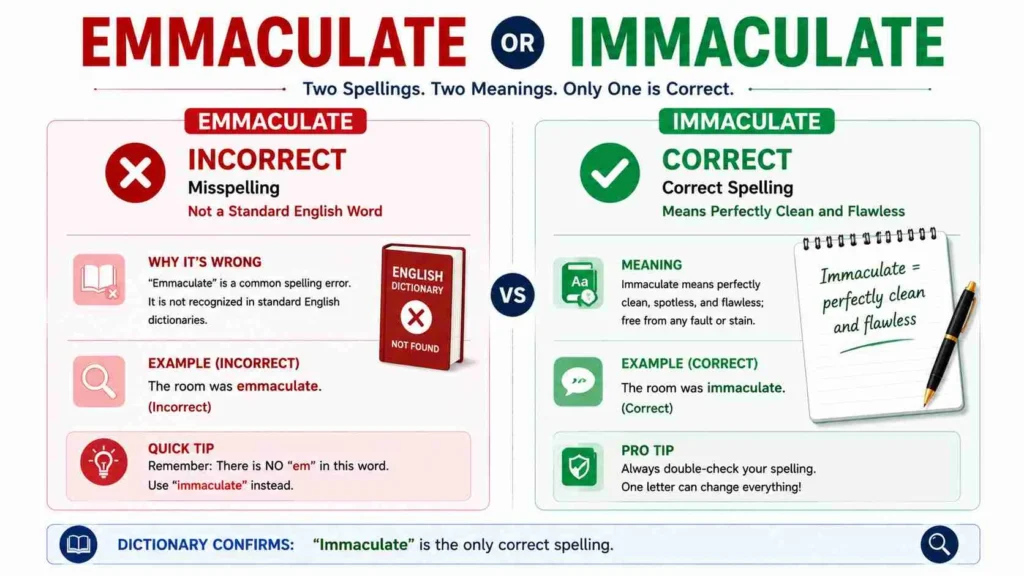
Visual Comparison of the Correct and Incorrect Spelling


4
When comparing emmaculate or immaculate, only one spelling appears in dictionaries and professional writing.
Always choose immaculate.
How Immaculate Is Used in Everyday English
The word appears in many situations.
Cleanliness
- The kitchen looked immaculate.
- The office remained immaculate all week.
Appearance
- He arrived in an immaculate suit.
- Her hair looked immaculate.
Work Quality
- The presentation was immaculate.
- The design appeared immaculate and professional.
Organization
- The files were arranged in immaculate order.
- The shelves were immaculate.
Because the word is versatile, it appears frequently in conversations and writing.
Examples of Immaculate in Sentences
Here are more examples of correct usage.
- The car remained immaculate despite years of use.
- The athlete kept an immaculate training record.
- Their home looked immaculate before the guests arrived.
- The painting was in immaculate condition.
- The restaurant maintained immaculate hygiene standards.
- Her handwriting was immaculate.
- The event planning was immaculate.
- The lawn appeared immaculate after careful maintenance.
- The room looked immaculate from floor to ceiling.
- His attention to detail produced immaculate results.
These examples show how the word can describe many different situations.
Common Contexts Where Immaculate Appears
Immaculate often appears in:
- Real estate listings
- Hotel descriptions
- Product reviews
- Academic writing
- Business communication
- Interior design articles
- Lifestyle blogs
- Travel guides
For example:
A property listing may say:
“The house is in immaculate condition.”
A hotel review may say:
“The rooms were immaculate and comfortable.”
Common Mistakes When Using Emmaculate or Immaculate
Mistake One
Writing emmaculate instead of immaculate.
Correction:
Always write immaculate.
Mistake Two
Assuming emmaculate is a regional spelling.
Correction:
There is no recognized English variation called emmaculate.
Mistake Three
Using immaculate when describing something average.
Correction:
Immaculate suggests an extremely high standard.
Mistake Four
Confusing immaculate with perfect.
Correction:
While similar, immaculate often emphasizes cleanliness, purity, or flawlessness.
Real World Examples
Example One
A homeowner prepares a property for sale.
The real estate agent describes it as:
“The property is in immaculate condition.”
Example Two
A student submits a report with no grammar mistakes.
The teacher comments:
“Your work is immaculate.”
Example Three
A luxury hotel advertises:
“Enjoy immaculate rooms and exceptional service.”
These examples demonstrate natural usage in everyday life.
Advantages of Using the Correct Spelling
Using immaculate correctly provides several benefits.
Better Communication
Readers understand your message immediately.
Professional Appearance
Correct spelling increases credibility.
Improved SEO
Search engines recognize immaculate as the correct keyword.
Academic Accuracy
Teachers and professors expect correct spelling.
Better User Experience
Readers trust content with fewer errors.
Related Words and Comparisons
Immaculate vs Perfect
Immaculate often refers to cleanliness or flawlessness.
Perfect refers to complete excellence.
Immaculate vs Spotless
Spotless focuses mainly on cleanliness.
Immaculate can describe cleanliness and overall perfection.
Immaculate vs Pristine
Pristine means original and untouched.
Immaculate means exceptionally clean and flawless.
Immaculate in SEO and Content Writing
For bloggers and website owners, correct spelling matters.
Search engines understand immaculate as a valid keyword. However, emmaculate is generally treated as a misspelling.
Benefits of using the correct spelling include:
- Better readability
- Improved trust
- Higher quality content
- Stronger search relevance
Content writers should always choose immaculate.
Visualizing Immaculate in Daily Life


7
These examples show how the word immaculate often relates to cleanliness, order, and excellence.
Beginner to Advanced Understanding
Beginner Level
Immaculate means very clean.
Emmaculate is incorrect.
Intermediate Level
Immaculate can describe cleanliness, appearance, quality, and organization.
Advanced Level
Immaculate carries a stronger meaning than simply clean. It suggests exceptional attention to detail and near perfection.
Regional and Global Usage
The spelling immaculate is used worldwide.
It is accepted in:
- American English
- British English
- Canadian English
- Australian English
Unlike some words that have regional spelling differences, immaculate remains the same everywhere.
Exercises With Answers
Question One
Which spelling is correct?
A. Emmaculate
B. Immaculate
Answer: Immaculate
Question Two
Which sentence is correct?
A. The room was emmaculate.
B. The room was immaculate.
Answer: The room was immaculate.
Question Three
What does immaculate mean?
Answer: Perfectly clean or flawless.
Question Four
Is emmaculate a dictionary word?
Answer: No.
Question Five
Which spelling should bloggers use?
Answer: Immaculate.
FAQs
Is emmaculate or immaculate correct?
Immaculate is correct. Emmaculate is a misspelling.
What does immaculate mean?
It means perfectly clean, neat, pure, or flawless.
Is emmaculate a real word?
No. Standard English dictionaries do not recognize it.
Why do people write emmaculate?
Usually because of pronunciation confusion or typing mistakes.
Can I use emmaculate in formal writing?
No. Always use immaculate.
Is immaculate positive or negative?
It is a positive word that describes excellence or cleanliness.
Does immaculate mean perfect?
It is similar to perfect but often emphasizes cleanliness and flawlessness.
How do you remember the spelling of immaculate?
Remember that it starts with “im” like impossible and important.
Is immaculate used in business writing?
Yes. It is commonly used to describe high quality work or presentation.
Does SEO prefer immaculate or emmaculate?
SEO favors immaculate because it is the correct and recognized spelling.
Conclusion
When comparing emmaculate or immaculate, the answer is clear. Immaculate is the correct spelling, while emmaculate is simply a spelling mistake. The word immaculate describes something that is perfectly clean, neat, pure, or free from flaws.
Understanding this difference improves writing quality, communication, and professionalism. you are a student, blogger, business owner, or content creator, using the correct spelling helps build trust with readers.
Immaculate appears in everyday conversations, academic writing, marketing content, property listings, and professional communication. Therefore, learning its correct spelling is valuable for anyone who writes in English.
Whenever you feel unsure, remember this simple rule: always choose immaculate and avoid emmaculate.