

Quick Answer
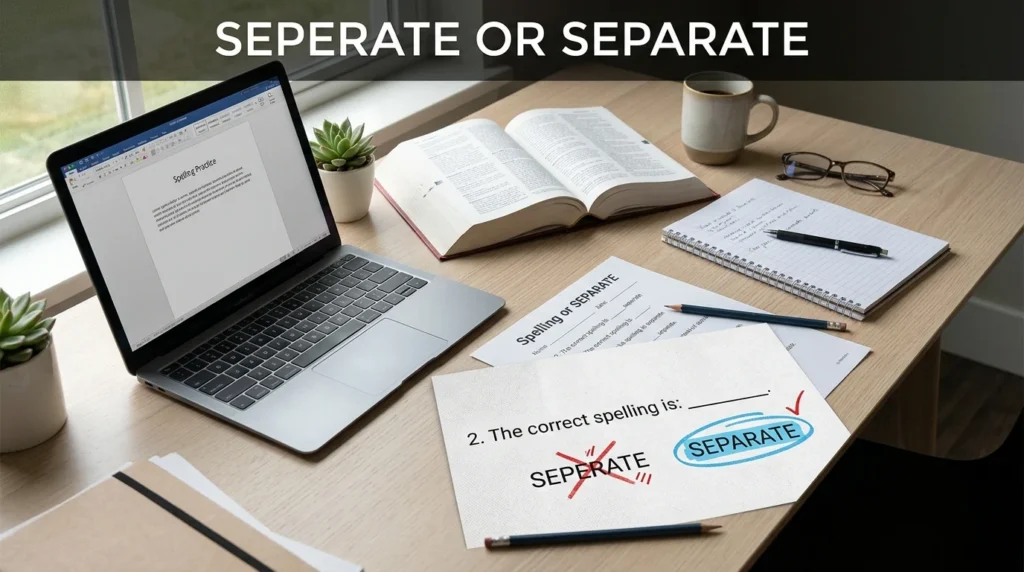
Separate is the correct spelling. Seperate is a common spelling mistake. Use separate when you mean to keep people or things apart or to describe something that is distinct.
Seperate or separate is a common spelling question because the two words look almost identical. The problem usually happens in the middle of the word, where people write seperate instead of separate.
The correct spelling is separate, with an a in the middle: sep-a-rate.
The word can work as an adjective, verb, or noun. You can have separate rooms, separate accounts, or separate opinions. You can also separate two objects or people. Once you learn where the a belongs, this spelling becomes much easier to remember.
Is Seperate or Separate Correct?
Separate is correct.
Seperate is incorrect.
The correct spelling contains an a after the first p:
separate
The incorrect version changes that vowel:
seperate
For example:
Please keep the two documents separate.
Not:
Please keep the two documents seperate.
This is a spelling issue, not a difference in meaning. Seperate is simply a misspelling of separate.
What Does Separate Mean?
Separate means apart, different, or not joined together.
For example:
- The two rooms have separate entrances.
- Keep the clean clothes separate from the dirty clothes.
- They have separate accounts.
- We need separate tables.
- The two issues should be discussed separately.
The word can describe physical things that are apart, but it can also describe ideas, groups, responsibilities, or situations that are distinct.
For example:
These are two separate problems.
Here, the problems may be connected in some way, but they are being treated as different issues.
Why Do People Spell Separate as Seperate?
The mistake happens because the pronunciation does not make the spelling obvious.
When people say separate, the middle vowel can sound weak in normal speech. As a result, some writers naturally spell it with an e, producing seperate.
Another reason is visual memory. Many English words contain patterns such as -e- in the middle, so seperate can look believable even though it is not the standard spelling.
The safest approach is to memorize the correct form:
separate
How to Remember the Spelling of Separate
A useful trick is to focus on the a.
Think:
sep-A-rate
The middle a can remind you that seperate is not correct.
Another simple memory sentence is:
There is A rat in separate.
The word separate contains the letters:
sep A rat e
This may look silly, but it can make the spelling easier to remember.
You do not need to use the trick forever. After seeing the correct spelling often enough, separate will start to look natural.
Separate as an Adjective
Separate can describe things that are apart or distinct.
Examples:
- We have separate bedrooms.
- The children have separate desks.
- She keeps separate folders for each project.
- They live in separate houses.
- The company has separate offices.
In each example, separate tells us that two or more things are not together.
It can also describe ideas:
These are separate questions.
That means the questions should be considered individually.
Separate as a Verb
Separate can also work as a verb.
As a verb, it means to move things apart, divide them, or stop them from being together.
Examples:
- Please separate the white clothes from the dark clothes.
- The teacher separated the students into groups.
- We need to separate the damaged items.
- The wall separates the two rooms.
- She separated the papers into three piles.
The verb can describe a physical action or a process.
For example:
The machine separates the useful material from the waste.
Here, separates means divides one thing from another.
Separate as a Noun
Separate can sometimes be used as a noun, although this use is less common in everyday writing.
For example, in clothing, a separate can refer to an individual piece of clothing that can be worn with other pieces.
You may see phrases such as:
matching separates
The noun use is much less common than the adjective and verb uses.
For most everyday situations, you will use separate as an adjective or verb.
Separate vs Seperate
The difference is simple:
| Word | Status | Meaning |
|---|---|---|
| Separate | Correct | Apart, distinct, or to divide |
| Seperate | Incorrect | Misspelling of separate |
There is no separate definition for seperate.
If you see it in a sentence, the writer almost certainly intended to write separate.
Separate in Everyday Sentences
Here are some natural examples:
- Please put the dishes in separate boxes.
- We sat at separate tables.
- They have separate bedrooms.
- Keep these files separate.
- The two stores have separate entrances.
- I keep my work and personal emails separate.
- The teacher gave us separate assignments.
- We need separate tickets.
- Their opinions are separate from the main issue.
- The two roads separate after the bridge.
These examples show how flexible the word can be.
Separate in School and Academic Writing
Separate is common in school and academic writing.
For example:
The teacher asked students to write separate answers.
You might also write:
The study examined the two groups separately.
Or:
These two concepts should be treated as separate ideas.
The word is useful when a writer needs to make a clear distinction between subjects, groups, ideas, or categories.
Separate in Business Writing
Businesses often use separate when discussing accounts, teams, departments, records, or responsibilities.
Examples:
- The company maintains separate accounts.
- Each department has a separate budget.
- Keep customer records separate from employee records.
- The two teams work on separate projects.
- The company created a separate support team.
In these sentences, separate helps show that different items or responsibilities should not be mixed.
Separate in Personal Communication
You may also use separate when discussing everyday life.
For example:
My brother and I have separate rooms.
We decided to keep our finances separate.
Please pack the gifts in separate bags.
I keep my work clothes separate from my casual clothes.
These sentences sound natural because separate is a common everyday word.
Separate From or Separate From?
The standard phrase is separate from.
Examples:
- This issue is separate from the main problem.
- Keep the medicine separate from the food.
- Her opinion is separate from the group’s decision.
- The garage is separate from the house.
- These costs are separate from the original price.
A common mistake is forgetting the preposition after the adjective.
For example:
The two issues are separate from each other.
This clearly shows that the issues are distinct.
Separate From vs Separately
These two forms are related but have different jobs.
Separate from describes a relationship between two things.
Example:
The kitchen is separate from the dining room.
Separately is an adverb that means individually or apart.
Example:
The items were packed separately.
Another example:
Please send the documents separately.
So remember:
separate = adjective or verb
separately = adverb
Separate vs Separately
Consider these examples:
We have separate accounts.
Here, separate describes the accounts.
We manage the accounts separately.
Here, separately describes how the accounts are managed.
The two words are closely related, but they do different jobs in a sentence.
Separate vs Apart
Separate and apart can have similar meanings.
For example:
The two houses are separate.
The two houses are far apart.
Both sentences show that the houses are not together.
However, they are not always interchangeable.
You can say:
Please separate the papers.
But you would not normally replace it with:
Please apart the papers.
That sentence does not work.
Separate can function as a verb, while apart usually does not work that way.
Separate vs Different
Separate and different can also overlap, but they are not identical.
Different means not the same.
Separate means apart, distinct, or not joined.
For example:
We have different opinions.
This means our opinions are not the same.
We have separate offices.
This means the offices are not shared or joined.
Something can be different without being physically separate.
That distinction helps you choose the right word.
Common Mistakes With Separate
The biggest mistake is writing:
seperate
The correct form is:
separate
Another mistake is forgetting the middle a when typing quickly.
Some people also pronounce the word in a way that makes the spelling harder to remember. Because of that, they may write the spelling based on how they hear it.
Instead, remember the written pattern:
sep-a-rate
Separate in Professional Writing
Correct spelling matters in professional communication because simple spelling mistakes can make otherwise clear writing look less polished.
For example:
Please keep the invoices in separate folders.
looks clean and professional.
The incorrect version:
Please keep the invoices in seperate folders.
contains a spelling mistake that is easy to avoid.
This does not mean the reader cannot understand the sentence. The meaning is still obvious. However, using the standard spelling is better for formal writing.
Pronunciation of Separate
Separate can have different pronunciations depending on whether it is used as an adjective or verb.
As an adjective, it is commonly pronounced with three syllables:
SEP-uh-rət
As a verb, the final part is pronounced more clearly:
SEP-uh-rate
The spelling remains the same in both cases.
This is one reason English learners may find the word confusing. The written form stays unchanged while the pronunciation can shift with its grammatical use.
Separate in Common Phrases
Here are some useful expressions containing separate.
Separate Ways
Go separate ways means to stop going or working together.
Example:
After the project ended, the two partners went their separate ways.
Separate Issue
A separate issue is another matter that should be considered on its own.
Example:
That is a separate issue and should be discussed later.
Separate Account
A separate account is an account kept apart from another account.
Example:
She opened a separate savings account.
Separate Room
A separate room is a room that is not shared with another space or person.
Example:
The guests had a separate room.
Separate From
This phrase shows that one thing is distinct from another.
Example:
The fee is separate from the monthly payment.
How to Use Separate Correctly
When you want to say that something is apart, distinct, or divided, separate is usually the word you need.
Use it before a noun:
separate rooms
Use it after a linking verb:
The rooms are separate.
Use it as a verb when you mean divide:
Separate the papers.
Use separately when you need an adverb:
The papers were filed separately.
The spelling stays separate in all of these basic forms.
Practice Questions
Try these sentences and choose the correct spelling.
1. Please keep the two files ______.
Answer: separate
2. The children sat in ______ rooms.
Answer: separate
3. The teacher asked us to ______ the cards into groups.
Answer: separate
4. We have ______ accounts for our business expenses.
Answer: separate
5. The packages were shipped ______.
Answer: separately
6. The two subjects are ______ from each other.
Answer: separate
7. The company created a ______ department.
Answer: separate
The incorrect spelling seperate should not be used in any of these sentences.
Seperate or Separate in a Sentence
Look at these examples:
❌ The rooms are seperate.
✅ The rooms are separate.
❌ Please keep the documents seperate.
✅ Please keep the documents separate.
❌ They opened a seperate account.
✅ They opened a separate account.
❌ The teacher asked us to seperate the papers.
✅ The teacher asked us to separate the papers.
The easiest correction is simply to replace seperate with separate.
A Simple Spelling Trick
If you often make this mistake, remember this sentence:
There is an A in separate.
Then break the word into parts:
sep + a + rate
The important letter is the a.
When you type seperate, stop and check the middle vowel.
Ask yourself:
Did I write the A in separate?
If the answer is no, correct it before finishing the sentence.
Separate or Seperate: Quick Comparison
| Question | Answer |
|---|---|
| Is separate correct? | Yes |
| Is seperate correct? | No |
| What does separate mean? | Apart, distinct, or to divide |
| What is the common spelling mistake? | Writing seperate |
| Does separate work as a verb? | Yes |
| Does separate work as an adjective? | Yes |
| What is the adverb form? | Separately |
This covers the main points you need to remember.
Final Tips
Keep these rules in mind:
- Separate is the correct spelling.
- Seperate is incorrect.
- Remember the middle a.
- Separate can mean apart or distinct.
- Separate can also mean to divide something.
- Separately is the adverb form.
- Use separate from when showing that two things are distinct.
- Do not spell the word based only on how it sounds.
- Check the middle of the word if you are unsure.
- A simple memory trick is sep-a-rate.
FAQs
Is seperate or separate correct?
Separate is correct. Seperate is a common misspelling and should not be used in standard English.
Why do people spell separate as seperate?
The mistake often happens because the middle vowel is weak in normal pronunciation. The spelling seperate may therefore feel natural, even though the correct spelling contains an a.
What is the difference between separate and separately?
Separate can be an adjective or verb, while separately is an adverb. For example, “They have separate rooms” uses the adjective, while “The items were packed separately” uses the adverb.
How do you remember how to spell separate?
Remember the middle a. You can break the word into a simple pattern: sep-a-rate. The main thing is not to replace the a with an e.
Is separate a verb or an adjective?
It can be both. As an adjective, it describes things that are apart or distinct. As a verb, it means to divide or move things apart.
Conclusion
Separate is the correct spelling, while seperate is a common spelling mistake. The confusion usually comes from the pronunciation of the word and the easy-to-miss a in the middle.
Remember the simple form sep-a-rate whenever you are unsure. You can use separate to describe things that are apart, different, or distinct, and you can also use it as a verb when you mean to divide something.
Once you remember the middle a, this spelling becomes much easier to get right.