

Quick Answer
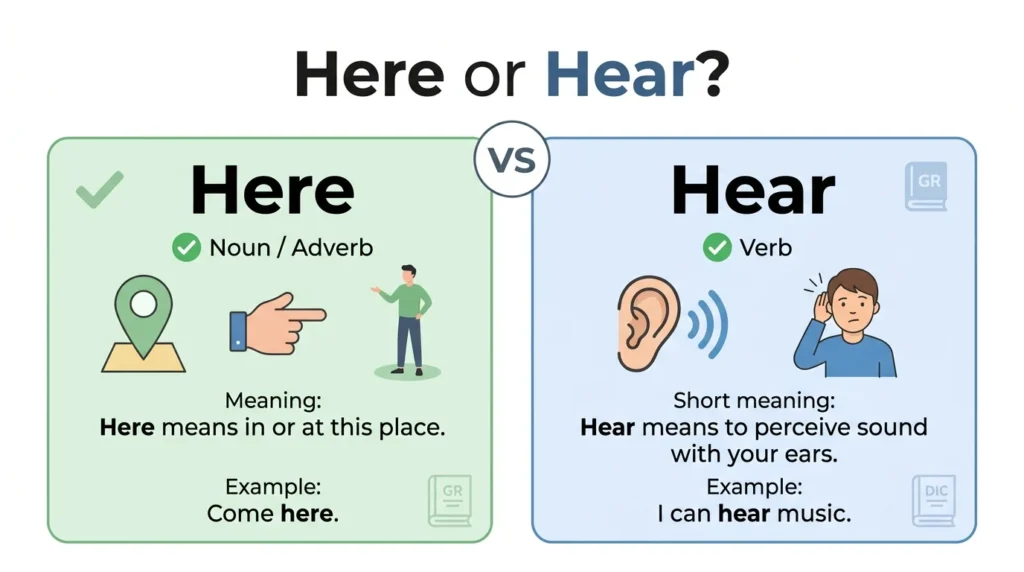
Here and hear are both correct English words, but they have different meanings and uses. Here usually refers to a place or location, while hear is a verb related to sound and listening. For example, “Come here” refers to a place, while “Can you hear me?” refers to sound.
Many English learners confuse here or hear because the two words sound the same in American English. However, their spelling and meanings are different. Learning when to use each word can help you avoid common spelling and grammar mistakes.
This guide explains here or hear in simple English. You will learn their definitions, pronunciation, grammar rules, examples, common mistakes, everyday expressions, exercises, FAQs, and an easy way to remember the difference.
Quick Overview
- Here refers to a place or location.
- Hear refers to receiving or noticing sound.
- Here is commonly used as an adverb.
- Hear is a verb.
- Both words usually have the same pronunciation.
- Here = place
- Hear = sound
Definition of Here
The word here is usually an adverb used to refer to a particular place, position, or location.
Examples:
- Come here.
- I live here.
- Your phone is here.
- Please sit here.
- We are here now.
In each example, here identifies a place or position.
Common Uses of Here
Here can be used to talk about:
- A location
- A nearby place
- A particular position
- Someone’s current location
- A current situation
Examples:
Come here.
Your bag is here.
Please wait here.
I work here.
Definition of Hear
The word hear is a verb. It means to perceive or notice a sound with your ears.
Examples:
- I can hear music.
- Can you hear me?
- Did you hear that?
- I heard a loud noise.
- She heard someone calling.
In these sentences, hear is connected with sound and the sense of hearing.
Common Uses of Hear
Hear can be used when talking about:
- Voices
- Music
- Sounds
- Conversations
- News
- Information
Examples:
I can hear the birds.
Did you hear the news?
She heard a strange noise.
We heard someone outside.
Key Difference Between Here or Hear
The easiest way to remember the difference is:
Here = place
Hear = sound
For example:
Come here.
This means come to this place.
Can you hear me?
This means can you perceive my voice or sound?
Although the two words sound alike, they have completely different meanings.
Quick Comparison Table
| Feature | Here | Hear |
|---|---|---|
| Part of Speech | Adverb | Verb |
| Main Meaning | Place or location | Perceive sound |
| Related To | Position | Ears and sound |
| Example | Come here. | Can you hear me? |
| Common Question | Where? | What did you hear? |
Here or Hear Pronunciation
Here and hear are generally pronounced the same in American English.
Both are pronounced approximately:
/hɪr/
For example:
Come here.
I can hear you.
Because they have the same pronunciation but different meanings and spellings, here and hear are called homophones.
Homophones are words that sound the same but have different meanings and spellings.
Other common homophones include:
- There / Their / They’re
- To / Too / Two
- Right / Write
- See / Sea
- Your / You’re
Using Here Correctly
Example One
Come here.
Here refers to a particular place.
Example Two
Your keys are here.
Here identifies the location of the keys.
Example Three
Please wait here.
Here tells someone where to wait.
Example Four
I work here.
Here refers to the place where the speaker works.
Example Five
The restaurant is right here.
Here identifies the exact location of the restaurant.
Using Hear Correctly
Example One
Can you hear me?
Hear means to perceive someone’s voice.
Example Two
I can hear music.
Hear refers to noticing music through the ears.
Example Three
Did you hear that noise?
Hear refers to noticing a sound.
Example Four
I heard the news yesterday.
Hear can also mean receiving information.
Example Five
She heard someone knocking on the door.
Hear refers to perceiving the sound of knocking.
Common Expressions With Here
There are many common English expressions that use here.
Examples:
- Come here
- Stay here
- Sit here
- Right here
- Over here
- From here
- Here you are
- Here it is
- Here we go
- Here and there
Examples:
Come here for a minute.
Your order is right here.
Here we go!
I have been here before.
Common Expressions With Hear
The word hear is also used in many common expressions.
Examples:
- Hear me out
- Hear about
- Hear from
- Hear of
- I hear you
- Can you hear me?
Examples:
Please hear me out before you make a decision.
I heard about the new restaurant.
I haven’t heard from him recently.
I hear you, but I have a different opinion.
Here or Hear in Real-World Examples
Example One
Come here and sit down.
Here refers to a place.
Example Two
Can you hear the music?
Hear refers to sound.
Example Three
Your package is here.
Here refers to location.
Example Four
I heard a strange noise outside.
Hear refers to sound.
Example Five
We are here to help you.
Here refers to being present.
Example Six
Did you hear what she said?
Hear refers to listening to someone’s words.
Example Seven
The manager is here.
Here identifies the manager’s location.
Example Eight
I can hear the traffic outside.
Hear describes the perception of sound.
Common Mistakes With Here or Hear
Mistake One
Incorrect:
Come hear.
Correct:
Come here.
The sentence refers to a place, so here is correct.
Mistake Two
Incorrect:
Can you here me?
Correct:
Can you hear me?
The sentence refers to hearing, so hear is correct.
Mistake Three
Incorrect:
Your phone is hear.
Correct:
Your phone is here.
The sentence refers to location.
Mistake Four
Incorrect:
I can here the music.
Correct:
I can hear the music.
The sentence refers to sound.
Mistake Five
Incorrect:
Please wait hear.
Correct:
Please wait here.
The word refers to a location.
Why English Learners Confuse Here or Hear
Several factors can cause confusion between these words.
Same Pronunciation
In American English, here and hear generally sound the same.
Different Spelling
Although they sound alike, their spelling is completely different.
Fast Typing
People can easily type the wrong word when writing quickly.
Similar Sound
English learners may recognize the sound but forget which spelling matches the meaning.
Limited Writing Practice
Regular reading and writing help learners remember the correct spelling.
Easy Memory Trick
An easy way to remember these words is:
Here = place
Hear = ears
Notice that hear contains ear in its spelling:
H + EAR = HEAR
This can remind you that hear is connected with your ears and sound.
So remember:
Here → Place
Hear → Ears and Sound
For example:
Come here.
I can hear you.
Here vs There
Here and there are both used for locations.
Here usually refers to the place where the speaker is or a nearby location.
Example:
Come here.
There usually refers to another location.
Example:
Go there.
Compare:
Your bag is here.
Your shoes are there.
Hear vs Listen
Hear and listen are related, but they are not exactly the same.
Hear usually means that you perceive a sound naturally.
Example:
I can hear music.
Listen usually means that you deliberately pay attention to a sound.
Example:
Listen to the music.
Compare:
I heard a noise.
This means you noticed the sound.
I listened to the noise.
This suggests that you intentionally paid attention to it.
Visual Comparison
Image Placement Suggestion
Create a professional educational comparison image titled “Here vs Hear: Place or Sound?” Use a clean white background with a 1600 by 900 ratio. On the left side, show a person pointing to a location with the word HERE and labels such as Place, Location, and Position. On the right side, show a person listening with visible ears and sound waves with the word HEAR and labels such as Sound, Ears, and Listening. Use a clean modern educational style, simple illustrations, clear typography, and high resolution.
Advantages of Using Here and Hear Correctly
Clear Communication
Using the correct word makes your meaning easy to understand.
Better Writing
Correct spelling improves emails, essays, messages, and online content.
Professional English
Correct word choice makes your writing look more polished.
Better Academic Writing
Students can avoid common spelling mistakes in assignments and exams.
Greater Confidence
Understanding common homophones makes everyday English easier.
Disadvantages of Incorrect Usage
Confusion
Using hear instead of here can change the meaning of a sentence.
Spelling Errors
Incorrect homophones can make otherwise good writing look careless.
Professional Mistakes
A spelling mistake in an email or business document can create a poor impression.
Academic Errors
Students may lose marks for repeated spelling mistakes.
Beginner to Advanced Understanding
Beginner Level
Remember:
Here = place
Hear = sound
Examples:
Come here.
I can hear you.
Intermediate Level
Learn common expressions such as:
Here you are.
Here we go.
Hear me out.
I heard about it.
Advanced Level
At an advanced level, learn how context determines meaning and practice expressions such as hear from, hear about, hear of, here and there, and from here on.
Exercises With Answers
Question One
Choose the correct word:
Come ___ and sit down.
Answer: Here
Question Two
Choose the correct word:
Can you ___ me?
Answer: Hear
Question Three
Choose the correct word:
Your keys are ___.
Answer: Here
Question Four
Choose the correct word:
I can ___ the music.
Answer: Hear
Question Five
Choose the correct word:
Please wait ___.
Answer: Here
Question Six
Choose the correct word:
Did you ___ that noise?
Answer: Hear
Question Seven
Choose the correct word:
The teacher is ___.
Answer: Here
Question Eight
Choose the correct word:
I couldn’t ___ what he said.
Answer: Hear
Question Nine
Choose the correct word:
Put the book ___.
Answer: Here
Question Ten
Choose the correct word:
We could ___ someone outside.
Answer: Hear
FAQs
1. What is the difference between here and hear?
Here refers to a place or location, while hear is a verb related to perceiving sound.
2. Is it “come here” or “come hear”?
The correct phrase is “come here” because it refers to a place or location.
3. Is it “Can you hear me?” or “Can you here me?”
The correct sentence is “Can you hear me?” because it refers to hearing someone’s voice.
4. Do here and hear sound the same?
Yes. In standard American English, here and hear are generally pronounced the same, so they are homophones.
5. How can I remember the difference between here and hear?
Remember here = place and hear = ears. The spelling of hear contains ear, which can remind you that it is connected with sound.
Conclusion
Understanding the difference between here and hear is simple once you connect each word with its meaning. Here is used for a place or location, while hear is used for sounds and listening. For example, “Come here” refers to a location, while “Can you hear me?” refers to sound.
The easiest way to remember these words is here = place and hear = ears. Although they usually sound the same in American English, their spelling and meanings are different. With regular reading and writing practice, you can easily avoid this common English mistake and use here and hear correctly in everyday communication.