
Quick Answer
The difference between super and supper is simple.
Super usually means excellent, very good, very, or above normal. It can also describe a person or thing with special or extraordinary qualities.
Feature Snippet
Super is an adjective, adverb, noun, or informal prefix used to mean excellent, very, or above normal. Supper is a noun that means an evening meal, usually a light or informal dinner. Although super or supper sound similar, they have completely different meanings and uses.
Supper is a noun that means an evening meal. In many contexts, it is another word for dinner, although it can suggest a lighter or more informal meal.
| Word | Part of Speech | Meaning | Example |
|---|---|---|---|
| Super | Adjective, adverb, noun, prefix | Excellent, very, extraordinary | The movie was super. |
| Supper | Noun | An evening meal | We had supper at seven. |
A simple way to remember them is:
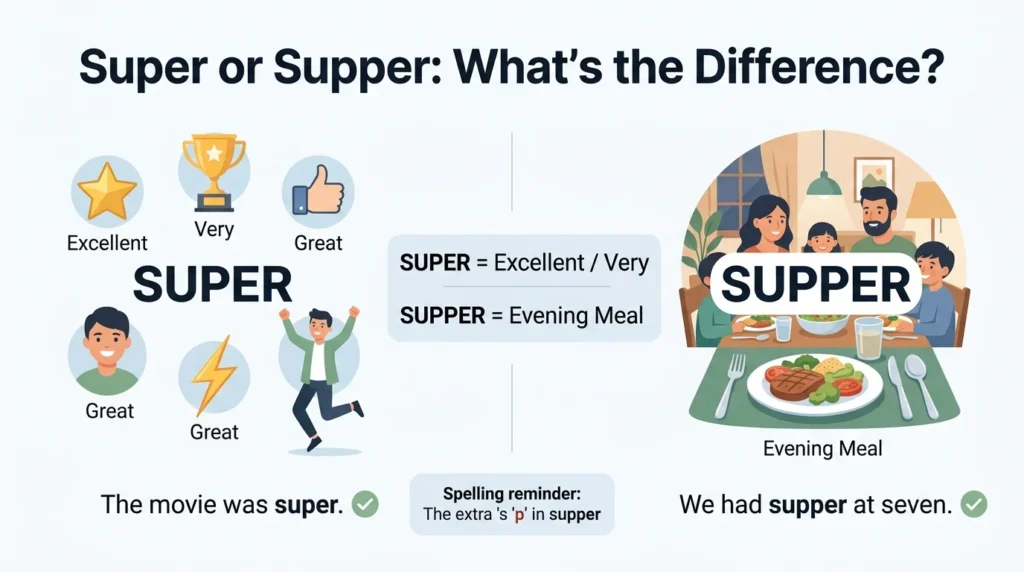
Super = Excellent or Very
Supper = Evening Meal
Super or Supper
Many English learners confuse super and supper because they look and sound very similar. The difference is only one extra p, but that small spelling difference changes the meaning completely.
For example, if you write “We had super at eight,” a reader may not understand what you mean. If you are talking about an evening meal, the correct word is supper.
On the other hand, if you want to say that something was excellent, you might say “The movie was super.” Using supper in that sentence would be incorrect because supper refers to food or an evening meal.
Understanding the difference between super or supper is useful for students, writers, bloggers, professionals, and English learners. These words can appear in everyday conversations, restaurant discussions, school assignments, social media posts, and informal writing.
The good news is that the difference is easy to remember. Super is connected with something excellent, powerful, special, or very good. Supper is connected with eating an evening meal.
This guide explains their meanings, pronunciation, grammar, examples, common mistakes, real world usage, comparisons, exercises, and frequently asked questions. By the end, you will know exactly when to use super and when to use supper.
What Does Super Mean?
The word super has several meanings and can be used in different ways. Its most common modern use is to describe something that is excellent, very good, impressive, or enjoyable.
For example:
The movie was super.
Here, super means very good or excellent.
You can also use super before an adjective or adverb to make its meaning stronger.
Examples:
- The test was super easy.
- She is super friendly.
- The restaurant is super popular.
- He runs super fast.
- This book is super interesting.
In informal English, super is often used in place of words such as very, really, or excellent.
Different Meanings of Super
Super Means Excellent
The simplest meaning of super is excellent or very good.
Examples:
- You did a super job.
- That was a super idea.
- We had a super time.
- Your presentation was super.
- The new restaurant is super.
In these sentences, super expresses positive feelings or approval.
Super Means Very
In informal English, super can work as an intensifier. It makes another adjective stronger.
Examples:
- She is super happy.
- The room is super clean.
- This phone is super fast.
- The weather is super hot.
- The lesson was super easy.
Here, super has a meaning similar to very or extremely.
Super Means Extraordinary
The word can also describe something unusually powerful, large, or impressive.
Examples:
- The athlete has super strength.
- The company built a super computer.
- The team needs a super talented player.
This use often appears in compound words.
Super as a Prefix
Super can also be used as a prefix. A prefix is added to the beginning of another word to change or strengthen its meaning.
Examples include:
- Superhuman
- Superstar
- Superpower
- Supermarket
- Superfast
- Supernatural
- Superhero
- Supercomputer
The meaning depends on the word.
For example, a superhero is a hero with extraordinary abilities.
A superstar is an extremely successful or famous person.
A superhuman person or ability is beyond normal human limits.
Super as a Noun
In some contexts, especially in American English, super can be a noun.
For example, super may be short for superintendent, especially a building superintendent.
Example:
I’ll call the super to fix the problem.
It can also refer to someone or something considered exceptional.
However, this noun use is less important for basic English learners. The most common everyday uses are super = excellent and super = very.
What Does Supper Mean?
The word supper is a noun. It means an evening meal.
In many situations, supper can mean the same thing as dinner. However, there can be a small difference depending on the region, family, culture, or context.
Examples:
- We had supper at seven.
- What are we having for supper?
- She prepared supper for the family.
- They invited us to supper.
- I usually eat a light supper.
- After supper, we watched television.
In each sentence, supper refers to a meal.
Supper vs Dinner
One of the most interesting parts of understanding supper is its relationship with dinner.
In many varieties of English, dinner is the normal word for the evening meal.
For example:
What are we having for dinner?
is very common.
However, some speakers use supper for the evening meal, especially when the meal is informal or lighter.
For example:
We had a light supper before bed.
The exact distinction depends on region, family tradition, and social context.
Super vs Supper: Key Differences
| Feature | Super | Supper |
|---|---|---|
| Part of Speech | Adjective, adverb, noun, prefix | Noun |
| Main Meaning | Excellent, very, extraordinary | Evening meal |
| Related to Food | Usually no | Yes |
| Related to Quality | Yes | No |
| Example | The movie was super. | We had supper at eight. |
| Common Use | Informal English | Meal-related English |
The easiest rule is:
Super describes something.
Supper is something you eat.
When Should You Use Super?
Use super when you want to say that something is excellent, impressive, very good, or very strong.
Examples
- The movie was super.
- She is super friendly.
- That was a super idea.
- He is a super athlete.
- The new computer is super fast.
- Your answer was super.
- We had a super day.
- The hotel was super comfortable.
When Should You Use Supper?
Use supper when you are talking about an evening meal.
Examples
- We had supper at eight.
- Mom is preparing supper.
- What did you have for supper?
- They invited us to supper.
- We usually eat supper together.
- She cooked a delicious supper.
- After supper, I went for a walk.
- The children went to bed after supper.
Pronunciation of Super and Supper
Pronunciation is another reason learners confuse these words.
In many varieties of English, super and supper have different vowel sounds.
Super is commonly pronounced like:
SOO per
Supper is commonly pronounced like:
SUP er
The first vowel sound is the main difference.
| Word | Simple Pronunciation |
|---|---|
| Super | SOO per |
| Supper | SUP er |
Try saying them slowly.
Super
Supper
The difference becomes clearer when you listen carefully.
Super or Supper in American English
Both words are common in American English, but they are not equally common.
Super is very common in informal speech.
Examples:
- That’s super cool.
- She is super nice.
- The movie was super good.
- Thanks, that’s super helpful.
Supper is also used, but dinner is often the more common word for the evening meal.
For example:
What are you having for dinner?
is extremely common.
Still, supper is perfectly correct in appropriate contexts.
Super or Supper in British English
British English also uses both words.
Super can mean excellent or very good.
Example:
That’s super!
This can sound friendly and informal.
Supper can refer to an evening meal, especially in certain regional, traditional, or family contexts.
The meaning remains the same even when regional preferences differ.
Super or Supper in Canadian English
Canadian English uses super in much the same way as American and British English.
Examples:
- That’s super!
- The movie was super.
- She is super friendly.
Supper is also used by some Canadian speakers, especially in family or regional contexts.
For example:
We had supper at my grandmother’s house.
Super or Supper in Australian English
Australian English also uses super to mean excellent or very good.
Examples:
- That sounds super.
- The food was super.
- She’s super friendly.
Supper can refer to a light evening meal or food eaten later in the evening.
Common Mistakes With Super and Supper
Because the words sound similar, learners sometimes choose the wrong one.
Mistake One
Incorrect:
We had super at eight.
Correct:
We had supper at eight.
Why?
You are talking about an evening meal, so supper is correct.
Mistake Two
Incorrect:
The movie was supper.
Correct:
The movie was super.
Why?
You are describing the movie as excellent, so super is correct.
Mistake Three
Incorrect:
She is supper friendly.
Correct:
She is super friendly.
Why?
Here, super means very.
Mistake Four
Incorrect:
What did you have for super?
Correct:
What did you have for supper?
Why?
The sentence asks about an evening meal.
Mistake Five
Incorrect:
We had a super before bed.
Correct:
We had supper before bed.
Why?
The word refers to the meal, so use supper.
Easy Ways to Remember Super and Supper
A simple memory trick can make these words easy.
Think of super as a word connected with something special or excellent.
Examples:
super good
super fast
super easy
super helpful
Now think of supper as a word connected with food.
Examples:
eat supper
cook supper
have supper
prepare supper
This gives you a simple rule:
Super = very or excellent
Supper = evening meal
Super or Supper in Everyday Conversations
These words are common in daily conversations.
Conversation Example
A: How was the movie?
B: It was super!
Here, super means excellent.
Another Example
A: What are you doing?
B: I’m preparing supper.
Here, supper means the evening meal.
Another Example
A: Was the restaurant good?
B: Yes. The food was super.
A: What did you have for supper?
Both words can appear in the same conversation, but they have completely different meanings.
Super or Supper in Sentences
Here are more examples to make the difference clear.
Super
- The weather is super today.
- Your idea is super.
- She is super talented.
- This exercise is super easy.
- He is super excited.
- The new car is super fast.
- The presentation was super helpful.
- We had a super weekend.
Supper
- We had supper at six.
- Dad is cooking supper.
- Supper is ready.
- I skipped supper last night.
- What are we having for supper?
- They invited us to supper.
- She made a delicious supper.
- We talked after supper.
Super vs Very
These words can sometimes have similar meanings.
Super is generally more informal.
Compare:
She is very friendly.
She is super friendly.
Both sentences are correct.
However, very friendly is more neutral, while super friendly sounds more casual and conversational.
More Examples
Very easy
Super easy
Very important
Super important
Very fast
Super fast
Very interesting
Super interesting
In formal academic writing, very may be more suitable. In casual speech and informal writing, super is common.
Super vs Excellent
Super and excellent can both express positive judgment.
Examples:
The food was excellent.
The food was super.
The second sentence is more informal.
Excellent sounds more formal and precise.
Super sounds casual and friendly.
Supper vs Dinner
The words supper and dinner are sometimes interchangeable, but their use can vary.
| Word | General Meaning |
|---|---|
| Dinner | Main meal, often the evening meal |
| Supper | Evening meal, often informal or light |
For many speakers:
Dinner = main evening meal
Supper = lighter or more informal evening meal
But this is not a universal rule. In some regions and families, supper simply means dinner.
Real World Usage
At Home
You might hear:
Supper is ready.
This means the evening meal is ready.
At a Restaurant
A server might say:
Are you ready to order dinner?
The word dinner is usually more common in restaurant settings.
With Friends
Someone might say:
That restaurant was super!
Here, super means excellent.
In School
A teacher may write:
The students did a super job.
Here, super means excellent.
In Family Conversations
A parent may say:
Come downstairs. Supper is ready.
Here, supper refers to food.
Common Phrases With Super
Here are useful expressions containing super:
- Super good
- Super easy
- Super fast
- Super important
- Super helpful
- Super friendly
- Super excited
- Super busy
- Super cute
- Super strong
- Super popular
- Super talented
These expressions are usually informal.
Common Phrases With Supper
Common expressions include:
- Have supper
- Eat supper
- Cook supper
- Prepare supper
- Make supper
- After supper
- Before supper
- Supper time
- Supper table
- Supper party
Examples:
We eat supper at seven.
She is cooking supper.
We went for a walk after supper.
Advantages of Learning the Difference
Knowing the difference between super or supper can help you in several ways.
- It improves spelling.
- It improves vocabulary.
- It helps you write clearer sentences.
- It improves everyday communication.
- It reduces embarrassing mistakes.
- It helps with English exams.
- It improves blog and website content.
- It makes informal writing more natural.
- It improves listening comprehension.
- It helps you understand native speakers.
Why the Extra P Matters
The extra p in supper is not just a spelling detail. It changes the meaning of the entire word.
Compare:
Super
Excellent or very.
Supper
An evening meal.
This is a good example of how one letter can create a completely different English word.
Similar examples exist in English.
Later and latter
Desert and dessert
Small spelling differences can create major changes in meaning. This is why learning words in context is better than memorizing spelling alone.
Practice Exercises
Now test your understanding of super or supper.
Exercise One: Choose the Correct Word
Fill in each blank with super or supper.
- We had ______ at seven o’clock.
- The movie was ______.
- She is ______ friendly.
- What are we having for ______?
- That was a ______ idea.
- Dad is preparing ______.
- The new phone is ______ fast.
- We invited our neighbors to ______.
- Your presentation was ______.
- The children finished ______ before going outside.
Answers
- supper
- super
- super
- supper
- super
- supper
- super
- supper
- super
- supper
Exercise Two: Correct the Mistakes
Correct the following sentences.
- We had super at eight.
- The movie was supper.
- She is supper nice.
- What did you eat for super?
- Dad is cooking super.
Answers
- We had supper at eight.
- The movie was super.
- She is super nice.
- What did you eat for supper?
- Dad is cooking supper.
Exercise Three: Identify the Meaning
Decide whether super means excellent/very or supper means evening meal.
- The food was super.
- We ate supper at nine.
- She is super talented.
- Supper is ready.
- The book was super interesting.
Answers
- Super = excellent
- Supper = evening meal
- Super = very
- Supper = evening meal
- Super = very
Conclusion
The difference between super and supper is simple once you focus on their meanings. Super is commonly used to mean excellent, very good, very, or extraordinary. It can work as an adjective, adverb, noun, or prefix depending on the context. Supper, on the other hand, is a noun that refers to an evening meal. In many situations, it has a meaning similar to dinner, although some speakers use it specifically for a lighter or more informal evening meal.
The easiest way to remember super or supper is to connect each word with its main meaning. Think of super when you want to describe something as excellent or very good. Think of supper when you are talking about an evening meal. Pay attention to the extra p, because it completely changes the word and its meaning.
With regular reading and practice, you can quickly master this common English confusion. Use super for quality and intensity, and use supper for a meal. This simple rule will help you write more accurately and speak English with greater confidence.