

Quick Answer
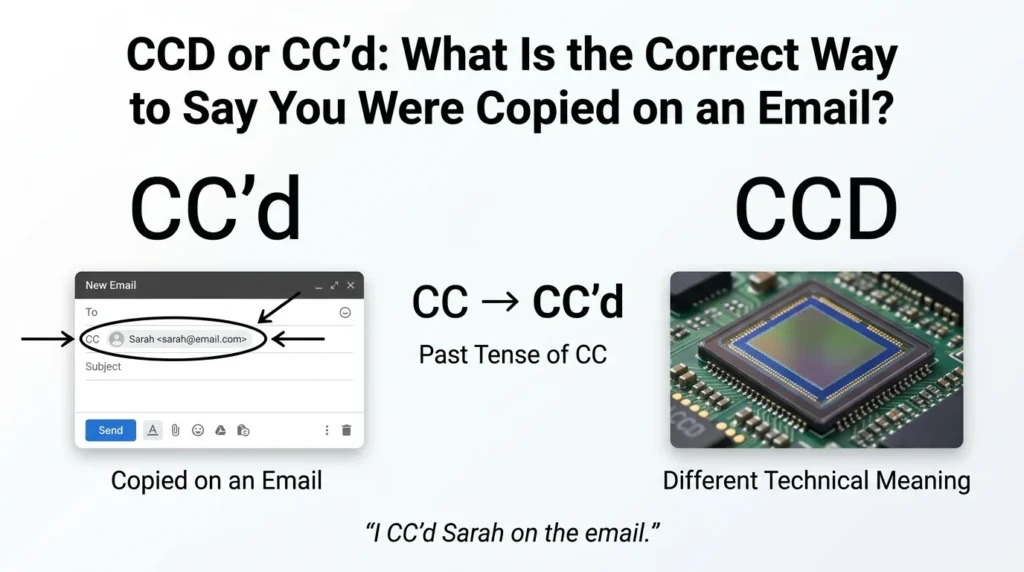
CC’d is the clearest and most common form when you mean that someone was copied on an email. For example, “I CC’d Sarah on the email” means Sarah received a copy, while CCD can mean something completely different in another context.
Email has made CC one of the most common abbreviations in everyday American English. Still, writing about a past email action can create a small grammar problem. Should you write CCD, CC’d, or CCed when you want to say that someone was copied?
The clearest choice is usually CC’d. You might write, “I CC’d my manager on the email,” or “She CC’d me on the message.” Both sentences tell the reader that another person received a copy of the email. The form CCD is different because it can be an abbreviation for other words and may confuse the reader.
This difference matters most in workplace emails, customer messages, business communication, and professional writing. Fortunately, the rule is easy to remember. Once you understand how CC works as a verb, choosing between CCD and CC’d becomes much easier.
What Does CC Mean in Email?
CC stands for carbon copy.
In email, the CC field lets you send a copy of a message to another person. That person does not have to be the main recipient.
For example:
To: Michael
CC: Sarah
Michael is the primary recipient.
Sarah receives a copy of the email.
Everyone who receives the message can normally see the people listed in the CC field.
Today, CC is a standard part of email communication. You will see it in personal emails, workplace messages, customer service conversations, school communication, and business correspondence.
What Does CC’d Mean?
CC’d is a common past tense form of CC when CC is being used as a verb.
It means that someone was copied on an email.
For example:
I CC’d Sarah on the email.
This means:
I copied Sarah on the email.
Another example is:
My manager was CC’d on the message.
That means the manager received a copy of the message.
The apostrophe helps readers recognize CC as the abbreviation and d as the past tense ending.
CCD or CC’d: Which One Should You Use?
When you mean copied on an email, CC’d is the better choice.
Consider these two sentences:
I CC’d John on the email.
I CCD John on the email.
The first sentence is much clearer in ordinary English.
The second can look like CCD is a separate abbreviation. Since CCD already has other meanings, it may distract the reader or create confusion.
Therefore, when talking about email, CC’d is a safe and natural choice.
Is CC’d Correct in American English?
Yes.
CC’d is widely understood in American English and works well in everyday workplace communication.
For example:
I CC’d you on the latest update.
I CC’d our accountant on the email.
She CC’d the project manager.
We CC’d the client on the revised proposal.
These sentences sound natural in American workplace writing.
You may also see cc’d with lowercase letters. Email programs often display CC in uppercase, so uppercase is a natural choice when referring directly to the email feature.
CC’d vs CCed
There is another form you may encounter:
CCed
For example:
I CCed Sarah on the email.
This form is also understandable and appears in English writing. Some writers prefer it because it avoids the apostrophe.
You may therefore see:
CC’d
and
CCed
Both communicate the idea of copying someone on an email.
For a simple American English article or workplace message, however, CC’d is an especially familiar form.
Why Do Writers Use an Apostrophe in CC’d?
The apostrophe separates the abbreviation from the past tense ending.
Think about the structure:
CC + ’d
The result is:
CC’d
This makes the abbreviation easy to recognize.
For example:
I CC’d my supervisor.
The reader can quickly identify CC as the email action.
Without the apostrophe:
I CCD my supervisor.
the result looks like a completely different abbreviation.
That is why punctuation helps here.
Can CC Be Used as a Verb?
Yes.
Although CC began as an abbreviation for carbon copy, modern English commonly uses it as a verb.
For example:
Please CC me on the email.
Here, CC means “send me a copy.”
You can also use it in the past tense:
I CC’d you yesterday.
For an action happening now:
I am CC’ing you on this message.
These forms are common in workplace communication.
CC as a Noun
CC can also function as a noun.
For example:
Please add me to the CC.
You might also say:
I was on the CC list.
In these sentences, CC refers to the copied recipients or the email field rather than the action itself.
The exact wording can vary depending on the situation.
CC as a Verb
As a verb, CC means to send someone a copy of an email.
For example:
Please CC the sales team.
The sentence gives an instruction.
Another example:
I CC’d the sales team yesterday.
This describes a completed action.
The difference is similar to other verbs that change form according to tense.
The Basic CC Verb Forms
Here is the easiest way to remember the common forms:
| Time | Form | Example |
|---|---|---|
| Present | CC | Please CC me. |
| Past | CC’d | I CC’d you. |
| Ongoing | CC’ing | I am CC’ing you. |
| Future | CC | I will CC you. |
These forms cover most everyday email situations.
Examples of CC’d in Email Writing
Here are some natural examples:
I CC’d my manager on the email.
I CC’d you so you could see the conversation.
She CC’d the entire team on the update.
We CC’d the client on the final message.
I CC’d our legal team for review.
He CC’d me on the original request.
Each sentence describes a past action involving email.
“I CC’d You on the Email”
This is one of the most common sentence patterns.
I CC’d you on the email.
It means:
I included you as a copied recipient.
You can replace “you” with a person’s name or role.
For example:
I CC’d Sarah on the email.
I CC’d my supervisor on the email.
I CC’d the finance department on the email.
The pattern is simple and useful.
“You Were CC’d on the Email”
You can also use the passive voice.
For example:
You were CC’d on the email.
This means that someone included you as a copied recipient.
Another example:
The manager was CC’d on the message.
This construction is common when the person who sent the email is not important to the sentence.
However, active sentences can sound more direct.
I CC’d you on the email.
That version clearly identifies who performed the action.
CC’d vs Copied
You do not always need to use the abbreviation.
I CC’d you on the email.
and
I copied you on the email.
have the same basic meaning.
The second option is often easier for readers who may not be familiar with email terminology.
In professional communication, either can work. Choose CC’d when the context is clearly about email and the audience understands the abbreviation.
When Should You CC Someone?
CC is useful when someone should be aware of an email but does not need to be the main person responding.
For example, you might CC:
- A manager
- A coworker
- A client
- A supervisor
- A department
- A project team member
Suppose you send a report to your department manager and want your coworker to stay informed.
You could put the manager in the To field and the coworker in CC.
That keeps the roles clear.
CC vs BCC
CC and BCC are different.
CC means the copied recipients are visible to the other recipients.
BCC means the copied recipients are hidden from the other recipients.
For example:
To: Alex
CC: Sarah
BCC: David
Alex and Sarah can normally see Sarah’s address in the message.
David’s address is hidden from the other recipients.
Because of this difference, use BCC carefully, especially in professional communication.
What Does BCC’d Mean?
Just as CC can become CC’d, BCC can become BCC’d.
For example:
I BCC’d the distribution list.
This means the recipients were added to the blind carbon copy field.
The apostrophe works in the same way.
BCC + ’d = BCC’d
This is different from CC’d because BCC hides the recipient from the other people receiving the message.
Why CCD Can Be Confusing
The main problem with CCD is not that the letters cannot appear together.
They can.
The issue is that CCD already works as an abbreviation in other contexts.
For example, CCD can refer to a charge coupled device, a type of image sensor used in cameras and other imaging equipment.
Therefore, when you write:
I CCD you on the email.
a reader may wonder whether CCD is a technical abbreviation rather than an email verb.
Writing:
I CC’d you on the email.
removes much of that confusion.
CCD in Technology
In technology and photography, CCD can refer to a charge coupled device.
For example:
The camera uses a CCD image sensor.
That sentence has nothing to do with email.
This is why context matters when you see the letters CCD.
In an email discussion, CC’d is likely to mean copied.
In a camera discussion, CCD may refer to an image sensor.
CCD Is Not Simply the Past Tense of CC
This is an important distinction.
You should not automatically turn:
CC
into:
CCD
when you want to describe a past action.
Instead, common forms include:
CC’d
or
CCed
For example:
I CC’d Sarah yesterday.
That is much clearer than:
I CCD Sarah yesterday.
CC’d in Workplace Emails
American workplaces use CC constantly.
You might receive a message such as:
I CC’d the accounting team so they can review the invoice.
This sentence tells you why another group was included.
Another example:
I CC’d my supervisor so she is aware of the issue.
The purpose of CC is often to keep another person informed.
CC’d in Customer Service
Customer service teams also use CC.
For example:
I CC’d our billing department so they can help with your request.
The billing department now has a copy of the conversation.
A customer might also say:
I CC’d your support team on my reply.
Again, the meaning is that the support team received a copy.
CC’d in Business Communication
Professional emails often involve several people.
For example:
I sent the proposal to the client and CC’d our sales manager.
The client is the primary recipient.
The sales manager is included for awareness.
Another example:
I CC’d the legal team before sending the final agreement.
Here, CC helps keep another department involved.
CC’d in School Communication
The same wording can appear in education.
For example:
I CC’d the school counselor on the email.
Or:
The teacher CC’d the parents on the update.
The grammar does not change because the setting changes.
CC’d in Personal Emails
CC is not limited to business.
For example:
I CC’d my brother on the travel plans.
I CC’d Mom so she has the address.
These sentences are informal but perfectly understandable.
When CC Is Better Than BCC
CC is usually better when transparency matters.
For example, if three coworkers are working on the same project, putting them in CC lets everyone see who received the message.
That can make communication easier.
However, BCC may be more appropriate when recipient addresses should remain private.
The choice depends on the situation.
Common Mistake: “I CCD You”
A common mistake is:
I CCD you on the email.
If you mean that the person was copied, write:
I CC’d you on the email.
The apostrophe makes the intended meaning clearer.
Common Mistake: “I CC’d You” in the Present Tense
Another mistake occurs when writers use the past tense for an action that is happening now.
Incorrect:
I CC’d you now.
Better:
I am CC’ing you now.
If the action already happened, then this works:
I CC’d you earlier.
The tense should match the timing of the action.
Common Mistake: “Please CC’d Me”
After please, use the base form.
Incorrect:
Please CC’d me on the email.
Correct:
Please CC me on the email.
You can say:
I CC’d you on the email.
because that sentence describes a completed action.
The difference is based on grammar, not preference.
Common Mistake: “I Am CC’d You”
This sentence mixes two different forms.
Incorrect:
I am CC’d you on the email.
Correct:
I am CC’ing you on the email.
The phrase am CC’ing describes an action happening now.
Alternatively, you can say:
You are CC’d on the email.
That describes the person’s status as a copied recipient.
Common Mistake: Confusing CC With BCC
Another mistake is using CC when privacy requires BCC.
For example, if you send an email to a large group and do not want recipients to see each other’s addresses, BCC may be more appropriate.
In that case, saying:
I CC’d everyone
would describe a different action from:
I BCC’d everyone.
The difference matters.
Is “CCed” Better Than “CC’d”?
There is no need to treat one as the only possible form.
Both are used.
CC’d is visually familiar and clearly shows the original abbreviation.
CCed avoids the apostrophe and may appeal to writers who prefer a more regular spelling.
For an American English audience, CC’d is a natural choice because it is immediately recognizable in email contexts.
Is “CC’d” Too Informal?
Not necessarily.
You can use it in normal professional emails.
For example:
I CC’d our project manager on the update.
This sounds natural.
However, highly formal documents may benefit from spelling out the meaning instead:
I copied our project manager on the email.
That version is also clear and professional.
When “Copied” Is the Best Choice
Sometimes plain English is better than an abbreviation.
Compare:
I CC’d the client on the email.
I copied the client on the email.
The second version is especially useful for readers who are not familiar with email terminology.
If clarity is your top priority, copied is always a strong alternative.
CCD or CC’d in Formal Business Writing
For ordinary business email writing, CC’d is usually the clearest abbreviation.
For example:
I CC’d the finance team for visibility.
You can also avoid the abbreviation:
I copied the finance team on the email for visibility.
Both versions work.
The choice depends on your audience and the tone of the document.
CCD or CC’d in Casual Writing
In casual writing, CC’d is very natural.
For example:
I CC’d you so you know what is going on.
A shorter version might be:
I CC’d you on it.
The context usually makes the meaning obvious.
A Simple Rule to Remember
When you want to describe a past email action, remember:
CC → CC’d
For example:
Please CC me.
becomes:
I CC’d you.
Do not automatically write:
CCD
when you mean the past tense of CC.
This small rule will solve most CCD or CC’d questions.
Quick Comparison Table
| Form | Meaning | Example |
|---|---|---|
| CC | Copy someone on an email | Please CC me. |
| CC’d | Copied someone on an email | I CC’d you. |
| CCed | Alternative past form | I CCed you. |
| CC’ing | Copying someone now | I am CC’ing you. |
| CCD | Can have other meanings | The camera uses a CCD sensor. |
| BCC | Blind carbon copy | Please BCC the group. |
| BCC’d | Used BCC in the past | I BCC’d the list. |
Examples You Can Use
Here are some ready examples for everyday American English.
I CC’d you on the email.
I CC’d my manager so she can review it.
She CC’d the entire team.
We CC’d the client on the final update.
I CC’d our accountant on the invoice request.
Please CC me on future updates.
I am CC’ing Sarah on this message.
You were CC’d on the original email.
I copied you on the email for reference.
Practice Exercise
Choose the correct form.
Sentence One
I ______ Sarah on the email yesterday.
Answer: CC’d
Sentence Two
Please ______ me on future updates.
Answer: CC
Sentence Three
I am ______ my manager on this message.
Answer: CC’ing
Sentence Four
I ______ the client on the original email.
Answer: CC’d
Sentence Five
The camera uses a ______ image sensor.
Answer: CCD
Notice how the meaning determines the correct form.
Correct the Mistakes
Example One
I CCD my manager on the email.
Correct:
I CC’d my manager on the email.
Example Two
Please CC’d me on the next message.
Correct:
Please CC me on the next message.
Example Three
I am CC’d Sarah now.
Correct:
I am CC’ing Sarah now.
Example Four
I CCing my manager.
Correct:
I am CC’ing my manager.
Example Five
I CC’d you tomorrow.
Correct:
I will CC you tomorrow.
The final example shows why tense matters.
How to Choose the Right Form
When you are unsure, look at the time of the action.
If you are giving an instruction, use CC.
Please CC me.
If the action already happened, use CC’d.
I CC’d you.
If it is happening now, use CC’ing.
I am CC’ing you.
If it will happen later, use CC with a future verb.
I will CC you.
This pattern is simple and works in most email situations.
Why Clear Email Language Matters
Email communication often involves several people.
A small abbreviation can therefore create confusion if it has more than one possible meaning.
Using CC’d instead of CCD makes your intention easier to understand.
Clear wording also helps when emails are forwarded, saved, or read by people outside the original conversation.
For that reason, professional writers should favor familiar forms and simple language.
FAQs
Is it CCD or CC’d when talking about email?
Use CC’d when you mean that someone was copied on an email. For example, “I CC’d Sarah on the email.”
Is CC’d correct in American English?
Yes. CC’d is a common and natural form in American English, especially in workplace emails and business communication.
Can I write CCed instead of CC’d?
Yes. CCed is also used as the past tense of CC. However, CC’d is a familiar and clear form for everyday email writing.
What is the difference between CC’d and BCC’d?
CC’d means someone was copied openly on an email. BCC’d means someone was added through blind carbon copy, so other recipients normally cannot see that person’s address.
Is CCD ever correct?
Yes. CCD can be correct when it represents another term, such as a charge coupled device in technology. It is not the clearest choice when you mean that someone was copied on an email.
Conclusion
When choosing between CCD or CC’d, use CC’d when you are talking about someone being copied on an email. A sentence such as “I CC’d you on the email” is clear, natural, and widely understood in American English. The form CCed can also be found, but CC’d makes the original abbreviation easy to recognize.
On the other hand, CCD can represent completely different terms. In technology, for example, it can refer to a type of image sensor. That is why writing CCD as the past tense of CC may create unnecessary confusion.
The easiest rule is to remember the basic verb forms: CC for the present, CC’d for the past, and CC’ing for an action happening now. If you want to avoid abbreviations altogether, copied is an excellent alternative. For professional emails, focus on clarity and use CC only when the additional recipient needs to see the conversation. With these simple rules, you can confidently choose the right form whenever you need to write about being copied on an email.