

Quick Answer
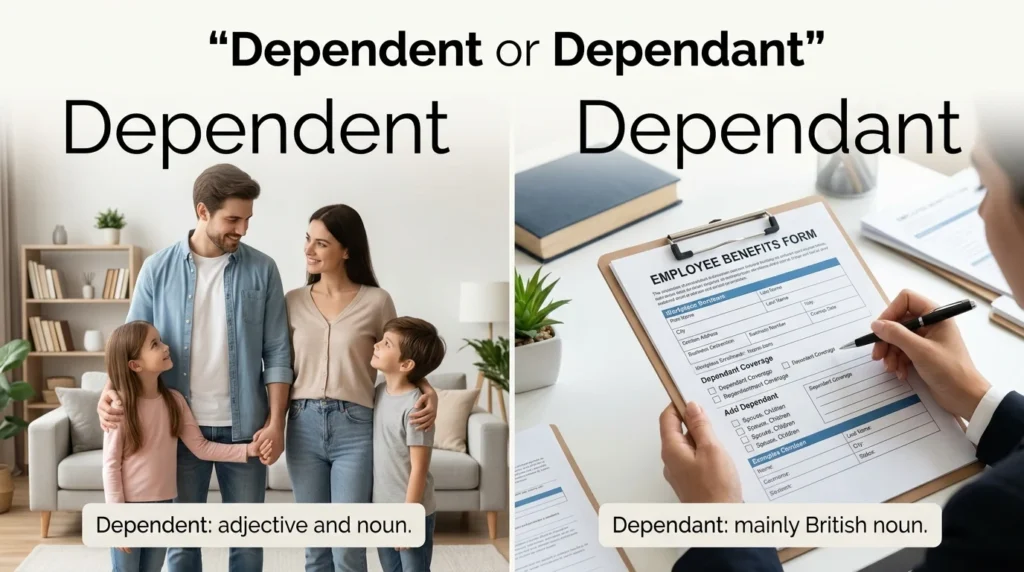
Dependent is the standard spelling in American English and is also widely used as a noun and adjective. Dependant is mainly used in British English, especially as a noun for a person who relies on someone else for financial or personal support.
Dependent and dependant look almost identical, so it is easy to wonder which spelling is correct. The answer depends partly on where the word is being used and what role it has in a sentence. In American English, dependent is the usual spelling for both the adjective and noun. British English often uses dependent as an adjective but dependant as a noun.
Both forms relate to the same basic idea: someone or something that relies on another person, thing, or condition. You might see the word in tax forms, insurance documents, family records, employment paperwork, academic writing, or everyday conversation.
Understanding the difference can help you choose the right spelling without guessing. Once you know how each form works, the choice becomes much easier.
What Does Dependent Mean?
Dependent means relying on someone or something for support, care, money, or another need.
It can work as an adjective or a noun.
As an adjective, it describes something that relies on another thing.
Examples:
- Children are often dependent on their parents.
- The plant is dependent on sunlight.
- The result is dependent on several factors.
- She became financially dependent on her family.
As a noun, dependent can refer to a person who relies on another person for support.
Examples:
- He added his wife as a dependent on his insurance plan.
- The employee listed two dependents on the form.
- The child is a dependent of the employee.
In American usage, dependent is the normal spelling in both situations.
What Does Dependant Mean?
Dependant has the same basic meaning as dependent when it is used as a noun.
It refers to a person who relies on someone else for financial or personal support.
For example:
- The employee listed his children as dependants.
- She supports two dependants.
- The form asks for the number of dependants in your household.
The spelling dependant is especially common in British English.
However, there is an important point to remember. British English commonly uses:
- dependent as an adjective
- dependant as a noun
So a British writer may say:
The child is dependent on her parents.
But:
She has two dependants.
This distinction helps explain why both spellings appear in English writing.
Dependent or Dependant: What Is the Difference?
The main difference is spelling and regional usage, not meaning.
| Word | Common use | Meaning |
|---|---|---|
| Dependent | American English and widely used elsewhere | Relying on someone or something |
| Dependant | Mainly British English noun | A person who relies on someone else |
There is no major difference in the underlying idea.
For example:
Dependent:
The child is dependent on his parents.
Dependant:
The employee supports three dependants.
The first sentence uses an adjective. The second uses a noun.
When Should You Use Dependent?
Use dependent when you need an adjective to describe something that relies on another person or thing.
Common patterns include:
dependent on
This is one of the most common structures.
- Success is dependent on preparation.
- The child is dependent on her parents.
- The price is dependent on demand.
- The outcome is dependent on the weather.
It can also describe people who need support.
- He is financially dependent on his parents.
- She is emotionally dependent on her partner.
- The patient is dependent on family members for care.
The word is also common in formal writing.
Examples:
- The treatment is dependent on the patient’s condition.
- Economic growth is dependent on consumer spending.
- The final decision is dependent on the available evidence.
When Should You Use Dependant?
Use dependant mainly when writing in British English and referring to a person who depends on another person.
For example:
- The company provides benefits for employees and their dependants.
- He has three dependants.
- The application asks whether you have any dependants.
- Her children are listed as dependants.
In American English, these same sentences normally use dependent.
For example:
- The company provides benefits for employees and their dependents.
- He has three dependents.
- The application asks whether you have any dependents.
Therefore, if you are writing for an American audience, dependent is the safer and more familiar spelling.
Dependent as an Adjective
As an adjective, dependent describes a person, thing, or situation that relies on something else.
The most common construction is dependent on.
Examples:
- Babies are dependent on adults for care.
- The project is dependent on funding.
- Plants are dependent on water.
- His decision is dependent on the results.
- The schedule is dependent on the weather.
Notice that dependent does not become dependant simply because it describes a person.
For example:
She is dependent on her parents.
This is correct.
She is dependant on her parents.
This spelling is not normally used for the adjective.
That distinction is especially useful when dealing with British English.
Dependent as a Noun
Dependent can also function as a noun.
It refers to someone who relies on another person for support.
For example:
- The worker has two dependents.
- His children are his dependents.
- She added her mother as a dependent.
- The employee can include eligible dependents on the plan.
This noun form is especially common in American English.
In British English, dependant is often preferred for this meaning.
Common Phrases With Dependent
Several common expressions use dependent.
Dependent on
This means relying on something.
The final price is dependent on the size of the order.
Financially dependent
This means relying on someone for money.
The student is financially dependent on her parents.
Emotionally dependent
This describes a strong emotional reliance on another person.
He became emotionally dependent on his close friend.
Completely dependent
This means relying heavily or entirely on someone or something.
The injured bird was completely dependent on human care.
Dependent variable
This is a common term in mathematics, science, and research.
A dependent variable is the variable that changes as a result of another variable.
For example:
In the experiment, plant growth was the dependent variable.
The spelling here is dependent, not dependant.
Dependent in Work and Business
The word appears often in employment and business documents.
You may see questions such as:
- Do you have any dependents?
- How many dependents do you have?
- Are your dependents covered by the plan?
- Please provide information about your dependents.
These forms usually refer to family members or other people who rely on an employee for financial support.
For example:
The employee added her two children as dependents to the health plan.
The same idea may appear as dependants in British documents.
Dependent in Taxes and Benefits
The word is also common in financial and tax-related contexts.
A dependent is generally someone who meets the relevant rules for being supported by another person.
You might see phrases such as:
- dependent child
- dependent spouse
- dependent parent
- qualifying dependent
- dependent care
- dependent benefits
For example:
The parent claimed an eligible child as a dependent.
Because financial forms can have specific legal definitions, the exact meaning of dependent may depend on the rules of the form or program.
Dependent in Family Relationships
People often use dependent when talking about children and family members.
Examples include:
- Young children are dependent on their parents.
- The family supports an dependent.
- She cares for a dependent relative.
- His children are financially dependent on him.
However, dependent does not always mean helpless.
Someone can be dependent on another person for one specific need while remaining independent in other areas.
For example:
The patient is physically dependent on a caregiver but can make personal decisions independently.
Dependent in Science and Research
Dependent has a special role in scientific and mathematical language.
A dependent variable is measured or observed in an experiment. Its value may change because another variable changes.
For example, imagine an experiment that studies how sunlight affects plant growth.
The amount of sunlight is the independent variable.
Plant growth is the dependent variable.
A simple example is:
Plant height was measured as the dependent variable.
This is always spelled dependent.
You should not write dependant variable.
Dependent and Independent
A useful way to understand dependent is to compare it with independent.
Dependent means relying on something or someone.
Independent means not relying on someone or something for support or control.
Compare these examples:
The child is dependent on her parents.
The adult is financially independent.
The meanings are opposite in many situations.
The same contrast appears in research.
Independent variable affects another variable.
Dependent variable is the result that researchers measure.
This pair is common in science, statistics, education, and academic writing.
Dependent vs Dependant in British English
British English makes this spelling difference more interesting.
A common British pattern is:
- dependent as an adjective
- dependant as a noun
For example:
She is dependent on her parents.
But:
She has two dependants.
This pattern is one reason you may see both spellings in books, websites, forms, and official documents.
However, usage can vary. Dependent is also widely understood and used as a noun in British English, particularly in international or formal contexts.
So the safest approach is to consider both region and grammatical role.
Dependent vs Dependant in American English
In American English, dependent is the standard spelling for both the adjective and noun.
Examples:
The child is dependent on his parents.
She has two dependents.
Add your dependents to the insurance plan.
The form asks for the number of dependents.
The spelling dependant is uncommon in American writing.
Therefore, if you are writing an American business document, application, resume, website, or general article, dependent is usually the right choice.
Why Do Dependent and Dependant Look Different?
The difference comes from spelling conventions that developed in different varieties of English.
Both forms come from the same word family and share the same basic meaning.
The ending can cause confusion because English contains many words with different regional spellings.
In this case, the easiest rule is:
Dependent works broadly and is the standard choice in American English.
Dependant is mainly used as a British noun.
You do not need to memorize a complicated rule. Focus on the role of the word and the variety of English you are using.
Common Mistakes With Dependent and Dependant
One common mistake is treating the two spellings as completely different words.
They are not.
Another mistake is using dependant as an adjective.
For example:
The child is dependant on his parents.
This is not the standard spelling.
Write:
The child is dependent on his parents.
Another common mistake is using dependent and dependant randomly in the same document.
If you are writing in American English, use dependent consistently.
If you are following British spelling and using the noun for a person, dependant may be appropriate.
Consistency makes your writing look cleaner and more professional.
Dependent or Dependant in Formal Writing
For formal writing, context matters.
If you are writing a scientific paper, use dependent in terms such as:
- dependent variable
- dependent measure
- dependent factor
- dependent relationship
If you are completing a form, follow the spelling used by the organization.
If the form says dependants, use that spelling in your response when appropriate.
If it says dependents, use dependents.
Matching the terminology of an official document can prevent confusion.
Dependent or Dependant in Everyday Conversation
In everyday speech, you will not hear a major difference in meaning.
The words refer to people or situations that rely on someone or something else.
For example:
The baby is dependent on her parents.
He has two dependents.
The result is dependent on timing.
Because dependent is widely used, it is often the easiest spelling to remember.
The spelling dependant is more likely to appear when following British conventions.
Dependent in Academic Writing
Academic writing uses dependent frequently.
Common phrases include:
- dependent variable
- dependent measure
- dependent relationship
- dependent factor
- dependent outcome
- dependent condition
Examples:
The researchers measured the dependent variable.
The outcome was dependent on several environmental factors.
Student performance was the dependent measure in the study.
In these examples, dependent is the correct spelling.
How to Remember the Difference
A simple memory trick can help.
Think of dependent as the general spelling.
It works as an adjective and noun and is especially standard in American English.
Then remember:
Dependant = mainly a British noun for a person who depends on someone else.
So:
He is dependent on his parents.
But in British usage:
His parents support him as a dependant.
You can also remember the common scientific phrase:
dependent variable
If you are talking about a variable, the spelling is always dependent.
Examples of Dependent in Sentences
Here are some natural examples:
- The child is dependent on her parents.
- The final price is dependent on demand.
- He is financially dependent on his family.
- The patient became dependent on a caregiver.
- The result is dependent on several factors.
- The experiment used temperature as an independent variable and growth as a dependent variable.
- She listed her children as dependents.
- The company offers coverage for eligible dependents.
- The student was once dependent on financial support from his family.
- Many young adults become financially independent after college.
Examples of Dependant in Sentences
Here are examples where dependant can appear in British usage as a noun:
- He supports three dependants.
- The employee listed his children as dependants.
- The benefit is available to eligible dependants.
- She has one dependant living at home.
- The form asks for details about your dependants.
In American English, these sentences would normally use dependent instead.
A Quick Grammar Test
Try choosing the correct form.
1. The child is ______ on his parents.
Answer: dependent
The word is an adjective.
2. She has two ______.
Answer: dependents in American English.
It is a noun referring to people.
3. The result is ______ on the weather.
Answer: dependent
The word is an adjective.
4. The employee listed three ______ on the form.
Answer: dependents in American English.
5. Plant growth was the ______ variable.
Answer: dependent
This is a scientific term.
Practice: Dependent or Dependant?
Choose the correct spelling for each sentence.
- The baby is ______ on her mother for care.
- He listed his children as ______.
- The final result is ______ on several factors.
- The experiment measured the ______ variable.
- The employee supports two ______.
- She is financially ______ on her family.
- The insurance plan covers eligible ______.
- The patient’s condition is ______ on treatment.
Answers
- dependent
- dependents in American English
- dependent
- dependent
- dependents in American English
- dependent
- dependents in American English
- dependent
If you are following British spelling, dependants can be used for the noun meaning people who rely on someone else.
Dependent or Dependant: Which One Should You Choose?
When in doubt, dependent is the best general choice.
Use dependent when:
- describing someone or something that relies on another
- writing about a dependent variable
- writing in American English
- using the word as an adjective
- referring to a person as a dependent in American English
Use dependant when:
- following British spelling
- using the word as a noun for a person who relies on someone else
The difference is small, but knowing it can make your writing more accurate.
Final Tips for Using Dependent and Dependant
Remember these simple points:
- Dependent is the standard spelling in American English.
- Dependent works as both a noun and an adjective.
- Dependant is mainly a British noun.
- Use dependent on when describing reliance.
- Use dependent variable in scientific and mathematical writing.
- Use dependents when referring to supported people in American English.
- Use dependants when following British noun usage.
- Keep your spelling consistent within the same document.
FAQs
Is dependent or dependant correct?
Both spellings are correct, but they have different usage patterns. Dependent is the standard spelling in American English and can be a noun or adjective. Dependant is mainly used as a British noun for a person who relies on someone else.
Should I write dependent or dependant in American English?
Use dependent. American English normally uses dependent for both the adjective and noun.
Is dependant a British spelling?
Yes. Dependant is mainly used in British English as a noun for someone who relies on another person. British English commonly uses dependent as an adjective.
What is the plural of dependent?
The plural is dependents. For example, “She has two dependents.”
What is the difference between dependent and dependant in a sentence?
Dependent can describe reliance or refer to a person who relies on someone else. Dependant is mainly used as a noun in British English. For example, “He is dependent on his parents” uses the adjective, while “He supports two dependants” uses the British noun.
Conclusion
Dependent and dependant have the same basic meaning, but their spelling depends on usage and regional convention. Dependent is the standard and more widely useful form, especially in American English. It works as both an adjective and a noun.
Dependant is mainly used as a British noun for a person who depends on another person for support. When the word describes a condition of reliance, dependent is the correct form, as in “dependent on” or “dependent variable.”
If you want one spelling that works in most situations, choose dependent. When following British spelling and referring to a person as a noun, dependant may be the better choice.