

Quick Answer
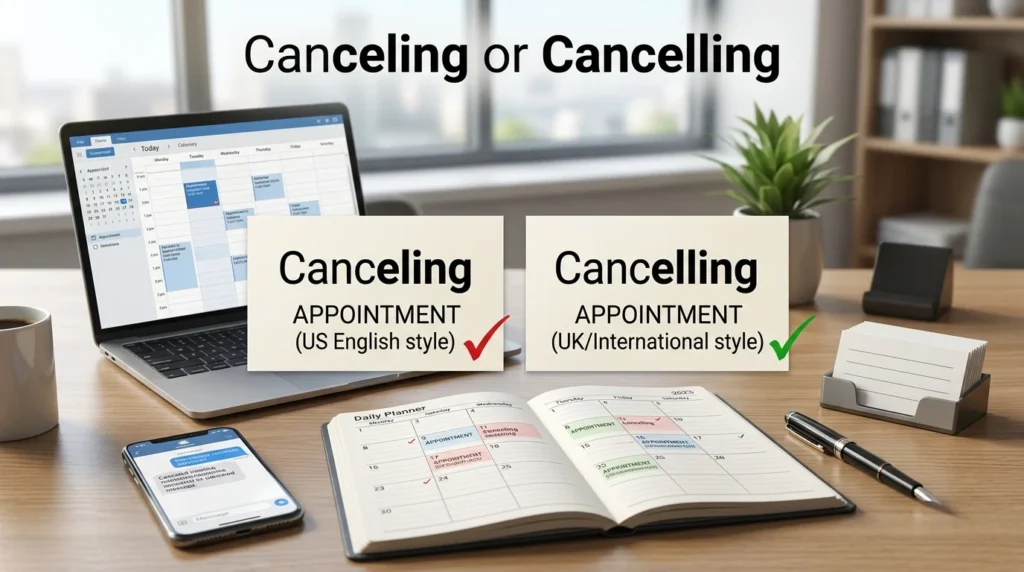
Canceling and cancelling are both correct spellings of the present participle of cancel. Canceling is more common in American English, while cancelling is more common in British English.
If you have ever typed canceling and wondered if it should have two l’s, you are not alone. The spelling of this word changes depending on the English spelling style being used.
Both canceling and cancelling are correct. They have the same meaning and come from the same verb, cancel. The difference is simply the way the final consonant is handled when the ending ing is added.
In American English, canceling with one l is commonly used. In British English, cancelling with two l’s is the usual form. Cambridge lists both patterns and identifies the one-L form as the usual US spelling.
Understanding this small spelling difference can help you write emails, messages, articles, business documents, and everyday sentences with confidence.
What Does Canceling Mean?
Canceling means stopping something that was planned, arranged, or expected to happen.
It is the present participle form of the verb cancel.
For example:
- I am canceling my appointment.
- She is canceling the meeting.
- They are canceling the event.
- We are canceling our reservation.
- He is canceling his subscription.
The word can describe an action that is happening now or around the current time.
For example:
I am canceling my order.
This means the speaker is taking action to stop the order.
The one-L spelling is especially common in American English.
What Does Cancelling Mean?
Cancelling has the same meaning as canceling.
It is the spelling commonly used in British English.
Examples:
- I am cancelling my appointment.
- She is cancelling the meeting.
- They are cancelling the event.
- We are cancelling our reservation.
- He is cancelling his subscription.
There is no difference in meaning between canceling and cancelling.
The difference is spelling style.
Cambridge lists cancelling as the present participle of cancel.
Canceling or Cancelling: What Is the Difference?
The main difference is regional spelling.
| Spelling | Common usage | Example |
|---|---|---|
| Canceling | American English | She is canceling the meeting. |
| Cancelling | British English | She is cancelling the meeting. |
Both forms describe the same action.
If someone says:
I am canceling my flight.
and another person says:
I am cancelling my flight.
Both people mean that they are stopping their planned flight.
The spelling changes, but the meaning stays the same.
Is Canceling or Cancelling Correct?
Both are correct.
There is no need to treat one as a spelling mistake.
If your writing follows American spelling, canceling is usually the form you will want.
If your writing follows British spelling, cancelling is usually the natural choice.
Cambridge gives the US form as canceling and the UK form as cancelling.
So the real question is not which word is universally correct. The better question is which spelling style you are following.
When Should You Use Canceling?
Use canceling when you are following American spelling conventions.
Examples:
- I am canceling my appointment.
- She is canceling the order.
- We are canceling the trip.
- The airline is canceling several flights.
- He is canceling his membership.
- They are canceling the event.
This form is common in everyday writing, business communication, emails, websites, and general American usage.
If the rest of your writing uses spellings such as color, center, and favorite, then canceling will usually fit that spelling style.
When Should You Use Cancelling?
Use cancelling when you are following British spelling conventions.
Examples:
- I am cancelling my appointment.
- She is cancelling the order.
- We are cancelling the trip.
- The airline is cancelling several flights.
- He is cancelling his membership.
- They are cancelling the event.
The additional l does not create a different meaning.
It simply follows a different spelling convention.
Canceling or Cancelling in Everyday English
The word appears in many normal situations.
You might be talking about plans:
We are canceling dinner tonight.
You might be talking about an appointment:
I am canceling my dentist appointment.
You might be talking about a purchase:
She is canceling her order.
You might be talking about travel:
They are canceling their flight.
You might be talking about a subscription:
He is canceling his membership.
In each case, canceling can be replaced with cancelling without changing the meaning.
Canceling or Cancelling for Appointments
Appointments are often canceled when schedules change.
Examples using the one-L spelling:
- I am canceling my appointment.
- She is canceling her interview.
- He is canceling his doctor’s appointment.
- The office is canceling today’s appointments.
- We are canceling the meeting.
With the two-L spelling:
- I am cancelling my appointment.
- She is cancelling her interview.
- He is cancelling his doctor’s appointment.
- The office is cancelling today’s appointments.
- We are cancelling the meeting.
The grammar stays the same.
Only the spelling changes.
Canceling or Cancelling for Flights
Travel is another common situation.
For example:
The airline is canceling the flight.
This means the airline has decided that the planned flight will not operate.
The British spelling would be:
The airline is cancelling the flight.
Both sentences are correct.
You can also say:
- We are canceling our flight.
- They are canceling several flights.
- The airline is canceling the service.
- She is canceling her reservation.
British spelling simply changes canceling to cancelling.
Canceling or Cancelling for Events
Events can also be canceled for many reasons.
Examples:
- They are canceling the concert.
- The school is canceling the event.
- We are canceling the party.
- The organizers are canceling the festival.
- The team is canceling the ceremony.
British spelling:
- They are cancelling the concert.
- The school is cancelling the event.
- We are cancelling the party.
- The organizers are cancelling the festival.
- The team is cancelling the ceremony.
Again, the meaning remains the same.
Canceling or Cancelling for Orders
Customers may decide to stop an order before it is completed.
Examples:
I am canceling my order.
She is canceling the purchase.
The customer is canceling the request.
He is canceling the delivery.
The British forms are:
I am cancelling my order.
She is cancelling the purchase.
The customer is cancelling the request.
He is cancelling the delivery.
Both versions are grammatically correct.
Canceling or Cancelling for Subscriptions
Subscriptions can also be canceled.
For example:
- I am canceling my subscription.
- She is canceling her membership.
- He is canceling the service.
- They are canceling their plan.
- We are canceling the monthly subscription.
The British spelling would use cancelling instead.
This usage is especially common in online services, memberships, streaming services, newsletters, and recurring purchases.
Canceling or Cancelling in Business Writing
Both forms can be used in professional communication.
For example:
We are canceling tomorrow’s meeting.
Or:
We are cancelling tomorrow’s meeting.
Both sentences are professional.
The main thing to watch is consistency.
If a business follows American spelling, using canceling throughout its documents creates a consistent style.
If it follows British spelling, cancelling will usually fit better.
Mixing the two styles in the same document can make the writing look inconsistent.
Canceling and Cancelling With Helping Verbs
Because canceling and cancelling are present participles, they often appear after forms of be.
Examples:
- I am canceling the appointment.
- She is canceling the order.
- We are canceling the trip.
- They were canceling the event.
- He was canceling his subscription.
The same sentences can use cancelling:
- I am cancelling the appointment.
- She is cancelling the order.
- We are cancelling the trip.
- They were cancelling the event.
- He was cancelling his subscription.
The spelling changes, but the grammar does not.
Canceling vs Cancelled
It is useful to understand the difference between canceling and cancelled.
Canceling describes the action of stopping something.
Example:
We are canceling the meeting.
The action is happening now.
Cancelled describes something that has already been stopped.
Example:
We cancelled the meeting yesterday.
So:
Canceling = ongoing action
Cancelled = completed action
The regional spelling difference still applies.
American English commonly uses:
- canceling
- canceled
British English commonly uses:
- cancelling
- cancelled
Cambridge identifies these as the corresponding US and UK patterns.
Why Does Canceling Have One L?
The spelling can seem strange because many people expect the final l to double before ing.
However, English spelling conventions differ between varieties.
In American spelling, canceling is commonly written with one l.
In British spelling, cancelling commonly uses two l’s.
This is why both forms appear in dictionaries and published English.
You do not need to think of one as an error. They belong to different spelling conventions.
Common Mistakes With Canceling and Cancelling
One common mistake is assuming that cancelling is always wrong.
It is not.
Another mistake is assuming that canceling is a typo because it has only one l.
It is not.
A third mistake is using canceling in one paragraph and cancelling in another without a reason.
For example:
We are canceling the event because the organizer is cancelling the venue.
If the document follows one spelling system, this combination may look inconsistent.
Choose one form and use it consistently.
Canceling or Cancelling in School Writing
Students may encounter either spelling depending on the source or teacher.
For example:
The school is canceling the field trip.
or:
The school is cancelling the field trip.
Both are correct.
If you are completing an assignment, it is useful to follow the spelling style expected by your course, school, or publication.
Consistency matters more than trying to change every word into one regional style.
Canceling or Cancelling in Emails
Both spellings are suitable for emails.
For example:
I am canceling our meeting scheduled for Friday.
A British-style version would be:
I am cancelling our meeting scheduled for Friday.
You can also write:
I need to cancel our meeting.
This avoids the spelling difference completely when you do not need the ing form.
That can be useful when writing quickly.
Canceling or Cancelling in Text Messages
Text messages are usually less formal, but spelling still matters when clarity is important.
Examples:
Sorry, I am canceling tonight.
I am cancelling tonight.
Both are easy to understand.
In casual texting, people may also shorten their message:
I need to cancel.
That sentence is simple and avoids the regional spelling difference.
Related Words You Should Know
Understanding related forms can make this spelling easier.
Cancel
The base verb:
I need to cancel the meeting.
Canceling
The common American present participle:
I am canceling the meeting.
Cancelling
The common British present participle:
I am cancelling the meeting.
Canceled
The common American past form:
We canceled the meeting.
Cancelled
The common British past form:
We cancelled the meeting.
Cancellation
The noun:
We received a cancellation notice.
Cambridge defines cancellation as the act of deciding that an arranged event will not happen or stopping an order.
A Simple Way to Remember the Spelling
You can remember the pattern as two pairs.
American spelling:
canceling
canceled
British spelling:
cancelling
cancelled
The easiest visual clue is the number of l’s.
One L: canceling, canceled
Two L’s: cancelling, cancelled
Once you remember this pair, it becomes easier to choose the right spelling.
Practice Questions
Choose the form that fits each sentence.
1. I am ______ my appointment.
Answer: canceling or cancelling
Both are correct. Choose according to your spelling style.
2. She is ______ her flight.
Answer: canceling or cancelling
Both are correct.
3. They are ______ the event.
Answer: canceling or cancelling
Both are correct.
4. We are ______ our reservation.
Answer: canceling or cancelling
Both are correct.
5. He is ______ his subscription.
Answer: canceling or cancelling
Both are correct.
The purpose of this exercise is to recognize that the choice depends on regional spelling rather than meaning.
Quick Comparison
| Form | Meaning | Common Style |
|---|---|---|
| Canceling | Stopping something | American English |
| Cancelling | Stopping something | British English |
| Canceled | Already stopped | American English |
| Cancelled | Already stopped | British English |
| Cancellation | The act of stopping something | Common noun form |
The most useful pair to remember is:
Canceling = American spelling
Cancelling = British spelling
Is Canceling a Correct Word?
Yes.
Canceling is a correct spelling of the present participle of cancel.
It is especially common in American English.
For example:
I am canceling the appointment.
There is no spelling error in that sentence.
Is Cancelling a Correct Word?
Yes.
Cancelling is also correct.
It is especially common in British English.
For example:
I am cancelling the appointment.
There is no spelling error in that sentence either.
Final Tips
Keep these points in mind:
- Canceling is correct.
- Cancelling is also correct.
- Both words have the same meaning.
- Canceling is commonly used in American English.
- Cancelling is commonly used in British English.
- Canceling has one l.
- Cancelling has two l’s.
- The past forms follow the same pattern: canceled and cancelled.
- Use one spelling style consistently.
- Cancellation is a related noun and has its own spelling.
FAQs
Is canceling or cancelling correct?
Both are correct. Canceling is commonly used in American English, while cancelling is commonly used in British English.
Is canceling the American spelling?
Yes. Canceling is the common American spelling of the present participle of cancel.
Is cancelling wrong in American English?
No. Cancelling is a valid spelling, although American English commonly uses canceling with one l.
What is the difference between canceling and cancelling?
There is no difference in meaning. Both mean stopping something that was planned or arranged. The difference is mainly regional spelling.
Is it canceling or cancelling a meeting?
Both are correct. You can write canceling a meeting in American English or cancelling a meeting in British English.
Conclusion
Canceling and cancelling are both correct forms of the verb cancel. They describe the same action, so there is no difference in meaning between them.
The main difference is spelling style. Canceling with one l is commonly used in American English, while cancelling with two l’s is commonly used in British English.
The same pattern appears with canceled and cancelled. If you use American spelling, keeping the one-L forms together is a simple way to stay consistent. If you use British spelling, the double-L forms will usually fit your writing.
Once you remember one L for canceling and two L’s for cancelling, this common spelling question becomes much easier.