
Quick Answer
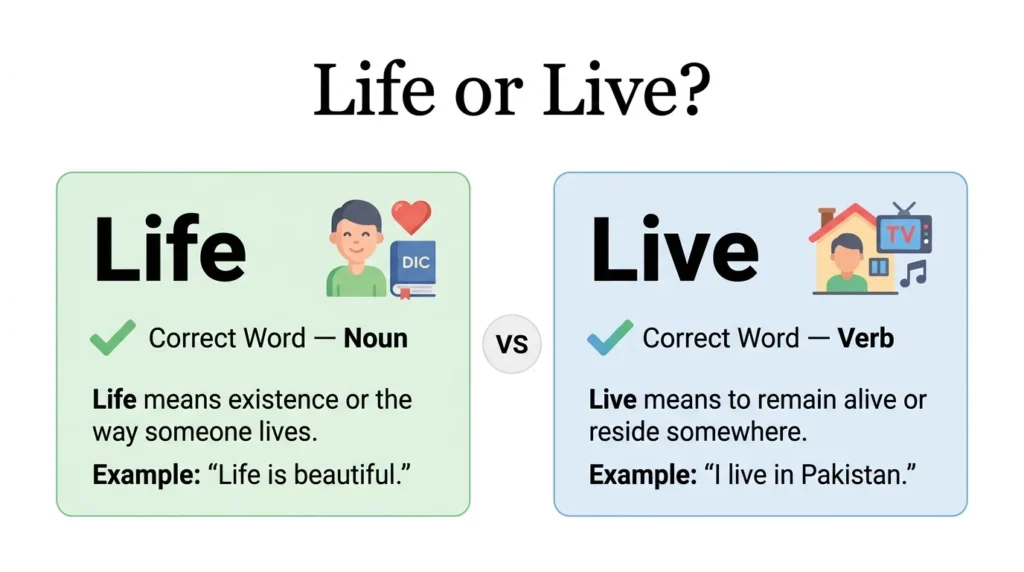
Life and Live are both correct English words, but they have different meanings and grammatical functions. Life is a noun that refers to the existence, experiences, or period of existence of a person, animal, or living thing. Live is commonly used as a verb meaning to exist or reside, and it can also be an adjective meaning happening now or broadcast in real time.
Understanding life or live is important because these words look very similar but are used differently in English. For example, “I live in London” means that I reside in London, while “My life is beautiful” refers to a person’s existence or experiences.
Many English learners confuse life or live because the spelling is similar and the pronunciation can also be confusing. Learning their meanings, pronunciation, grammar rules, and common uses can help you avoid mistakes and communicate more clearly.
This guide explains life or live in simple English. You will learn the definitions, key differences, pronunciation, examples, common mistakes, related words, exercises with answers, and frequently asked questions.
Quick Overview
Life is a noun.
Live is usually a verb.
Life refers to existence, experiences, or the period during which someone or something is alive.
Live as a verb means to exist, stay, or reside.
Live can also be an adjective meaning happening now or broadcast at the same time.
Examples:
- Life can be difficult sometimes.
- I live in Pakistan.
- They live in a small house.
- We watched a live television program.
Both words are extremely common in everyday English.
Definition of Life
The word life is a noun. It refers to the state of being alive, the existence of a person or living thing, or the experiences someone has during their existence.
Examples:
- Life is full of opportunities.
- She has a happy life.
- Human life is valuable.
- My life changed after I moved to another city.
In these examples, life is talking about existence or experiences.
Common Meanings of Life
The word life can be used in several ways.
Existence
Life can mean the condition of being alive.
Example:
Life exists in many forms.
A Person’s Experiences
Life can also refer to everything a person experiences.
Example:
He enjoys his life.
Period of Existence
Life can describe the period between birth and death.
Example:
She lived a long life.
Way of Living
Life can also describe a particular lifestyle or way of living.
Example:
City life can be very busy.
Definition of Live
The word live is commonly used as a verb. As a verb, it means to remain alive, exist, or have your home in a particular place.
Examples:
- I live in Lahore.
- They live in a large house.
- Many animals live in forests.
- We live with our parents.
In these examples, live describes an action or state.
Common Uses of Live
Live can be used to talk about:
- Residence
- Existence
- Survival
- Lifestyle
- Staying somewhere
Examples:
I live in Pakistan.
She lives with her family.
Fish live in water.
They live a peaceful life.
Live as an Adjective
Live can also be an adjective. In this use, it usually means something is happening now or being broadcast in real time.
Examples:
- We watched a live match.
- The singer performed live.
- This is a live broadcast.
- The news is being shown live.
Here, live does not mean “to reside.” It describes something happening at the present time.
For example:
I live in Karachi.
Here, live is a verb.
But:
We watched a live concert.
Here, live is an adjective.
Key Difference Between Life or Live
The simplest way to understand the difference is:
Life = existence or experiences.
Live = to exist, reside, or happen in real time.
Compare these sentences:
Life is beautiful.
Here, life is a noun.
I live in a beautiful city.
Here, live is a verb.
The two words are connected in meaning, but they do not have the same grammatical function.
Quick Comparison Table
| Feature | Life | Live |
|---|---|---|
| Part of Speech | Noun | Verb / Adjective |
| Main Meaning | Existence or experiences | Exist, reside, or happen now |
| Refers to Existence | Yes | Yes |
| Refers to Residence | No | Yes |
| Can Describe an Event | No | Yes |
| Example | Life is precious. | I live here. |
| Example as Adjective | — | A live show |
Life vs Live Pronunciation
One of the biggest reasons learners confuse life and live is pronunciation.
Life is pronounced like:
/laɪf/
It sounds similar to “lyfe.”
Example:
Life is short.
The final sound is f.
Live, when used as a verb, is pronounced:
/lɪv/
It sounds like “liv.”
Example:
I live here.
The final sound is v.
However, live as an adjective meaning happening now is usually pronounced:
/laɪv/
Example:
This is a live show.
So:
Life → /laɪf/
Live (verb) → /lɪv/
Live (adjective) → /laɪv/
This pronunciation difference is important because the spelling alone does not tell you exactly how the word should sound.
Using Life Correctly
The word life is generally used as a noun.
Example 1
Life is not always easy.
Here, life means existence or the experience of living.
Example 2
She has a wonderful life.
Here, life refers to her experiences and lifestyle.
Example 3
Human life is precious.
Here, life means the existence of human beings.
Example 4
He wants to change his life.
Here, life refers to his current situation and experiences.
Example 5
My life has changed completely.
Here, life refers to the person’s circumstances and experiences.
Using Live Correctly
The word live is commonly used as a verb.
Residence
I live in Pakistan.
This means I have my home in Pakistan.
Existence
Many animals live in the wild.
This means the animals exist and survive in natural environments.
Staying Somewhere
They live with their grandparents.
This describes where they stay or reside.
Lifestyle
Some people live a very simple life.
Here, live describes the way people conduct their lives.
Common Expressions with Life
English has many common expressions that use life.
Examples:
Life story
Life experience
Life lesson
Life goal
Life partner
Life choices
Daily life
Family life
City life
School life
Work life
Example:
Traveling gives us valuable life experiences.
Another example:
Everyone learns important lessons in life.
These expressions are common in everyday English.
Common Expressions with Live
The word live also appears in many common phrases.
Examples:
Live here
Live there
Live alone
Live together
Live abroad
Live peacefully
Live happily
Live online
Live broadcast
Live show
Examples:
They live together in a small apartment.
She wants to live abroad.
We watched the event live.
Life and Live in Real-World Examples
Example One
Life is full of surprises.
Here, life is a noun referring to human existence and experiences.
Example Two
I live in Islamabad.
Here, live is a verb showing residence.
Example Three
He wants to improve his life.
Here, life refers to his experiences and circumstances.
Example Four
They live in a large house.
Here, live means reside.
Example Five
We watched the football match live.
Here, live means the match was happening at the same time as the broadcast.
Example Six
Life can teach us many lessons.
Here, life refers to experiences.
Example Seven
Many people live in big cities.
Here, live means reside.
Example Eight
This is a live performance.
Here, live describes an event happening in real time.
Common Mistakes with Life or Live
Mistake One
Incorrect:
I life in Pakistan.
Correct:
I live in Pakistan.
Live is the verb used for residence.
Mistake Two
Incorrect:
My live is difficult.
Correct:
My life is difficult.
Life is the noun referring to existence or experiences.
Mistake Three
Incorrect:
I have a good live.
Correct:
I have a good life.
The noun life is required here.
Mistake Four
Incorrect:
They life in London.
Correct:
They live in London.
The verb live is used to describe where someone resides.
Mistake Five
Incorrect:
She wants to improve her live.
Correct:
She wants to improve her life.
Here, the sentence refers to her experiences and circumstances, so life is correct.
Why English Learners Confuse Life or Live
Several factors can cause confusion between these words.
Similar Spelling
Both words begin with li- and look very similar.
Different Pronunciation
The pronunciation changes depending on the word and its grammatical use.
Similar Meaning
Both words are related to existence and living, which can make them difficult to distinguish.
Grammar Confusion
Life is a noun, while live is commonly a verb. Learners sometimes use them interchangeably.
Limited Practice
Without enough reading, listening, and speaking practice, learners may continue making these mistakes.
Life vs Living
Another word that learners often confuse with life is living.
Life is a noun.
Example:
Life is beautiful.
Living can be a noun, adjective, or present participle depending on the sentence.
Example:
Living in a big city can be expensive.
Compare:
Life in the city is expensive.
Living in the city is expensive.
Both sentences are correct, but their grammatical structures are different.
Life vs Alive
Life and alive are also related but different.
Life is a noun.
Example:
Life is precious.
Alive is an adjective.
Example:
The animal is still alive.
We do not normally say:
The animal is still life.
The correct sentence is:
The animal is still alive.
Life vs Lifetime
Life refers broadly to existence or experiences.
Lifetime refers to the entire period during which someone or something exists.
Examples:
She has had an interesting life.
He saved money during his lifetime.
Another example:
This opportunity comes once in a lifetime.
The word lifetime emphasizes the complete period of existence.
Second Visual Comparison Section
Image Placement Suggestion
Create a professional educational infographic titled “Life vs Live: What’s the Difference?” Use a clean white background with a 1600 by 900 ratio. On the left side, show the word LIFE with a person, family, experiences, and a timeline representing existence and life experiences. On the right side, show LIVE with a house representing residence and a television screen showing a live broadcast. Add simple labels such as Noun, Verb, Existence, Residence, and Happening Now. Use a modern flat educational design with clear typography and high resolution.
Advantages of Using Life and Live Correctly
Better Communication
Using the correct word makes your meaning clear.
Improved Writing
Correct word choice improves grammar and writing quality.
Better Speaking
Correct pronunciation helps listeners understand you.
Professional Credibility
Accurate English creates a more professional impression.
Academic Improvement
Students can avoid simple vocabulary and grammar errors in essays and exams.
Disadvantages of Incorrect Usage
Confusion
Using life instead of live can make a sentence confusing.
Grammar Errors
Incorrect word choice reduces grammatical accuracy.
Pronunciation Problems
Mispronouncing live can sometimes change the intended meaning.
Poor Writing Quality
Repeated vocabulary mistakes can make writing appear less polished.
Regional and Global Usage
The basic distinction between life and live remains consistent in major forms of English, including:
- American English
- British English
- Canadian English
- Australian English
Although pronunciation and accent can vary between regions, the basic meanings and grammatical functions remain the same.
For example:
I live in London.
The word live has the same basic meaning whether the speaker uses British or American English.
Similarly:
Life is important.
The word life remains a noun.
Beginner to Advanced Understanding
Beginner Level
Remember these two simple rules:
Life = existence
Live = reside or exist
Examples:
Life is beautiful.
I live here.
Intermediate Level
At an intermediate level, learn that live can also be an adjective.
Example:
We watched a live concert.
Advanced Level
At an advanced level, focus on pronunciation, fixed expressions, context, idiomatic usage, and related words such as alive, living, lifetime, lifestyle, and livelihood.
Exercises With Answers
Question One
Choose the correct word:
I ___ in Pakistan.
Answer: Live
Question Two
Choose the correct word:
___ is full of challenges.
Answer: Life
Question Three
Choose the correct word:
She has a happy ___.
Answer: Life
Question Four
Choose the correct word:
They ___ in a small apartment.
Answer: Live
Question Five
Choose the correct word:
We watched the event ___.
Answer: Live
Question Six
Choose the correct word:
He wants to change his ___.
Answer: Life
Question Seven
Choose the correct word:
Many animals ___ in forests.
Answer: Live
Question Eight
Choose the correct word:
This is a ___ television broadcast.
Answer: Live
Question Nine
Choose the correct word:
Human ___ is valuable.
Answer: Life
Question Ten
Choose the correct word:
Where do you ___?
Answer: Live
FAQs
Is it “my live” or “my life”?
The correct phrase is:
My life.
Is life a verb?
No. Life is normally a noun.
Is live a noun?
Live is not normally used as the noun in these common constructions. It is mainly used as a verb or adjective.
What is the difference between life and alive?
Life is a noun, while alive is an adjective.
Example:
Life is precious.
The bird is alive.
What is the difference between life and living?
Life is a noun referring to existence or experiences. Living can describe the act or process of being alive or residing somewhere.
How can I remember the difference between life and live?
Use this simple rule:
Life = what you have.
Live = what you do or where you reside.
Example:
I live my life.
This sentence uses both words correctly.
Conclusion
Understanding the difference between life or live is essential for clear and accurate English communication. Although these words look very similar, they have different grammatical functions and meanings.
Life is a noun that refers to existence, experiences, lifestyle, or the period during which someone or something is alive. For example, “Life is beautiful” and “She has a happy life.”
Live is commonly a verb meaning to exist, reside, or stay in a particular place. For example, “I live in Pakistan” and “They live with their family.”
The word live can also be an adjective meaning something is happening now or being broadcast in real time. For example, “We watched a live match.”
A simple way to remember the difference is:
Life = existence or experiences.
Live = exist, reside, or happen now.
Paying attention to pronunciation is also important. Life is pronounced /laɪf/, while live as a verb is pronounced /lɪv/. When live is used as an adjective meaning happening now, it is pronounced /laɪv/.
With regular practice, reading, listening, and speaking, the difference between life and live becomes much easier to remember. Once you understand their grammatical roles and common patterns, you can use both words confidently in everyday conversations, academic writing, professional communication, and online content.