
Quick Answer
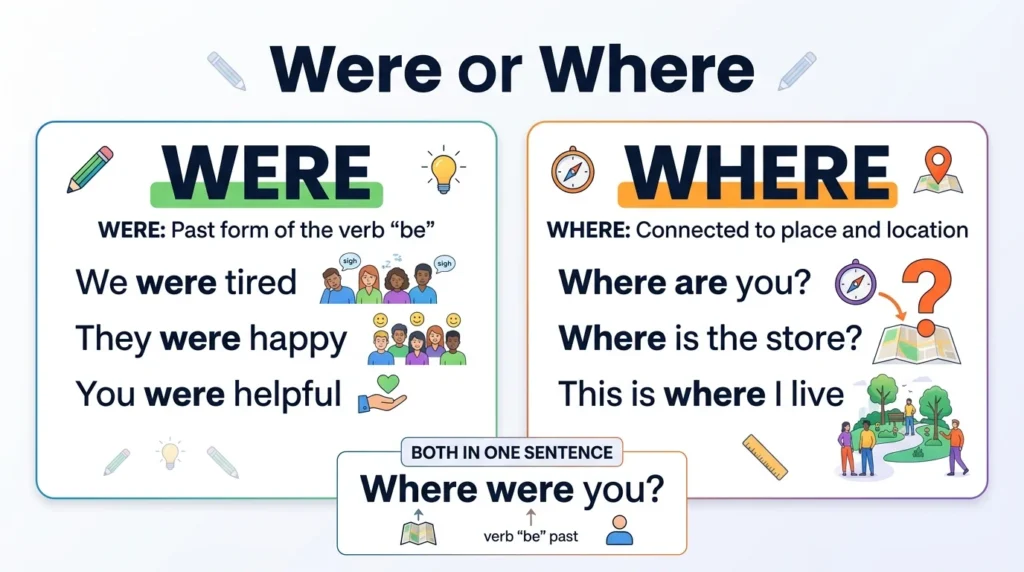
Were is a past-tense form of the verb be, while where refers to a place, location, or position. For example, “They were happy” uses were as a verb, while “Where are they?” asks about a location.
Were or where is a common English confusion because these two words sound very similar in everyday speech. Their meanings, however, are completely different. One is a verb form, while the other is mainly used when talking about a place or asking about location.
You will often see were in sentences about the past. For example, “We were tired after the trip.” On the other hand, where appears in questions such as “Where do you live?” It can also introduce information about a place, as in “This is the house where I grew up.”
The difference becomes much easier once you look at the job each word performs. Whether you are writing a text, school assignment, email, or professional document, knowing when to use were and where will help you avoid one of the most common spelling mistakes in English.
Were vs Where at a Glance
The quickest way to separate these words is to look at their meanings.
| Word | Meaning | Part of Speech | Example |
|---|---|---|---|
| Were | Past form of be | Verb | We were tired. |
| Where | Refers to a place or location | Adverb or conjunction | Where do you live? |
So, remember:
Were = a form of be
Where = place or location
That simple distinction solves most cases.
What Does Were Mean?
Were is a past-tense form of the verb be.
It is commonly used with:
- You
- We
- They
- Plural nouns
Examples:
- You were late.
- We were ready.
- They were excited.
- The students were quiet.
- My friends were at the restaurant.
The word tells us something about a past situation or state.
For example:
They were happy yesterday.
The sentence describes how they felt in the past.
What Does Where Mean?
Where is used when talking about a place, location, or position.
It is often used to ask questions.
Examples:
- Where do you live?
- Where is my phone?
- Where are the keys?
- Where did you go?
- Where can I buy this?
In each example, where asks about a location.
It can also connect a place with additional information:
This is the park where we met.
Here, where connects the word “park” with information about the place.
Were and Where Are Not Interchangeable
Although were and where sound similar, you cannot normally replace one with the other.
Consider:
We were at home.
This tells us what happened.
Now look at:
Where were you?
This asks about a location.
Notice that both words can appear in the same sentence:
Where were you yesterday?
Here, where asks for the location, while were is the verb.
This is one of the most useful examples for remembering the difference.
Where Were You?
The phrase “Where were you?” is very common in English.
It asks about someone’s location in the past.
For example:
Where were you last night?
Where were you when I called?
Where were you during the meeting?
The structure is:
Where + were + subject
For example:
Where were they?
Where were we?
Where were your parents?
In every case, where asks about location and were acts as the past-tense verb.
When to Use Were
Use were when you need the past form of be with you, we, they, or plural subjects.
For example:
You were very helpful.
We were at the store.
They were ready to leave.
The children were outside.
You can also use were in questions:
Were you busy?
Were they at home?
Were we supposed to call?
It can also appear in negative sentences:
We were not late.
They weren’t ready.
You weren’t there.
When to Use Where
Use where when you are talking about a location or asking where something is.
For example:
Where is the nearest gas station?
Where did you buy that jacket?
Where are the kids?
Where should we meet?
You can also use it to describe a place:
I remember the restaurant where we had dinner.
This is the city where she grew up.
The word does not describe the action itself. Instead, it points to a place or location.
Were in Past-Tense Sentences
One of the easiest ways to recognize were is to check whether the sentence talks about the past.
For example:
We were tired after the flight.
They were busy yesterday.
You were right about the problem.
The houses were expensive.
Each sentence describes a past condition or situation.
The present forms would be:
We are tired.
They are busy.
You are right.
The houses are expensive.
When the situation moves into the past, were can replace are with the appropriate subjects.
Where in Questions
Where appears frequently in questions because people often need to ask about locations.
Common examples include:
Where are you?
Where is she?
Where are they going?
Where did you park?
Where can I find the information?
Where should we meet?
These questions all ask for information about a place, position, or destination.
A useful clue is that you can often answer a where question with a location.
For example:
Where are you?
I’m at home.
Where did you put the keys?
They’re on the table.
Were or Where in Everyday Conversation
Both words appear constantly in everyday American English.
Consider this short conversation:
“Where were you this morning?”
“I was at work.”
The first where asks about location. The second word, were, is the past form of be.
Another example:
“Where were your friends?”
“They were at the mall.”
This pattern is very common:
Where + were + person or people
Understanding this structure can make the difference between the two words much easier to remember.
Common Mistakes With Were and Where
The most common mistake is choosing where when the sentence needs a verb.
Incorrect:
We where tired.
Correct:
We were tired.
Another common error is using were when the sentence needs a location word.
Incorrect:
Were is the restaurant?
Correct:
Where is the restaurant?
Here is another example:
Incorrect:
Were did you go?
Correct:
Where did you go?
The first word asks for a location, so where is required.
Were or Where in Text Messages
Texting can make these mistakes more common because people often type quickly.
You may see messages such as:
“Were are you?”
The correct version is:
“Where are you?”
Another example:
“We where at the movie theater.”
The correct sentence is:
“We were at the movie theater.”
These mistakes do not usually prevent people from understanding the intended meaning. Still, correct spelling makes your writing clearer and more professional.
Were or Where in School Writing
Students often encounter these words in essays, homework, and tests.
A simple method is to ask yourself what the sentence is doing.
If the word describes a past state or condition, choose were.
The students were prepared.
If the word asks about or connects to a location, choose where.
Where did the students meet?
This distinction works in most ordinary sentences.
Were or Where in Professional Writing
Correct spelling matters even more in professional communication.
Consider an email that says:
“Were should we meet?”
The intended meaning is easy to guess, but the spelling is incorrect.
The correct sentence is:
“Where should we meet?”
Similarly:
“The employees where ready.”
should be:
“The employees were ready.”
A small spelling mistake can make otherwise polished writing look careless. Therefore, checking were and where is worthwhile when preparing important documents.
Where Were They?
The phrase “Where were they?” combines both words naturally.
For example:
Where were they yesterday?
Where were they during the meeting?
Where were they when the storm started?
The construction is easy to understand:
Where asks about the location.
Were provides the past-tense verb.
You can use the same pattern with other subjects:
Where were we?
Where were you?
Where were the children?
Where were the cars?
This is a useful pattern to remember because it shows the different roles of the two words in one sentence.
Were vs Where Pronunciation
In many varieties of English, were and where have different pronunciations, although some speakers may pronounce them very similarly.
Were is commonly pronounced like “wur” in ordinary speech.
Where is commonly pronounced like “wair.”
For example:
We were busy.
Where are you?
Listening carefully to the vowel sound can help, but pronunciation alone is not always reliable. The meaning and grammar of the sentence are stronger clues.
Were, Where, and We’re
There is another word that often causes confusion: we’re.
These three forms are different:
- Were = past form of be
- Where = place or location
- We’re = contraction of “we are”
Examples:
We were tired yesterday.
Where are you going?
We’re going home.
The apostrophe in we’re is important because it shows that two words have been combined.
A useful comparison is:
We were at the store.
Where were you?
We’re at the store now.
These three sentences demonstrate three completely different meanings.
Where Were vs We’re
These combinations can look confusing when typed quickly.
For example:
Where were you?
This asks about a past location.
But:
We’re going home.
means:
We are going home.
The words may look similar on the page, yet their grammatical roles are different.
When proofreading, look carefully for the apostrophe in we’re.
More Examples of Were
Here are several examples using were correctly:
- We were late for dinner.
- They were excited about the trip.
- You were very helpful.
- The students were ready.
- My parents were at home.
- The dogs were outside.
- We were tired after work.
- They were surprised by the news.
Each example describes a past state, condition, or situation.
More Examples of Where
Here are several examples using where correctly:
- Where do you live?
- Where is the bathroom?
- Where did you buy it?
- Where are my glasses?
- Where should we park?
- Where can I find the report?
- I know where she works.
- This is the house where I grew up.
Each example relates to a place, location, or position.
A Simple Trick to Remember Were or Where
Think about the meaning before looking at the spelling.
If you are talking about a past form of be, use were.
If you are talking about a place or location, use where.
You can also connect where with the word here.
Both where and here are connected with location.
For example:
Where are you?
I am here.
This connection can help you remember that where relates to a place.
For were, think of the verb forms:
We are happy now.
We were happy yesterday.
That makes were easier to identify.
Practice Questions
Choose were or where to complete each sentence.
- ___ are you going?
- We ___ tired after the trip.
- ___ they at the office yesterday?
- I don’t know ___ she lives.
- They ___ excited about the concert.
- ___ were you last night?
- The children ___ outside.
- ___ should we meet?
- You ___ right about the answer.
- Do you remember ___ we parked?
Answers
- Where are you going?
- We were tired after the trip.
- Were they at the office yesterday?
- I don’t know where she lives.
- They were excited about the concert.
- Where were you last night?
- The children were outside.
- Where should we meet?
- You were right about the answer.
- Do you remember where we parked?
Notice how both words can appear together:
Where were you?
That combination is completely correct because each word has a different job.
Were or Where: Final Comparison
| Feature | Were | Where |
|---|---|---|
| Main meaning | Past form of be | Place or location |
| Grammar role | Verb | Adverb or conjunction |
| Common use | Past situations | Questions about places |
| Example | They were happy. | Where are they? |
| Past-related | Yes | Not necessarily |
| Location-related | Not by itself | Yes |
The distinction is simple once you focus on meaning rather than sound.
Frequently Asked Questions
What is the difference between were and where?
Were is a past form of the verb be, while where refers to a place or location. For example, “They were tired” uses were, while “Where are they?” uses where.
Is it where were you or were were you?
The correct phrase is “Where were you?” The word where asks about the location, and were is the past-tense verb.
How do I remember the difference between were and where?
Remember that where relates to a place or location. Were is a form of be used for past situations with subjects such as you, we, and they.
What is the difference between were, where, and we’re?
Were is a past form of be. Where refers to a place. We’re is short for we are. For example, “We were tired,” “Where are you?” and “We’re ready.”
Can were and where be used in the same sentence?
Yes. A common example is “Where were you?” Here, where asks about a location, while were functions as the past-tense verb.
Conclusion
The difference between were or where becomes much easier when you focus on what each word means. Were is a past form of the verb be, while where is used when talking about a place, location, or position.
For example, “They were at home” describes a past situation. In contrast, “Where were they?” asks about their location. The two words may sound similar, but they perform completely different jobs in a sentence.
When you are unsure, look at the sentence first. If you need a past form of be, choose were. If you are asking about or referring to a location, choose where. This simple check will help you avoid one of the most common English spelling mist.