

Quick Answer
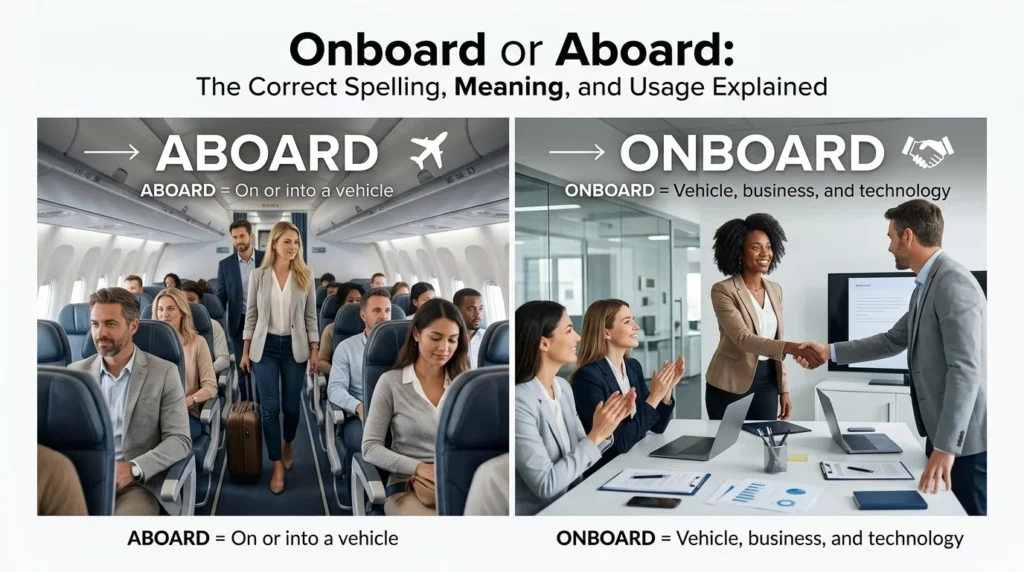
Onboard usually means on or into a vehicle, ship, aircraft, or organization. Aboard means on or into a ship, train, aircraft, bus, or other vehicle. For example, “Welcome aboard” is correct, while “The new employee is onboard” can describe someone who has joined a company.
Onboard and aboard are often confused because both words can describe being on a vehicle or becoming part of something. They are especially common in travel, business, aviation, shipping, and workplace communication. However, they are not always interchangeable.
Aboard is strongly connected with being on or into a vehicle, especially a ship, train, aircraft, or other form of transportation. Onboard can also describe being on a vehicle, but modern English uses it much more broadly. In business, for example, a company can bring a new employee onboard. You can also talk about onboard equipment, onboard systems, or an onboard computer.
Understanding the difference helps you choose the natural word in emails, travel writing, workplace messages, and everyday conversations.
What Does Onboard Mean?
Onboard can mean on or into a vehicle, but it also has an important business meaning.
When used in travel, it describes something or someone that is on a ship, aircraft, train, or other vehicle.
Examples:
- There are 200 passengers onboard.
- We have plenty of food onboard.
- The captain is onboard the ship.
- The aircraft has Wi-Fi onboard.
In business, onboard can mean included in a team, company, project, or organization.
Examples:
- We are happy to have you onboard.
- The company brought three new employees onboard.
- She is now onboard with the project.
- We need another designer onboard.
This broader business use is one of the biggest differences between onboard and aboard.
What Does Aboard Mean?
Aboard means on or into a vehicle.
It is especially common with ships, airplanes, trains, and other transportation.
Examples:
- All passengers are aboard the plane.
- We climbed aboard the train.
- Everyone was safely aboard the ship.
- Welcome aboard!
- There were 150 people aboard the aircraft.
The word often focuses on physical presence inside or on a vehicle.
Unlike onboard, aboard is not normally used to mean joining a company or agreeing with a business plan.
Onboard or Aboard: The Main Difference
The simplest distinction is this:
Aboard = on or into a vehicle.
Onboard = on or into a vehicle, or part of a team, company, project, or system.
Compare these examples:
- The passengers are aboard the plane.
- The passengers are onboard the plane.
- We welcomed a new employee onboard.
- We welcomed a new employee aboard.
The first three sentences can work naturally depending on context. The final sentence sounds unusual if the meaning is that the person joined a company.
Therefore, onboard has a much wider modern use.
Is Onboard One Word?
Yes. Onboard is commonly written as one word when it functions as an adjective, adverb, or verb.
Examples:
- onboard equipment
- onboard software
- onboard the aircraft
- onboard new employees
- welcome everyone onboard
However, on board can also appear as two words in certain grammatical constructions.
For example:
- We are on board the train.
- She is on board with the plan.
- Everyone is on board.
The one-word and two-word forms depend on how the expression functions in the sentence.
Is Aboard One Word?
Yes. Aboard is normally written as one word.
Examples:
- Welcome aboard.
- Everyone is aboard the ship.
- We climbed aboard the bus.
- The crew is aboard the aircraft.
Do not write a board when you mean being on a vehicle.
For example:
Correct:
We climbed aboard the train.
Incorrect:
We climbed a board the train.
The phrase a board has a completely different meaning because board can mean a flat piece of wood or another object.
Onboard in Business
Onboard is very common in workplace English.
Companies often use it when discussing new employees, customers, clients, partners, or team members.
Examples:
- We are excited to have you onboard.
- The company is onboarding five new employees.
- We need to bring another engineer onboard.
- The client is now onboard with the proposal.
- Everyone is onboard with the new strategy.
In these examples, onboard does not mean physically being inside a vehicle. Instead, it means joining, participating, supporting, or becoming part of something.
This business meaning makes onboard much more flexible than aboard.
What Does “Welcome Aboard” Mean?
Welcome aboard is a traditional expression used when someone joins a ship, aircraft, train, or similar vehicle.
Examples:
- Welcome aboard the flight.
- Welcome aboard, everyone.
- Welcome aboard the ship.
However, the expression is also widely used in business.
For example:
- Welcome aboard! We are excited to have you on the team.
Here, aboard has a figurative meaning. It suggests that the person is joining a group or organization.
Even though welcome onboard is also heard, welcome aboard is the more traditional expression.
What Does “On Board With” Mean?
The phrase on board with means agreeing with or supporting an idea, plan, or decision.
Examples:
- Are you on board with the new plan?
- My manager is on board with the idea.
- Everyone is on board with the changes.
- We need the entire team to be on board with this decision.
Here, on board is not about transportation.
It means supportive, willing, or in agreement.
You would not normally replace this expression with aboard.
For example:
Correct:
I am on board with the proposal.
Unnatural:
I am aboard with the proposal.
Onboard as a Verb
Onboard can also function as a verb, especially in business.
It means to bring someone into a company, organization, project, or system.
Examples:
- We need to onboard the new employees.
- The company onboarded several new customers.
- HR will onboard the new manager next week.
- The team is onboarding a new client.
The noun onboarding is also extremely common.
Examples:
- Employee onboarding starts Monday.
- Our onboarding process is simple.
- The company improved its customer onboarding system.
This use is strongly associated with modern workplace English.
Aboard for Travel
Aboard is especially natural in travel situations.
Examples:
- We are aboard the train.
- The passengers are aboard the aircraft.
- Everyone is aboard the ship.
- She climbed aboard the bus.
- The crew welcomed us aboard.
It often appears in announcements and travel-related language.
For example:
All passengers are now aboard the aircraft.
This sounds formal and natural.
Onboard for Travel
Onboard is also completely natural when talking about transportation.
Examples:
- There are children onboard the plane.
- Food is available onboard the train.
- The ship has a restaurant onboard.
- Passengers can use Wi-Fi onboard.
The main difference is that onboard often emphasizes something existing or happening within the vehicle.
For example:
The aircraft has onboard entertainment.
This is more natural than using aboard.
Onboard Equipment and Technology
One important use of onboard is with technology and equipment.
Examples:
- The car has an onboard computer.
- The aircraft uses onboard navigation systems.
- The ship has onboard medical equipment.
- The device includes onboard storage.
- The vehicle has an onboard camera.
In these cases, aboard would not work naturally.
You would not normally say:
an aboard computer
The correct expression is:
an onboard computer
This is because onboard can function as an adjective meaning something is built into or carried by a vehicle or system.
Onboard or Aboard in American English
Both words are used in American English, but their common uses differ.
Aboard is strongly associated with transportation and traditional travel expressions.
Onboard has expanded into business, technology, projects, and organizations.
For US readers, these examples sound natural:
- Welcome aboard!
- The passengers are aboard the plane.
- We have Wi-Fi onboard.
- The car has an onboard computer.
- We hired a new employee and brought her onboard.
- Are you on board with the plan?
Therefore, the best choice depends on what you are trying to say.
Common Mistakes With Onboard and Aboard
One common mistake is using aboard for business participation.
Incorrect:
The manager is aboard with the new strategy.
Correct:
The manager is on board with the new strategy.
Another mistake is confusing onboard with on board.
Correct:
The technician is onboard the aircraft.
Correct:
The technician is on board the aircraft.
Both forms can be correct, depending on sentence structure and style.
Another mistake is writing a board when you mean aboard.
Correct:
They climbed aboard the ship.
Incorrect:
They climbed a board the ship.
Onboard vs On Board
These forms are related, but they often serve different grammatical roles.
Onboard is commonly used as an adjective or verb.
Examples:
- onboard equipment
- onboard services
- onboard new employees
On board commonly works as a phrase.
Examples:
- We are on board the plane.
- She is on board with the plan.
- Everyone is on board.
In modern business writing, onboard is also frequently used as a verb.
Example:
We need to onboard the new client.
Aboard vs On Board
These expressions can sometimes describe the same physical situation.
For example:
The passengers are aboard the plane.
The passengers are on board the plane.
Both are natural.
However, the expressions have different wider uses.
Aboard mainly stays connected to transportation.
On board can also mean agreement or support.
Example:
Are you on board with this idea?
Here, it means:
Do you support this idea?
Pronunciation of Onboard and Aboard
Both words are easy to pronounce because they contain familiar sounds.
The main stress usually falls on the second part of each word.
When speaking naturally, focus on keeping the word smooth rather than separating every sound.
In everyday American speech, both words are common enough that context usually makes their meaning clear.
Real World Examples
Here are natural examples you may hear or read:
- Welcome aboard the flight.
- Everyone is aboard the train.
- There are 300 passengers onboard.
- The ship has a medical team onboard.
- The car has an onboard navigation system.
- We are bringing a new designer onboard.
- Are you on board with the plan?
- The entire team is on board.
- Please remain onboard until the train stops.
- The crew welcomed the passengers aboard.
These examples show why the two words cannot always replace each other.
How to Remember Onboard or Aboard
Use this simple rule:
Aboard = transportation.
Onboard = transportation plus business, technology, and participation.
Think about a plane.
You can say:
The passengers are aboard the plane.
You can also say:
The passengers are onboard the plane.
Now think about a company.
You can say:
We brought a new employee onboard.
But you would not normally say:
We brought a new employee aboard.
That difference is the easiest way to remember the broader meaning of onboard.
Practice: Choose Onboard or Aboard
Choose the best word or phrase for each sentence.
- Welcome ___ the flight.
- The company hired a new designer and brought her ___.
- Everyone is ___ the train.
- The aircraft has ___ entertainment.
- Are you ___ with the new proposal?
- The passengers are ___ the ship.
- We need to ___ the new employees.
- The car has an ___ computer.
- The captain welcomed everyone ___.
- The entire team is ___ with the decision.
Answers
- aboard
- onboard
- aboard
- onboard
- on board
- aboard
- onboard
- onboard
- aboard
- on board
Onboard or Aboard: Quick Comparison
| Word or Phrase | Main Meaning | Example |
|---|---|---|
| Aboard | On or into a vehicle | We climbed aboard the train. |
| Onboard | On or inside a vehicle | There is Wi-Fi onboard. |
| Onboard | Join a company or team | We brought her onboard. |
| On board | Agree or support | I am on board with the plan. |
| Onboard | Built into or carried by a system | The car has an onboard computer. |
Which One Should You Use?
Use aboard when your sentence focuses on being on or entering a vehicle.
Examples:
- Welcome aboard.
- We climbed aboard the plane.
- Everyone is aboard the ship.
Use onboard when you are discussing something inside a vehicle, equipment, technology, or joining a company or project.
Examples:
- The plane has onboard Wi-Fi.
- We brought a new employee onboard.
- The vehicle has an onboard computer.
Use on board when you mean being in a vehicle or supporting an idea.
Examples:
- We are on board the train.
- Are you on board with the plan?
Final Tips
Remember these points when choosing between onboard or aboard:
- Aboard mainly relates to transportation.
- Onboard can also relate to transportation.
- Onboard has important business and technology meanings.
- Onboard can be a verb meaning to bring someone into a company or system.
- On board with means agreeing with or supporting something.
- Welcome aboard is a common travel expression.
- Onboard equipment means equipment carried by or built into a vehicle or system.
- Aboard is always written as one word when it has this meaning.
- Onboard and on board can both be correct, depending on grammar and context.
The safest rule is simple: use aboard mainly for vehicles, and use onboard when the meaning extends beyond simply being on a vehicle.
FAQs
1. What is the difference between onboard and aboard?
Aboard mainly means on or into a vehicle. Onboard can have the same transportation meaning, but it also means joining a company, team, project, or system.
2. Is it correct to say “welcome onboard”?
Yes, welcome onboard can be used, especially in modern workplace or business contexts. However, welcome aboard is the traditional expression associated with travel and joining a group.
3. Should I say “onboard the plane” or “aboard the plane”?
Both are correct. “Aboard the plane” has a traditional travel tone, while “onboard the plane” is also common in modern English.
4. Is “on board with the idea” correct?
Yes. On board with means agreeing with or supporting an idea, plan, or decision.
5. Can onboard be used as a verb?
Yes. In modern business English, onboard can mean to bring a new employee, customer, client, or team member into an organization or system. For example, “We need to onboard the new employees next week.”
Conclusion
The difference between onboard or aboard depends mainly on context. Aboard is most closely connected with transportation and means being on or entering a ship, plane, train, bus, or another vehicle. Onboard can describe the same physical situation, but its meaning is much broader.
In modern American English, onboard is common in business and technology. A company can bring an employee onboard, a team can have a new member onboard, and a vehicle can have onboard equipment or technology. Meanwhile, on board with means that someone supports or agrees with an idea.
When in doubt, remember: aboard is mainly about being on a vehicle, while onboard can also be about joining, supporting, or being part of something.