
Quick Answer
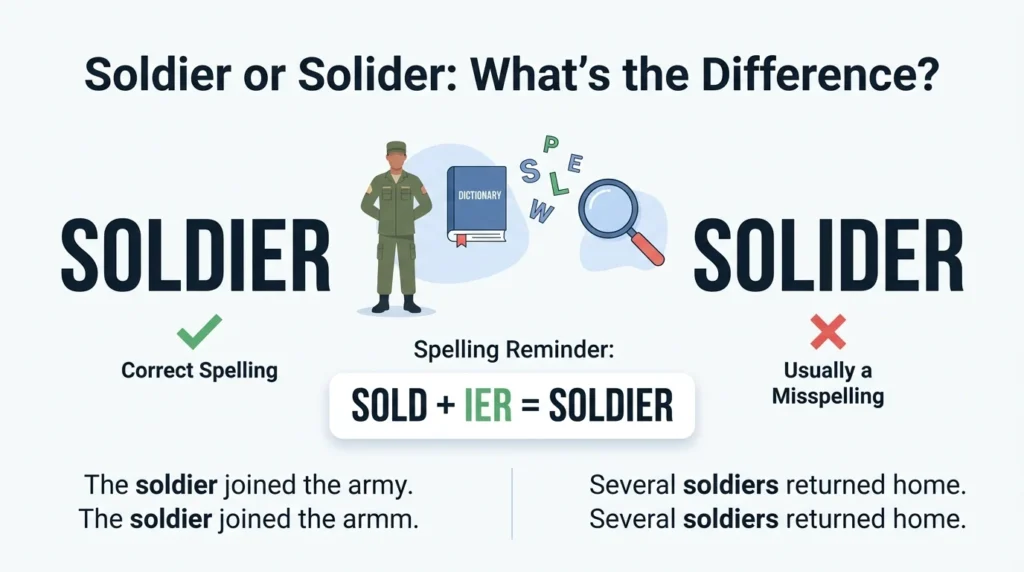
Soldier is the correct spelling for a person who serves in the military or armed forces. Solider is usually a misspelling of soldier, although it is a separate, uncommon word related to the word “solid.”
The words soldier and solider are easy to confuse because they contain almost the same letters. The main difference is that soldier is the correct and common word for a person who serves in the military, while solider is usually a spelling mistake when someone intends to write soldier. This confusion often happens because the letters in soldier do not sound exactly as learners expect. Understanding soldier or solider is useful for students, writers, English learners, and anyone who wants to improve spelling accuracy. In this guide, you will learn the meaning, pronunciation, grammar, examples, common mistakes, related words, exercises, and simple ways to remember which spelling is correct.
What Does Soldier Mean?
Soldier is a noun. It refers to a person who serves in an army or military force.
A soldier may have different duties depending on their country, military branch, rank, and role.
Examples
- The soldier wore a military uniform.
- The soldier returned home after completing his service.
- The army trained every soldier carefully.
- A soldier helped the injured civilians.
- The young soldier followed his commander’s instructions.
- Many soldiers work together as a team.
The plural form of soldier is soldiers.
Example
One soldier
Many soldiers
What Does Solider Mean?
Solider is usually a misspelling of soldier when someone is trying to refer to a military person.
For example:
❌ The solider carried a backpack.
✔ The soldier carried a backpack.
However, solider can technically appear as a comparative form of the adjective solid in some contexts. It is rare and generally not the word English learners mean when they write solider.
For example:
This material is solider than the other one.
Here, solider means something like more solid. This use is uncommon, and more solid is usually clearer.
Therefore, if you are talking about a military person, always use soldier.
Soldier or Solider: Key Difference
| Word | Meaning | Common Use | Example |
|---|---|---|---|
| Soldier | A person who serves in the military | Very common | The soldier returned home. |
| Solider | Usually a misspelling of soldier; rarely means more solid | Very uncommon | The metal is solider than before. |
The easiest rule is:
Soldier = Military person
Solider = Usually incorrect spelling
Why Do People Spell Soldier as Solider?
The spelling mistake happens because soldier is not pronounced exactly as it looks.
Learners may see:
sold + ier
and assume the spelling should be:
sol + dier
or simply:
solider
The correct spelling contains the letters:
S O L D I E R
So remember:
soldier
not:
solider
How to Spell Soldier Correctly
Break the word into smaller parts to make it easier.
SOLD + IER
This gives:
SOLDIER
Another useful trick is to remember the word sold inside soldier.
SOLD + IER = SOLDIER
Although this is only a spelling trick, it can help you remember where the d belongs.
Pronunciation of Soldier
The pronunciation of soldier can also cause confusion.
It is commonly pronounced approximately like:
SOHL-jer
The d is not pronounced as clearly as learners may expect.
This is one reason people sometimes write solider after hearing the word.
Example
Soldier
Sounds roughly like:
SOHL-jer
The spelling and pronunciation are different enough that learners may need extra practice.
Is Soldier a Noun?
Yes. Soldier is a noun because it names a person.
Examples
- The soldier is standing outside.
- A soldier helped the family.
- The soldier received a medal.
- Several soldiers arrived at the location.
The word can also be modified by adjectives.
Examples
- young soldier
- brave soldier
- trained soldier
- experienced soldier
- professional soldier
- injured soldier
Soldier as Part of Common Expressions
The word soldier appears in many common expressions.
Examples
- Army soldier
- Infantry soldier
- Young soldier
- Professional soldier
- Female soldier
- Military soldier
- Veteran soldier
- Foot soldier
- Toy soldier
- Unknown soldier
Some of these phrases are more natural than others depending on context.
Soldier vs Military
These words are related but do not mean exactly the same thing.
Soldier refers to a person.
Military refers to the armed forces or things connected with them.
Examples:
The soldier joined the military.
Here, soldier is the person and military refers to the armed forces.
Another example:
Military training can be difficult.
Here, military is an adjective.
Soldier vs Army
Army and soldier also have different meanings.
An army is a large organized military force.
A soldier is an individual member of a military force.
Examples:
The army moved to the area.
The soldier followed the order.
A simple way to remember this is:
Army = Group
Soldier = Person
Soldier vs Warrior
These words are related but not identical.
A soldier is someone who serves in a military organization.
A warrior is a person who fights in battles or is associated with fighting, especially in historical or cultural contexts.
Examples:
The soldier served in the army.
The warrior fought with a sword.
The word warrior can also be used figuratively.
For example:
She is a warrior in the fight against poverty.
Soldier vs Solider in Sentences
Compare these sentences.
Correct
The soldier stood near the vehicle.
Incorrect
The solider stood near the vehicle.
If you mean a military person, the second sentence contains a spelling error.
Another example:
Correct
The soldiers returned to their base.
Incorrect
The soliders returned to their base.
The correct plural is:
soldiers
not:
soliders
Common Mistakes
Mistake One
❌ The solider joined the army.
✔ The soldier joined the army.
The correct spelling for a military person is soldier.
Mistake Two
❌ Several soliders arrived.
✔ Several soldiers arrived.
The plural of soldier is soldiers.
Mistake Three
❌ He wants to become a solider.
✔ He wants to become a soldier.
Mistake Four
❌ The solider was wearing a uniform.
✔ The soldier was wearing a uniform.
Soldier Plural Form
The plural form of soldier is soldiers.
Singular
The soldier is ready.
Plural
The soldiers are ready.
Notice that the spelling remains:
soldier
and then s is added.
soldier → soldiers
Do not change it to:
❌ soliders
Soldier in American and British English
The spelling soldier is used in both American and British English.
Examples:
American English: soldier
British English: soldier
There is no major spelling difference between these varieties.
The same spelling is also widely used in Canadian, Australian, and other varieties of English.
Soldier in Everyday English
The word soldier is common in news reports, books, documentaries, history lessons, and everyday discussions about military service.
Examples
- The soldier returned from deployment.
- The soldiers received new equipment.
- The documentary followed the life of a soldier.
- The museum displays uniforms worn by soldiers.
- His grandfather was a soldier.
Soldier in Academic Writing
Students may encounter soldier in history, politics, international relations, literature, and social studies.
Examples:
- The soldiers played an important role in the historical event.
- The novel follows the life of a young soldier.
- The historian described the experiences of soldiers during the conflict.
When writing academically, make sure the spelling is correct because solider may be marked as an error.
Soldier in Professional Writing
If you are writing an article, report, news story, or educational document, always use soldier when referring to a military service member.
For example:
✔ The soldier received training before beginning his assignment.
Not:
❌ The solider received training before beginning his assignment.
Correct spelling improves the quality and credibility of your writing.
Advantages of Knowing the Difference
Understanding soldier or solider can help you:
- Improve spelling accuracy.
- Avoid common English errors.
- Write better essays.
- Improve vocabulary.
- Perform better in English tests.
- Write professional content.
- Understand military articles.
- Improve proofreading skills.
- Communicate more clearly.
- Build confidence in English writing.
Easy Memory Trick
One of the easiest ways to remember soldier is:
SOLD + IER
Look for the word sold at the beginning.
SOLDIER
The spelling contains:
S O L D I E R
The d comes before i.
Think:
SOLD → SOLDIER
This can help you avoid writing solider.
Related Spelling Mistakes
Soldier is one of many English words whose spelling may confuse learners.
For example:
- Friend or freind
- Believe or beleive
- Receive or recieve
- Separate or seperate
- Definitely or definately
These words are difficult because English spelling does not always follow simple pronunciation rules.
The best approach is to learn the correct spelling and practice it in sentences.
Practice Exercises
Exercise One: Choose the Correct Word
Choose soldier or solider.
- The ______ wore a uniform.
- He wants to become a ______.
- Several ______ returned home.
- The ______ helped the civilians.
- The army trained every ______ carefully.
Answers
- soldier
- soldier
- soldiers
- soldier
- soldier
Exercise Two: Correct the Spelling
Correct each sentence.
- The solider joined the army.
- Several soliders were present.
- He wants to become a solider.
- The young solider received a medal.
Answers
- The soldier joined the army.
- Several soldiers were present.
- He wants to become a soldier.
- The young soldier received a medal.
Exercise Three: Fill in the Blank
- A ______ serves in the military.
- The ______ wore protective equipment.
- Many ______ returned after their service.
- The young ______ received an award.
- His grandfather was a ______.
Answers
- soldier
- soldier
- soldiers
- soldier
- soldier
FAQs
What is the difference between soldier and solider?
Soldier is the correct and common word for a person who serves in the military. Solider is usually a misspelling of soldier.
Is soldier the correct spelling?
Yes. Soldier is the correct spelling when you mean a person who serves in the military or armed forces.
Why do people spell soldier as solider?
The pronunciation of soldier can make the spelling difficult to hear clearly. This often causes learners to leave out the d and write solider.
What is the plural of soldier?
The plural is soldiers. For example: The soldiers returned home.
How can I remember the spelling of soldier?
Remember SOLD + IER = SOLDIER. The word contains sold at the beginning, which can help you remember where the d belongs.
Conclusion
The difference between soldier or solider is mainly a spelling issue. Soldier is the correct and commonly used word for a person who serves in the military or armed forces. Solider is usually a misspelling when someone intends to write soldier. Although solider can technically appear as a rare comparative form related to the adjective solid, this use is uncommon and is not what most English learners mean.
The best way to remember the correct spelling is to focus on the letters d and i. Write SOLDIER, not SOLIDER. You can remember it by breaking the word into SOLD + IER. Regular practice with simple sentences such as “The soldier joined the army” and “Several soldiers returned home” will make the correct spelling natural.
If you are writing an essay, article, report, or professional document, always check the spelling carefully. Correct word choice and spelling make your English clearer, more accurate, and more professional.