

Quick Answer
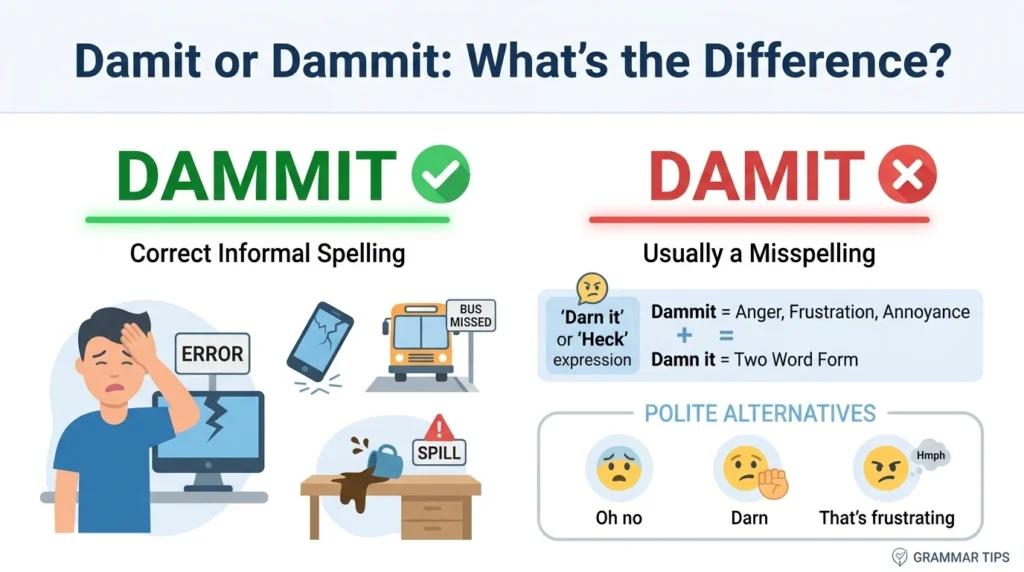
The correct and commonly accepted spelling is dammit.
Dammit is an informal interjection used when someone feels angry, frustrated, annoyed, or disappointed.
Feature Snippet
Dammit is a standard informal spelling of an exclamation used to show anger, frustration, or annoyance. Damit is usually a misspelling of dammit, although it may appear informally online or as a deliberate variation in casual writing.
Damit is generally considered a misspelling of dammit. It may appear in online messages, social media, or casual writing, but it is not the preferred spelling in standard English.
| Word | Status | Meaning | Example |
|---|---|---|---|
| Dammit | Standard informal spelling | Shows anger, frustration, or annoyance | Dammit, I forgot my keys! |
| Damit | Usually a misspelling | Usually intended to mean dammit | Damit, I made the same mistake again. |
A simple rule to remember is:
Dammit = preferred spelling
Damit = usually incorrect spelling
Damit or Dammit
English has many words that look almost identical but have different levels of correctness. Damit or dammit is a good example. The difference may seem very small, but knowing which spelling is preferred can help you write more accurately.
The word dammit is an informal exclamation. People use it when something goes wrong or when they feel frustrated, angry, annoyed, or disappointed. For example, someone who drops their phone might say, “Dammit, I dropped it again!”
The spelling damit is commonly seen because people often type quickly or write words the way they sound. However, in standard English, dammit is the preferred spelling when you intend to use this exclamation.
It is also important to understand that dammit is informal and can be considered mildly offensive or inappropriate in some situations. It is more suitable for casual conversations, fiction, dialogue, and informal writing than for professional emails, academic papers, or formal communication.
In this guide, you will learn the meaning of dammit, why damit is usually considered incorrect, how to use the word naturally, pronunciation, examples, common mistakes, alternatives, exercises, and more.
What Does Dammit Mean?
Dammit is an informal interjection used to express strong emotion.
It commonly shows:
- Anger
- Frustration
- Annoyance
- Disappointment
- Irritation
- Surprise
Examples
- Dammit, I forgot my wallet.
- Dammit, the computer stopped working.
- Oh, dammit! I missed the bus.
- Dammit, I made the same mistake again.
- Dammit, we are already late.
In each sentence, dammit expresses an emotional reaction.
It does not describe an object or action. Instead, it tells the reader or listener how the speaker feels.
What Does Damit Mean?
Damit is generally not the preferred spelling when you want to write the informal exclamation dammit.
People may write damit because the word is pronounced quickly and the second m can be easy to miss.
For example:
Damit, I forgot my phone!
Most readers will understand that the writer means:
Dammit, I forgot my phone!
However, if you want to use the standard informal spelling, dammit is the better choice.
Is Dammit a Real Word?
Yes. Dammit is a recognized informal English word and interjection.
It is closely related to the phrase “damn it.”
Over time, the phrase became commonly written in contracted forms such as dammit.
The word is still informal, so it should be used with care.
Example
Dammit, I lost my keys again!
This is natural in casual speech or dialogue.
However, it would usually be better to avoid it in a formal business email.
Is Damit Correct?
In most standard English contexts, damit is not the preferred spelling of the interjection.
If you mean the emotional expression, write:
Dammit
rather than:
Damit
This is especially important in:
- Formal editing
- Educational writing
- Professional content
- Published articles
- School assignments
- Carefully written fiction
Although readers can understand damit, it may look like a spelling mistake.
Dammit vs Damn It
The expression damn it is the original two-word form.
Examples:
Damn it, I forgot my keys.
Dammit, I forgot my keys.
Both forms can express frustration.
The one-word form dammit is common in informal writing and dialogue.
| Form | Usage |
|---|---|
| Damn it | Two-word informal expression |
| Dammit | Common one-word informal spelling |
| Damit | Usually a misspelling |
Why Do People Write Damit?
There are several reasons.
Fast Typing
When people type quickly, they may accidentally leave out one letter.
Dammit
can easily become:
Damit
especially in short messages.
Pronunciation
In natural speech, the word can be pronounced quickly. The two m sounds may not be clearly heard by learners.
This can lead people to spell it based on what they hear.
Informal Internet Writing
Social media and messaging often contain shortened or altered spellings.
People may intentionally write:
Damit!
because it looks casual or humorous.
However, informal online usage does not necessarily make a spelling standard.
Pronunciation of Dammit
Dammit is commonly pronounced approximately like:
DAM it
The first part sounds like dam, followed by it.
Because the word is often spoken quickly, the second m may not sound very strong.
This is one reason learners sometimes spell it as damit.
When Should You Use Dammit?
Use dammit when you want to express frustration or annoyance in an informal context.
Examples
- Dammit, I missed the train.
- Dammit, my phone is dead.
- Dammit, I forgot the meeting.
- Dammit, this isn’t working.
- Dammit, we were so close to winning.
The word normally appears at the beginning of a sentence, but it can also appear elsewhere for emphasis.
Dammit in Dialogue
Dammit is common in fictional dialogue because it helps show a character’s emotion.
Example
“Dammit!” John shouted when he saw the broken window.
Another example:
“Dammit, we don’t have enough time,” she said.
Writers often use it to make dialogue sound emotional and natural.
Dammit in Casual Conversation
You may hear dammit when someone makes a mistake.
For example, someone spills coffee on their shirt.
“Dammit! I just cleaned this shirt.”
The word communicates frustration.
Another example:
A person tries to open a door, but the key does not work.
“Dammit, why won’t this key work?”
Dammit in Professional Communication
It is usually better to avoid dammit in professional communication.
For example, avoid writing:
Dammit, the report is late again.
in a business email.
Instead, use:
Unfortunately, the report is late again.
or:
I’m frustrated that the report was delayed again.
Professional communication should be clear and respectful.
Polite Alternatives to Dammit
If you want to express frustration without using a potentially offensive word, you have many alternatives.
Mild Alternatives
- Oh no!
- Darn!
- Shoot!
- Ugh!
- Oh, man!
- That’s frustrating!
- What a shame!
- Unfortunately!
- This is annoying!
- I can’t believe it!
Examples
Instead of:
Dammit, I forgot my keys!
You could say:
Darn, I forgot my keys!
Or:
Oh no, I forgot my keys!
These alternatives are safer in family, school, and professional settings.
Dammit vs Darn
Darn is a milder alternative to dammit.
Compare:
Dammit, I missed the bus!
Darn, I missed the bus!
The first expresses stronger frustration.
The second is softer and more polite.
Dammit vs Damn
These words are related but are not always used in exactly the same way.
Damn can function as an interjection, verb, adjective, or other grammatical form depending on context.
Dammit is mainly used as an emotional exclamation.
Examples:
Damn! That was difficult.
Dammit! I forgot my password.
Both express frustration, but dammit is especially associated with a reaction to something going wrong.
Common Mistakes
Mistake One
Incorrect or non-preferred:
Damit, I forgot my phone.
Preferred:
Dammit, I forgot my phone.
Mistake Two
Incorrect spelling:
Damm it!
Preferred:
Damn it!
or:
Dammit!
Mistake Three
Using Dammit in formal writing.
Less appropriate:
Dammit, the project failed.
Better:
Unfortunately, the project failed.
Mistake Four
Thinking Damit and Dammit have different meanings.
Usually, damit is simply an incorrect or informal variation of dammit, not a separate standard word with a different meaning.
Comparison Table
| Expression | Meaning | Formality |
|---|---|---|
| Dammit | Anger or frustration | Informal |
| Damn it | Anger or frustration | Informal |
| Darn | Mild frustration | Informal but softer |
| Oh no | Surprise or disappointment | Neutral |
| Unfortunately | Regret or bad news | Formal |
| That’s frustrating | Clearly expresses frustration | Neutral |
Real World Examples
Example One: Forgetting Something
Dammit, I forgot my passport!
The speaker is frustrated because they forgot something important.
A polite alternative would be:
Oh no, I forgot my passport!
Example Two: Technical Problem
Dammit, my computer froze again.
The speaker is annoyed by the computer problem.
A more professional version would be:
My computer has frozen again, which is frustrating.
Example Three: Sports
Dammit, we lost the match!
The speaker is disappointed about the result.
A neutral version would be:
We lost the match. That’s disappointing.
Example Four: Fiction
“Dammit!” he shouted as the car stopped.
This is acceptable in informal fictional dialogue when the character’s emotion is important.
Regional and Global Usage
The word dammit is widely understood in English-speaking countries.
It appears in:
- American English
- British English
- Canadian English
- Australian English
- New Zealand English
The meaning remains essentially the same.
However, attitudes toward mild profanity can vary between cultures, families, workplaces, and social situations.
A word that seems mild to one speaker may sound rude to another.
For this reason, context is important.
Super Simple Memory Trick
Remember:
Dammit has two m’s.
You can break it visually into:
DAM + MIT
The preferred spelling contains:
DAMMIT
not:
DAMIT
Another useful trick is to remember the original phrase:
DAMN IT
The one-word informal form is:
DAMMIT
Practice Exercises
Exercise One: Choose the Correct Spelling
Choose damit or dammit.
- ______, I forgot my wallet.
- ______, the computer crashed again.
- He shouted, “______!”
- ______, we missed the train.
- She whispered, “Oh, ______.”
Answers
- Dammit
- Dammit
- Dammit
- Dammit
- Dammit
The preferred spelling is dammit.
Exercise Two: Choose the Best Expression
Choose the most suitable option.
- You are writing a formal business email about a delayed project.
A. Dammit, the project is late.
B. Unfortunately, the project has been delayed.
- You are writing casual dialogue for a frustrated character.
A. Dammit, I can’t open this door!
B. Unfortunately, I cannot open this door.
- You forgot your keys and are speaking casually.
A. Dammit, I forgot my keys!
B. The keys were unfortunately forgotten by me.
Answers
- B
- A
- A
Exercise Three: Correct the Spelling
Correct these sentences.
- Damit, I lost my phone.
- Damm it, that’s annoying.
- Damit! We missed the bus.
- I wrote “damit” in my article.
Answers
- Dammit, I lost my phone.
- Damn it, that’s annoying.
- Dammit! We missed the bus.
- I wrote “dammit” in my article.
FAQs
What is the difference between damit and dammit?
Dammit is the preferred informal spelling of the exclamation used to express anger or frustration. Damit is generally a misspelling or informal variation.
Is dammit a correct word?
Yes. Dammit is a recognized informal spelling used to express frustration, anger, annoyance, or disappointment.
Is damit a correct spelling of dammit?
Usually no. If you mean the informal exclamation, dammit is the preferred spelling.
Is dammit a bad word?
It is an informal swear word or mild profanity. It can be inappropriate in formal, professional, or sensitive situations.
What is a polite alternative to dammit?
You can use oh no, darn, shoot, that’s frustrating, or unfortunately, depending on the situation.
Conclusion
The difference between damit or dammit is mainly a matter of spelling. Dammit is the preferred informal spelling of an exclamation used to express anger, frustration, annoyance, or disappointment. Damit is generally considered a misspelling when the writer intends to use the word dammit, although it may appear in casual online communication or as an intentional informal variation.
It is also important to consider the situation before using dammit. The word is informal and can be considered mildly offensive, so it is better suited to casual conversations, fictional dialogue, social media, or informal writing. In professional emails, academic work, and formal communication, polite alternatives such as unfortunately, oh no, or that’s frustrating are usually better choices.
The easiest rule is simple: remember DAMMIT with two m’s. If you are unsure, use a polite alternative. Knowing both the correct spelling and the right context will help you communicate more clearly and professionally.