
Quick Answer
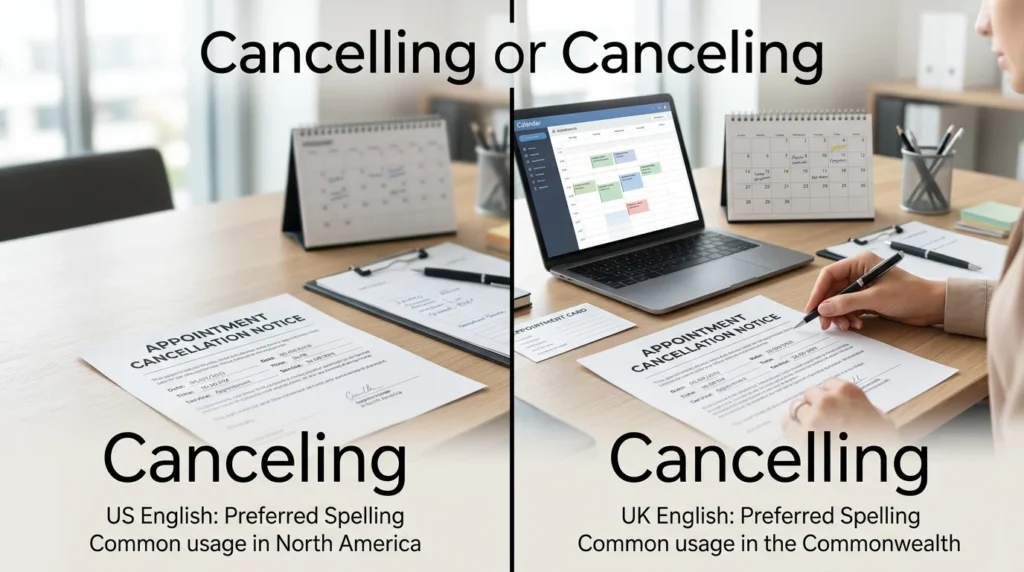
Cancelling and canceling are both correct spellings of the present form of cancel. Canceling is more common in American English, while cancelling is more common in British English.
If you have ever typed cancelling and wondered whether one of the two l’s should disappear, you are not alone. The spelling of this word changes depending on the English style being used.
Both canceling and cancelling describe the same action. They mean stopping something that was planned, arranged, or expected to happen. You can use either form when talking about a meeting, flight, appointment, order, subscription, event, or personal plan.
The real question is not whether one spelling is right and the other is wrong. Both are accepted. Instead, you need to know which spelling fits the English style you are following. Once you learn that simple difference, this spelling choice becomes much easier.
What Does Canceling Mean?
Canceling is the form of cancel used with -ing.
It describes the action of stopping something or deciding that something will not happen.
For example:
- I am canceling my appointment.
- She is canceling the order.
- They are canceling the event.
- We are canceling our trip.
- The airline is canceling several flights.
The spelling with one l is especially common in American English.
The word can describe both personal decisions and actions taken by businesses, organizations, schools, airlines, and other groups.
What Does Cancelling Mean?
Cancelling has the same meaning as canceling.
The only major difference is the spelling.
The form with two l’s is more common in British English.
For example:
- I am cancelling my appointment.
- She is cancelling the order.
- They are cancelling the event.
- We are cancelling our trip.
- The airline is cancelling several flights.
Nothing about the action changes. The extra l simply reflects a different spelling convention.
Cancelling or Canceling: What Is the Difference?
The main difference is regional spelling.
| Spelling | Common Usage | Example |
|---|---|---|
| Canceling | American English | She is canceling the meeting. |
| Cancelling | British English | She is cancelling the meeting. |
Both forms are grammatically valid.
Both have the same pronunciation.
Both come from the same verb, cancel.
The important thing is to keep your spelling consistent throughout your writing.
Is Canceling or Cancelling Correct?
Both are correct.
This is the easiest answer to remember.
If you follow American spelling, canceling is generally the natural choice.
If you follow British spelling, cancelling is generally the natural choice.
Therefore, seeing one l does not mean the writer made a spelling mistake. Seeing two l’s does not mean the writer added an unnecessary letter.
The spelling simply reflects the variety of English being used.
When Should You Use Canceling?
Use canceling when your writing follows American spelling conventions.
For example:
- The airline is canceling the flight.
- I am canceling my reservation.
- She is canceling her subscription.
- We are canceling the meeting.
- The company is canceling the order.
- He is canceling his appointment.
This spelling is especially natural in American business writing, emails, websites, messages, and everyday communication.
When Should You Use Cancelling?
Use cancelling when your writing follows British spelling conventions.
Examples:
- The airline is cancelling the flight.
- I am cancelling my reservation.
- She is cancelling her subscription.
- We are cancelling the meeting.
- The company is cancelling the order.
- He is cancelling his appointment.
The word does not become more formal or less formal because of the extra l.
It is simply a different spelling style.
Why Are There Two Spellings?
English has developed different spelling conventions in different regions.
That is why you can find pairs such as:
- color and colour
- traveled and travelled
- labeled and labelled
- canceled and cancelled
- canceling and cancelling
The same basic idea appears with canceling and cancelling.
One spelling uses a single l, while the other uses a double l.
Neither form changes the basic meaning of the word.
Canceling and Cancelling in Everyday Use
You can use both forms in many ordinary situations.
For example, imagine that you have plans to meet a friend but something unexpected happens.
You could say:
I am canceling our plans tonight.
Or, using the other spelling:
I am cancelling our plans tonight.
Both sentences mean that you have decided not to continue with the plans.
The same applies to appointments, reservations, trips, subscriptions, and events.
Canceling or Cancelling an Appointment
Appointments are frequently canceled.
For example:
- I am canceling my dentist appointment.
- She is canceling her interview.
- He is canceling his appointment for Friday.
- The office is canceling several appointments.
With the double l spelling:
- I am cancelling my dentist appointment.
- She is cancelling her interview.
- He is cancelling his appointment for Friday.
- The office is cancelling several appointments.
Choose the spelling that matches the style of the rest of your writing.
Canceling or Cancelling a Flight
Air travel provides another common use.
For example:
The airline is canceling the flight because of severe weather.
Or:
The airline is cancelling the flight because of severe weather.
You can also say:
- Passengers are canceling their bookings.
- The airline is canceling several flights.
- We are canceling our travel plans.
In British spelling, use cancelling instead.
The meaning remains unchanged.
Canceling or Cancelling a Meeting
The word is also common in workplace communication.
For example:
I am canceling today’s meeting.
You might also write:
We are canceling the meeting because several team members are unavailable.
With the British spelling:
I am cancelling today’s meeting.
We are cancelling the meeting because several team members are unavailable.
Both are clear and natural.
Canceling or Cancelling an Order
Customers often cancel orders before they are shipped.
Examples include:
- I am canceling my order.
- The customer is canceling the purchase.
- She is canceling the order before it ships.
- The store is canceling the order because the item is unavailable.
British spelling changes only the word itself:
- I am cancelling my order.
- The customer is cancelling the purchase.
- She is cancelling the order before it ships.
- The store is cancelling the order because the item is unavailable.
Canceling or Cancelling a Subscription
Subscriptions can also be canceled.
For example:
I am canceling my streaming subscription.
She is canceling her membership.
He is canceling the service before the next payment.
With the British spelling:
I am cancelling my streaming subscription.
She is cancelling her membership.
He is cancelling the service before the next payment.
Again, the meaning is exactly the same.
Canceling or Cancelling Plans
Personal plans are another common use.
You might say:
I am canceling my plans for Saturday.
Or:
We are canceling dinner tonight.
Other examples include:
- She is canceling the party.
- They are canceling their weekend trip.
- He is canceling his visit.
- We are canceling our vacation plans.
Using the other spelling gives you:
- She is cancelling the party.
- They are cancelling their weekend trip.
- He is cancelling his visit.
- We are cancelling our vacation plans.
Canceling vs Canceled
Do not confuse canceling with canceled.
They are related forms, but they are used differently.
Canceling describes an action that is happening or being carried out.
Example:
She is canceling the appointment.
Canceled describes something that has already been stopped.
Example:
She canceled the appointment.
The same distinction works with the double l forms:
She is cancelling the appointment.
She cancelled the appointment.
This is an important difference in grammar.
Canceling vs Cancellation
Another related word is cancellation.
Canceling describes the action.
Example:
We are canceling the event.
Cancellation is a noun.
Example:
The cancellation surprised everyone.
You can remember the difference this way:
Canceling = action
Cancellation = the act or result
For example:
The airline is canceling the flight.
The flight cancellation caused delays.
The two words are related but have different grammatical roles.
Is Cancelling With Two L’s Wrong?
No.
Cancelling is a correct spelling.
It is especially common in British English and other writing that follows similar spelling conventions.
For example:
She is cancelling her appointment.
There is nothing grammatically wrong with this sentence.
The mistake would be assuming that every English-speaking region must use the same spelling.
English has several accepted regional spelling differences, and this is one of them.
Is Canceling With One L Wrong?
No.
Canceling is also correct.
It is the more common form in American English.
For example:
She is canceling her appointment.
This sentence is completely standard.
So, if your spell checker accepts one form but flags the other, the language setting may be responsible. A US English setting and a UK English setting can prefer different spellings.
Pronunciation of Canceling and Cancelling
There is no important pronunciation difference between canceling and cancelling.
The extra l in the written form does not create a different sound.
Both are pronounced essentially the same way.
This is another reason the difference can be confusing. You can hear the word in conversation without knowing which spelling the speaker would choose when writing it.
The difference appears on the page rather than in normal pronunciation.
Common Mistakes
One common mistake is assuming that canceling is the only correct form.
That is not true.
Another mistake is assuming that cancelling is a typo.
It is not.
A third mistake is mixing both spellings in the same document without a reason.
For example:
The company is canceling one event and cancelling another.
If the document follows one spelling system, this looks inconsistent.
A better approach is to choose one form and use it throughout the document.
How to Remember the Difference
Use this simple rule:
Canceling = one L
Cancelling = two L’s
Then connect the forms to the regional styles:
American English → canceling
British English → cancelling
You can also connect them to their past forms:
American English
- canceling
- canceled
British English
- cancelling
- cancelled
This makes the pattern easier to remember.
What About Cancelled?
The past form follows the same regional pattern.
You will commonly see:
canceled
and:
cancelled
For example:
The company is canceling the event.
Later:
The company canceled the event.
In the other spelling style:
The company is cancelling the event.
Later:
The company cancelled the event.
This is useful because once you understand canceling vs cancelling, you can also understand canceled vs cancelled.
What About Cancellation?
The noun cancellation is normally written with two l’s.
Examples:
- The cancellation was unexpected.
- We received a cancellation notice.
- The airline announced the cancellation.
- There is a cancellation fee.
- The cancellation affected hundreds of customers.
Do not assume that the one-L pattern from canceling should automatically be applied to every related word.
Cancellation has its own standard spelling.
Canceling or Cancelling in Professional Writing
Both forms can be used in professional writing.
The important thing is consistency.
For example, if your document uses American spelling, write:
We are canceling the meeting scheduled for Monday.
If it follows British spelling, write:
We are cancelling the meeting scheduled for Monday.
Avoid switching between the two forms simply because you see both online.
A consistent spelling style makes an email, report, website, or business document look more polished.
Canceling or Cancelling in Emails
Both spellings are fine in emails.
For example:
I am canceling our meeting because I have another appointment.
Or:
I am cancelling our meeting because I have another appointment.
If you are writing to someone in a setting where a particular English style is expected, follow that style.
The same rule applies to other regional spellings in the email. Consistency matters more than trying to make every word follow one universal English system.
Canceling or Cancelling in Academic Writing
Academic writing also allows both forms.
However, academic writers should follow the style used by their institution, publisher, or chosen style guide.
For example:
The researchers are canceling the second phase of the study.
Or:
The researchers are cancelling the second phase of the study.
Neither spelling changes the meaning of the sentence.
The important point is to avoid switching styles randomly.
Practice Questions
Choose the form that fits the requested spelling style.
Question One
American English:
The airline is ______ several flights.
Answer: canceling
British English:
The airline is ______ several flights.
Answer: cancelling
Question Two
American English:
I am ______ my reservation.
Answer: canceling
British English:
I am ______ my reservation.
Answer: cancelling
Question Three
American English:
She is ______ her subscription.
Answer: canceling
British English:
She is ______ her subscription.
Answer: cancelling
Question Four
American English:
We are ______ the meeting.
Answer: canceling
British English:
We are ______ the meeting.
Answer: cancelling
Question Five
American English:
They are ______ the event.
Answer: canceling
British English:
They are ______ the event.
Answer: cancelling
The important lesson is that the sentence itself does not determine which spelling is correct. The English style you are following does.
Quick Comparison
| Word | Meaning | Common Style |
|---|---|---|
| Canceling | Stopping something | American English |
| Cancelling | Stopping something | British English |
| Canceled | Something was stopped | American English |
| Cancelled | Something was stopped | British English |
| Cancellation | The act of stopping something | Standard noun form |
This comparison shows the spelling pattern clearly.
Final Tips
Remember these simple rules:
- Canceling is correct.
- Cancelling is also correct.
- Both words have the same meaning.
- Canceling is more common in American English.
- Cancelling is more common in British English.
- The pronunciation is essentially the same.
- Canceled and cancelled follow the same regional pattern.
- Cancellation normally keeps two l’s.
- Do not mix spelling styles without a reason.
- Choose one spelling system and stay consistent.
FAQs
Is canceling or cancelling correct?
Both are correct. Canceling is more common in American English, while cancelling is more common in British English.
Is canceling the American spelling?
Yes. Canceling, with one l, is the more common spelling in American English.
Is cancelling with two L’s wrong?
No. Cancelling is a correct spelling and is especially common in British English.
Do canceling and cancelling mean the same thing?
Yes. Both mean stopping something that was planned, arranged, or expected to happen. The difference is spelling, not meaning.
Is it canceled or cancelled after canceling?
The same regional pattern applies. American English commonly uses canceled, while British English commonly uses cancelled. For example, “She is canceling the meeting” can later become “She canceled the meeting.”
Conclusion
Canceling and cancelling are both correct. They come from the same verb and describe the same action: stopping something that was planned or arranged.
The main difference is the spelling style. Canceling with one l is more common in American English, while cancelling with two l’s is more common in British English.
If you are writing in American English, choose canceling. If you are following British spelling, choose cancelling. Most importantly, keep the same spelling style throughout your writing.
Once you remember the simple rule of one L for canceling and two L’s for cancelling, this common spelling question becomes much easier.