
Quick Answer
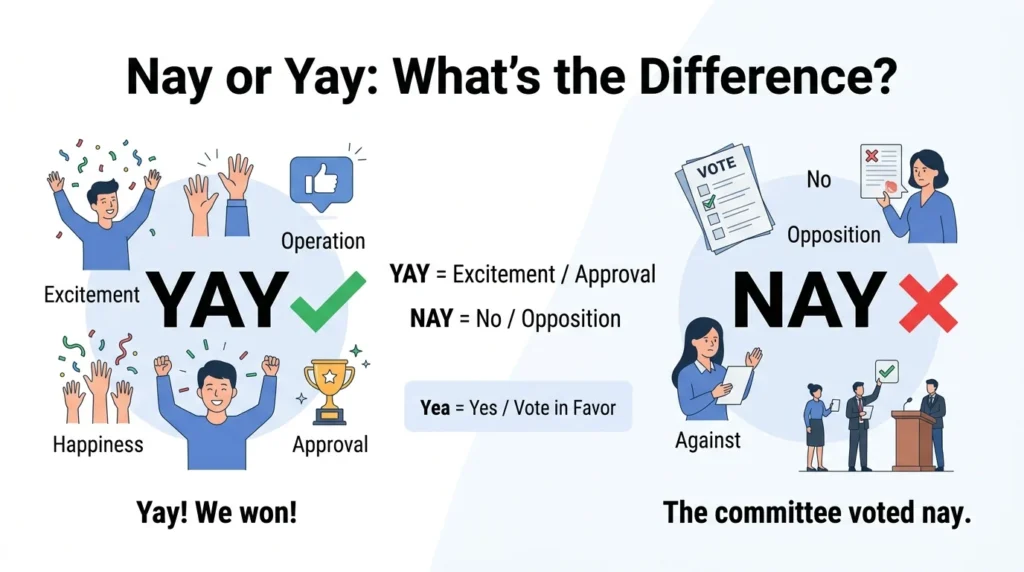
Yay is an informal expression used to show happiness, excitement, or approval. Nay means “no” or “against,” and it is often used in voting, formal, historical, or old fashioned contexts.
The words nay and yay are short and easy to confuse because they rhyme and are often used as quick responses. However, they have very different meanings. Yay is a cheerful expression that shows excitement, happiness, or approval, while nay usually means no, rejection, or opposition. You may hear yay in everyday conversations, text messages, and social media. Nay is less common in casual English but still appears in voting, formal speech, literature, and historical writing. Learning the difference between nay or yay helps you understand conversations more easily and choose the right word when writing. Once you connect yay with excitement and nay with no, the difference becomes simple.
What Does Yay Mean?
Yay is an informal interjection. It is mainly used to express happiness, excitement, joy, celebration, or approval.
When something good happens, people often say yay as a quick emotional response.
Examples
- Yay! We won the game.
- Yay! I passed my exam.
- Yay, we are going on vacation.
- Yay! It is finally Friday.
- Yay! My package arrived.
- Yay, you are coming with us.
In each example, yay expresses a positive feeling.
Yay Meaning in Simple English
The easiest meaning of yay is:
Yay = I am happy or excited about this.
For example:
Yay! We won!
This means the speaker is very happy because the team won.
Another example:
Yay! No school tomorrow!
Here, the speaker is excited about having no school.
When to Use Yay
Use yay in casual situations when you want to show excitement or happiness.
You can use it in:
- Text messages
- Social media
- Casual conversations
- Friendly emails
- Informal writing
- Personal messages
- Fictional dialogue
Examples
Yay! I got the job.
Yay! My friends are coming tonight.
Yay, we finished the project.
Yay! I finally bought the book I wanted.
Yay in Social Media
Yay is especially common online.
People often write:
- Yay!
- Yayyy!
- Yaaay!
- Yay for Friday!
- Yay, we did it!
- Yay! Finally!
Extra letters are used to show stronger emotion.
For example:
Yayyy! We won!
This is very informal. It is suitable for social media or texting but not normally appropriate for academic writing.
What Does Nay Mean?
Nay usually means no, not, or against.
It is an interjection in some contexts and can also be used as a noun when referring to a negative vote.
Examples
- Nay, I will not go.
- The committee voted nay.
- The proposal received several nays.
- The members voted yea or nay.
- He answered nay.
Today, nay is less common in normal conversation than no.
Nay Meaning in Simple English
The easiest meaning of nay is:
Nay = No or against.
For example:
The committee voted nay.
This means the committee voted against the proposal.
Nay in Voting
One of the most important modern uses of nay is in voting.
You may hear:
Yea or nay?
This means:
Yes or no?
In a vote:
Yea = In favor
Nay = Against
Example
The motion received 70 yea votes and 30 nay votes.
This means 70 people supported the motion and 30 opposed it.
Nay in Formal and Historical English
The word nay has a long history in English. It was once much more common as a direct way to say no.
For example:
Nay, I shall not do it.
Modern English would normally say:
No, I will not do it.
Because of this, nay can sound old fashioned today.
It may appear in:
- Historical novels
- Classic literature
- Poetry
- Traditional speeches
- Fantasy stories
- Religious writing
- Formal voting language
Nay vs No
Although nay can mean no, they are not equally common.
| Word | Meaning | Common Use |
|---|---|---|
| No | Negative answer | Everyday English |
| Nay | No or against | Voting, formal, historical, literary |
For everyday conversation, use no in most situations.
Example
Natural:
No, I don’t want coffee.
Less natural in everyday English:
Nay, I don’t want coffee.
However:
The senator voted nay.
sounds natural in a voting context.
Yay vs Yea
One of the most important differences to understand is between yay and yea.
They sound similar but have different meanings.
Yay
Yay expresses happiness or excitement.
Yay! We won!
Yea
Yea means yes or indicates support, especially in voting.
The proposal received 50 yea votes.
Remember:
Yay = Excitement
Yea = Yes or in favor
Nay vs Yea
These words are commonly paired in voting.
Yea = Yes
Nay = No
Example:
The members were asked to vote yea or nay.
This means they were asked to vote for or against the proposal.
| Word | Meaning |
|---|---|
| Yea | Yes / In favor |
| Nay | No / Against |
Nay or Yay: Main Difference
The difference between nay or yay becomes easy when you focus on emotion and meaning.
| Feature | Yay | Nay |
|---|---|---|
| Main Meaning | Happiness or excitement | No or opposition |
| Tone | Positive | Negative |
| Common in Casual English | Very common | Less common |
| Common in Social Media | Yes | Rare |
| Common in Voting | No | Yes |
| Example | Yay! We won! | The motion received a nay. |
The simple rule is:
Yay = Happy
Nay = No
Pronunciation of Nay and Yay
Both words are easy to pronounce.
Yay rhymes with:
- Day
- Say
- May
- Way
Nay also rhymes with:
- Day
- Say
- May
- Way
The main difference is the first sound.
Yay starts with a y sound.
Nay starts with an n sound.
Practice saying them:
Yay
Nay
This pronunciation difference is useful when listening to native speakers.
Common Mistakes With Nay and Yay
Mistake One
Incorrect:
Nay! We won the competition!
If you want to express excitement, use yay.
Correct:
Yay! We won the competition!
Mistake Two
Incorrect:
Yay, I don’t support the proposal.
If you are talking about a vote against a proposal, nay is the appropriate word.
Correct:
Nay, I do not support the proposal.
In everyday conversation, however, No, I don’t support the proposal sounds more natural.
Mistake Three
Confusing yay and yea.
Incorrect:
Yea! I am so excited!
Correct:
Yay! I am so excited!
Here, yay expresses excitement.
Mistake Four
Using nay instead of no in normal conversations.
Instead of:
Nay, I don’t want pizza.
Use:
No, I don’t want pizza.
Nay can sound formal, old fashioned, or unusual in casual conversation.
Real World Examples
At School
A student receives good news from a teacher.
Yay! I passed the test!
The student uses yay to show excitement.
At Work
A team finishes a difficult project.
Yay! We finished the project on time.
Again, yay shows happiness.
During a Vote
A committee is voting on a new rule.
The members voted yea or nay.
Here, nay means against.
In a Historical Story
A character might say:
Nay, I shall not surrender.
This sounds old fashioned and fits a historical or literary style.
Regional and Global Usage
Both yay and nay are understood in major varieties of English, including American English, British English, Canadian English, and Australian English.
However, their frequency differs.
Yay is widely used in casual English around the world. It is especially common among younger speakers and in digital communication.
Nay is less common in everyday speech. It is more likely to appear in voting, formal language, literature, historical writing, or humorous situations.
The meaning remains essentially the same across English speaking regions.
Yay in American English
American English uses yay frequently.
Examples:
Yay! It’s Friday!
Yay! We won!
Yay, I’m going on vacation.
American English also uses nay in voting and political contexts.
The senator voted nay.
Yay in British English
British speakers also use yay in informal situations.
Example:
Yay! We made it!
The word nay can appear in formal or parliamentary language.
However, no is much more common in ordinary conversation.
Yay in Canadian and Australian English
Canadian and Australian speakers also understand and use yay as an informal expression of happiness or excitement.
Yay! We are going to the beach!
Yay! I passed my exam!
Nay remains less common in everyday conversation but can be used in voting and formal contexts.
Advantages of Understanding Nay and Yay
Knowing the difference between these two words can help you:
- Improve your vocabulary.
- Understand informal English.
- Express emotions naturally.
- Understand voting language.
- Read historical texts more easily.
- Avoid confusing similar words.
- Improve your writing.
- Understand social media language.
- Write natural dialogue.
- Communicate more confidently.
Related Concepts
Yay vs Yes
Yay and yes are both positive, but they are not identical.
Yes shows agreement or gives a positive answer.
Yay shows excitement or happiness.
Example:
Yes, I will attend the meeting.
This is a confirmation.
Yay! I get to attend the concert!
This expresses excitement.
Nay vs No
No is the normal modern word for a negative response.
Nay can also mean no, but it is less common and often has a formal, literary, historical, or voting related tone.
Yay vs Yea
Yay means excitement.
Yea means yes or in favor.
This distinction is important in writing.
Nay vs Nope
Nope is an informal form of no.
Nay is usually more formal, old fashioned, or associated with voting.
Compare:
Nope, I don’t want it.
Nay, I shall not accept it.
The first sounds casual. The second sounds traditional or literary.
Easy Memory Trick
Use this simple rule:
Yay = Yes + excitement
Nay = No
You can also remember:
Yay = Happy
Nay = Against
This makes it easier to choose the right word quickly.
Practice Exercises
Exercise One
Choose yay or nay.
- ______! We won the competition.
- The committee voted ______.
- ______! I got the job.
- The proposal received three ______ votes.
- ______! We are going on vacation.
Answers
- Yay
- Nay
- Yay
- Nay
- Yay
Exercise Two
Choose yay, yea, nay, or no.
- ______! I finally finished my work.
- The senator voted ______.
- Do you want more coffee? ______, thank you.
- The motion received 60 ______ votes.
- ______! We are going to the concert.
Answers
- Yay
- Nay
- No
- Yea
- Yay
Exercise Three
Correct the mistakes.
- Nay! We won the championship.
- Yea! I am very excited about my birthday.
- Yay, I do not support the proposal.
- The committee voted yay.
Answers
- Yay! We won the championship.
- Yay! I am very excited about my birthday.
- Nay, I do not support the proposal.
- The committee voted nay.
FAQs
What is the difference between nay and yay?
Yay expresses happiness, excitement, or approval, while nay means no, rejection, or opposition.
Is yay the same as yes?
Not exactly. Yay expresses excitement or happiness, while yes is normally used for agreement or confirmation.
What does nay mean in voting?
In voting, nay means a vote against a proposal or motion. It is the opposite of yea.
Are yay and yea the same word?
No. Yay expresses excitement, while yea means yes or indicates a vote in favor.
Is nay commonly used in everyday English?
Not usually. No is much more common in everyday conversation, while nay is more common in voting, formal, historical, or literary contexts.
Conclusion
The difference between nay or yay is easy to understand when you remember what each word expresses. Yay is an informal exclamation that shows happiness, excitement, celebration, or approval. It is common in everyday conversations, text messages, social media, and other casual settings. Nay, on the other hand, means no, rejection, or opposition. It is less common in modern everyday speech but remains useful in voting, formal language, historical writing, literature, and certain humorous situations.
You should also remember the difference between yay and yea. Yay shows excitement, while yea means yes or indicates support in a vote. In the same way, nay means no or against. The simplest memory rule is Yay = excitement or happiness and Nay = no or opposition. Use these words according to the situation, and choose simpler alternatives such as yes and no when they sound more natural. With regular practice, you can use nay, yay, and yea correctly and confidently.