
Quick Answer
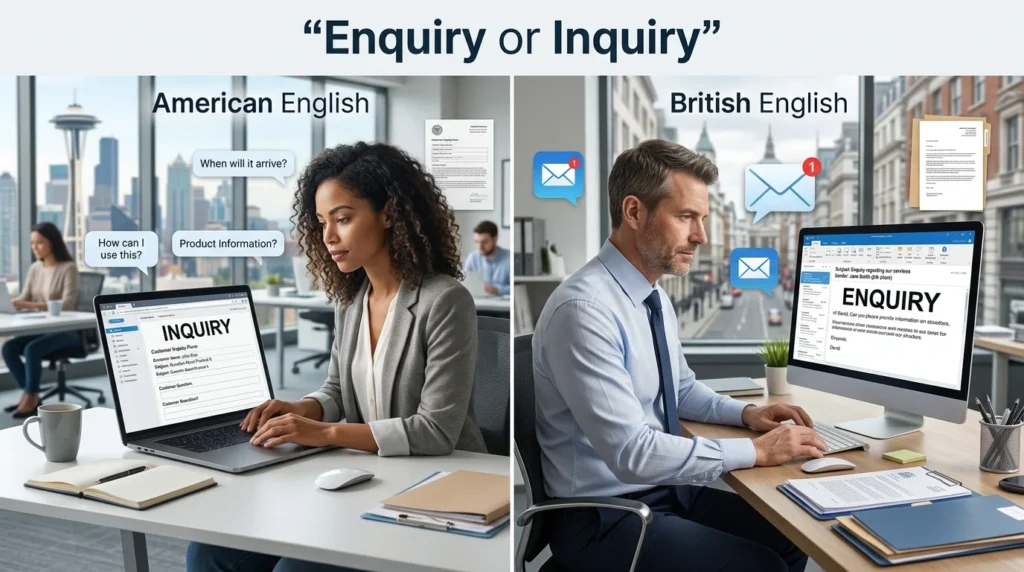
Inquiry is the standard spelling in American English, while enquiry is mainly used in British English. Both words mean a request for information, but inquiry is the better choice for US readers, websites, business writing, and American audiences.
Many English learners wonder whether enquiry or inquiry is the correct spelling. The confusion is understandable because both forms appear in dictionaries, emails, websites, and business documents. The difference is not that one word is always wrong. Instead, the preferred spelling depends on the type of English you are using.
If you write for an American audience, inquiry is the spelling you will see most often. It appears in phrases such as customer inquiry, sales inquiry, media inquiry, and general inquiry. In British English, enquiry is often used when someone simply asks for information.
Knowing this small spelling difference can make your writing look more natural and professional. It also matters for websites, customer service pages, emails, resumes, and formal communication.
Enquiry or Inquiry: Which One Is Correct?
Both enquiry and inquiry are correct English words.
The main difference is regional usage.
Inquiry is the preferred spelling in American English.
Enquiry is commonly used in British English for a general request for information.
For example:
- I have a question about your services.
- I sent an inquiry to the company.
- We received several customer inquiries today.
In British English, you may see:
- I sent an enquiry to the company.
- Please contact us with any enquiries.
For US readers, however, inquiry is the natural choice.
What Does Inquiry Mean?
Inquiry is a noun that means a request for information, an investigation, or an examination of a subject.
The meaning depends on the context.
When someone wants information, an inquiry can be a simple question.
Example:
I made an inquiry about the new membership plan.
Here, the person wants more information.
Inquiry can also describe a formal investigation.
Example:
The government launched an inquiry into the incident.
In this sentence, inquiry means a serious investigation.
Therefore, inquiry can describe both a request for information and a formal investigation.
What Does Enquiry Mean?
Enquiry has a very similar meaning. It usually refers to a request for information.
For example:
I sent an enquiry about the available rooms.
This means the person contacted someone to ask for information.
The spelling enquiry is especially common in British English.
For American readers, the same sentence would normally use inquiry:
I sent an inquiry about the available rooms.
The meaning stays almost the same. The main difference is spelling and regional preference.
Inquiry in American English
If your content is written for people in the United States, inquiry should usually be your first choice.
You will commonly see it in:
- Customer service
- Business emails
- Company websites
- Job applications
- Media contacts
- Sales pages
- Government information
- Academic writing
- Professional communication
Here are some natural examples:
Please send your inquiry to our support team.
We received a customer inquiry this morning.
For media inquiries, contact our communications team.
I have an inquiry about my order.
These examples sound natural to American readers.
Enquiry in British English
British English often uses enquiry when referring to a general request for information.
For example:
I made an enquiry about the course.
The hotel received several enquiries.
Please contact us if you have any further enquiries.
This spelling is widely recognized and accepted in British English.
So, if you are writing specifically for readers in the United Kingdom, enquiry may feel more natural.
However, you should not assume that every British writer uses only enquiry. The word inquiry also exists in British English, especially in formal contexts involving investigation.
Inquiry vs Enquiry in Business Writing
Business writing is one of the most common places where people notice this difference.
For a US company, inquiry is usually the best spelling.
Common phrases include:
- Customer inquiry
- Sales inquiry
- Product inquiry
- General inquiry
- Business inquiry
- Media inquiry
- Service inquiry
- Pricing inquiry
- Job inquiry
For example:
Our team responds to every customer inquiry within one business day.
For a British company, you may see:
Our team responds to every customer enquiry within one business day.
Both sentences are understandable. The spelling simply reflects the preferred variety of English.
Inquiry or Enquiry for Customer Service?
If you run a website for US customers, use inquiry.
For example:
Have a question? Send us an inquiry.
Other natural phrases include:
Submit an inquiry.
Send a product inquiry.
Contact us with your inquiry.
Our team will respond to your inquiry soon.
We handle customer inquiries every day.
If your website targets British customers, enquiry may be a better fit.
For SEO, consistency matters. If your website is written for US users, using inquiry throughout your content will create a more consistent style.
Inquiry or Enquiry in Email Writing
Both forms can appear in professional emails, but US writers normally choose inquiry.
For example:
Hello,
I am writing to make an inquiry about your pricing plans.
Could you please provide more information about your services?
Thank you for your help.
This sounds professional and natural in American English.
For a British audience, the spelling may change:
I am writing to make an enquiry about your pricing plans.
The sentence structure remains the same.
Inquiry as a Formal Investigation
There is another important meaning of inquiry.
It can refer to an official or formal investigation.
For example:
The committee began an inquiry into the financial report.
An independent inquiry was ordered after the incident.
The inquiry examined several important questions.
In this context, inquiry does not simply mean someone asking a question. It refers to a structured investigation.
This meaning is especially important in government, law, education, research, and journalism.
Inquiry as a Simple Question
Inquiry can also mean a simple request for information.
For example:
I called the store with an inquiry about the product.
She submitted an inquiry through the website.
The customer has an inquiry about the warranty.
Here, inquiry means a question or request for information.
This is one reason the word appears so often in customer service and business communication.
Inquiry and Question: Are They the Same?
Inquiry and question are related, but they are not always interchangeable.
A question can be very simple.
What time does the store open?
An inquiry often sounds more formal.
I am writing to make an inquiry about your opening hours.
In everyday conversation, question is usually more natural.
In business, customer service, and formal communication, inquiry can sound more professional.
For example:
Casual:
I have a question about my order.
Professional:
I have an inquiry about my order.
Both are correct. The best choice depends on the situation.
Inquiry and Investigation: What Is the Difference?
An inquiry can be a request for information or an investigation.
An investigation usually suggests a deeper and more organized effort to discover facts.
For example:
I made an inquiry about the course.
This means you asked for information.
But:
The police conducted an investigation.
This means authorities examined facts or evidence.
The two words can overlap when inquiry refers to a formal investigation, but they are not always identical.
Common Mistakes With Enquiry and Inquiry
One common mistake is assuming that enquiry is always incorrect.
It is not.
Enquiry is a legitimate English spelling and is common in British English.
Another mistake is using enquiry on a US-focused website when the rest of the content uses American spelling.
For example:
Customer inquiries are welcome.
is more natural for a US audience than:
Customer enquiries are welcome.
A third mistake is confusing inquiry with the verb inquire.
The noun is:
inquiry
The verb is:
inquire
Example:
I made an inquiry.
I will inquire about the price.
For British English, you may also see:
enquiry
and
enquire
Inquiry, Inquiries, Inquire, and Inquiring
These words belong to the same word family.
Inquiry is the singular noun.
I sent an inquiry.
Inquiries is the plural noun.
We received five inquiries.
Inquire is the verb.
I will inquire about the price.
Inquiring is the present participle.
She is inquiring about the course.
These forms are useful in professional and everyday writing.
Examples
The customer sent an inquiry.
The company received many inquiries.
I will inquire about the delivery date.
He is inquiring about available positions.
Learning the full word family can help you avoid spelling mistakes.
How to Remember the Difference
A simple way to remember the difference is to connect the spelling with the region.
Think:
Inquiry = American English
Enquiry = British English
If you are writing for a US website, blog, business, or customer service page, choose inquiry.
If you are writing for a British audience, enquiry may be the more natural choice for a general request for information.
The most important point is consistency. Once you choose a style, keep the same spelling throughout your content.
Real-World Examples of Inquiry
Here are several examples that sound natural in American English.
Customer Service
We received your inquiry and will respond shortly.
Business
Our sales team handles product inquiries.
Education
Students can submit an inquiry about the program.
Employment
Please direct employment inquiries to the human resources department.
Media
All media inquiries should be sent to the communications team.
Shopping
I have an inquiry about the return policy.
Travel
I sent an inquiry about available hotel rooms.
Government
The committee opened an inquiry into the matter.
These examples show how flexible the word can be.
Common Phrases With Inquiry
Several common phrases use inquiry.
Customer Inquiry
Our support team answered the customer inquiry.
General Inquiry
For general inquiries, contact our office.
Sales Inquiry
The sales team received a new inquiry.
Media Inquiry
Please direct media inquiries to our press office.
Product Inquiry
I submitted a product inquiry online.
Further Inquiry
Please contact us if you have any further inquiry.
The plural form is often more natural when referring to multiple possible requests:
Please contact us if you have any further inquiries.
Is Inquiry More Professional Than Question?
Not always.
Inquiry can sound more formal than question, but that does not mean it is always better.
In a casual conversation, you would normally say:
I have a question.
In a business email, you might say:
I have an inquiry regarding my account.
Using a formal word in every situation can make writing sound unnatural. Choose the word that fits the context.
Enquiry or Inquiry for SEO?
If your website targets readers in the United States, inquiry is generally the better keyword choice.
You can naturally use related search terms such as:
- enquiry or inquiry
- inquiry meaning
- inquiry definition
- inquiry vs enquiry
- inquiry spelling
- correct spelling of inquiry
- customer inquiry
- business inquiry
- general inquiry
- how to spell inquiry
- inquiry in American English
Avoid stuffing every variation into the same paragraph. Instead, use them where they fit naturally.
For US-focused SEO, inquiry should be your main spelling.
Practice: Choose the Correct Word
Choose enquiry or inquiry in each sentence.
- I sent an ______ about the job opening.
- The company received several customer ______.
- Please contact us with any further ______.
- She made an ______ about the course.
- The committee launched an ______ into the issue.
Answers
- inquiry
- inquiries
- inquiries
- inquiry
- inquiry
For the first four examples, the American spelling is used.
The fifth example uses inquiry in the sense of a formal investigation.
Enquiry or Inquiry: A Simple Comparison
| Word | Main Use | Common Regional Preference |
|---|---|---|
| Inquiry | Request for information or investigation | American English |
| Enquiry | General request for information | British English |
| Inquiries | Plural of inquiry | American English |
| Enquiries | Plural of enquiry | British English |
| Inquire | Verb | Common in American English |
| Enquire | Verb | Common in British English |
The important difference is not meaning alone. Regional spelling preference plays a major role.
Which Spelling Should You Use?
Choose inquiry if:
- Your audience is mainly in the United States.
- You write US business content.
- You run a US-focused website.
- You write customer service content for Americans.
- You want standard American spelling.
- You are writing a professional email for a US company.
Choose enquiry if:
- Your audience is mainly in the United Kingdom.
- You are following British spelling conventions.
- You are writing for a British organization.
- The surrounding content already uses British spelling.
If you are unsure and your content targets the US, inquiry is the safer choice.
Final Tips for Using Inquiry and Enquiry
Remember these simple points:
Inquiry is the standard choice for American English.
Enquiry is common in British English, especially for general requests for information.
Both spellings are correct.
Inquiry can mean either a request for information or a formal investigation.
Question is usually more natural in casual conversation.
Inquire is the related verb in American English.
business websites, and professional writing, use inquiry consistently.
FAQs
Is enquiry or inquiry correct in American English?
Inquiry is the standard and more common spelling in American English. If you are writing for a US audience, use inquiry.
Is enquiry wrong in English?
No. Enquiry is a correct English spelling and is widely used in British English. It is not simply a misspelling of inquiry.
What is the difference between enquiry and inquiry?
The main difference is regional usage. Inquiry is preferred in American English, while enquiry is commonly used in British English for a general request for information.
Should I use inquiry or enquiry on a US website?
Use inquiry. It matches standard American spelling and will sound more natural to US readers.
What is the plural of inquiry?
The plural is inquiries. For example: We received several inquiries from customers.
Conclusion
When choosing between enquiry or inquiry, the best spelling depends mainly on your audience. Both words are correct, but inquiry is the standard choice for American English. It works well in business writing, customer service, websites, emails, education, and formal communication.
Enquiry is more common in British English, particularly when someone is making a general request for information. The two forms share the same basic meaning, so the choice is usually about regional style rather than correctness.