
Quick Answer
Suppose and supposed come from the same word family, but they are used differently in English grammar. Suppose is usually a verb that means to assume, imagine, or believe something.
Supposed is the past form and is also commonly used as an adjective to describe something expected or believed to be true
Many English learners get confused about suppose or supposed. The words look very similar, and both come from the same root word. However, their grammar usage is different.
Suppose is mainly used as a verb in the present tense. People use it when they imagine, assume, or think about something. On the other hand, supposed is often used in the past tense or as an adjective to describe expectation or obligation.
For example, someone may say, “I suppose it will rain today.” Another person may say, “You are supposed to finish your homework.”
Although these sentences sound related, they use different grammar structures and meanings. Because of this, many students make mistakes while speaking or writing English.
Understanding suppose or supposed is important for grammar accuracy, academic writing, daily conversation, and professional communication. This guide explains everything in simple language. You will learn meanings, grammar rules, sentence patterns, common mistakes, examples, comparisons, exercises, and FAQs.
Quick Overview
Suppose means to assume, imagine, or believe.
Supposed means expected, required, or believed.
Suppose is mainly a verb.
Supposed is often used as an adjective or past form.
Both words are common in spoken and written English.
Key Difference Between Suppose or Supposed


4
The main difference is grammar function and sentence usage.
Suppose is usually used as a present tense verb.
Supposed is used as a past tense form or adjective.
For example:
I suppose he is busy.
You are supposed to call before visiting.
Comparison Table
| Feature | Suppose | Supposed |
|---|---|---|
| Word type | Verb | Adjective or verb form |
| Main meaning | Assume or imagine | Expected or required |
| Tense | Present | Past or descriptive |
| Example | I suppose she knows | He was supposed to arrive |
| Usage | Ideas and assumptions | Rules and expectations |
Definition of Suppose
Suppose means to think, assume, imagine, or guess something.
People often use suppose when they are not fully certain.
Examples of Suppose
- I suppose it might rain today
- We suppose the meeting will start soon
- She supposes he already knows
In these examples, the speaker is making an assumption.
Definition of Supposed
Supposed is the past form of suppose, but it is also commonly used as an adjective.
It often means expected, required, or believed.
Examples of Supposed
- You are supposed to wear a uniform
- He was supposed to arrive early
- This is the supposed location of the event
Here, supposed refers to expectation or belief.
How Suppose Is Used in English
Suppose is commonly used in conversation and writing.
To Express Assumption
People use suppose when they think something may be true.
Example
I suppose she forgot the appointment.
To Imagine a Situation
Suppose can introduce imaginary situations.
Example
Suppose you won a million dollars. What would you do?
To Show Uncertainty
Example
I suppose that could happen.
How Supposed Is Used in English
Supposed appears in many grammar structures.
To Express Obligation
Example
Students are supposed to complete assignments on time.
To Describe Expectation
Example
The train was supposed to arrive at noon.
To Describe Belief
Example
He is the supposed owner of the building.
Common Sentence Patterns
Suppose Patterns
- I suppose
- We suppose
- Suppose that
- Suppose you
Supposed Patterns
- Be supposed to
- Was supposed to
- Were supposed to
These patterns are extremely common in spoken English.
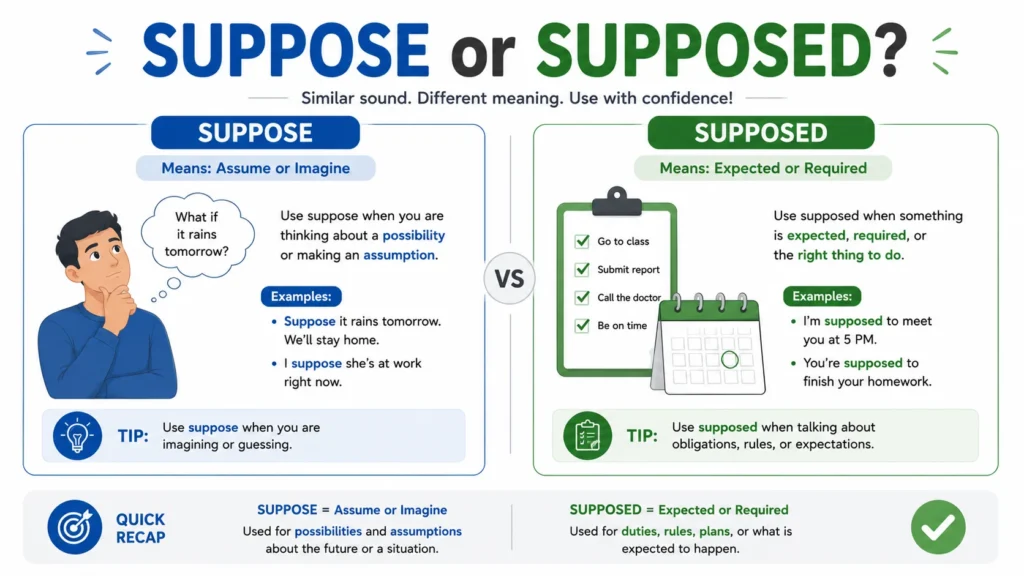
Visual Grammar Difference


4
Suppose focuses on ideas, assumptions, or imagination.
Supposed usually focuses on expectations, duties, or plans.
Real World Examples
Example One Daily Conversation
I suppose he will join us later.
This means the speaker thinks it may happen.
Example Two School Rules
Students are supposed to wear uniforms.
This means it is expected or required.
Example Three Missed Plan
She was supposed to call yesterday.
This means the call was expected but may not have happened.
Grammar Rules for Suppose
Suppose acts like a regular verb.
Present Tense
- I suppose
- You suppose
- They suppose
Past Tense
- I supposed
- She supposed
Future Tense
- I will suppose
Grammar Rules for Supposed
Supposed often works with helping verbs.
Be Supposed To Structure
This structure is very important.
Pattern
Subject + be + supposed + to + verb
Examples
- You are supposed to study
- He is supposed to arrive soon
- They were supposed to attend
This structure expresses expectation or duty.
Common Mistakes With Suppose or Supposed
Mistake One Using Suppose Instead of Supposed
Incorrect
You suppose to finish the work.
Correct
You are supposed to finish the work.
Mistake Two Forgetting Helping Verb
Incorrect
He supposed to call me.
Correct
He was supposed to call me.
Mistake Three Using Supposed for Assumption
Incorrect
I supposed it will rain.
Correct
I suppose it will rain.
Why People Confuse Suppose or Supposed
The words look similar and come from the same root word. In fast speech, many people also pronounce them similarly.
Another reason is the common phrase “be supposed to,” which learners hear often without understanding the grammar structure.
Therefore, students mix the words during speaking and writing.
Related Comparisons
Suppose vs Assume
Suppose is more casual.
Assume sounds more formal.
Supposed vs Expected
Both relate to expectation, but supposed is more conversational.
Suppose vs Think
Think expresses opinion.
Suppose expresses assumption with uncertainty.
Beginner to Advanced Understanding
Beginner Level
Suppose means think or imagine.
Supposed means expected.
Intermediate Level
Suppose is a verb.
Supposed is often used with “be supposed to.”
Advanced Level
Supposed can function as both a past participle and adjective depending on sentence structure.
Regional and Global Usage
Both suppose and supposed are common in British and American English.
However, spoken English often shortens pronunciation. For example, “supposed to” may sound like “sposta” in casual speech.
Even so, correct writing still requires proper grammar.
Importance in Academic and Professional English
Using suppose or supposed correctly improves communication.
In professional writing, grammar accuracy creates trust and clarity.
For example:
Incorrect grammar may confuse readers.
Correct grammar makes communication professional.
Therefore, understanding these words is important for students, workers, and English learners.
Everyday Situations Using Suppose or Supposed
At School
Students are supposed to submit homework on time.
At Work
Employees are supposed to attend meetings.
In Family Conversations
I suppose we can eat dinner later.
In Travel Plans
The flight was supposed to leave at eight.
Advanced Grammar Insights
Supposed as Adjective
Example
The supposed treasure was never found.
Here, supposed means believed or claimed.
Hypothetical Suppose
Example
Suppose aliens visited Earth.
This introduces an imaginary situation.
Writing Tips for Correct Usage
- Use suppose for assumptions
- Use supposed for expectations
- Remember “be supposed to” structure
- Check helping verbs carefully
- Practice with real examples
These tips reduce grammar mistakes.
Exercises With Answers
Exercise One
Question
Which sentence is correct
A You suppose to study
B You are supposed to study
Answer
B You are supposed to study
Exercise Two
Question
Which word expresses assumption
Answer
Suppose
Exercise Three
Question
Complete the sentence
He was ______ to arrive early.
Answer
Supposed
Exercise Four
Question
What does suppose mean
Answer
To assume or imagine
Exercise Five
Question
Which structure is correct
A I supposed it will rain
B I suppose it will rain
Answer
B I suppose it will rain
Practice Sentences
- I suppose they are busy today
- You are supposed to follow the rules
- She was supposed to meet us yesterday
- Suppose you had unlimited money
- We suppose the project will succeed
Practicing these sentences improves grammar accuracy.
Common Conversation Examples
Conversation One
Person A
Will John attend the meeting
Person B
I suppose he will
Conversation Two
Teacher
Students are supposed to complete the assignment today
Conversation Three
Friend A
Where is Sarah
Friend B
She was supposed to arrive an hour ago
Professional Communication Examples
Workplace Example
Employees are supposed to follow safety procedures.
Customer Service Example
The package was supposed to arrive yesterday.
Academic Example
Researchers suppose that climate conditions affected results.
Importance for English Learners
Understanding suppose or supposed improves grammar confidence.
Learners who master these structures speak more naturally and write more clearly.
Teachers often focus on this topic because it appears frequently in conversation, exams, and professional communication.
Memory Trick for Suppose or Supposed
A simple trick can help.
Suppose equals think.
Supposed equals expected.
If the sentence talks about rules, duties, or plans, use supposed.
If the sentence talks about guessing or imagining, use suppose.
FAQs
What is the difference between suppose or supposed?
Suppose means to assume or imagine, while supposed usually means expected or required.
Is “suppose to” correct English?
No, the correct phrase is “supposed to.”
How do you use suppose in a sentence?
Example: I suppose he will come later.
How do you use supposed in a sentence?
Example: You are supposed to wear a seatbelt.
Why do learners confuse suppose or supposed?
Because the words sound similar and are closely related.
What does “be supposed to” mean?
It means expected or required.
Can supposed mean believed?
Yes, it can describe something believed to be true.
Is suppose formal or informal?
Suppose is common in both casual and formal English.
Do British and American English use these words differently?
No, both forms are used similarly.
Which is correct “I suppose” or “I supposed”?
“I suppose” is correct for present assumptions.
Conclusion
Understanding suppose or supposed is important for correct English grammar. Although the words look similar, they serve different purposes.
Suppose is mainly a verb that means assume, imagine, or think. Meanwhile, supposed often describes expectation, obligation, or belief. The phrase “be supposed to” is especially common in daily English.
Many learners confuse these words because they sound alike. However, practicing sentence patterns and grammar rules makes the difference easier to understand.
Using suppose and supposed correctly improves speaking, writing, academic work, and professional communication. Therefore, English learners should practice these structures regularly and pay attention to context.