

Quick Answer
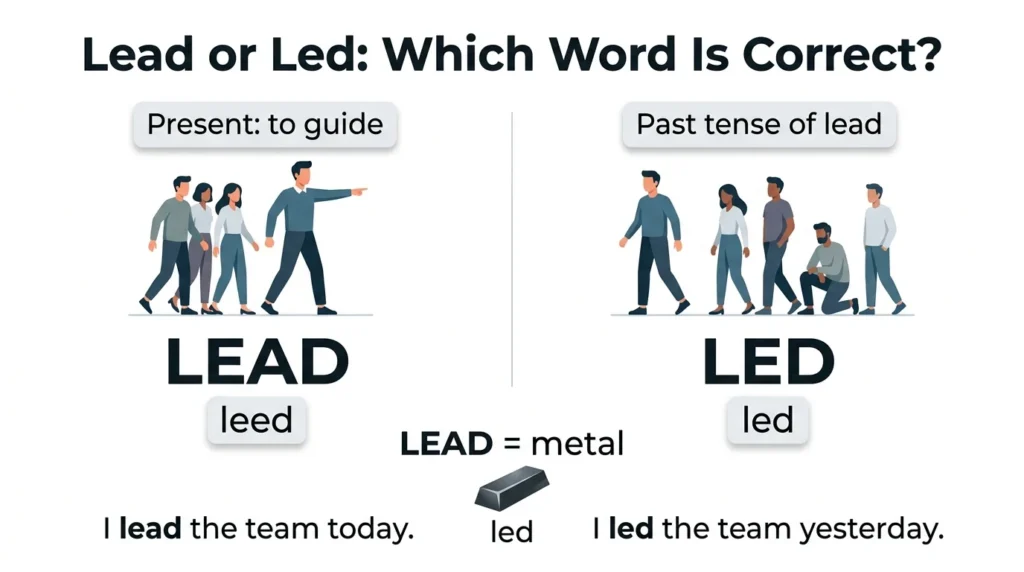
Lead means to guide or direct someone and is pronounced “leed” when used as a verb. Led is the past tense of lead and is pronounced “led.” The word lead can also mean the metal, which is pronounced “led.”
Lead or led can be confusing because the words look similar, but they do not always have the same meaning or pronunciation. If you are writing an email, school assignment, resume, or everyday message, choosing the right form matters. The good news is that the main grammar rule is simple. Lead is the present form of the verb when it means to guide or direct. Led is the past form. For example, you can say, “She leads the team today,” but “She led the team last year.” There is also another meaning of lead: a heavy metal pronounced like led. Understanding the context makes the correct choice much easier.
Lead and Led at a Glance
The fastest way to understand the difference is to look at meaning, tense, and pronunciation together.
| Word | Meaning | Pronunciation | Example |
|---|---|---|---|
| lead | Guide or direct | leed | I lead the team. |
| leads | Guides or directs | leeds | She leads the team. |
| led | Past form of lead | led | She led the team. |
| lead | A heavy metal | led | The paint contained lead. |
The key detail is that lead has two different pronunciations.
When it means to guide, it sounds like leed.
When it means the metal, it sounds like led.
What Does Lead Mean?
As a verb, lead means to guide, direct, manage, or take someone somewhere.
For example:
I lead the team at work.
She leads the discussion every Monday.
The coach will lead the players onto the field.
This road leads to the airport.
In all of these examples, the word relates to guidance or direction.
When used as a verb in this meaning, lead is pronounced leed.
What Does Led Mean?
Led is the past tense of lead.
It describes an action that already happened.
For example:
I led the team last year.
She led the meeting yesterday.
The coach led the players to victory.
He led the project before moving to another department.
Notice the time difference:
Today: I lead the team.
Yesterday: I led the team.
That simple contrast solves most lead or led questions.
When to Use Lead
Use lead when you are talking about the present or when the word follows a modal or helping verb that requires the base form.
For example:
I lead the marketing team.
They lead the company.
She will lead the meeting.
We can lead the project.
You should lead by example.
After words such as will, can, and should, use the base form lead.
So:
He will lead the meeting.
is correct.
He will led the meeting.
is incorrect.
When to Use Leads
When lead is used in the present tense with he, she, or it, the form becomes leads.
Examples include:
She leads the sales team.
He leads the discussion.
The manager leads the department.
This path leads to the lake.
The extra s is required because the subject is third-person singular.
Compare:
I lead the team.
She leads the team.
The meaning stays the same, but the grammar changes with the subject.
When to Use Led
Use led when an action happened in the past.
For example:
She led the company for five years.
He led the team during the championship season.
The teacher led the class discussion yesterday.
Our manager led the project in 2025.
The past form does not change according to the subject.
You can say:
I led
you led
he led
she led
we led
they led
That makes led easier to use once you know that it represents the past.
Lead in Future Sentences
Future sentences use lead, not led.
For example:
She will lead the meeting tomorrow.
I will lead the presentation next week.
They will lead the new department.
The reason is simple: will is followed by the base form of the verb.
Therefore:
will lead
is correct.
will led
is incorrect.
This rule also applies to other helping verbs:
can lead
may lead
should lead
might lead
Lead as a Noun
Lead has another completely different meaning when it refers to a heavy metal.
For example:
The old paint contained lead.
Lead is used in some industrial products.
Workers must take precautions when handling lead.
In this meaning, lead is pronounced led, not leed.
That creates one of the unusual features of English: the same spelling can have two different pronunciations.
Why Lead Has Two Pronunciations
Context determines the pronunciation.
When lead means guide or direct, pronounce it:
leed
Example:
She will lead the team.
When lead means the metal, pronounce it:
led
Example:
The material contains lead.
Meanwhile, led is always pronounced led when it is the past tense of lead.
Here is the easiest comparison:
lead = guide = leed
led = past tense = led
lead = metal = led
Lead or Led in American English
American English follows the same basic grammar pattern.
Use lead for the present form:
She leads the team.
Use led for the past:
She led the team.
Use lead after will:
She will lead the team.
The metal is also spelled lead, although its pronunciation is different:
lead = led
There is no separate American spelling for these meanings.
Lead or Led in the Workplace
This distinction is especially useful in professional writing.
Suppose someone currently manages a team:
Maria leads a team of ten employees.
If she managed that team in the past, write:
Maria led a team of ten employees.
For a future assignment:
Maria will lead a new team next month.
These small differences make workplace writing more precise.
Lead or Led on a Resume
Resumes often use both forms.
For a current position:
Lead a team of five designers.
For a previous position:
Led a team of five designers.
The past tense led tells the reader that the responsibility belonged to a previous role.
On the other hand, lead can describe an ongoing responsibility.
This distinction is useful when describing professional experience in American resumes.
Lead or Led in Sports
Sports writing provides many natural examples.
Present:
The captain leads the team onto the field.
Past:
The captain led the team to victory.
Future:
The captain will lead the team in Sunday’s game.
The same tense rule works whether you are talking about football, basketball, baseball, soccer, or another sport.
Lead or Led in School
Students often use these words in essays and assignments.
For example:
The teacher leads the discussion.
Past:
The teacher led the discussion yesterday.
Another common use is:
The study led to an important discovery.
Here, led to means that one event caused or resulted in another.
Lead to and Led to
The phrases lead to and led to are closely related but use different tenses.
Present or general statement:
Poor planning can lead to delays.
Past:
Poor planning led to delays last year.
Future:
The changes may lead to better results.
The choice depends on when the result occurs or whether you are making a general statement.
Lead by Example
Lead by example is a common English expression.
It means showing others how to behave by doing the right thing yourself.
For example:
Good managers lead by example.
Past:
Our coach led by example throughout the season.
Future:
She will lead by example in her new role.
This phrase is common in business, education, sports, and leadership discussions.
Lead the Way
Another common expression is lead the way.
It means to go first or guide other people.
Present:
You lead the way.
Past:
She led the way through the park.
Future:
He will lead the way during the hike.
Again, the tense determines whether you need lead or led.
Common Mistakes With Lead and Led
One frequent error is using lead for a past action.
Incorrect:
She lead the team last year.
Correct:
She led the team last year.
Another mistake is using led after will.
Incorrect:
He will led the meeting.
Correct:
He will lead the meeting.
There is also a common spelling mistake involving leaded.
Incorrect:
She leaded the team.
Correct:
She led the team.
For the ordinary past tense of the verb, the correct form is led.
A Simple Time Test
When you are unsure, look for a time clue.
If the action is happening now:
lead
If it happened in the past:
led
If it will happen later:
will lead
For example:
I lead the team today.
I led the team yesterday.
I will lead the team tomorrow.
This three-part pattern is enough to solve most everyday questions.
Real World Examples
Here are some examples from common situations.
At Work
Present: Sarah leads the project.
Past: Sarah led the project last year.
Future: Sarah will lead the next project.
In Sports
Present: The captain leads the team.
Past: The captain led the team to a win.
Future: The captain will lead the team again.
At School
Present: The teacher leads the discussion.
Past: The teacher led the discussion yesterday.
Future: The teacher will lead the discussion tomorrow.
In Everyday Life
Present: This road leads to the beach.
Past: That road led us to the wrong address.
Future: The signs will lead you to the entrance.
These examples show how naturally the forms change with time.
How to Remember the Difference
A simple timeline can make the rule stick:
Present → lead
Past → led
Future → will lead
You can also connect the meanings:
Lead means guide.
Led means guided in the past.
For the metal, remember that lead is pronounced led.
Once these three ideas are separated, the spelling becomes much easier.
Practice Exercise
Choose lead, leads, or led.
She ___ the department every day.
He ___ the team last season.
We will ___ the discussion tomorrow.
The manager ___ the project in 2024.
This road ___ to the city center.
The decision ___ to higher costs.
Exercise Answers
She leads the department every day.
He led the team last season.
We will lead the discussion tomorrow.
The manager led the project in 2024.
This road leads to the city center.
The decision led to higher costs.
The tense and sentence structure determine the correct form.
More Examples to Test Yourself
Consider these sentences:
I lead the team now.
I led the team before.
I will lead the team tomorrow.
She leads the meeting every Monday.
She led the meeting last Monday.
She will lead the meeting next Monday.
The pattern remains consistent, even when the subject changes.
Lead vs Led: Quick Reference
| Situation | Correct Form | Example |
|---|---|---|
| Present with I | lead | I lead the team. |
| Present with | leads | She leads the team. |
| Past | led | She led the team. |
| Future | lead | She will lead the team. |
| After can | lead | He can lead the group. |
| After should | lead | You should lead the meeting. |
| Metal | lead | The paint contains lead. |
Final Rule
If you only remember one thing, remember this:
Lead is the present form.
Leads is the present form with he, she, or it.
Led is the past form.
Lead is also the spelling for the metal, but that meaning is pronounced led.
So the most useful pattern is:
I lead today.
I led yesterday.
I will lead tomorrow.
That rule will cover most situations you encounter in everyday American English.
FAQs
Is it lead or led for past tense?
Led is the past tense of lead. For example, “She led the team last year.”
How do you know when to use lead or led?
Use lead for the present and future base form. Use led for a completed action in the past.
Is lead pronounced like led?
Sometimes. Lead meaning “to guide” is pronounced leed, while lead meaning the metal is pronounced led.
Is led always the past tense of lead?
When led is used as a verb related to guidance or direction, it is the past tense and past participle of lead.
What is the difference between lead and led in American English?
In American English, lead is the present form of the verb, while led is the past form. Lead can also mean the metal and has a different pronunciation in that context.
Conclusion
The difference between lead and led is mainly about tense, meaning, and pronunciation. When lead means to guide or direct, it is pronounced leed and is used as the present form of the verb. For example, “She leads the team.” When that same action happened in the past, use led, as in “She led the team last year.”
There is also another meaning of lead. When it refers to the metal, it is pronounced led. That is why context matters so much with this word.
For everyday American English, the easiest rule is present: lead, past: led, future: will lead. After words such as will, can, and should, use lead. If you remember that simple pattern, you can avoid most common mistakes in school writing, workplace communication, resumes, and everyday conversations.