
Quick Answer
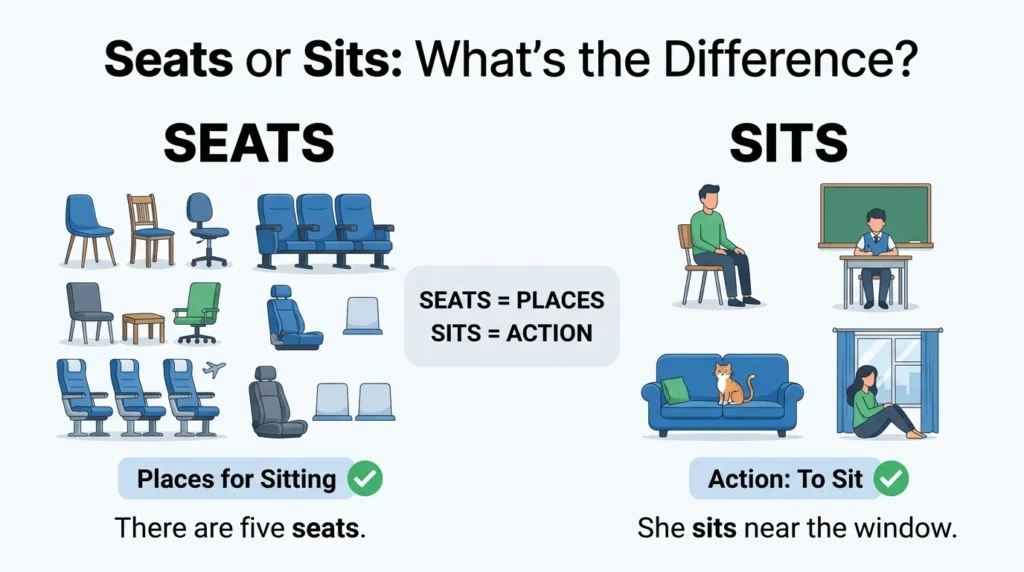
Seats is usually a noun meaning chairs or places where people can sit, while sits is a verb meaning to be in a seated position. For example, “There are five seats in the car” and “She sits near the window.”
Seats or sits is a common English confusion because the two words look and sound quite similar. The difference is only one letter, but their meanings and grammatical roles are different. Knowing which word to use can make your English clearer and more accurate.
The word seats usually refers to places where people can sit. It is the plural form of seat. For example, you can say, “The theater has hundreds of seats.” The word sits, however, is a verb. It describes what a person or animal does when they are in a seated position. For example, “The cat sits on the chair.”
The difference becomes easy when you focus on the sentence. If you are talking about chairs, places, or spaces for sitting, use seats. If you are describing someone or something performing the action of sitting, use sits.
This guide explains seats or sits in simple English, with definitions, grammar rules, examples, comparisons, common mistakes, exercises, and practical usage.
What Does Seat Mean?
Seat is a noun that refers to a place designed for someone to sit.
A seat can be a chair, a position in a vehicle, a place in a theater, or any other designated space for sitting.
Examples
- Please take a seat.
- This seat is comfortable.
- I reserved a seat on the bus.
- Her seat is near the door.
- The chair has a soft seat.
When we talk about more than one seat, we use seats.
Examples
- The theater has 500 seats.
- All the seats are occupied.
- We need three seats.
- The bus has many seats.
- There are empty seats in the classroom.
What Does Sits Mean?
Sits is the third person singular form of the verb sit.
The basic verb is:
Sit
With he, she, or it, we use:
Sits
Examples
- He sits near the window.
- She sits beside me.
- The cat sits on the sofa.
- My brother sits in the front row.
- The dog sits quietly.
- The teacher sits at the desk.
In each example, sits describes an action or position.
Seats or Sits: The Main Difference
The easiest way to understand the difference is to look at their grammatical roles.
| Word | Part of Speech | Meaning | Example |
|---|---|---|---|
| Seat | Noun | A place for sitting | This seat is free. |
| Seats | Plural noun or verb | Places for sitting, or formally places someone | The car has five seats. |
| Sit | Verb | To be in a seated position | I sit here. |
| Sits | Verb | He, she, or it sits | She sits here. |
The most common distinction is:
Seats = places for people to sit
Sits = an action performed by someone or something
When Should You Use Seats?
Use seats when you are talking about more than one place where people can sit.
Examples
- There are ten seats in the room.
- The stadium has thousands of seats.
- We booked four seats.
- All the seats were taken.
- The airplane has comfortable seats.
- Please keep these seats empty.
- The restaurant has outdoor seats.
- We found two empty seats.
Here, seats is a plural noun.
When Should You Use Sits?
Use sits when the subject is he, she, or it and you are describing the action of sitting.
Examples
- She sits near the window.
- He sits in the front row.
- The baby sits on the floor.
- My dog sits beside me.
- The teacher sits at the desk.
- John sits next to his brother.
- The bird sits on the branch.
The word sits always describes an action or position in these examples.
Seat, Seats, Sit, and Sits
Understanding all four forms can make the difference much easier.
| Word | Type | Example |
|---|---|---|
| Seat | Singular noun | This is my seat. |
| Seats | Plural noun | These are our seats. |
| Sit | Base verb | I sit here every day. |
| Sits | Third person singular verb | She sits here every day. |
Remember
One place = seat
More than one place = seats
I/you/we/they = sit
He/she/it = sits
This is one of the most useful grammar rules for understanding seats or sits.
Examples of Seats in Sentences
Here are several examples using seats correctly.
- The theater has comfortable seats.
- We reserved two seats.
- The seats are near the entrance.
- All the seats were occupied.
- There are empty seats at the back.
- The car has five seats.
- The stadium added more seats.
- Please do not stand on the seats.
- We need seats for six people.
- The airplane seats were comfortable.
In all these sentences, seats refers to places where people can sit.
Examples of Sits in Sentences
Now look at sits.
- She sits next to her friend.
- He sits quietly in class.
- The dog sits near the door.
- My father sits in this chair every evening.
- The bird sits on the roof.
- Sarah sits at the front.
- The child sits on the floor.
- My cat sits beside the window.
- The manager sits in the corner office.
- He always sits in the same place.
Here, sits tells us what someone or something does.
Seats or Sits in Everyday English
These words appear frequently in everyday conversations.
Example
A: Are there any seats available?
B: Yes, there are two seats near the door.
Here, seats means places to sit.
Another example:
A: Where is Maria?
B: She sits near the window.
Here, sits describes Maria’s position.
Both words can appear in the same conversation.
Seats or Sits in Transportation
The word seats is very common when talking about buses, trains, airplanes, and cars.
Examples
- The bus has 40 seats.
- We booked three seats on the train.
- These airplane seats are comfortable.
- The car has five seats.
- Please remain in your seats.
- Our seats are in the front row.
However, sits can describe the position of a passenger.
Example:
She sits in the back of the bus.
He sits beside the driver.
Seats or Sits in Schools
Both words are common in classrooms.
Seats
- The classroom has thirty seats.
- There are two empty seats.
- Students should remain in their seats.
Sits
- Ali sits in the front row.
- Sarah sits beside her friend.
- The teacher sits at the desk.
The difference remains the same.
Seats refers to places.
Sits describes an action.
Seats or Sits in Restaurants
Restaurants also provide many examples.
Seats
- The restaurant has 80 seats.
- We need four seats.
- Are these seats available?
- The outdoor seats are full.
Sits
- She sits near the window.
- He sits at the corner table.
- The customer sits beside his friend.
Seats or Sits in Sports
You can also see both words in sports contexts.
Seats
- The stadium has thousands of seats.
- Our seats are near the field.
- The best seats were already sold.
Sits
- The coach sits on the bench.
- The player sits beside his teammates.
- The goalkeeper sits down after the match.
Common Mistakes
Because seats and sits look similar, learners sometimes use them incorrectly.
Mistake One
Incorrect:
She seats near the window.
Correct:
She sits near the window.
Why?
You are describing what she does, so you need the verb sits.
Mistake Two
Incorrect:
There are five sits in the room.
Correct:
There are five seats in the room.
Why?
You are talking about places for people to sit, so use seats.
Mistake Three
Incorrect:
He seats beside me.
Correct:
He sits beside me.
Why?
The correct verb is sit, and its third person singular form is sits.
Mistake Four
Incorrect:
We need three sits.
Correct:
We need three seats.
Why?
You need three places to sit, so seats is correct.
Seats vs Sits Grammar Rule
Here is a simple grammar formula.
Seats
Number + seats
Examples:
- Two seats
- Five seats
- Ten seats
- Many seats
Sits
He/She/It + sits
Examples:
- He sits.
- She sits.
- It sits.
This rule will help you choose the correct word quickly.
Seat vs Sit
Before understanding seats or sits, it is also useful to understand seat vs sit.
Seat is generally a noun.
Sit is a verb.
Compare:
This is my seat.
I sit here.
The first sentence names a place.
The second sentence describes an action.
Seats vs Sitting
Seats and sitting are also different.
Seats refers to places.
Sitting refers to the activity or state of being seated.
Examples:
- The theater has 300 seats.
- Sitting for long periods can be uncomfortable.
This difference is important in more advanced English.
Sit, Sits, Sat, and Sitting
The verb sit has several forms.
| Form | Example |
|---|---|
| Sit | I sit here. |
| Sits | She sits here. |
| Sat | She sat here yesterday. |
| Sitting | She is sitting here now. |
Understanding these forms helps prevent confusion.
Present
I sit here.
She sits here.
Past
She sat here yesterday.
Present Continuous
She is sitting here now.
Advantages of Knowing the Difference
Understanding seats or sits can improve your English in several ways.
- Better grammar
- Better spelling
- Clearer writing
- Improved speaking
- Better exam performance
- Stronger vocabulary
- More natural conversations
- Fewer common mistakes
- Better professional communication
- Improved reading comprehension
Common Situations Where People Confuse Them
Asking About Availability
Correct:
Are there any seats available?
Incorrect:
Are there any sits available?
You are asking about places, so use seats.
Describing a Person
Correct:
She sits near the door.
Incorrect:
She seats near the door.
You are describing an action, so use sits.
Talking About a Car
Correct:
The car has five seats.
Incorrect:
The car has five sits.
Talking About a Student
Correct:
The student sits in the front row.
Incorrect:
The student seats in the front row.
Easy Memory Trick
Use this simple trick:
Seats have space.
A seat is a place where someone can sit.
Sits shows action.
If someone sits, they are doing something.
So remember:
Seats = places
Sits = action
This short rule is enough for most everyday situations.
Real World Examples
Imagine you enter a movie theater.
You might ask:
Are these seats free?
You are asking about places to sit.
Now imagine you are describing your friend:
My friend sits beside me.
You are describing what your friend does.
Another example is an airplane.
Our seats are in row 12.
But:
My brother sits beside the window.
Both words are correct because they have different meanings.
Practice Exercises
Exercise One
Choose seats or sits.
- There are four ______ in the car.
- She ______ near the window.
- We need two ______.
- He ______ in the front row.
- The theater has hundreds of ______.
- My dog ______ beside me.
- Are these ______ available?
- Sarah ______ next to her teacher.
Answers
- seats
- sits
- seats
- sits
- seats
- sits
- seats
- sits
Exercise Two
Correct the mistakes.
- She seats near the door.
- We need three sits.
- The bus has many sits.
- He seats beside his brother.
- There are two empty sits.
Answers
- She sits near the door.
- We need three seats.
- The bus has many seats.
- He sits beside his brother.
- There are two empty seats.
Exercise Three
Choose the correct word.
- My father ______ in this chair every evening.
A. seats
B. sits
- The stadium has thousands of ______.
A. seats
B. sits
- We booked four ______ for the concert.
A. seats
B. sits
- The cat ______ on the sofa.
A. seats
B. sits
Answers
- B. sits
- A. seats
- A. seats
- B. sits
FAQs
What is the difference between seats and sits?
Seats usually means more than one place where people can sit, while sits is the third person singular form of the verb sit.
Is “she seats near the window” correct?
No. The correct sentence is “She sits near the window.” Use sits because it describes what she does.
Is “there are five sits” correct?
No. The correct sentence is “There are five seats.” Use seats when talking about places for people to sit.
What is the difference between seat, sit, seats, and sits?
Seat is a noun for one place, seats is its plural form, sit is the base verb, and sits is used with he, she, or it.
How can I remember seats or sits?
Remember seats = places and sits = action. If you are talking about chairs or spaces, use seats. If you are describing someone sitting, use sits.
Conclusion
The difference between seats or sits becomes simple when you understand their grammatical roles. Seats is most commonly the plural form of the noun seat, meaning places where people can sit. Sits is the third person singular form of the verb sit, meaning that someone or something is in a seated position.
The easiest rule is to remember that seats are places, while sits is an action. For example, you can say, “The theater has many seats,” because you are talking about places. You can also say, “She sits near the window,” because you are describing what she does.
When you are unsure, look at the subject and meaning of the sentence. If the sentence talks about chairs, spaces, or available places, choose seats. If it talks about what he, she, or it does, choose sits. With regular practice, these two words will become easy to recognize, and you will be able to use them correctly in everyday conversations, academic writing, and professional communication.