

Quick Answer
Seat is a noun or verb related to a place for sitting, while sit is a verb meaning to rest your body on a chair, surface, or other support. For example, “Please take a seat” is correct, while “Please sit down” is also correct.
“Seat” and “sit” are easy to confuse because both words are closely connected to the action of sitting. However, they do not have the same grammatical role or meaning. Sit usually describes what a person does, while seat usually refers to the place where someone sits or the act of putting someone in a seat. This difference matters in everyday conversation, school writing, workplace communication, travel, restaurants, and many other situations.
For example, you can say, “Please sit here,” when asking someone to lower their body onto a chair. You can also say, “Please take a seat,” when inviting that person to use a particular place. Once you understand this simple distinction, choosing between seat or sit becomes much easier.
What Does Seat Mean?
Seat usually means a place designed for someone to sit.
It can refer to a chair, bench, car seat, theater chair, airplane seat, or another place where a person can sit.
Examples:
- I found a seat near the window.
- Please take a seat.
- My seat is in the front row.
- The car has five seats.
- We reserved our seats online.
Seat can also work as a verb. As a verb, it means to place someone in a seat or provide someone with a place to sit.
Examples:
- The hostess seated us near the window.
- The restaurant can seat 100 people.
- The teacher seated the students in groups.
What Does Sit Mean?
Sit is mainly a verb. It means to rest your body on a chair, bench, floor, or another surface.
Examples:
- Please sit here.
- I need to sit down.
- She is sitting on the couch.
- We sat outside.
- He sits near the door.
Unlike seat, the word sit describes an action or position.
A simple way to understand it is:
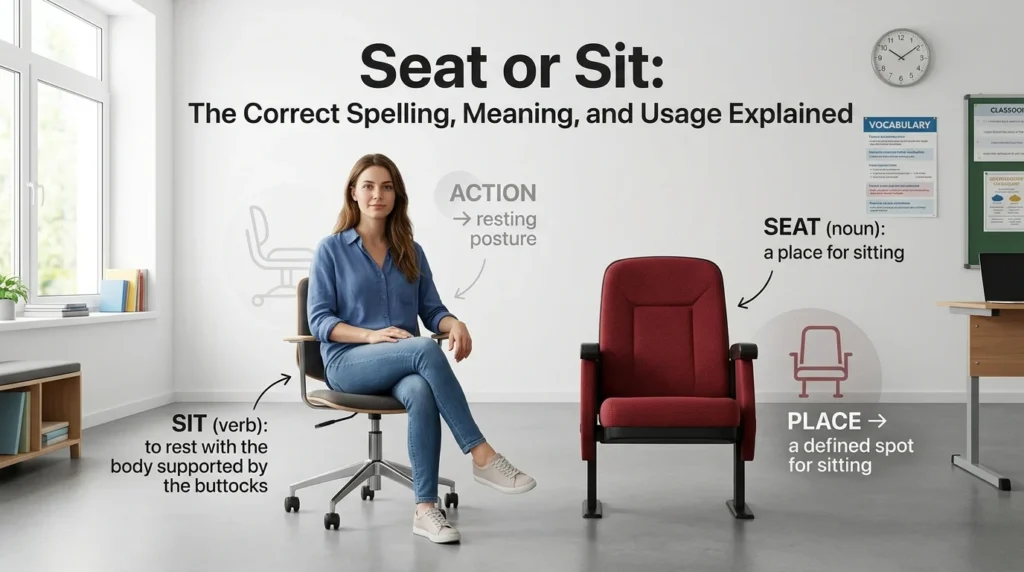
Sit = what a person does.
Seat = where a person sits.
Seat or Sit: The Main Difference
The main difference between seat and sit is their grammatical use.
| Word | Common Use | Example |
|---|---|---|
| Seat | A place for sitting | This seat is taken. |
| Seat | To place someone somewhere | The waiter seated us. |
| Sit | To rest in a seated position | Please sit here. |
Consider these two sentences:
Please sit in this seat.
Here, sit describes the action, and seat describes the place.
Another example:
She sat in the front seat.
The word sat comes from sit, while seat refers to the place where she was sitting.
Is Seat a Noun or a Verb?
Seat can be both a noun and a verb.
As a noun, it means a place for sitting.
- I saved you a seat.
- That seat is comfortable.
- We need two seats.
As a verb, it means to place someone in a seat or have enough space for people.
- The restaurant seats 200 guests.
- The staff seated us quickly.
- This theater seats 500 people.
This flexibility makes seat different from sit.
Is Sit a Noun or a Verb?
Sit is primarily a verb.
It describes the action or position of resting on something.
Examples:
- Sit down.
- Sit here.
- She sits beside me.
- They sat at the table.
- We are sitting outside.
The verb also changes form depending on tense.
Sit: present
Sat: past
Sitting: present participle
For example:
- I sit here every morning.
- I sat here yesterday.
- I am sitting here now.
Sit Down or Take a Seat?
Both expressions are correct, but they have slightly different structures.
Sit down directly tells someone to sit.
Example:
- Please sit down.
Take a seat is a polite expression meaning “sit down.”
Examples:
- Please take a seat.
- You can take a seat while you wait.
- Please take a seat in the waiting area.
In professional settings, take a seat can sound more polite and welcoming.
Sit in a Seat
The word sit often appears with seat when you want to describe where someone is sitting.
Examples:
- Please sit in your seat.
- I sat in the back seat.
- She is sitting in the driver’s seat.
- He sat in the empty seat beside me.
Notice that both words can appear in the same sentence because they perform different jobs.
Sit describes the action.
Seat identifies the place.
Seat Someone or Sit Someone?
This is an important distinction.
You can seat someone, but you normally do not say sit someone when you mean placing them in a chair.
Correct:
- The hostess seated the guests.
- The teacher seated the children.
- Please seat the customer.
Incorrect in standard usage:
- The hostess sat the guests.
However, sit can be used in certain causative or informal constructions, but learners should generally use seat when they mean “place someone in a seat.”
Sit Yourself Down
You may sometimes hear:
Sit yourself down.
This means “sit down.”
For example:
- Come in and sit yourself down.
- Sit yourself down and relax.
It is grammatically possible, but the tone can sound casual, forceful, or conversational depending on the context.
In polite professional speech, Please have a seat or Please sit down is usually better.
Seat in Everyday American English
In the United States, seat appears often in conversations about cars, airplanes, restaurants, theaters, stadiums, and classrooms.
Examples:
- Where is my seat?
- Is this seat taken?
- Can I change seats?
- We have seats near the stage.
- Please remain in your seat.
- The restaurant seats 80 people.
Meanwhile, sit is common when describing an action.
Examples:
- Sit over here.
- Sit down for a minute.
- I usually sit near the window.
- We sat outside.
Both words are common, but they cannot always replace each other.
Seat or Sit in Restaurants
Restaurants provide many natural examples of the difference.
A host may say:
- Please take a seat.
- We can seat you in about 15 minutes.
- Would you like to sit inside or outside?
A customer might say:
- Can we sit outside?
- Is this seat available?
- We would like to sit near the window.
Here, seat can describe a physical place or the restaurant’s ability to accommodate guests. Sit describes where the customer wants to be.
Seat or Sit in Cars
Cars also make the difference easy to see.
Examples:
- I sat in the driver’s seat.
- My child sits in the back seat.
- Please sit in your seat.
- The front passenger seat is empty.
- She moved to the back seat.
You would not normally say:
- “I seated in the driver’s seat.”
The natural sentence is:
I sat in the driver’s seat.
Seat or Sit on an Airplane
Air travel uses both words frequently.
Examples:
- What is your seat number?
- Please sit in your assigned seat.
- I have a window seat.
- We sat next to each other.
- Please remain seated during takeoff.
The seat is the physical place. Sit describes the person’s position or action.
Seat or Sit at School
In a classroom, teachers may use both words.
Examples:
- Please sit down.
- Sit in your assigned seat.
- Your seat is in the second row.
- The teacher seated the students alphabetically.
A teacher might also say:
Please take your seat.
This is a common and polite classroom expression.
Seat or Sit at Work
The distinction is also useful in workplace English.
Examples:
- Please take a seat.
- You can sit here.
- My seat is next to the conference room.
- The manager seated everyone around the table.
In formal communication, take a seat often sounds more natural than a direct command such as sit down.
For example:
Please take a seat while we prepare the documents.
This sounds polite and professional.
Common Mistakes With Seat and Sit
One common mistake is using seat when the sentence needs a verb such as sit.
Incorrect:
- I will seat here.
Correct:
- I will sit here.
Another mistake is using sit when you mean a physical place.
Incorrect:
- This sit is comfortable.
Correct:
- This seat is comfortable.
Another common error involves past tense.
Incorrect:
- Yesterday, I sit in the front.
Correct:
- Yesterday, I sat in the front.
Remember that the past tense of sit is sat, not seated when you mean that you personally rested in a sitting position.
Sit, Sat, and Sitting
The forms of sit can cause confusion.
Sit
Use sit for the present form.
- I sit near the window.
- Please sit here.
- They sit together.
Sat
Use sat for the past tense.
- I sat beside her yesterday.
- We sat outside.
- He sat in the front row.
Sitting
Use sitting for an ongoing action.
- I am sitting here.
- She is sitting on the couch.
- They were sitting at the table.
These forms are different from seat, seated, and seating.
Seat, Seated, and Seating
The word family of seat is also useful.
Seat can be a noun or verb.
- There is an empty seat.
- The staff will seat you.
Seated can describe someone who is sitting or someone who has been placed in a seat.
- Please remain seated.
- The guests were seated at the table.
Seating can refer to seats collectively or the arrangement of seats.
- The restaurant has outdoor seating.
- The seating arrangement has changed.
These forms appear frequently in travel, restaurants, events, and professional settings.
Real World Examples
Here are some natural examples that show the difference clearly:
- Please sit beside me.
- Please take a seat.
- Is this seat available?
- We sat in the front row.
- The restaurant seats 150 people.
- The host seated us near the window.
- I am sitting in my favorite chair.
- Please remain seated.
- She sat in the passenger seat.
- We need more seating for the event.
Each sentence uses the words according to their meaning and grammatical role.
How to Remember Seat or Sit
A simple memory trick can help.
Think:
Sit = action
Seat = place
For example:
I sit in my seat.
This short sentence contains both words and shows their relationship.
You perform the action of sitting, and you use a seat as the place where you sit.
Another useful example is:
Please sit in your seat.
Once you connect these two words, the difference becomes much easier to remember.
Practice: Choose Seat or Sit
Choose the correct word in each sentence.
- Please ___ down.
- I found an empty ___.
- We ___ near the front yesterday.
- The restaurant can ___ 100 guests.
- Please take a ___.
- She is ___ beside her friend.
- Is this ___ taken?
- I usually ___ in the back.
- The host ___ us near the window.
- Please remain ___.
Answers
- sit
- seat
- sat
- seat
- seat
- sitting
- seat
- sit
- seated
- seated
Seat or Sit: Quick Comparison
| Feature | Seat | Sit |
|---|---|---|
| Main meaning | A place for sitting | To rest in a sitting position |
| Common grammar | Noun and verb | Verb |
| Past form | Seated | Sat |
| Example | Take a seat | Sit here |
| Physical place | Yes | No |
| Describes action | Sometimes as a verb | Yes |
The easiest distinction remains:
Seat is usually the place. Sit is usually the action.
When Should You Use Seat?
Use seat when you are talking about a physical place for someone to sit.
Examples:
- My seat is near the door.
- We bought two seats.
- This seat is reserved.
Use seat as a verb when you mean placing someone in a seat or providing enough space.
Examples:
- The restaurant seats 50 people.
- The host seated us quickly.
When Should You Use Sit?
Use sit when you are talking about the action or position of being seated.
Examples:
- Please sit here.
- I need to sit down.
- She sat on the bench.
- They are sitting outside.
If you are describing what someone does, sit is usually the word you need.
Final Tips for Using Seat and Sit
Keep these points in mind:
- Seat can mean a place for sitting.
- Seat can also be a verb meaning to place someone in a seat.
- Sit is mainly a verb.
- The past tense of sit is sat.
- Sitting describes an ongoing action.
- “Take a seat” means “sit down.”
- “Sit in your seat” correctly uses both words.
- Use seat when discussing chairs, places, or capacity.
- Use sit when describing the action of resting in a seated position.
Once you learn the basic relationship between the two words, you can use them naturally in everyday American English.
FAQs
1. What is the difference between seat and sit?
Seat usually refers to a place where someone sits, while sit is a verb describing the action of resting in a seated position.
2. Is it correct to say “sit in your seat”?
Yes. “Sit in your seat” is completely correct because sit describes the action and seat identifies the place.
3. Is “Please take a seat” correct English?
Yes. “Please take a seat” is a common and polite way to ask someone to sit down.
4. What is the past tense of sit?
The past tense of sit is sat. For example, “I sat in the front row yesterday.”
5. Can seat be used as a verb?
Yes. Seat can be a verb meaning to place someone in a seat or provide enough space for people. For example, “The restaurant can seat 200 guests.”
Conclusion
The difference between seat or sit is simple once you focus on their roles. Seat usually means a place where someone sits, although it can also be used as a verb when someone is placed in a seat. Sit is mainly a verb that describes the action or position of resting on a chair, bench, couch, or another surface.
Remember the basic pattern: you sit in a seat. You can also take a seat, save a seat, or find a seat. Meanwhile, you sit down, sit here, or sat there yesterday. With these patterns in mind, you can confidently use both words in conversations, school writing, workplace communication, travel, and everyday American English.