

Quick Answer
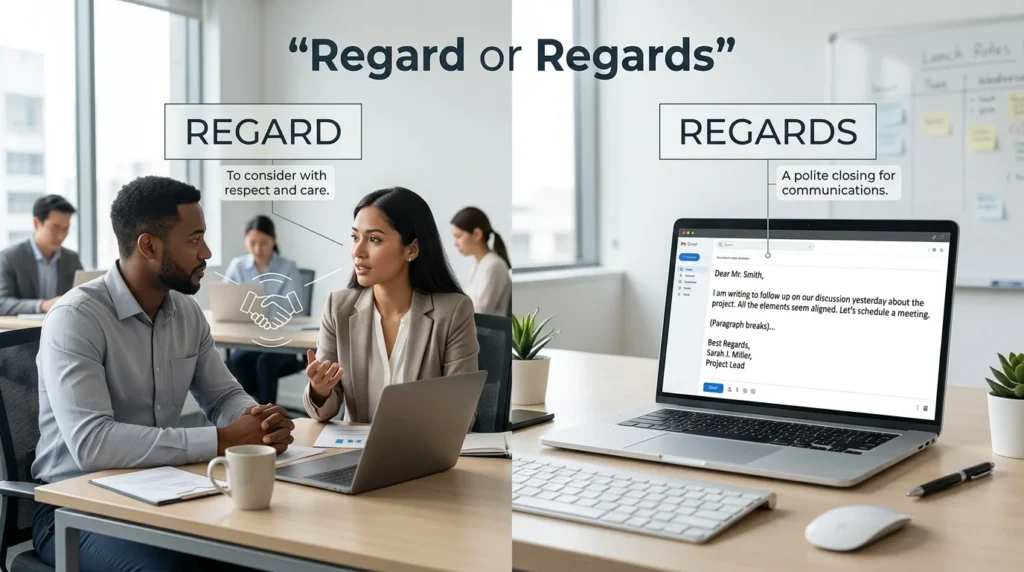
Regard and regards are both correct words, but they have different uses. Regard usually means respect, attention, or consideration, while regards often means good wishes or appears in the phrase “in regard to” for referring to a subject.
Many English learners see regard and regards in emails, letters, conversations, and formal writing. The words look almost the same, so it is easy to use the wrong form. However, their meanings and grammar can change depending on the sentence.
You may write “with regard to” when discussing a specific topic. In an email, you may also see “best regards” at the end of a message. Meanwhile, regard can describe respect or the way someone thinks about another person.
Understanding the difference between regard or regards becomes much easier when you look at their common phrases and sentence patterns. This guide explains both words with simple definitions, examples, common mistakes, and practical rules.
What Does Regard Mean?
Regard can work as both a noun and a verb.
As a noun, it can mean respect, attention, or consideration.
For example:
- I have great regard for my teacher.
- The company holds safety in high regard.
- She showed little regard for the rules.
As a verb, regard means to consider, view, or think of someone or something in a particular way.
For example:
- I regard him as a close friend.
- Many people regard this book as a classic.
- She regarded the problem as serious.
So, regard often connects with ideas such as respect, consideration, and opinion.
What Does Regards Mean?
Regards is the plural form of regard, but it also has several common uses.
One of the most familiar uses appears in polite messages and letters:
Best regards
Here, regards means good wishes or friendly feelings.
For example:
- Best regards,
- Kind regards,
- Warm regards,
You will often see these expressions at the end of emails and letters.
Regards can also appear in expressions such as “with regard to” and “in regard to.”
For example:
- I am writing with regard to your recent request.
- We have a question in regard to the schedule.
In these expressions, regard is usually used in the singular form.
Regard vs Regards: The Main Difference
The simplest way to remember the difference is to look at the meaning.
| Word | Common Meaning | Example |
|---|---|---|
| Regard | Respect or consideration | I have great regard for her. |
| Regard | Consider or view | I regard him as a good leader. |
| Regards | Good wishes | Best regards, John |
| Regard | Reference to a subject | With regard to your request |
| Regards | Plural form in some contexts | She sends her regards. |
Therefore, neither word is simply the “correct” version. The correct choice depends on what you want to say.
When to Use Regard
Use regard when you mean respect, consideration, or the way someone views something.
Regard as a Noun
When regard means respect or admiration, it usually appears with for.
Examples:
- I have great regard for my parents.
- She has a high regard for honest people.
- The manager has little regard for unnecessary delays.
The phrase “have regard for” is especially useful in formal writing.
Regard as a Verb
As a verb, regard can mean consider or view.
A common pattern is:
regard + person or thing + as + noun or adjective
Examples:
- They regard her as an expert.
- I regard this decision as important.
- Many people regard him as a great writer.
This structure is common in academic, professional, and everyday writing.
When to Use Regards
Use regards when you mean good wishes, especially at the end of an email or letter.
Common expressions include:
- Best regards
- Kind regards
- Warm regards
- Regards
For example:
Thank you for your help.
Best regards,
Michael
Here, regards is not talking about respect in the usual sense. It is a polite closing that expresses good wishes.
Best Regard or Best Regards?
The standard expression is:
Best regards
Not:
Best regard
When you finish an email, use the plural form regards.
Correct:
Best regards,
Incorrect:
Best regard,
The same rule applies to kind regards and warm regards.
Correct:
Kind regards,
Incorrect:
Kind regard,
This is one of the most common mistakes people make with these two words.
With Regard To vs With Regards To
The standard expression is:
with regard to
Not:
with regards to
For example:
- I am contacting you with regard to your application.
- We have received your message with regard to the payment.
- I have a question with regard to the new policy.
Although “with regards to” appears in everyday writing, “with regard to” is the traditional and widely accepted form for formal writing.
You can also use regarding as a simpler alternative.
For example:
- I am writing with regard to your application.
- I am writing regarding your application.
The second sentence is shorter and often sounds more natural.
In Regard To vs In Regards To
The standard phrase is:
in regard to
For example:
- I have a question in regard to your order.
- The manager spoke in regard to the new policy.
In regards to is common in informal speech and writing, but many style guides prefer in regard to in careful formal writing.
Another useful alternative is simply:
regarding
For example:
- I have a question regarding your order.
This version is concise and clear.
Regard in Professional Emails
Regard and regards appear often in professional emails.
At the beginning or middle of an email, you might use:
- With regard to your request
- With regard to your application
- In regard to the meeting
- Regarding your recent message
At the end of an email, you can use:
- Best regards
- Kind regards
- Warm regards
For example:
Thank you for sending the updated information. I will review it and contact you if I have any questions.
Best regards,
Sarah
This is a standard and polite email closing.
Best Regards vs Kind Regards
Both best regards and kind regards are polite email closings.
Best regards has a neutral and professional tone. It works well for many business emails.
Kind regards can sound slightly warmer while remaining professional.
Examples:
- Thank you for your time. Best regards,
- I look forward to hearing from you. Kind regards,
Your relationship with the reader can help you choose between them.
For a formal first contact, Best regards is a safe choice. For an ongoing professional relationship, either expression can work well.
Warm Regards and Regards
Warm regards sounds more personal and friendly.
For example:
Thank you again for your support.
Warm regards,
Emily
It can work well when the message has a friendly tone.
Simply writing Regards is shorter and more neutral.
For example:
Regards,
David
It is acceptable, but some people may find it less warm than Best regards or Kind regards.
She Sends Her Regards
Another common use of regards appears when someone sends good wishes to another person.
For example:
- My mother sends her regards.
- Please give my regards to your family.
- He sends his regards to everyone on the team.
Here, regards means good wishes or greetings.
You can remember this use by connecting regards with friendly messages from one person to another.
Regard for Someone
When regard means respect, use the phrase regard for.
Examples:
- I have great regard for my coach.
- She has deep regard for her mentor.
- The community has high regard for the doctor.
The phrase can also be negative:
- He showed no regard for other people’s feelings.
- The driver had little regard for the rules.
In these examples, regard means consideration or respect.
Hold in High Regard
The phrase hold in high regard means to respect or admire someone greatly.
Examples:
- The students hold their teacher in high regard.
- She is held in high regard by her colleagues.
- The organization holds its volunteers in high regard.
This phrase is common in professional and formal writing.
A similar expression is:
hold someone in low regard
For example:
- He holds dishonest behavior in low regard.
That means he has little respect for it.
Regard as a Verb
When regard means consider, it often follows this pattern:
regard + object + as
Examples:
- They regard her as a talented artist.
- We regard this issue as a priority.
- Many experts regard the discovery as important.
This construction is useful because it clearly shows how someone views a person, thing, or situation.
You can replace regard with words such as consider or view in many sentences.
For example:
- I regard him as a friend.
- I consider him a friend.
- I view him as a friend.
The exact grammar changes slightly, but the general meaning remains similar.
Regard in Common Expressions
Several common expressions use regard.
With Regard To
This means concerning or about.
Example:
- I am writing with regard to your request.
In Regard To
This also means concerning or about.
Example:
- We have some questions in regard to the contract.
As Regards
As regards means concerning or with respect to.
Example:
- As regards your application, we need more information.
This phrase sounds formal and is less common in casual conversation.
In This Regard
This means in connection with the matter being discussed.
Example:
- The new policy has created some concerns. In this regard, the manager plans to hold a meeting.
Common Mistakes With Regard and Regards
These words create a few predictable mistakes.
Mistake 1: Best Regard
Incorrect:
Best regard,
Correct:
Best regards,
Use the plural regards in this email closing.
Mistake 2: With Regards To
Often avoided in careful formal writing:
With regards to your request
Preferred:
With regard to your request
Or use the simpler:
Regarding your request
Mistake 3: In Regards To
Preferred:
In regard to your question
Or:
Regarding your question
Mistake 4: Using Regards for Respect
If you mean respect, use regard.
Correct:
I have great regard for her.
Not:
I have great regards for her.
Mistake 5: Confusing Regards With Greetings
Regards can mean good wishes, but it does not always mean a simple greeting.
For example:
Please send my regards to your brother.
This means you are sending good wishes, not simply saying hello.
Regard or Regards in Everyday English
In everyday conversations, regard is common when discussing respect or opinions.
For example:
- I have a lot of regard for him.
- She regards the situation as serious.
- He has little regard for money.
Regards is especially common when sending good wishes:
- Give my regards to your family.
- She sends her regards.
- Best regards.
The surrounding words usually make the meaning clear.
Regard or Regards in Formal Writing
Both forms can appear in formal writing, but they have different jobs.
Use regard in phrases such as:
- with regard to
- in regard to
- in this regard
- regard for
- hold in high regard
- regard as
Use regards in phrases such as:
- best regards
- kind regards
- warm regards
- send my regards
For formal writing, choosing the right phrase matters more than simply choosing the singular or plural form.
Regard vs Regards vs Regarding
These three forms are easy to connect.
Regard can mean respect or consideration.
I have great regard for her.
Regards can mean good wishes.
Please give my regards to your family.
Regarding means concerning or about.
I am writing regarding your request.
If you want a short replacement for with regard to, regarding is often the easiest choice.
Compare:
I am writing with regard to your application.
I am writing regarding your application.
The second sentence is more direct.
Examples of Regard and Regards
Here are more examples to make the difference clear.
Regard
- I have great regard for my grandfather.
- She regards the decision as unfair.
- The company has little regard for outdated practices.
- He is held in high regard by his colleagues.
- We need to discuss this with regard to the new rules.
Regards
- Best regards,
- Kind regards,
- Please give my regards to your parents.
- She sends her regards.
- He asked me to send his regards.
Notice that the meaning changes with the sentence.
How to Remember the Difference
A simple memory trick can help.
Think of regard as respect or consideration.
I have great regard for her.
Think of regards as good wishes.
Best regards.
Then remember this special phrase:
with regard to
If you mean about or concerning, you can often use regarding instead.
So the three easiest connections are:
Regard = respect
Regards = good wishes
Regarding = concerning
These simple links cover many everyday situations.
Practice Exercise
Choose regard, regards, or regarding in each sentence.
- I have great ______ for my manager.
- Best ______, Daniel.
- I am writing ______ your recent email.
- Please give my ______ to your family.
- She ______ him as a reliable friend.
- We have a question with ______ to the schedule.
- The professor is held in high ______.
- Kind ______, Sarah.
Answers
- regard
- regards
- regarding
- regards
- regards
- regard
- regard
- regards
These examples show how the correct form depends on the sentence structure and meaning.
Quick Comparison Table
| Expression | Meaning | Example |
|---|---|---|
| regard for | Respect or consideration | I have great regard for him. |
| regard as | Consider or view | They regard her as a leader. |
| with regard to | Concerning | With regard to your request… |
| in regard to | Concerning | In regard to the issue… |
| in this regard | In connection with this matter | In this regard, we agree. |
| best regards | Polite good wishes | Best regards, James |
| kind regards | Polite and warm closing | Kind regards, Anna |
| send my regards | Send good wishes | Send my regards to your family. |
| regarding | Concerning or about | Regarding your question… |
Final Tips for Using Regard and Regards
Remember these simple rules:
Use regard for respect.
I have great regard for her.
Use regard as a verb for considering or viewing.
I regard him as a good leader.
Use regards for email closings.
Best regards,
Use regard in “with regard to.”
With regard to your request…
Use regards when sending good wishes.
Please give my regards to your parents.
Use regarding when you simply mean about or concerning.
I am writing regarding your application.
Once you learn these patterns, choosing between regard or regards becomes much easier.
FAQs
Is regard or regards correct?
Both are correct. Regard commonly means respect, consideration, or the act of considering something. Regards can mean good wishes and is common in email closings such as Best regards.
Should I write best regard or best regards?
Write Best regards. The plural form is the standard expression used to close an email or letter.
Is it with regard to or with regards to?
With regard to is the preferred standard form, especially in careful formal writing. Regarding is also a simple and natural alternative.
What is the difference between regard and regards in an email?
Use regard in phrases such as with regard to your request. Use regards in a closing such as Best regards or when sending good wishes, such as Please give my regards to your family.
Can regard mean respect?
Yes. As a noun, regard can mean respect, admiration, or consideration. For example, I have great regard for my teacher means that I have great respect for my teacher.
Conclusion
Regard and regards are both correct, but they do different jobs. Regard often means respect, consideration, or the way someone views something. It also appears in phrases such as with regard to, in regard to, and hold in high regard.
Regards commonly means good wishes. You will often see it in expressions such as Best regards, Kind regards, and Please give my regards to your family.
When you remember these common patterns, the difference becomes simple. Use regard for respect and consideration, and use regards for good wishes and common email closings.